
How to Write a Child Support Demand Letter
This is the formal request for child support that has stopped arriving. It creates the record, and it is the step before going back to court.
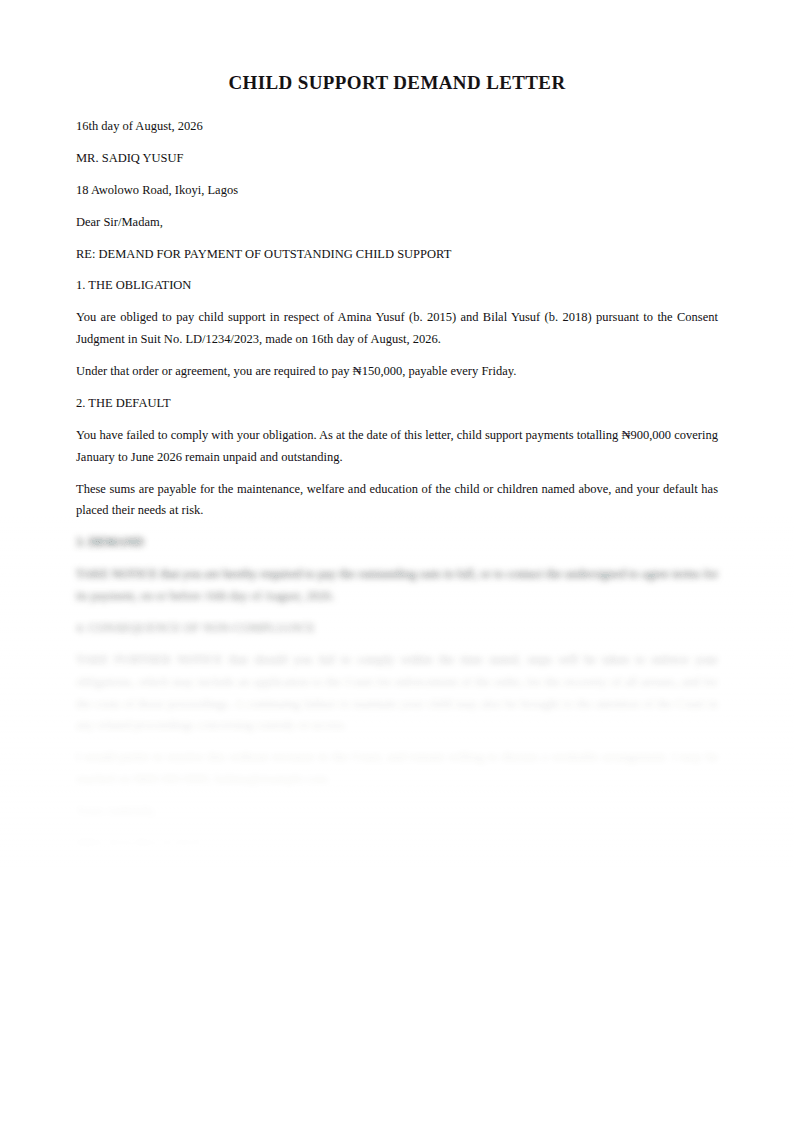
What a child support demand letter is
A child support demand letter is a formal written request that a parent pay maintenance they owe and have not paid.
It does what any demand letter does, with one difference: the obligation usually already exists in a court order or a written agreement, so this letter is not asserting a new claim. It is calling in an obligation the other parent already accepted.
That makes it a stronger document than an ordinary demand. You are pointing to a specific order or agreement, a specific amount, and a specific shortfall.
It also creates the record you need for the next step. Where the obligation is in a court order, non payment can be pursued through the court that made it, and a documented demand showing the arrears and the failure to respond is what supports that application.
Who needs one
Parents owed child support under a court order, consent judgment or written agreement.
Anybody whose informal arrangement has broken down and who wants to create a formal record before escalating.
Parents preparing to apply to court for enforcement, since the correspondence forms part of the picture.
If there is no order and no written agreement, this letter still serves a purpose, but the underlying obligation should be established properly, and an application to court is the route to that.
Before you start
Gather the evidence, because this letter works on specifics.
The order or agreement, with its date and, where it is a court order, the suit number.
A record of what should have been paid and over what period.
A record of what was actually received, with dates and amounts.
The resulting arrears, calculated rather than estimated.
And any previous requests you made, since a pattern of asking and being ignored is relevant to what follows.
The walkthrough
Filling in the form, step by step
Every question you will be asked, what it means, and an example of a good answer.
Step 1 of 3
Child Support Demand Letter
You, them and the date
The letter opens with the parties and the date.
Keep the tone measured. These letters are written in difficult circumstances and the temptation to say more than the situation requires is considerable. A calm, factual letter is more effective and reads far better if it is later put before a court, which it may well be.
Name both parents fully. Use the names as they appear in the order or agreement you are relying on, since that is the document doing the work.
The date starts the clock on the deadline you set later. Send it on the day you date it and keep evidence of how it was delivered.
- Your full name
- Your full name, as it appears in the court order or agreement you are relying on. Consistency with that document matters, since it is what establishes the obligation.
- Your address
- Your address for correspondence and for any payment arrangement that follows.
- Date of this letter
- The date of the letter. The deadline you set later runs from here, so send it on the day you date it and keep proof of delivery.
- Their full name
- The full name of the parent who owes the payments, again as named in the order or agreement.
- Their address
- Their current address. Where they have moved and you are unsure, send it to the last known address and to any other address you have, and keep a record of both.
Step 2 of 3
Child Support Demand Letter
The obligation and the children
This step establishes that the obligation exists and identifies who it is for.
Name the source precisely. A consent judgment in a numbered suit is the strongest basis, and citing the suit number tells the recipient, and any court later, exactly what you are relying on. A written agreement should be identified by its date.
Name the children with their years of birth. It confirms the obligation is still running for each of them, which matters where an older child may have passed the age at which support ends.
State the amount payable each time rather than the total owed, since the two are asked separately and confusing them muddles the claim. This is the periodic figure the order or agreement specifies.
- What created the obligation to pay?
- What created the obligation: a consent judgment with its suit number, a court order, or a written agreement. Citing it precisely is what makes this a demand for something already owed rather than a new claim.
- Name(s) of the child or children
- The children, with their years of birth. It confirms the obligation still runs for each of them, which matters where an older child may have reached the age at which support ends.
- Date of that order or agreement
- The date of the order or agreement. Together with the suit number it identifies the document beyond doubt.
- Amount payable each time
- The amount payable each time under the order or agreement. This is the periodic figure, not the total outstanding, which is asked separately below.
Step 3 of 3
Child Support Demand Letter
The schedule, the arrears and the deadline
The final step sets out the shortfall and what you want done about it.
State the payment frequency and the due day, taken from the order. It shows precisely which payments were missed and when each fell due.
The total outstanding is the heart of the letter, and it should be calculated rather than estimated. State the period it covers, for example nine hundred thousand naira covering January to June. Where partial payments were made, credit them, because a demand that ignores payments actually received is easily attacked and damages your credibility on everything else.
Give a specific deadline. Fourteen days is reasonable for arrears of this kind. A specific date creates a point at which you can act rather than continuing to ask.
And give contact details, because a meaningful proportion of these letters produce a response proposing a payment plan. Recovering the arrears over three months is usually better than an enforcement application, and a parent who cannot reach you cannot propose it.
- How often is it payable?
- The frequency under the order or agreement. It establishes precisely which payments were missed and when each one fell due.
- Which day of the week is it due?
- If weekly, the day it falls due, for example every Friday. Stating it lets the recipient, and a court, count the missed payments exactly.
- Which day of the month is it due?
- If monthly, the day of the month, for example the first. Precision here is what turns a general complaint about non payment into a countable list of defaults.
- State the payment period
- If another interval, describe it as the order does, for example quarterly on the first day of the quarter.
- Total amount now outstanding
- The total arrears, calculated and with the period stated. Credit any partial payments actually received, since a demand that ignores them is easily attacked and undermines the rest of the letter.
- Deadline to pay or respond
- A specific date to pay or respond by. Fourteen days is reasonable for arrears. A date gives you a point at which to act rather than continuing to ask indefinitely.
- Your phone number and/or email
- A phone number and email you monitor. Many of these letters produce a proposal to pay by instalments, and recovering the arrears over a few months usually beats an enforcement application.
Ready to make yours?
Answer those questions in the builder and download a finished child support demand letter in Word and PDF.
Start now, ₦5,000After you download it
Send it so you can prove delivery
Courier with tracking, or email you can produce later. A demand you cannot show was received does much less work in an enforcement application.
Keep the payment records
Bank statements showing what arrived and when are the evidence behind the arrears figure. Assemble them before you send rather than after.
Be open to a payment plan
Arrears recovered over a few months usually beat an enforcement application. Record any arrangement in writing and keep the original obligation intact.
Go back to the court that made the order
Where the obligation is in a court order and the deadline passes, enforcement is pursued through that court, and this letter forms part of the record.
Questions people ask
What is a child support demand letter?
A formal written request that a parent pay maintenance they owe under a court order or agreement. It calls in an existing obligation rather than asserting a new claim.
What if there is no court order or agreement?
The letter still creates a record, but the obligation should be established properly. An application to court is the route to a maintenance order that can be enforced.
How do I calculate the arrears?
From the periodic amount in the order and the payments actually received. Credit partial payments, since a demand that ignores money actually paid is easily attacked.
How long should I give them?
Around fourteen days is reasonable for arrears. Set a specific date rather than a vague period, since a date gives you a point at which to escalate.
What happens if they still do not pay?
Where the obligation sits in a court order, enforcement is pursued through the court that made it, and this letter and its delivery record form part of that application.
Should I accept instalments?
Usually yes. Arrears recovered over a few months are generally better than an enforcement application, provided the arrangement is recorded and the underlying obligation stays intact.
Documents that go with this
Terms used on this page
Maintenance
Maintenance is financial support for a child or a spouse. Both parents owe it to their children regardless of whether they were married, and it is the child's entitlement rather than the other parent's.
Child Custody
Child custody is the court decision about who a child lives with and who makes decisions for them after a separation. In Nigeria the only test that matters is the welfare of the child.
Judgment
A judgment is the court's decision in a case. Winning one is not the same as being paid, because enforcement is a separate process that begins after the judgment is delivered.
Demand Letter
A demand letter is a formal written request for payment or action, sent before you take legal steps. In Nigeria it is usually the cheapest and fastest way to get somebody to take you seriously.
Guardianship
Guardianship is legal responsibility for a child who is not your own, or for an adult who cannot manage their own affairs. For parents, the point of it is naming in advance who takes care of your children if you are not there.
Garnishee
A garnishee is a third party, usually a bank, ordered by a court to pay a judgment debtor's money to the judgment creditor instead. It is the most effective way to enforce a money judgment in Nigeria.
Writ of Execution
A writ of execution authorises the court's officers to seize and sell a judgment debtor's property to satisfy a judgment. It is what turns a judgment into money.
Affidavit
An affidavit is a written statement of facts that you swear is true, signed in front of someone authorised to take oaths. Once sworn, it becomes evidence a court or government office can rely on.
Read more on this
How to Write a Demand Letter That Actually Gets You Paid (With a Template)
Travel Consent for a Child in Nigeria: What Parents Must Know
Travel Consent for a Child in Nigeria: What Parents Must Know Before Any Domestic or International Trip Taking a child on a trip sounds routine until the paperwork comes into play. The moment a child is traveling alone,…
Where to Get Legal Documents Online in Nigeria
Where to Get Legal Documents Online in Nigeria Running a business or managing personal affairs often requires legal documentation. Whether you are starting a company, hiring a freelancer, creating a partnership agreement…
Step by step guides for every document on LegalDoc
Browse all guides