
How to Write a Codicil to a Will
A codicil amends a will without replacing it. It needs the same witnessing formalities as the will itself, and for big changes a new will is cleaner.
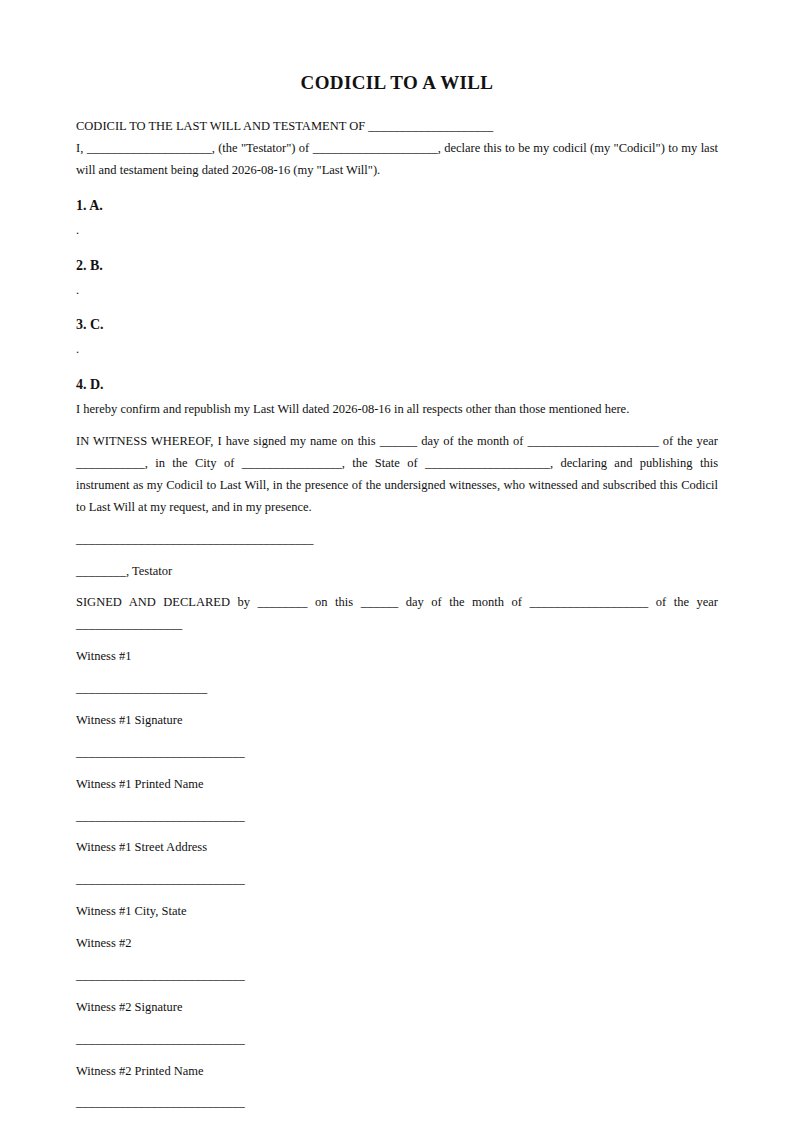
What a codicil to a will is
A codicil is a supplementary document that changes an existing will without replacing it.
It is read together with the original, so the two must be consistent. The codicil identifies the will it amends, states what is being changed, and leaves everything else in the will standing.
Codicils suit small, discrete changes: a different executor, a new gift, removing a provision that no longer applies. They exist because rewriting an entire will for a single alteration is disproportionate.
The important thing to understand is that a codicil requires exactly the same formalities as a will. Two witnesses, present together, signing in your presence. A codicil signed informally does not amend anything, and the original will continues to apply as though the change had never been made.
For anything substantial, or where you have already made a codicil or two, a fresh will is cleaner than a document that has to be read alongside several others.
Who needs one
Anybody making a limited change to a will they are otherwise content with.
People whose executor has died, moved abroad or become unsuitable.
Testators who have acquired something significant since the will was written, or disposed of something it mentions.
Anybody whose family circumstances have changed in a way the will does not reflect.
Where the changes are extensive, or where marriage or divorce has intervened, a new will is the better answer, since marriage can revoke a will made beforehand.
Before you start
Have the original will in front of you.
Identify the exact clause or provision you are changing, by number where the will is numbered.
Decide precisely what the new position should be.
Check whether the change has knock on effects elsewhere in the will, since removing a beneficiary or an executor may leave a gap.
And line up two witnesses who take nothing under the will or the codicil, because the same rule about beneficiaries witnessing applies here.
The walkthrough
Filling in the form, step by step
Every question you will be asked, what it means, and an example of a good answer.
Step 1 of 2
Codicil to a Will
The will you are amending and the change
This step identifies the original will and sets out the amendment.
The date of the original will is what ties the codicil to it. Where you have made more than one will, this date is how the executors and the probate registry know which document is being amended.
On the amendment itself, the three options do different things. Adding a provision inserts something new. Deleting removes something without putting anything in its place. Revoking and replacing takes out an existing provision and substitutes a new one, which is the option to use when you are changing rather than simply removing.
Be precise about what you are changing. Refer to the clause by number where the will has them, and quote enough of the existing wording that there is no doubt. I revoke clause 4 of my will and replace it with the following is unambiguous. I change the gift to my brother is not, particularly if the will mentions him more than once.
Complete only the boxes matching what you ticked, and where you are replacing, complete both the revocation and the replacement so the change is a single coherent instruction.
- Testator's name
- Your full name, identical to the name on the original will. A discrepancy between the two invites the question of whether the same person made both documents.
- Testator's address
- Your current address. Where it has changed since the will, that is fine and worth noting, since the codicil is the later document.
- Date on the Last Will
- The date of the will being amended. This is what ties the codicil to the correct document, which matters if you have made more than one will over the years.
- What amendment are you making to the will?
- What kind of change this is. Adding inserts something new, deleting removes without replacement, and revoking and replacing substitutes new wording for old. Use the third where you are changing rather than simply removing.
- Add a new provision
- If adding, set out the new provision in full, as it should read in the will. Write it as a standalone clause rather than a note about your intention.
- Delete a provision
- If deleting, identify the provision precisely, by clause number and by quoting enough of the wording to be certain. Consider whether removing it leaves a gap elsewhere in the will.
- Revoke a provision
- If revoking and replacing, identify the clause being revoked with the same precision, so there is no doubt which provision is going.
- To be replaced with
- The new wording that takes its place, written as it should read in the will. Complete this together with the revocation above, so the change reads as one coherent instruction.
- State
- The state whose law governs, which should match the original will. Probate is administered at state level, and the codicil should sit under the same law as the document it amends.
Step 2 of 2
Codicil to a Will
The witnesses
The final step names the two witnesses, and this is where codicils most often fail.
A codicil needs the same formalities as a will. You sign in the presence of both witnesses, who must be present together at the same time, and each of them then signs in your presence. A codicil signed at your kitchen table and witnessed later by somebody who was not there does not amend the will.
Neither witness should be a beneficiary under the will or the codicil, nor married to one. A witness who benefits generally forfeits the gift, and using a beneficiary as a witness on a codicil can cost that person the very thing you were trying to give them.
The witnesses do not need to read the codicil or know what it says. They are witnessing your signature, not the contents.
Keep the codicil with the original will. A codicil found without the will it amends, or a will found without the codicil that changed it, produces exactly the confusion the document was meant to avoid.
- First witness full name
- The first witness, who must be present when you sign and must then sign in your presence. They must not be a beneficiary under the will or the codicil, nor married to one.
- Second witness full name
- The second witness, present at the same time as the first. Both must witness your signature together, since a codicil signed in front of one and shown to the other later is not validly executed.
Ready to make yours?
Answer those questions in the builder and download a finished codicil to a will in Word and PDF.
Start now, ₦10,000After you download it
Execute it exactly like a will
Sign in front of both witnesses together, and have each sign in your presence. An informally signed codicil changes nothing and the original will stands.
Keep it with the original will
Store them together. A will found without its codicil, or the reverse, creates the confusion the codicil was supposed to prevent.
Tell your executors it exists
They need to know the will has been amended, otherwise they may administer the estate on the original terms without realising.
Consider a new will instead
After two or three codicils, or for any substantial change, a fresh will is cleaner than a document read alongside several amendments.
Questions people ask
What is a codicil?
A supplementary document that amends an existing will without replacing it. The two are read together, so the codicil must identify the will and state precisely what is changing.
Does a codicil need witnesses?
Yes, the same as a will: two witnesses present together, signing in your presence after you sign in theirs. An informally signed codicil amends nothing.
Can a beneficiary witness a codicil?
They should not. A witness who benefits generally forfeits the gift, so using a beneficiary as a witness can cost them the very thing you were trying to leave them.
When should I write a new will instead?
For substantial changes, or once you have two or three codicils. A will read alongside several amendments is harder to administer and easier to dispute.
Does marriage affect my will?
It can. Marriage may revoke a will made beforehand, which is a situation calling for a new will rather than a codicil. Take advice if your marital status has changed.
How specific do I need to be?
Very. Refer to the clause by number and quote enough of the existing wording to be certain, since a codicil that could apply to more than one provision creates the dispute it was meant to avoid.
Documents that go with this
Terms used on this page
Codicil
A codicil is a short document that changes part of an existing will without replacing it. It must be executed with the same formality as the will itself, or it changes nothing.
Will
A will is a legal document setting out who gets your property when you die and who should administer it. Without one, Nigerian intestacy rules decide, and the outcome is often not what anybody wanted.
Executor
An executor is the person named in a will to carry it out. They gather in the estate, pay the debts, and distribute what remains to the beneficiaries.
Probate
Probate is the court order confirming that a will is valid and that the executors named in it may deal with the estate. Until it is granted, nobody can lawfully move the deceased's bank accounts or property.
Beneficiary
A beneficiary is the person or organisation entitled to receive something, usually under a will, a trust, an insurance policy or a pension. They receive the benefit without necessarily managing it.
Estate
An estate is everything a person owned when they died, less what they owed. It has to be gathered, the debts paid, and only what remains is distributed to the people entitled.
Intestate
Dying intestate means dying without a valid will. The estate is then distributed under intestacy rules or customary law, and the outcome is often nothing like what the deceased would have chosen.
Letters of Administration
Letters of administration are the court grant that allows somebody to deal with the estate of a person who died without a valid will. It is the intestacy equivalent of probate.
Read more on this
How to Reseal a Grant of Probate or Letters of Administration in Lagos State
Probate Affairs — How to Reseal a Grant of Probate or Letters of Administration in Lagos State When a person dies owning assets in more than one Nigerian state, or holding property in a foreign (commonwealth) jurisdictio…
Where to Get Legal Documents Online in Nigeria
Where to Get Legal Documents Online in Nigeria Running a business or managing personal affairs often requires legal documentation. Whether you are starting a company, hiring a freelancer, creating a partnership agreement…
Power of Attorney in Nigeria: When You Need One and the Mistakes That Make It Useless
Step by step guides for every document on LegalDoc
Browse all guides