
How to Write a Copyright Licence Agreement
This agreement lets somebody use work you own without giving away ownership. The territory and the payment are the two answers that matter.
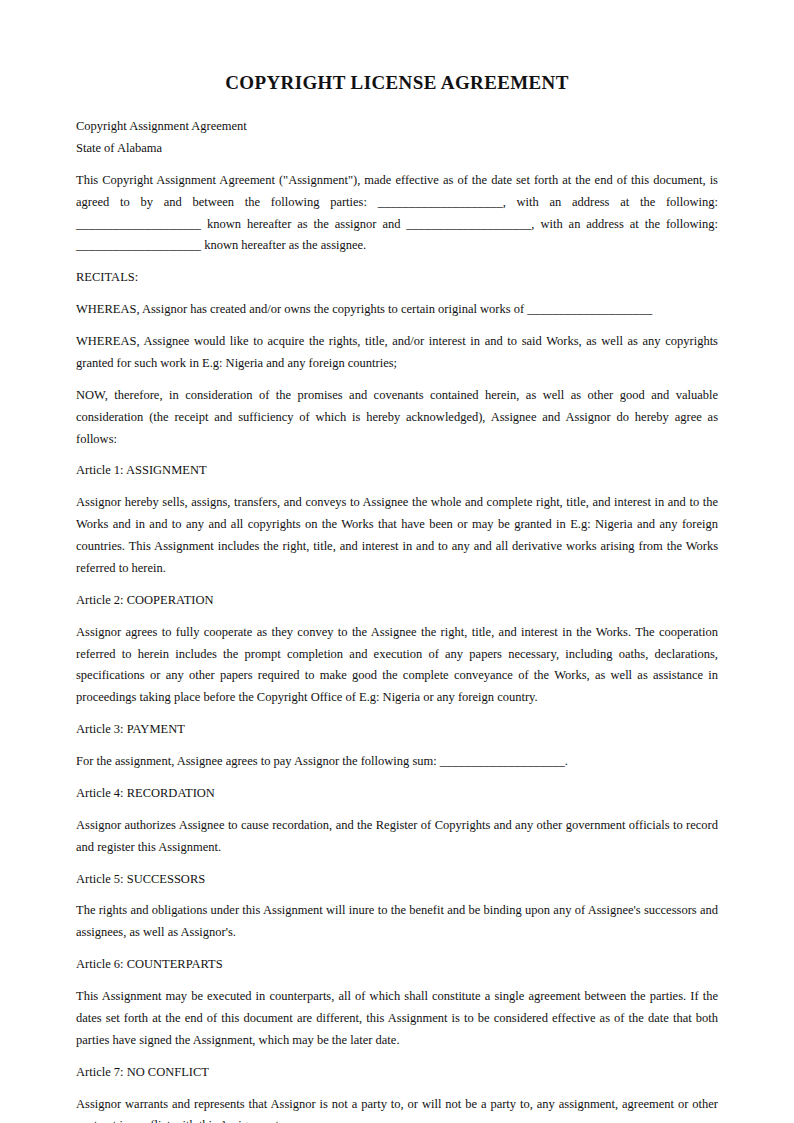
What a copyright license agreement is
This agreement governs the use of copyrighted work by somebody other than its owner.
A distinction worth drawing at the outset, because the form uses both words. An assignment transfers ownership: the creator gives up the copyright and the new owner holds it. A licence grants permission to use the work while ownership stays where it was. The form is titled a licence agreement and names the parties assignor and assignee, so be clear in your own mind which you intend and say so plainly in the description of the work and the payment terms.
For most arrangements a licence is the right answer. A photographer licensing images to a magazine, a musician licensing a track for an advertisement, a writer licensing an article: each keeps ownership and grants a defined permission.
In Nigeria copyright arises automatically on creation of an original work. Registration with the Nigerian Copyright Commission is not what creates the right, though it provides useful evidence of ownership and date.
Who needs one
Creators licensing photographs, music, writing, designs or software to somebody who wants to use them.
Businesses acquiring the right to use creative work in their marketing, products or publications.
Anybody who has been using somebody else's work on an informal understanding and wants it documented before it becomes a dispute.
Agencies and clients where the ownership of commissioned work has never actually been settled, which is far more common than it should be.
If you want to transfer ownership outright rather than permit use, say so explicitly, and note that an assignment of copyright in Nigeria generally needs to be in writing and signed by the owner.
Before you start
Establish these first.
Whether you are licensing or assigning, and be explicit about it.
Exactly which work is covered, identified so precisely that nothing else could be included.
Where it may be used, and in what media.
How long the permission lasts.
Whether it is exclusive, since an exclusive licence prevents even the owner from using the work in that territory or medium.
And what is being paid: a single fee, a royalty, or both.
The walkthrough
Filling in the form, step by step
Every question you will be asked, what it means, and an example of a good answer.
Step 1 of 2
Copyright License Agreement
The owner and the user
The agreement names the party granting the rights and the party receiving them.
The assignor is the copyright owner. Confirm that they actually are. Copyright in commissioned work does not automatically belong to the person who paid for it, and copyright in work created by an employee in the course of employment usually belongs to the employer. A photographer who shot images as a staff member of a newspaper may not own them, and a business licensing from somebody who does not own the work acquires nothing.
Where the work has more than one creator, all of them need to be party to the agreement, since a co owner cannot generally license the whole work alone.
The assignee is the party being granted the rights. Name the entity that will actually use the work, since a licence to one company does not extend to its subsidiaries or affiliates unless it says so.
- Assignor's Name
- The copyright owner granting the rights. Confirm they genuinely own it: work created by an employee in the course of employment usually belongs to the employer, and commissioned work does not automatically belong to whoever paid.
- Assignor's Address
- The owner's address, for notices and for any royalty payments due under the agreement.
- Assignee's Name
- The party receiving the rights, named as the entity that will actually use the work. A licence granted to one company does not extend to its subsidiaries or affiliates unless it says so.
- Assignee's Address
- The user's address, where notices and any accounting for use are directed.
Step 2 of 2
Copyright License Agreement
The work, the territory, the money and the law
This step is the substance of the agreement and each answer narrows or widens what is being granted.
Describe the work so precisely that nothing else could fall within it. Name the photographs by series and number, the track by title and recording date, the text by its title and length. A description reading my photographs grants far more than most creators intend.
The territory is the geographical scope. Nigeria alone is a very different grant from worldwide, and the difference is usually reflected in the price. A creator granting worldwide rights for a Nigerian campaign fee has given away considerably more than they were paid for.
This is also the place to record what the form does not separately ask: the duration of the permission, the media it covers, and whether it is exclusive. A licence with no stated duration may run indefinitely, and an exclusive licence prevents the owner themselves from using the work within its scope. Put all three in the description of the work or the payment terms.
On payment, state whether it is a single fee or a royalty, and if a royalty, the rate, what it is calculated on, and how often it is accounted for.
- The copyrighted work to be assigned
- The work covered, described so precisely that nothing else could fall within it: photographs by series and number, a track by title and recording date, text by title. Use this space also to state the duration of the permission, the media it covers, and whether it is exclusive, since the form does not ask separately and all three matter enormously.
- Specific Location where the work is to be used
- The territory the permission covers, for example Nigeria. Worldwide is a far larger grant than Nigeria alone and should be priced as such. A creator granting worldwide rights for a local campaign fee has given away much more than they were paid for.
- Payment for the use of the copyrighted work
- What is paid. State whether it is a one off fee or a royalty, and for a royalty give the rate, what it is calculated on, and how often the user must account. A royalty with no accounting obligation is difficult to collect.
- Governing Law
- The law governing the agreement, for example Nigerian law. Copyright is territorial, so where the work will be used across borders, this is worth thinking about rather than defaulting.
- The name of the state where the agreement will be notarized?
- Where the agreement will be notarised. Notarisation is not required for copyright to transfer, and it provides useful evidence of execution and date if ownership is later disputed.
Ready to make yours?
Answer those questions in the builder and download a finished copyright license agreement in Word and PDF.
Start now, ₦10,000After you download it
Be explicit about licence or assignment
The form uses both words. A licence permits use and keeps ownership; an assignment gives ownership away. Say which you mean in the body of the agreement.
Consider registering the work
Copyright arises automatically in Nigeria, but registration with the Nigerian Copyright Commission provides useful evidence of ownership and date if it is ever challenged.
State the duration and the media
The form does not ask. A licence with no end date may run indefinitely, and one with no media limit may cover uses you never contemplated.
Keep evidence of creation
Original files with their metadata, drafts and dated correspondence. Ownership disputes turn on who can show they made the work first.
Questions people ask
What is the difference between a copyright licence and an assignment?
A licence permits somebody to use the work while ownership stays with the creator. An assignment transfers ownership outright. The form uses both terms, so state clearly which you intend.
Do I need to register copyright in Nigeria?
No. Protection attaches the moment an original work is created. Registering with the Nigerian Copyright Commission is voluntary, and what it gives you is evidence of ownership and of the date.
Who owns work created by an employee?
Usually the employer, where it was created in the course of employment. That is why confirming the licensor actually owns the work matters before paying for a licence.
Who owns commissioned work?
Not automatically the person who paid for it. Ownership of commissioned work should be settled in writing, and the absence of that agreement is a common and expensive oversight.
Should the licence be exclusive?
It depends what is being paid. An exclusive licence prevents even the owner from using the work within its scope, which is a much larger grant and should be priced accordingly.
What territory should the licence cover?
The narrowest one that meets the user's actual need. Worldwide rights granted for a Nigerian campaign fee give away far more than the payment reflects.
Documents that go with this
Terms used on this page
Copyright
Copyright is the automatic right you get over original work you create, such as writing, music, film, photographs and software. It protects the expression, not the underlying idea.
Intellectual Property
Intellectual property is the legal ownership of things you create rather than things you can touch, including trademarks, copyright, patents and designs. In Nigeria each type has its own registry and its own rules.
Licensing
Licensing is permission to use something you own without giving it away. The owner keeps the asset, the licensee gets defined rights for a defined period, and money usually flows as a royalty or a fee.
Work for Hire
Work for hire is the question of who owns something created by somebody you paid. For employees the answer usually favours the employer. For freelancers it usually does not.
Royalty
A royalty is a payment for using something somebody else owns, usually calculated as a share of the revenue it generates. Musicians, authors, franchisors and patent holders all earn this way.
Infringement
Infringement is using somebody's intellectual property without permission. What you have to prove, and what you can recover, depends on which right was infringed.
Assignment
An assignment is the transfer of your rights under a contract or over property to somebody else. The person handing over is the assignor, the person receiving is the assignee.
Moral Rights
Moral rights are an author's personal rights in their work: to be credited as its creator, and to object to it being treated in a way that damages their reputation. They stay with the author even after the copyright is sold.
Read more on this
How to Trademark a Catchphrase or Slogan
How to Trademark a Catchphrase or Slogan A catchphrase or slogan is often the most memorable part of a brand. Short, distinctive phrases such as advertising taglines, campaign slogans, or promotional expressions help con…
10 Legal Documents Every Startup in Nigeria Needs
10 Legal Documents Every Startup in Nigeria Needs Starting a business in Nigeria is exciting. Entrepreneurs launch new ventures every day—technology startups, creative agencies, e-commerce platforms, consulting firms, an…
The Unpopular but Essential Document Called a Consulting Agreement in Nigeria
The Unpopular but Essential Document Called a Consulting Agreement Most business relationships don’t fall apart at the beginning—they unravel somewhere in the middle. At the start, everything feels clear. The consultant…
Step by step guides for every document on LegalDoc
Browse all guides