
How to Write a Joint Venture Agreement
A joint venture is two or more businesses combining for one project without merging. The obligations clause is what stops it becoming an argument.
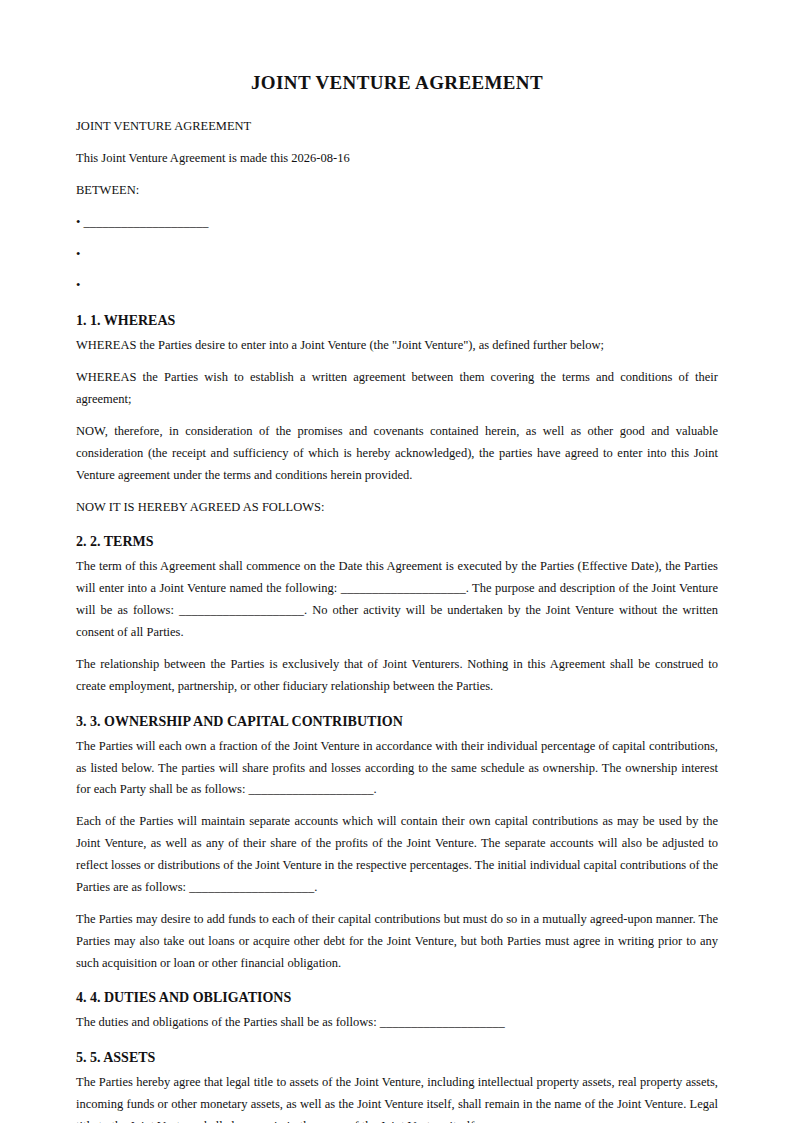
What a joint venture agreement is
A joint venture agreement records two or more parties combining resources for a specific project while remaining separate businesses.
That last part is the distinguishing feature. A merger makes one business out of two. A joint venture leaves both intact and creates a defined collaboration between them, usually for a project, a contract or a market.
Joint ventures take different legal shapes. An incorporated joint venture creates a new company owned by the parties. A contractual joint venture leaves each party as it is and governs the relationship purely by agreement. The choice affects liability, tax and how the venture ends, and it should be made deliberately rather than discovered later.
In Nigeria joint ventures are the standard route into sectors with local content requirements, particularly oil and gas, construction and government contracting, where a foreign party brings capability and a Nigerian party brings standing and local presence.
Who needs one
Businesses bidding jointly for a contract neither could win alone.
Foreign companies entering Nigeria with a local partner, which is often a practical necessity as well as a commercial preference.
Companies pooling resources for a property development, a distribution arrangement or a defined project.
Anybody who has agreed to work with another business on a handshake and is about to spend money on the strength of it.
Where the parties intend to build a permanent shared business rather than complete a project, a properly structured company with a shareholders agreement is usually the better vehicle.
Before you start
Have the hard conversations first, because a joint venture with vague terms fails predictably.
What each party actually contributes: capital, equipment, licences, personnel, relationships.
How ownership and profit are split, and whether those are the same ratio.
Who manages the venture day to day and who decides what.
What happens if one party fails to deliver what they promised.
And how the venture ends, including who keeps what.
The walkthrough
Filling in the form, step by step
Every question you will be asked, what it means, and an example of a good answer.
Step 1 of 2
Joint Venture Agreement
The parties, the venture and the money
The opening step covers who is involved and what they are building together.
The number of parties question changes the dynamics. Two parties can deadlock; three or more need a decision rule, because unanimity across four businesses on every question is not workable. Fill in only the box matching your answer, and identify each party by registered name.
The description of the venture defines its scope, and scope is what keeps a joint venture from expanding into areas one party never agreed to. Describe the project, the territory and the duration.
Ownership structure and capital arrangement are separate questions for a reason. Ownership is who holds what interest in the venture. Capital is who puts in what to fund it. They frequently differ, particularly where one party contributes cash and another contributes equipment, licences or local standing, and stating both prevents the argument that a contribution was undervalued.
- Date on this agreement
- The date the parties commit. Where preparatory work or bidding has already happened, note that history rather than implying the collaboration starts today, since costs already incurred usually need addressing.
- How many parties to the agreement?
- How many businesses are involved. Two parties can deadlock and need a mechanism; three or more need a decision rule, since requiring unanimity from several businesses on every question does not work in practice.
- Two parties
- If two, identify both by registered name and address. Note that a two party venture has no majority to break a tie, so a deadlock provision matters more here than anywhere else.
- Three parties
- If three, identify each by registered name and address, and set out the voting basis. State whether decisions follow interest held or one vote per party, because those produce different outcomes.
- Four parties
- If four, identify each by registered name and address. With this many participants, define which decisions need unanimity and which can pass by majority, otherwise the venture stalls on routine matters.
- Name of the Joint Venture
- What the venture is called. Where an incorporated joint venture is intended, check the name is available at the CAC before adopting it here.
- Description of the Joint Venture
- What the venture will do, including the project, the territory and the duration. Scope is what stops a joint venture drifting into activities one party never signed up for.
- Ownership structure
- Who owns what proportion of the venture, and whether it is incorporated as a company or purely contractual. That structural choice affects liability, tax and how the venture is wound up, so state it clearly.
- Capital arrangement
- Who contributes what, and when. Value non cash contributions explicitly, since equipment, licences, personnel and local standing are all real contributions and the party providing them will expect them recognised.
Step 2 of 2
Joint Venture Agreement
Obligations and the governing state
This step is short and it carries the most weight in the whole agreement.
The obligations clause is where joint ventures succeed or fail. Write what each party must actually do, specifically enough to tell whether they have done it. Party A obtains the regulatory approvals and provides the site; Party B supplies the equipment, the technical personnel and the working capital. That is a set of commitments you can hold somebody to.
Also deal with what happens when a party does not perform. A joint venture where one side fails to deliver and the agreement is silent about the consequence is a joint venture heading for court.
Use this clause for the things the form has not asked about: how profits are distributed, who manages day to day operations, how disputes are resolved, what is confidential, and how a party exits.
On governing state, name where the venture is actually carried out. For a Nigerian project that is the state where the work happens, which is also where any regulatory relationships sit.
- Obligations of parties
- What each party must do, written specifically enough to tell whether they have done it. Include the consequence of failing to perform, and use this clause for the matters the form has not asked about: profit distribution, day to day management, dispute resolution, confidentiality and how a party exits.
- Write the State where the Joint Venture will be carried out
- The Nigerian state where the venture operates, for example Rivers State. It should follow where the work actually happens, since that is where regulatory relationships sit and where a dispute would be brought.
Ready to make yours?
Answer those questions in the builder and download a finished joint venture agreement in Word and PDF.
Start now, ₦10,000After you download it
Decide the structure properly
Incorporated or contractual is not a formality. It determines liability, tax treatment and how the venture is unwound, and changing it later is a restructuring.
Check local content requirements
In oil and gas, construction and government contracting, Nigerian content rules shape what the venture must demonstrate. Build that into the structure rather than retrofitting it.
Make the Nigerian partner real
Arrangements where the local party exists only on paper carry serious risk for both sides. The agreement should describe a genuine division of work.
Agree the exit before you need it
Who keeps the equipment, the customer relationships and the intellectual property when the venture ends. Deciding that at the end is considerably harder than at the start.
Questions people ask
What is a joint venture agreement?
A contract recording two or more businesses combining resources for a specific project while remaining separate companies. It is not a merger, and both parties stay intact.
What is the difference between an incorporated and a contractual joint venture?
An incorporated venture creates a new company owned by the parties. A contractual one governs the relationship purely by agreement. The choice affects liability, tax and how the venture ends.
Why do foreign companies use joint ventures in Nigeria?
Often to meet local content expectations and to combine international capability with Nigerian standing and presence, particularly in oil and gas, construction and government contracting.
What is the most important clause?
The obligations clause. Written specifically, with a consequence for non performance, it is what prevents the venture becoming an argument about who was supposed to do what.
How should profits be split?
However the parties agree, and it need not match the ownership split. Where one party contributes cash and another contributes equipment or licences, the two ratios frequently differ.
What happens when the venture ends?
Whatever the agreement provides, which is why it should provide for it. Who keeps equipment, customer relationships and intellectual property is far easier to settle at the start.
Documents that go with this
Terms used on this page
Joint Venture
A joint venture is two or more parties combining resources for a specific project or business, while remaining separate organisations. It can be a contract between them or a jointly owned company.
Local Content
Local content rules require Nigerian companies, people and goods to be given first consideration in certain industries. In oil and gas it is a statutory requirement with a board enforcing it.
Partnership
A partnership is two or more people carrying on business together with a view to profit. Unless it is a limited liability partnership, the partners are personally liable for the debts, including debts a partner created alone.
Shareholders Agreement
A shareholders agreement is the private contract between the owners of a company covering how it is run, how shares move and what happens when they disagree. The articles do not do that job.
Due Diligence
Due diligence is the investigation you carry out before committing to a deal. You are checking that what you are buying, funding or partnering with is actually what it was described to be.
Good Faith
Good faith means dealing honestly and not undermining the purpose of the bargain. Nigerian law does not imply a general duty of it into every commercial contract, so where you want it, write it in.
Termination for Convenience
Termination for convenience is a right to end a contract without anybody being in breach, simply on notice. Where a contract has one, it is usually the safest way out.
Force Majeure
Force majeure is a contract clause that excuses a party from performing when something outside their control makes it impossible. It only helps you if it is actually written into the contract.
Read more on this
Joint Venture Agreement in Nigeria: What Every Business Partner Must Know
Joint Venture Agreement in Nigeria: What Every Business Partner Must Know Business growth often requires collaboration. A company may have access to capital but lack industry expertise. Another may possess technical know…
Founders Vs. Shareholders
When building a company, it’s important to understand the distinct roles of founders and shareholders and the legal documents that formalize their relationships. Founders: Globally, roughly 40 million startup companies a…
11 Essential and Protective Documents Needed by a Startup Company
Business Plan Certificate of Incorporation, Memart, Art. of association, Status Report Founders’ Agreement Service Level Agreements Non-Disclosure Agreement Employee Contracts Intellectual Property Agreements Shareholder…
Step by step guides for every document on LegalDoc
Browse all guides