
How to Write a Month to Month Lease Agreement
A month to month lease renews automatically until either side gives notice. This form uses US states, so Nigerian lettings need a tenancy agreement instead.
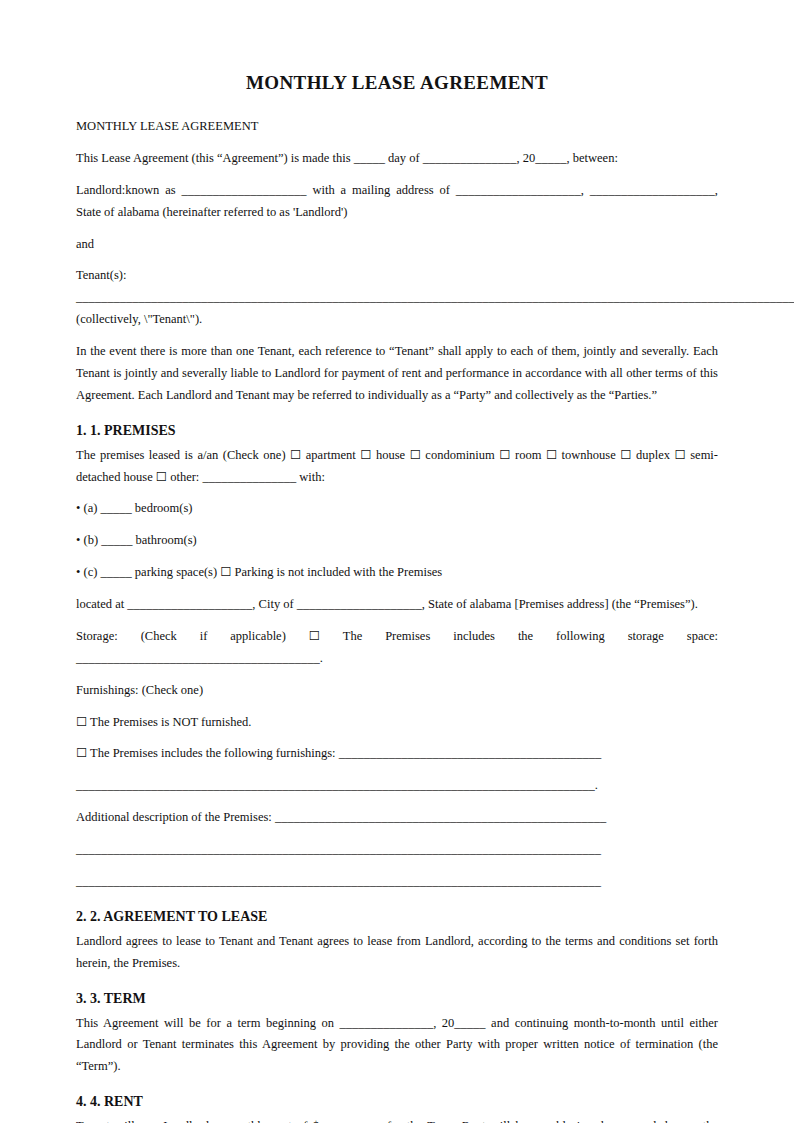
What a monthly lease agreement is
A month to month lease is a tenancy that runs from month to month, renewing automatically until either party gives notice to end it.
It suits arrangements where neither side wants a fixed commitment: a tenant between homes, a landlord planning to sell, a property being let while something is decided.
The trade off is symmetrical. The tenant can leave on short notice, and the landlord can end it on short notice too. Anybody who wants security of occupation is better served by a fixed term.
A practical note before you use this form: its state fields list United States states rather than Nigerian ones, so the document it produces is built for a US letting. For a Nigerian property, the tenancy agreement is the right document, and its monthly variant carries the notice periods Nigerian law actually applies.
Who needs one
Landlords and tenants in the United States wanting a periodic rather than a fixed term arrangement.
Owners letting a property they may want back at short notice.
Tenants who need somewhere temporarily and do not want to commit to a year.
For a Nigerian letting, use the tenancy agreement. A Nigerian monthly tenancy carries its own notice requirement, generally one month, and a document naming a US state does not sit properly alongside that.
Before you start
Decide these before completing the form.
The rent, when it falls due, and how it is paid.
The notice each side must give to end the tenancy, which for a monthly arrangement is usually one month.
What deposit is held and what it can be applied to.
Who is responsible for utilities and maintenance.
And whether the arrangement is genuinely temporary, since a month to month tenancy that runs for years without review tends to drift out of date.
The walkthrough
Filling in the form, step by step
Every question you will be asked, what it means, and an example of a good answer.
Step 1 of 2
Monthly Lease Agreement
The landlord
The lease opens by identifying the landlord and where notices are sent.
This is where the notice to end the tenancy will be served, which in a month to month arrangement is the most important correspondence either party sends. Use an address where post is reliably received rather than the property itself.
Where the property is jointly owned, name every owner. A lease granted by one of several co owners is open to challenge from the others.
The state field lists US states. For a Nigerian property this is the signal that you are using the wrong form: the tenancy agreement is the document that fits, and it names Nigerian states and carries the notice periods that apply here.
- Landlord's name
- The owner letting the property, using the registered name for a company. Every co owner must be named where the property is held jointly, since a lease granted by one of them alone is open to challenge.
- Landlord's address
- The landlord's address for notices, not the property being let. In a month to month tenancy this is where notice to end the arrangement is served, which makes it the most consequential address in the document.
- City
- The city of the landlord's address.
- State
- Which state the landlord's own address sits in. The list here is of United States states. For a Nigerian property, use the tenancy agreement instead, which names Nigerian states and applies the correct notice periods.
Step 2 of 2
Monthly Lease Agreement
The property
The final step identifies the property being let.
Describe it precisely, including the unit or apartment number where the building contains more than one. A description that could apply to two units in the same building is what produces an argument about which one was let.
Note what the letting includes: parking, storage, appliances, access to shared areas. In a month to month arrangement people move quickly and assume more than they should, and anything unstated is what gets disputed on the way out.
The state field is again a US list. For a Nigerian letting, the tenancy agreement is the correct document, and if the property sits in Nigeria while this lease names a US state, the document is internally inconsistent in a way that would matter if it were ever relied on.
Worth adding beyond what the form asks: the rent and its due date, the notice period each side must give, the deposit and what it covers, and who pays utilities. Those are the terms a month to month tenancy actually turns on.
- Address of the Property
- The full address of the property being let, including the unit or apartment number where the building has several. A description that could apply to two units is the beginning of an argument about which was let.
- City
- The city where the property is located.
- State
- The state where the property sits, from a list of United States states. If your property is in Nigeria, this is the point to switch to the tenancy agreement, since a document naming a US state for Nigerian land is internally inconsistent.
Ready to make yours?
Answer those questions in the builder and download a finished monthly lease agreement in Word and PDF.
Start now, ₦10,000After you download it
Add the rent and notice terms
The form does not ask for them. The rent, its due date, the deposit and the notice each side must give are what a month to month tenancy actually runs on.
Record the condition at handover
Photograph the property when the tenant takes occupation. Short tenancies end quickly and deposit disputes follow just as fast.
Give notice in writing
Whichever side ends the tenancy, put it in writing to the address in the lease and keep proof. Verbal notice is the most disputed part of periodic tenancies.
For Nigerian property, use a tenancy agreement
A Nigerian monthly tenancy generally requires one month's notice, and the tenancy agreement names Nigerian states and reflects that position.
Questions people ask
What is a month to month lease?
A tenancy that renews automatically each month until either party gives notice. It suits arrangements where neither side wants a fixed commitment.
Can I use this form for a Nigerian property?
Not well. Its state fields list United States states. For a Nigerian letting, the tenancy agreement is the correct document and reflects Nigerian notice periods.
How much notice ends a month to month tenancy?
Usually one month, though it depends on the jurisdiction and on what the lease says. In Nigeria a monthly tenant is generally entitled to one month's notice.
Is a month to month arrangement worse for the tenant?
It is symmetrical: the tenant can leave on short notice and the landlord can end it on short notice. Anybody wanting security of occupation should take a fixed term.
What should I add that the form does not ask?
The rent and its due date, the deposit and what it covers, the notice period each side must give, and who pays utilities. Those are the terms the tenancy actually runs on.
Can a month to month tenancy run for years?
It can, and many do. The risk is that it drifts out of date while rent, condition and expectations all change, so it is worth reviewing periodically.
Documents that go with this
Terms used on this page
Lease
A lease is a grant of exclusive possession of property for a fixed term, in exchange for rent. It creates an interest in the land itself, which is what separates it from a mere permission to occupy.
Tenancy at Will
A tenancy at will is occupation with the owner's consent, with no fixed term, ending whenever either party chooses. It is what exists while a lease is being negotiated.
Rent
Rent is what a tenant pays for the right to occupy a property. In Nigeria it is normally paid in advance, and how far in advance a landlord may demand is limited by law in some states.
Landlord
A landlord is the person who grants somebody else the right to occupy their property in exchange for rent. The role carries rights to rent and possession, and duties that Nigerian law enforces.
Tenant
A tenant is a person who occupies property belonging to somebody else in exchange for rent. Nigerian law gives tenants real protections, including proper notice and the right to a refund of the caution fee.
Notice Period
A notice period is how much warning either side must give before ending an employment. The Labour Act sets minimums based on length of service, and the contract can give more but not less.
Deposit
A deposit is money paid to secure a transaction. Whether you get it back if the deal falls through depends on whether it was a true deposit or a part payment, and most people never ask.
Holding Over
Holding over is a tenant staying on after the tenancy has ended. They are no longer a tenant paying rent, they are an occupier who may owe mesne profits until they leave.
Read more on this
Tenancy Relationships: The Different Types of Tenants
Tenancy Relationships: The Different Types of Tenants If you rent property in Nigeria—or you own one—you’ve probably used the word “tenant” casually. But in law, not all tenants are the same. The type of tenancy relation…
8 Essential Clauses Every Tenancy Agreement Should Contain
8 Essential Clauses Every Tenancy Agreement Should Contain Renting property in Nigeria is often straightforward at the beginning. A landlord has a space to let, a tenant needs accommodation, and both parties are eager to…
Tenancy Agreement vs Commercial Lease Agreement
Tenancy Agreement vs Commercial Lease Agreement Choosing the right agreement for occupying property in Nigeria is more than just a paperwork exercise. Whether you are renting a flat, opening a shop, or taking a warehouse…
Step by step guides for every document on LegalDoc
Browse all guides