
How to Write a Power of Attorney
A power of attorney lets somebody act for you. It delegates authority and transfers nothing, which is the point Nigerian land buyers most often get wrong.
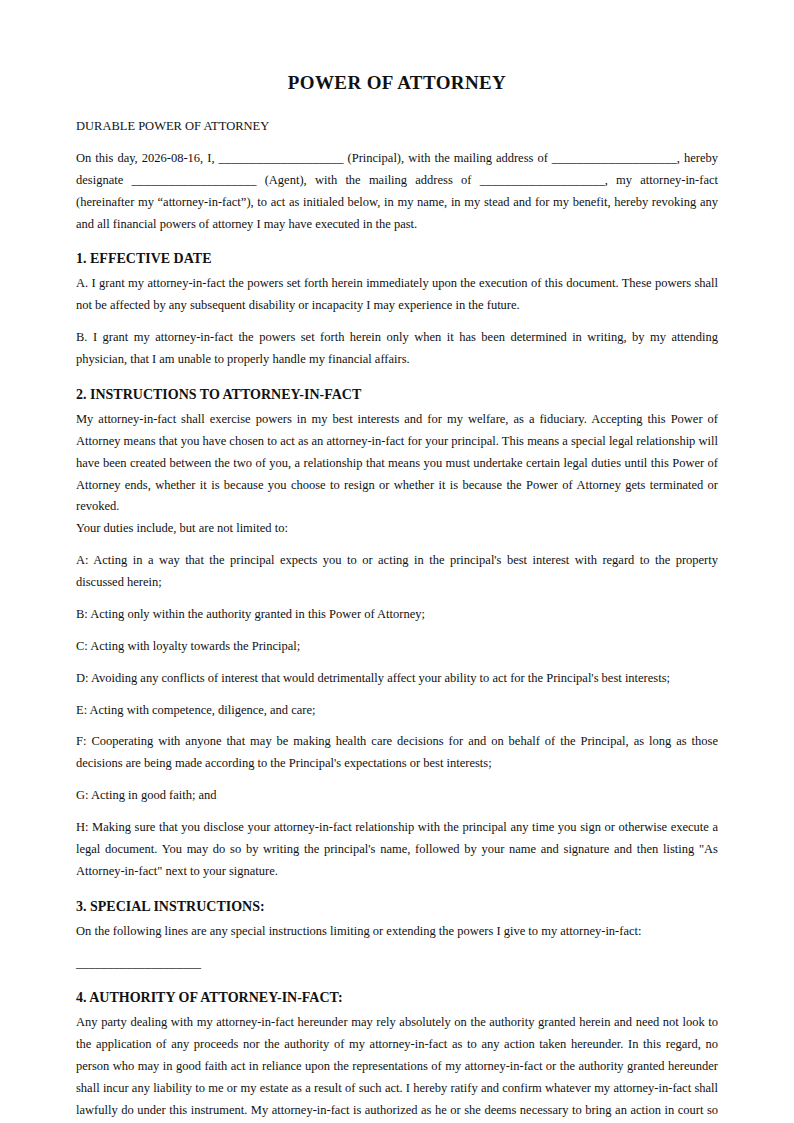
What a power of attorney is
A power of attorney is a document authorising one person, the agent or attorney, to act on behalf of another, the principal.
It is an instrument of delegation. The agent can do the things the document authorises, in the principal's name, and the principal is bound by what they do within that authority.
What it never does is transfer ownership. A power of attorney over land authorises somebody to deal with the land; it does not make them the owner of it. Nigerian courts have said so repeatedly, and buyers offered a power of attorney instead of a deed of assignment are being offered authority over somebody else's property rather than title to their own.
A power of attorney also generally ends on the death or incapacity of the principal, which is precisely when people most expect it to work.
Who needs one
People living abroad who need somebody in Nigeria to manage property, deal with a bank or attend to a transaction.
Anybody unable to attend a signing in person who needs a document executed on their behalf.
Business owners authorising a manager to sign specified documents.
Family members handling affairs for an elderly relative, where the arrangement should be set up while the person still has capacity to grant it.
If you are buying land and being offered a power of attorney rather than a deed, this is a warning sign rather than a convenience.
Before you start
Decide these before drafting.
Exactly what the agent may do, since a narrow authority is safer than a general one.
Who you genuinely trust, because a power of attorney is one of the most consequential documents a person signs.
How long it should last, or what event ends it.
Whether it needs to be irrevocable, which is a narrower concept than people assume and applies where it is given for consideration to secure an interest.
And whether the transaction requires it to be stamped and registered, which it usually does where land is involved.
The walkthrough
Filling in the form, step by step
Every question you will be asked, what it means, and an example of a good answer.
Step 1 of 4
Power of Attorney
The date and the governing state
The document opens with the date and the law that governs it.
The date matters because a power of attorney can be revoked, and where more than one exists, the sequence determines which is current. It also starts any period the document runs for.
The state should be where the transaction happens or where the property sits. Where the power relates to land, use the state the land is in, because that is where the deed will be stamped and registered and where the registry will examine it.
A point worth knowing before you go further: where a power of attorney relates to land, it should be executed as a deed, and it will generally need to be stamped and, depending on the state and the transaction, registered. A power of attorney presented to a land registry without those steps will be questioned.
- What is the date on the agreement
- The date the power is granted. Where more than one power of attorney exists, the sequence determines which is current, so an accurate date matters for anybody relying on it.
- Governing law of which State
- The state whose law governs, normally where the transaction takes place or the property sits. For land, use the state the land is in, since that registry will examine the document.
Step 2 of 4
Power of Attorney
The principal
This step names the person granting the authority.
Use your full legal name exactly as it appears on the documents the agent will be dealing with. Where the power relates to land, the name here must match the name on the title documents, because a registry comparing the two will query any difference.
The address identifies you and is where correspondence about the arrangement is sent.
One substantive point: you must have capacity to grant a power of attorney at the moment you sign it. An ordinary power of attorney also generally ends if the principal later loses capacity, which surprises families who set one up precisely because they anticipated that. If planning for future incapacity is the objective, take advice about what is available rather than assuming this document covers it.
- principal Information
- Your full legal name as the person granting the authority. Where the power relates to land, this must match the name on the title documents exactly, since the registry will compare them.
- Principal's address
- Your address. Where you live abroad, give both your foreign address and a Nigerian contact address if you have one, since correspondence about the transaction may need to reach somebody locally.
Step 3 of 4
Power of Attorney
The agent
This step names the person who will act for you, and it deserves more thought than any other answer in the document.
A power of attorney gives somebody the ability to bind you. Depending on how it is drafted, they can sign documents, deal with your bank, and transact with your property, and the people they deal with are entitled to rely on their authority. Choose accordingly.
Name them precisely, since third parties will compare their identification against this document before accepting their authority. A bank or a registry will refuse an agent whose name does not match.
A Nigerian address for the agent is important where they will be transacting here. Institutions want somebody they can locate, and an agent contactable only abroad creates practical friction at every step.
Consider appointing two agents where the stakes are high, requiring them to act jointly. It is slower and it removes the single point of failure that one agent represents.
- Agent Information
- The full legal name of the person authorised to act for you, exactly as on their identification. Banks and registries compare the name on their identification against this document, and refuse anything that does not match.
- Agent's address
- The agent's address, ideally in Nigeria where they will be transacting here. Institutions want an agent they can locate, and one contactable only abroad creates friction at every step.
Step 4 of 4
Power of Attorney
What the agent may actually do
The special instructions field is the whole substance of the document, and this form gives you one box for it.
Define the authority narrowly. A general power authorising the agent to do anything you could do is simple to write and dangerous to grant. A specific power listing the transactions is more work and considerably safer: to execute a deed of assignment in respect of the property at a stated address, to receive the purchase money and to pursue the Governor's consent and registration.
Include the limits as well as the powers. Say what the agent may not do: sell without your written instruction, mortgage the property, or delegate the authority to somebody else.
State the duration or the event that ends it. A power of attorney with no end date remains outstanding indefinitely, and revoking one that has been circulated to banks and registries is harder than granting it.
And if the arrangement is intended to be irrevocable, say so and state the consideration and the interest it secures, since irrevocability depends on those rather than on the label.
- Special Instruction
- Exactly what the agent may do, listed specifically rather than granted generally. Include the limits too: what they may not do, whether they may delegate, and what ends the authority. A general power authorising anything you could do is easy to write and dangerous to grant, and this single box is where the whole scope of the document is set.
Ready to make yours?
Answer those questions in the builder and download a finished power of attorney in Word and PDF.
Start now, ₦5,000After you download it
Execute it as a deed
Where the power relates to land it should be executed as a deed, signed and witnessed. An informally signed power will be questioned by registries and banks.
Stamp and register where required
Powers of attorney relating to land generally need stamping, and depending on the state and transaction, registration. Budget for it before the agent needs to act.
Give the agent certified copies
Banks and registries want to see the document. Certified copies let the agent act without surrendering the original at every institution.
Revoke it in writing when it ends
Notify the agent and anybody who has relied on it. An outstanding power that everybody has forgotten is a live authority somebody could still use.
Questions people ask
Does a power of attorney transfer ownership of property?
No. It authorises somebody to act on your behalf and transfers no title. Nigerian courts have said so repeatedly, and a seller offering one instead of a deed of assignment usually has a title problem.
What happens if the principal dies?
A power of attorney generally terminates on the death or incapacity of the principal. That is exactly when families expect it to work, which is why it is a poor tool for planning around future incapacity.
Should the authority be general or specific?
Specific, wherever possible. A general power authorising anything you could do is simple to write and dangerous to grant, since the agent can bind you in ways you never contemplated.
Does a power of attorney need to be stamped?
Where it relates to land, generally yes, and depending on the state and the transaction it may also need registration. A registry will question a document that has neither.
Can I appoint two agents?
Yes, and requiring them to act jointly removes the single point of failure one agent represents. It is slower, which is usually an acceptable price where the stakes are high.
How do I cancel a power of attorney?
Revoke it in writing, notify the agent, and notify anybody who has been relying on it such as banks or registries. An outstanding power everybody has forgotten is still a live authority.
Documents that go with this
Terms used on this page
Power of Attorney
A power of attorney is a document giving somebody legal authority to act for you, on property, money or personal matters. It is used constantly by Nigerians abroad who need someone at home to sign on their behalf.
Irrevocable Power of Attorney
An irrevocable power of attorney authorises somebody to act and states it cannot be revoked. It is not a transfer of ownership, and Nigerian buyers who accept one instead of a deed are exposed.
Agency
Agency is the relationship where one person acts on behalf of another and can bind them legally. The principal carries the consequences of what the agent does within their authority.
Deed
A deed is a document executed with extra formality, which binds even where nothing was given in return. Nigerian land transfers, powers of attorney and gifts all have to be made this way.
Stamp Duty
Stamp duty is a tax on certain documents and transactions. In Nigeria it applies to instruments such as deeds, leases and share capital, and an unstamped document can be inadmissible in court.
Perfection of Title
Perfection of title is what you do after buying Nigerian land: obtain the Governor's consent, stamp the deed and register it. Skip it and you hold a receipt rather than a title.
Governor's Consent
Governor's consent is the state governor's approval of a transfer of land held under a statutory title. Under Section 22 of the Land Use Act, a transfer made without it risks being void.
Estate Agent
An estate agent introduces buyers and sellers or landlords and tenants for a commission. General estate agency in Nigeria is largely unregulated, which is the whole problem.
Read more on this
Power of Attorney in Nigeria: When You Need One and the Mistakes That Make It Useless
What Is a Power of Attorney? Scope and Common Usage
What Is a Power of Attorney? Scope and Common Usage A power of attorney is one of the most important and practical legal instruments for managing personal, financial, and business affairs when you cannot act for yourself…
Power of Attorney: When It’s Useful and How to Draft One Correctly
Power of Attorney: When It’s Useful and How to Draft One Correctly A property owner may need someone to manage land transactions while living abroad. A business owner may want a trusted representative to sign documents d…
Step by step guides for every document on LegalDoc
Browse all guides