
How to Write a Quit Notice in Nigeria
A quit notice ends a tenancy and starts the clock on recovering possession. Get the notice period wrong and you start again from the beginning.
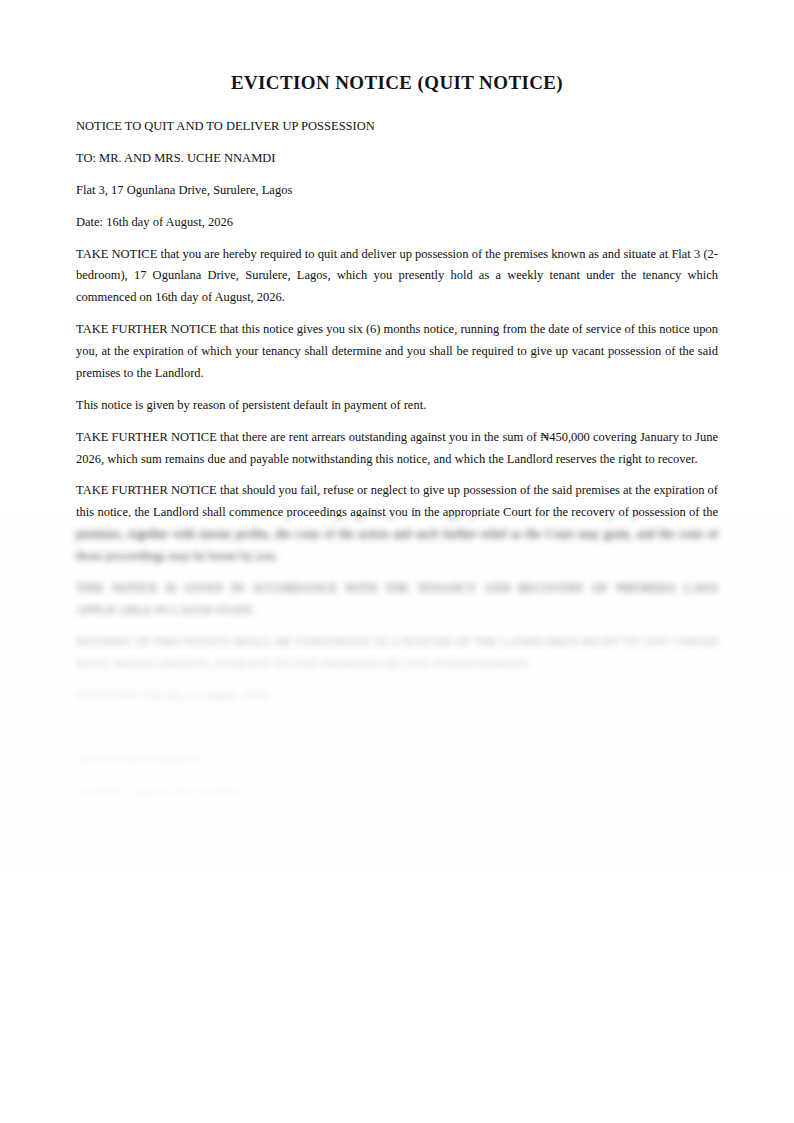
What a eviction notice (quit notice) is
A quit notice is the written notice a landlord serves to bring a tenancy to an end.
It is the first formal step in recovering possession, and it does one thing: it terminates the tenancy on a stated date. It does not, by itself, get anybody out.
What follows is a second notice, the notice of the owner's intention to recover possession, and then a court action if the tenant still has not left.
Nigerian landlords lose months at this stage, usually for the same reason. The notice period was too short for the type of tenancy, so the notice was invalid, and the whole sequence had to start again.
Who needs one
Landlords ending a tenancy, whether the term has run out, the rent is unpaid, or the property is needed back.
Agents and property managers serving notice on an owner's behalf, who should confirm they have written authority to do it.
It is also worth reading if you are the tenant. A notice giving you less time than your tenancy type requires is defective, and knowing that is worth a great deal.
Before you start
Establish three things, because the notice stands or falls on them.
What type of tenancy it is: weekly, monthly, quarterly, half yearly or yearly. This is determined by how rent is paid and accepted, not by what the agreement calls it.
The state the property sits in, since tenancy law is state law and Lagos has its own Tenancy Law.
And how you will prove service. A notice nobody can prove was delivered is the second most common failure after a short notice period.
The walkthrough
Filling in the form, step by step
Every question you will be asked, what it means, and an example of a good answer.
Step 1 of 3
Eviction Notice (Quit Notice)
The tenant and the property
The notice must identify the person being served and the property being recovered, precisely enough that neither is arguable.
Name every tenant on the agreement. A notice addressed to one of two joint tenants leaves the other unserved, and a tenant who was never served cannot be removed.
The address for service is where the notice is delivered, and it is usually the property itself. Where the tenant has given a different address for correspondence, serve both.
The date of service is not a formality. Every notice period in this document is counted from it, so it must be the date the notice actually reached the tenant rather than the date you signed it.
- Tenant's full name
- The full name of every tenant named on the tenancy agreement. Where a couple or several people hold the tenancy, name them all. Serving one joint tenant does not put the others on notice, and it is a defect a tenant can rely on.
- Tenant's address for service
- Where the notice is being served, usually the rented property itself. If the tenant has given another address for correspondence, serve at both and keep proof of each.
- Date the notice is served on the tenant
- The day the notice actually reaches the tenant. Every period in the notice counts from this date, so use the delivery date rather than the date of drafting. Keep evidence of how it was delivered.
- Address of the property
- The property being recovered, described precisely, including the flat or house number. For example, Flat 3, a two bedroom flat, at 17 Ogunlana Drive, Surulere, Lagos. A vague description gives a tenant something to argue about.
Step 2 of 3
Eviction Notice (Quit Notice)
The tenancy and the notice period
This step decides whether the notice is valid, so it deserves more care than the rest of the document combined.
The notice a landlord must give follows the type of tenancy. Broadly, a yearly tenant is entitled to six months, a half yearly or quarterly tenant to three months, a monthly tenant to one month, and a weekly tenant to one week. A tenant at will is entitled to a week.
The type is determined by how rent is paid and accepted, not by what the agreement is titled. Somebody who pays yearly is a yearly tenant even if the document calls the arrangement something else, and a landlord who has been accepting monthly rent for two years has a monthly tenancy whatever the original term said.
Giving less than the required notice does not shorten the process. It invalidates the notice, and you begin again from the start.
The reason and the arrears are optional. Stating arrears helps where you intend to claim them later, and stating a reason is sometimes worth doing for clarity, but neither is required to end a tenancy that has run its course.
- Date the tenancy began
- When the tenancy began. It establishes the anniversary date, which matters for a yearly tenancy because notice is generally expressed to expire on the eve of an anniversary of the term.
- How much notice are you giving?
- The length of notice, written out. Match it to the tenancy type below: six months for a yearly tenancy, three months for quarterly or half yearly, one month for monthly, one week for weekly. Giving less than the law requires makes the notice invalid rather than merely short.
- State where the property is located
- The state where the property physically sits. Tenancy law differs by state, and Lagos has its own Tenancy Law which does not apply uniformly across the whole state. This answer decides which rules govern the notice.
- What kind of tenancy is it?
- How the tenancy actually runs, judged by how rent is paid and accepted rather than by the title of the agreement. A tenant paying monthly for two years is a monthly tenant even where the original document granted a year.
- Reason for the notice (optional)
- Optional. You may state a reason such as persistent default in rent, or leave it out where the term has simply expired. A reason is not required to end a tenancy, but it can be useful context if the matter reaches court.
- Rent arrears owed (optional)
- Optional. Where rent is owed, state the amount and the period it covers, for example four hundred and fifty thousand naira covering January to June 2026. Recording it here supports a later claim for the money, which is a separate matter from recovering possession.
Step 3 of 3
Eviction Notice (Quit Notice)
The landlord and the date
The last step identifies who is giving the notice and when.
The notice must come from the landlord or somebody authorised to act for them. Where an agent serves it, the agent needs written authority, and a tenant is entitled to ask for it. Notices served by somebody with no authority are a recurring reason recovery actions fail in Nigeria.
Give contact details that work. A tenant who wants to negotiate, pay arrears or arrange to leave needs somewhere to reach you, and many disputes end at that point rather than in court.
Keep a copy of what you served and record how you served it: by hand with a witness, by courier with proof of delivery, or by whatever method the tenancy agreement specifies.
- Landlord's full name
- The full name of the landlord, matching the tenancy agreement. Where the property is owned by a company, use the registered company name. Where an agent serves this, the landlord is still the person named here.
- Landlord's address
- The landlord's own address for correspondence, not the rented property. This is where the tenant sends any reply, payment or request to negotiate.
- Landlord's phone number and/or email
- A phone number and email the tenant can actually use. Many tenancies end by agreement once the tenant has somebody to talk to, which is faster and cheaper than the alternative.
- Date of this notice
- The date the notice is signed. Keep it consistent with the service date above, and keep proof of how and when the notice was delivered.
Ready to make yours?
Answer those questions in the builder and download a finished eviction notice (quit notice) in Word and PDF.
Start now, ₦5,000After you download it
Serve it so you can prove it
Deliver by hand with a witness, or by a method that produces a receipt. A notice you cannot prove was served is treated as never served.
Wait for the full period
The notice expires on the date it states. Acting before that date undermines everything that follows, however clear the tenant's position seems.
Then serve the seven day notice
If the tenant stays on after the quit notice expires, the next step is a notice of the owner's intention to recover possession before proceedings begin.
Never change the locks
Self help is unlawful. Removing a tenant, their belongings, or their power and water without a court order exposes a landlord to a claim, and it hands the tenant the stronger case.
Questions people ask
How much notice must I give a tenant in Nigeria?
It follows the tenancy type. A yearly tenant is generally entitled to six months, quarterly and half yearly to three months, monthly to one month and weekly to one week. Short notice invalidates the notice entirely.
What kind of tenancy do I have?
It is judged by how rent is paid and accepted, not by the title on the agreement. A tenant who has been paying monthly for years has a monthly tenancy even if the original document granted a year.
Can I evict a tenant who has not paid rent?
Not directly. Arrears do not remove the need for a valid quit notice, the follow up notice of intention to recover possession, and a court order if the tenant stays.
What happens after the quit notice expires?
If the tenant remains, you serve a notice of the owner's intention to recover possession, and then apply to court. Only a court can order a tenant out.
Can I change the locks or cut the power?
No. Self help is unlawful in Nigeria and it exposes the landlord to a claim, while strengthening the tenant's position in the recovery action.
Does the notice need a reason?
No. A reason is optional and the notice is valid without one where the term has run its course, though stating arrears is useful if you intend to claim the money separately.
Documents that go with this
Terms used on this page
Quit Notice
A quit notice is the written notice a landlord serves to end a tenancy. How much notice you must give depends on the tenancy type, unless the tenancy agreement fixes a different period.
Notice of Intention to Recover Possession
This is the second notice a Nigerian landlord serves, after the quit notice expires and before going to court. Skipping it is the most common reason recovery of premises cases are struck out.
Holding Over
Holding over is a tenant staying on after the tenancy has ended. They are no longer a tenant paying rent, they are an occupier who may owe mesne profits until they leave.
Tenant
A tenant is a person who occupies property belonging to somebody else in exchange for rent. Nigerian law gives tenants real protections, including proper notice and the right to a refund of the caution fee.
Landlord
A landlord is the person who grants somebody else the right to occupy their property in exchange for rent. The role carries rights to rent and possession, and duties that Nigerian law enforces.
Possession
Possession is actual control of property. Nigerian law protects it separately from ownership, which is why the person on the land can sue a trespasser without first proving title.
Tenancy at Will
A tenancy at will is occupation with the owner's consent, with no fixed term, ending whenever either party chooses. It is what exists while a lease is being negotiated.
Rent
Rent is what a tenant pays for the right to occupy a property. In Nigeria it is normally paid in advance, and how far in advance a landlord may demand is limited by law in some states.
Read more on this
Quit Notice in Nigeria: Exactly How Many Days Your Landlord Must Give You (by Tenancy Type)
Your notice period depends on your tenancy type, which is determined by how your rent is structured, not how often you happen to pay it.
Landlord Rights in Nigeria
Landlord Rights in Nigeria: What Every Property Owner Needs to Know Being a landlord in Nigeria is one of those ventures that looks straightforward from the outside and reveals its complexities only after you’re already…
Tenancy Relationships: The Different Types of Tenants
Tenancy Relationships: The Different Types of Tenants If you rent property in Nigeria—or you own one—you’ve probably used the word “tenant” casually. But in law, not all tenants are the same. The type of tenancy relation…
Step by step guides for every document on LegalDoc
Browse all guides