
How to Write a Remote Work Agreement
Remote employment needs the ordinary employment terms plus answers to the questions distance creates: hours, equipment, expenses and office days.
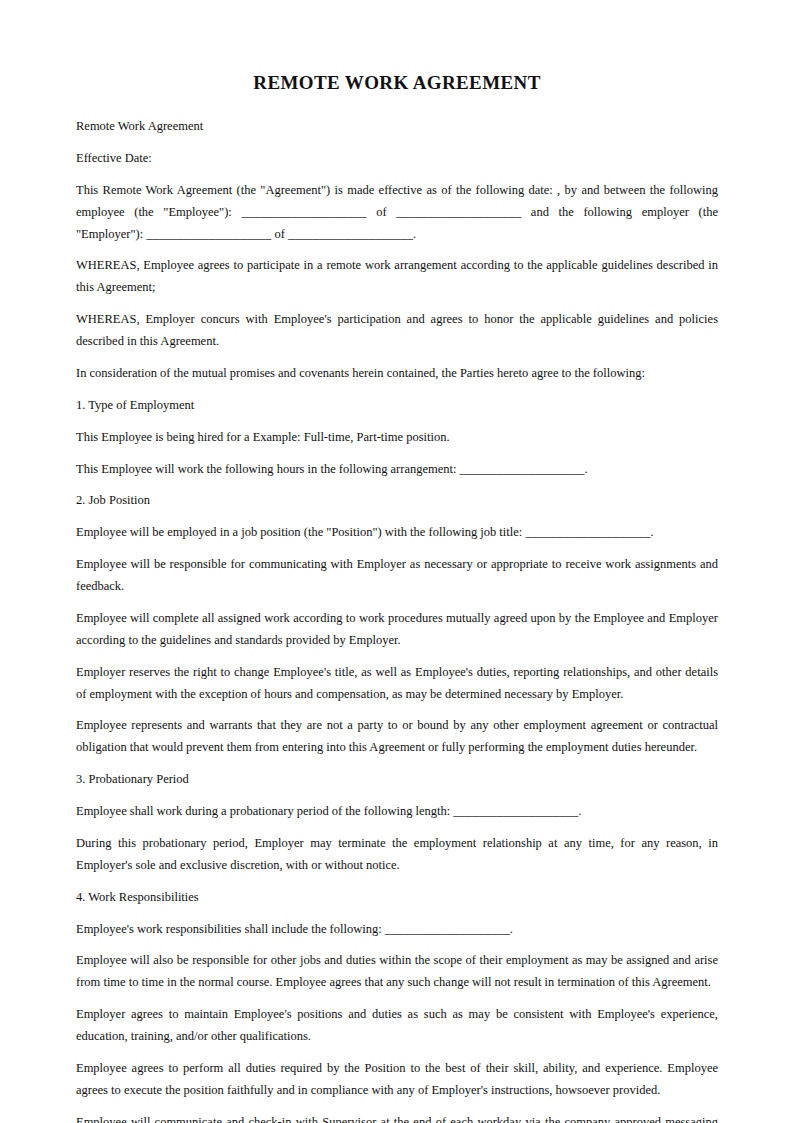
What a remote work agreement is
A remote work agreement is an employment contract written for somebody who works away from the office.
It covers everything an ordinary contract does, and then the questions that only arise at a distance. When is the person expected to be available. Do they ever come in. Who provides the laptop. Who pays for internet and power. How is performance reviewed when nobody sees the work being done.
Nigerian businesses hire remotely far more than they did, and most of them use an office contract with the word remote added. That leaves the practical questions unanswered until they cause friction, usually around availability and expenses.
The person is still an employee. All the usual obligations apply, including PAYE, pension and the Labour Act requirements.
Who needs one
Employers hiring staff who work from home, whether fully remote or on a hybrid pattern.
Companies with employees in other states, or in other countries, where being clear about which law governs matters more.
Businesses formalising arrangements that started informally during a period of remote working and were never documented.
Where the person is genuinely running their own business and serving other clients, an independent contractor agreement is the right document instead.
Before you start
Decide the practical policy before writing it down.
The hours you expect somebody to be reachable, which is different from the hours they work.
Whether they come into an office, how often, and who pays to get them there.
What equipment you provide and what happens to it when they leave.
Whether you contribute to internet or electricity costs, which in Nigeria is a real and recurring expense.
And how performance will actually be measured, since supervision by observation is not available.
The walkthrough
Filling in the form, step by step
Every question you will be asked, what it means, and an example of a good answer.
Step 1 of 4
Remote Work Agreement
The parties, the role and the hours
The agreement opens with the same essentials any employment contract needs.
The employee's address does extra work in a remote arrangement, because it is where the work is actually performed. That has consequences worth thinking about: it may affect which state's law is most appropriate, and where an employee is in another country entirely it raises tax and social security questions this document does not answer.
Hours per week set the baseline. In remote work the number matters less than the pattern, which is asked about in the next step, but it still fixes what full time means and what overtime is measured against.
- Employee's name
- The employee's full legal name, matching their identification and payroll records.
- Employee's address
- Where the employee lives, which in a remote arrangement is also where the work is performed. Note that an employee based in another state or country raises tax and regulatory questions this agreement does not resolve on its own.
- Employer's name
- The registered name of the company. It remains the employer whether or not it keeps an office the employee ever visits.
- Employer's address
- The company's registered or principal address, used for formal correspondence even though the employee does not work there.
- Type of employment
- Full time or part time. It sets the baseline for pay, leave accrual and what the working week means, and should match how the role is genuinely structured.
- How many hours a week will the employee work?
- Contracted hours per week, for example 40. In remote work the pattern matters more than the total, but this fixes what full time means and gives overtime something to be measured against.
- Job Title
- The role, for example Customer Support Specialist. Keep it consistent with the offer letter and any handbook, since the title frames what duties can reasonably be assigned.
Step 2 of 4
Remote Work Agreement
Schedule, office days, duties and equipment
This step is what makes the agreement genuinely remote rather than an office contract with a different address.
The work schedule should distinguish between hours worked and hours available. Expected online from 8am to 5pm is an availability commitment, and it is usually what employers actually mean. Setting it out prevents both the employee who disappears for an afternoon and the employer who messages at ten at night.
Office attendance needs a stated pattern and, importantly, a position on who pays for the journey. An employee hired remotely and then required in the office weekly has effectively been given a commute they did not agree to, and the cost of that is a legitimate question.
The equipment answer should also say what happens at the end. Company laptops need returning, and an agreement silent on that leaves you asking for hardware back with nothing to point to.
- Probation period for the employee
- The probation length, for example three months. Remote probation needs active review rather than passive observation, so plan how you will actually assess somebody you do not see.
- Employee's responsibilities
- What the person is accountable for, framed as outcomes rather than activity. Remote management works on results, and responsibilities written as tasks to be observed do not translate to a distance.
- Work schedule
- The expected pattern, for example online and reachable from 8am to 5pm, Monday to Friday. Distinguish hours worked from hours available, since availability is usually what employers actually mean and rarely what they write.
- Will the employee be required to come into the physical office?
- Choose whether office attendance is required. Answer for the arrangement you intend to run, since an employee hired as remote and later required in weekly has been given a commute they did not agree to.
- Describe when the employee will be required to come to the office
- If attendance is required, set out the pattern and the notice given, for example a weekly strategy meeting on Tuesdays. Say who bears the travel cost, which is the question that causes friction if left unstated.
- No
- If no office attendance is required, confirm the role is fully remote. Note any exception, such as an annual gathering, rather than leaving a fully remote statement you will later contradict.
- What office equipments will the employee be given?
- What the company provides: laptop, phone, monitor, desk allowance. State that equipment remains company property and must be returned on leaving, otherwise recovering it is an awkward conversation with nothing behind it.
Step 3 of 4
Remote Work Agreement
Salary, overtime, expenses and benefits
This step covers pay and the costs that remote work shifts onto the employee.
Reimbursement is the question most Nigerian remote agreements skip, and it is the most locally significant one. Working from home means the employee is paying for internet and, realistically, for fuel or an inverter to keep power on during working hours. Those are business costs being borne personally. A stated allowance or reimbursement limit resolves it; silence means either resentment or an expenses claim you did not expect.
Overtime needs care in remote roles, because the boundary between working and not working is soft. If overtime is payable, say how it is authorised, otherwise you may receive claims for evening hours nobody asked for. If it is not payable, say that plainly and be consistent about not expecting evening work.
- Employee's salary
- The salary, stated as gross and with the period it covers. Where the employee is in another state or country, note that this does not by itself resolve the tax treatment of their pay.
- What date will the employee be paid?
- The pay date, for example the 25th of each month. Give a date rather than a general reference to month end, since staff budget around it closely.
- Will there be overtime?
- Choose whether overtime is payable. The boundary between working and not working is soft in remote roles, so whichever you choose needs to be stated and then respected.
- Overtime
- If overtime is payable, say how it is authorised and at what rate. Requiring prior approval is what prevents claims for evening hours nobody asked for.
- No overtime
- If overtime is not payable, state that plainly. Then hold to it: an employer that does not pay overtime and routinely expects evening work is creating a grievance rather than a policy.
- How much is the limit for reimbursement?
- The cap on reimbursable expenses. In Nigerian remote work this realistically covers internet and power, which are genuine business costs the employee is otherwise absorbing. Leaving it unstated produces either resentment or unexpected claims.
- Other employee benefits
- Any further benefits: health cover, allowances, training budget, equipment refresh. List only what is actually in place, since staff rely on stated benefits.
Step 4 of 4
Remote Work Agreement
Leave, reviews, start date and notice
The closing step covers the remaining employment terms.
Performance review frequency matters more in remote work than in an office. Without incidental daily contact, a quarterly review may be the only structured feedback somebody receives, so set a rhythm you will actually keep.
The notice period here is expressed as what the employee must give. In practice notice cuts both ways, and the employer's obligation should mirror it. A month is common for salaried roles in Nigeria.
On governing law, name the state that genuinely connects to the employment. Where the employee works in a different state from the employer, choose deliberately rather than by default, and take advice where the employee is outside Nigeria altogether, since this agreement is not built for that.
- Leave/ Vacation period
- Annual paid leave. Remote employees take less leave than office staff without meaning to, so state the entitlement clearly and encourage it to be used.
- The frequency of performance review
- How often performance is formally reviewed, for example every three months. Without daily contact this may be the only structured feedback the person gets, so choose a rhythm you will keep.
- Start Date
- The first day of employment. Continuous service runs from here, which matters for leave, notice and any length of service condition later.
- Notice period the employee must give before terminating the agreement
- The notice the employee must give, commonly one month for salaried roles. The employer's obligation should mirror it, since notice running only one way is neither fair nor generally enforceable.
- The state whose laws shall govern this agreement
- The Nigerian state governing the employment. Where employer and employee are in different states, choose deliberately. Where the employee is outside Nigeria, take advice, because this agreement is not designed for cross border employment.
Ready to make yours?
Answer those questions in the builder and download a finished remote work agreement in Word and PDF.
Start now, ₦10,000After you download it
Log the equipment issued
Record serial numbers and the date issued. Recovering a laptop from a departed remote employee is much easier with a signed list than without one.
Set the communication norms
Which channel for what, and expected response times. Remote friction is usually a communication problem rather than a contractual one.
Keep the statutory obligations
Remote employees are employees. PAYE, pension and the Labour Act requirements apply exactly as they would for office staff.
Review the arrangement after six months
Remote patterns that looked right on paper often need adjusting once real work has flowed through them. Plan the review rather than waiting for a complaint.
Questions people ask
What should a remote work agreement cover beyond a normal contract?
Availability hours, office attendance and who pays for it, equipment provision and return, reimbursement for internet and power, and how performance will be reviewed without daily contact.
Should employers pay for internet and electricity?
It is worth addressing rather than ignoring. In Nigeria these are real recurring costs the employee absorbs, and a stated allowance or reimbursement cap prevents both resentment and unexpected claims.
Are remote workers still employees?
Yes. All the usual obligations apply, including PAYE, pension and the Labour Act requirement to provide a written statement of particulars of employment.
Can I require a remote employee to come into the office?
If the agreement says so. Hiring somebody as remote and then requiring weekly attendance gives them a commute they did not agree to, so set the pattern and the cost position up front.
How do I manage performance remotely?
By outcomes rather than observation. Write responsibilities as results, set a review rhythm you will actually keep, and accept that supervision by presence is not available.
What if the employee is in another country?
Take advice. Cross border employment raises tax, social security and employment law questions that a Nigerian remote work agreement does not resolve on its own.
Documents that go with this
Terms used on this page
Contract of Employment
A contract of employment is the agreement between an employer and an employee setting out the job, the pay and the terms. Nigerian law expects it in writing within three months of starting.
Employee
An employee works under a contract of service, meaning the employer controls how the work is done. The label on the contract does not decide it, and getting the classification wrong is expensive for the employer.
Hours of Work
Hours of work are the hours an employee is required to work. The Labour Act fixes them by agreement rather than by a national maximum, and it does guarantee rest.
Overtime
Overtime is work beyond an employee's normal hours. Nigerian law does not fix a national overtime rate, so what you are paid for it depends almost entirely on your contract.
Annual Leave
Annual leave is paid time off an employee earns by working. The Labour Act sets a minimum of six working days after twelve months of continuous service, and most Nigerian employers give considerably more.
Notice Period
A notice period is how much warning either side must give before ending an employment. The Labour Act sets minimums based on length of service, and the contract can give more but not less.
Probation Period
A probation period is an agreed stretch at the start of employment during which either side can end the relationship more easily. In Nigeria it is contractual, and it does not suspend an employee's rights.
Pension
Pension in Nigeria is the contributory scheme under the Pension Reform Act, where employer and employee both pay monthly into the employee's retirement savings account.
Read more on this
Employment Contracts: Key Clauses and Compliance Guide
Employment Contracts: Key Clauses and Compliance Guide An employment contract is one of the most important documents in any Nigerian workplace, yet it is also one of the most neglected. Many businesses, especially small…
Difference Between an Offer Letter and an Employment Contract in Nigeria
Difference Between an Offer Letter and an Employment Contract in Nigeria What Is an Offer Letter? An offer letter is a preliminary document issued by an employer to a prospective employee after a successful recruitment p…
11 Essential and Protective Documents Needed by a Startup Company
Business Plan Certificate of Incorporation, Memart, Art. of association, Status Report Founders’ Agreement Service Level Agreements Non-Disclosure Agreement Employee Contracts Intellectual Property Agreements Shareholder…
Step by step guides for every document on LegalDoc
Browse all guides