
How to Write a Share Purchase Agreement
A share purchase agreement transfers shares from one owner to another. The buyer takes the company as it stands, which is why what is not in the document matters.
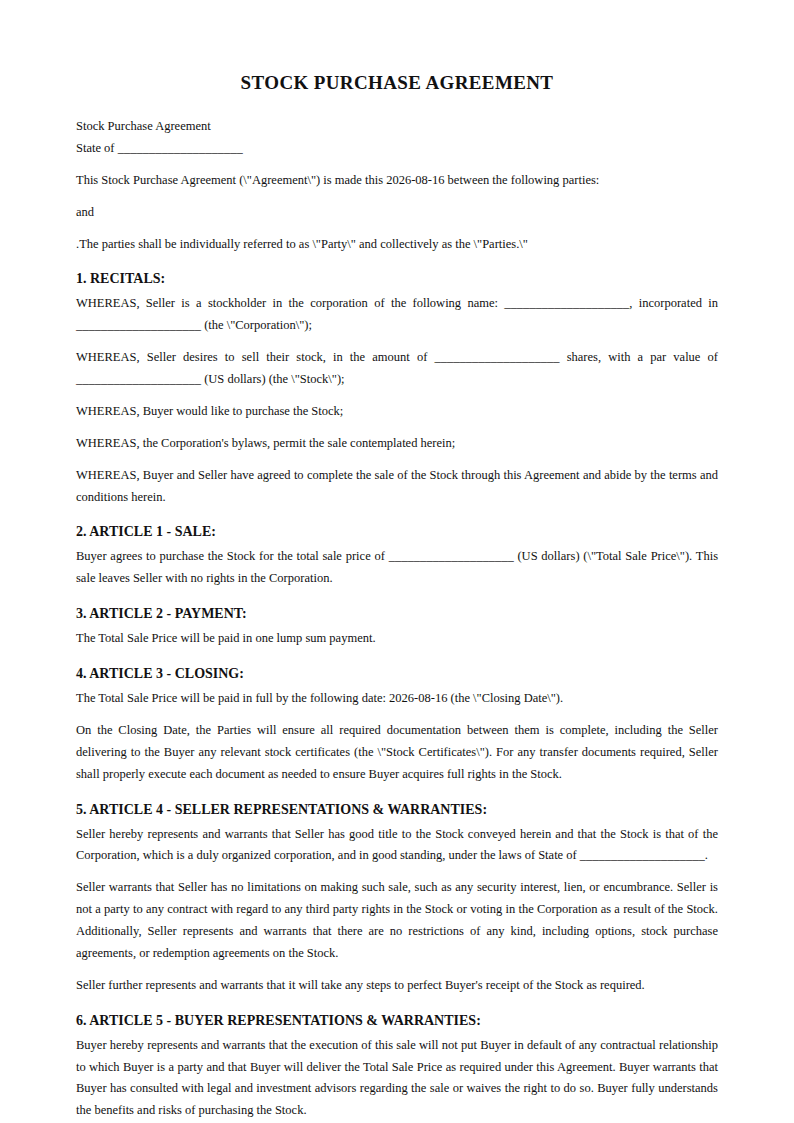
What a stock purchase agreement is
A share purchase agreement records the sale of shares in a company from a seller to a buyer.
Buying shares is different from buying a business. When you buy the assets of a business you choose what you take. When you buy shares you take the company whole, including its contracts, its employees, its tax history and any liability nobody mentioned.
That is the thing to understand before signing one. The company does not change; only its ownership does. Every debt, dispute and obligation the company carried yesterday it still carries tomorrow, and it is now your problem.
Which is why in any substantial share purchase the real work happens before the agreement: due diligence to find out what you are buying, and warranties in the document to allocate the risk of what diligence missed.
Who needs one
Anybody buying or selling shares in a private company.
Founders bringing in an investor who is acquiring existing shares rather than subscribing for new ones, which are different transactions.
Shareholders exiting a company, whether selling to a co owner or an outsider.
Family businesses transferring shares between generations.
For an investor putting new money into a company for newly issued shares, a subscription agreement is the right instrument instead, since that money goes to the company rather than to a selling shareholder.
Before you start
Do the diligence before the drafting.
Check the company's filings at the CAC: is it in good standing, are annual returns up to date, who are the recorded directors and shareholders.
Inspect the register of members, since that is what evidences who actually owns the shares.
Ask about debts, guarantees, disputes and unpaid taxes.
Check the articles and any shareholders agreement for pre-emption rights, because existing shareholders may have to be offered the shares first.
And agree the price and how it is calculated.
The walkthrough
Filling in the form, step by step
Every question you will be asked, what it means, and an example of a good answer.
Step 1 of 3
Stock Purchase Agreement
The date and the jurisdiction
The agreement opens by fixing when and under what law.
The country of incorporation matters more here than in most agreements, because share transfers are governed by company law. In Nigeria, CAMA 2020 sets out how shares are transferred, and the transfer is not complete until the company registers it and enters the buyer in the register of members. An agreement signed and paid for does not, by itself, make somebody a shareholder.
That is the single most common misunderstanding in Nigerian share purchases. Money changes hands, the agreement is executed, and nobody updates the register. The buyer then discovers they have a contractual right against the seller rather than the shares they thought they bought.
- Date on the agreement
- The date the parties sign. Where signing and completion happen on different days, this is the signing date and the closing date below is when the transaction actually completes.
- The Company is Incorporated in Which Country?
- The country of incorporation, for example Nigeria, which fixes the company law governing the transfer. Under CAMA a transfer is only complete once the company registers it and enters the buyer in the register of members.
Step 2 of 3
Stock Purchase Agreement
The company and the shares
This step identifies exactly what is being sold, and precision is the whole point.
Name the company exactly as registered. Then state the number of shares and their value, and be clear about which value you mean. The nominal value of a share and the price being paid for it are usually different numbers, and confusing them is a real source of dispute.
What this form does not ask, and what any substantial transaction needs, is the class of shares and what proportion of the company they represent. Forty thousand shares means nothing without knowing whether that is four per cent or forty. If the deal is significant, record the percentage as well, because that is what the buyer thinks they are buying.
Also confirm the shares are fully paid. Partly paid shares carry an obligation to pay the balance, and a buyer who did not check acquires that liability along with the shares.
- Name of the Company
- The registered name of the company whose shares are being sold, exactly as on the certificate of incorporation. Verify it against the CAC record rather than the letterhead.
- The amount of shares
- How many shares are being transferred. Also record what proportion of the issued share capital that represents, since a number of shares means nothing to a buyer without the percentage attached.
- The value of shares?
- The value of the shares. Be clear whether this is the nominal value or the price actually being paid, since those are usually different figures and confusing them causes real disputes.
Step 3 of 3
Stock Purchase Agreement
Seller, buyer and completion
The final step names the parties and sets the closing date.
The individual or company choice affects what happens next. Where a company is selling, the sale usually needs a board resolution authorising it, and the person signing needs authority. Where a company is buying, the same applies. Executing a share purchase with somebody who turns out to have had no authority to bind their company is a problem discovered late and solved expensively.
Where an individual is selling, check whether they are the registered holder or holding for somebody else, since nominee arrangements are common and the beneficial owner's consent may be needed.
The closing date is when the transaction completes: payment is made, the share transfer form is executed, and the company registers the transfer. Build in the time those steps actually take rather than setting a date that assumes the registry moves quickly.
- Seller
- Choose whether the seller is an individual or a company. A company seller normally needs a board resolution authorising the sale, and the signatory needs authority, which is worth verifying rather than assuming.
- Individual
- If an individual is selling, their full name and address. Confirm they are the registered holder rather than a nominee holding for somebody else, since nominee arrangements are common and change who must consent.
- Company
- If a company is selling, the registered name and address. Ask for the board resolution approving the sale, since a transfer executed without authority is open to challenge.
- Buyer
- Choose whether the buyer is an individual or a company. Where a company is buying, its own authority to acquire the shares should be confirmed before completion.
- Individual
- If an individual is buying, their full name and address as it should appear in the register of members. Spelling matters here, because this is the name that will evidence ownership.
- Company
- If a company is buying, the registered name and address exactly as incorporated. The register of members will record this entity as the holder, so it must be the one intended.
- Closing Date
- When the transaction completes: payment made, transfer form executed and the transfer registered by the company. Allow realistic time, since the buyer is not a shareholder until the register is updated.
Ready to make yours?
Answer those questions in the builder and download a finished stock purchase agreement in Word and PDF.
Start now, ₦10,000After you download it
Execute the share transfer form
The agreement records the bargain; the transfer form moves the shares. Both are needed, and the transfer form is the one that goes to the company.
Get the register of members updated
This is the step that makes the buyer a shareholder. An agreement signed and paid for, with no register entry, leaves the buyer holding a contract rather than shares.
Issue a new share certificate
The company should issue a certificate in the buyer's name and cancel the seller's. It is the document a buyer will be asked for later.
Update the CAC filings
Changes in shareholding are reflected in the company's filings. Leaving the public record showing the old owner causes problems at the next transaction or bank review.
Questions people ask
What is a share purchase agreement?
The contract recording the sale of shares in a company from a seller to a buyer. The company itself does not change, only its ownership, so the buyer inherits everything the company already carries.
Is buying shares the same as buying a business?
No. Buying assets lets you choose what you take. Buying shares means taking the company whole, including its debts, contracts, employees and tax history, whether or not anybody mentioned them.
When does the buyer actually become a shareholder?
When the company registers the transfer and enters them in the register of members. Signing and paying is not enough on its own, and this is the most commonly missed step in Nigerian share purchases.
What is the difference between nominal value and price?
Nominal value is the figure attached to the share in the company's capital structure. The price is what the buyer actually pays, and the two are usually different numbers.
Do existing shareholders have to be offered the shares first?
Often yes. Check the articles and any shareholders agreement for pre-emption rights, since a transfer made in breach of them can be challenged.
What should a buyer check before signing?
CAC filings and good standing, the register of members, outstanding debts and guarantees, unpaid taxes, ongoing disputes, and whether the shares are fully paid.
Documents that go with this
Terms used on this page
Share Transfer
A share transfer is the sale or gift of shares from an existing shareholder to somebody else. It is not complete when the money is paid. It is complete when the company enters the new owner in its register of members.
Share Capital
Share capital is the value of shares a company has issued or is permitted to issue. It is not cash in the bank, and the figure you declare at the CAC drives your registration cost.
Shareholders Agreement
A shareholders agreement is the private contract between the owners of a company covering how it is run, how shares move and what happens when they disagree. The articles do not do that job.
Due Diligence
Due diligence is the investigation you carry out before committing to a deal. You are checking that what you are buying, funding or partnering with is actually what it was described to be.
Warranty
A warranty is a promise in a contract that something is true. If it turns out not to be, the other side can claim damages, though usually not walk away from the deal.
Minority Shareholder
A minority shareholder holds too few shares to control anything. CAMA gives them remedies, and a shareholders agreement gives them protection, which is a different and better thing.
Share Certificate
A share certificate is the document a company issues showing that somebody holds shares in it. It is evidence of ownership, but the register of members is the actual record.
Statutory Registers
Statutory registers are the records CAMA requires a company to keep: members, directors, charges and significant control. They are the first thing anybody buying or investing asks to see.
Read more on this
Founders Vs. Shareholders
When building a company, it’s important to understand the distinct roles of founders and shareholders and the legal documents that formalize their relationships. Founders: Globally, roughly 40 million startup companies a…
11 Essential and Protective Documents Needed by a Startup Company
Business Plan Certificate of Incorporation, Memart, Art. of association, Status Report Founders’ Agreement Service Level Agreements Non-Disclosure Agreement Employee Contracts Intellectual Property Agreements Shareholder…
10 Legal Documents Every Startup in Nigeria Needs
10 Legal Documents Every Startup in Nigeria Needs Starting a business in Nigeria is exciting. Entrepreneurs launch new ventures every day—technology startups, creative agencies, e-commerce platforms, consulting firms, an…
Step by step guides for every document on LegalDoc
Browse all guides