
How to Write a Shareholders Agreement
A shareholders agreement governs the relationship between owners, privately, covering the things the public articles do not. Dividends are where most start.
What a shareholder agreement is
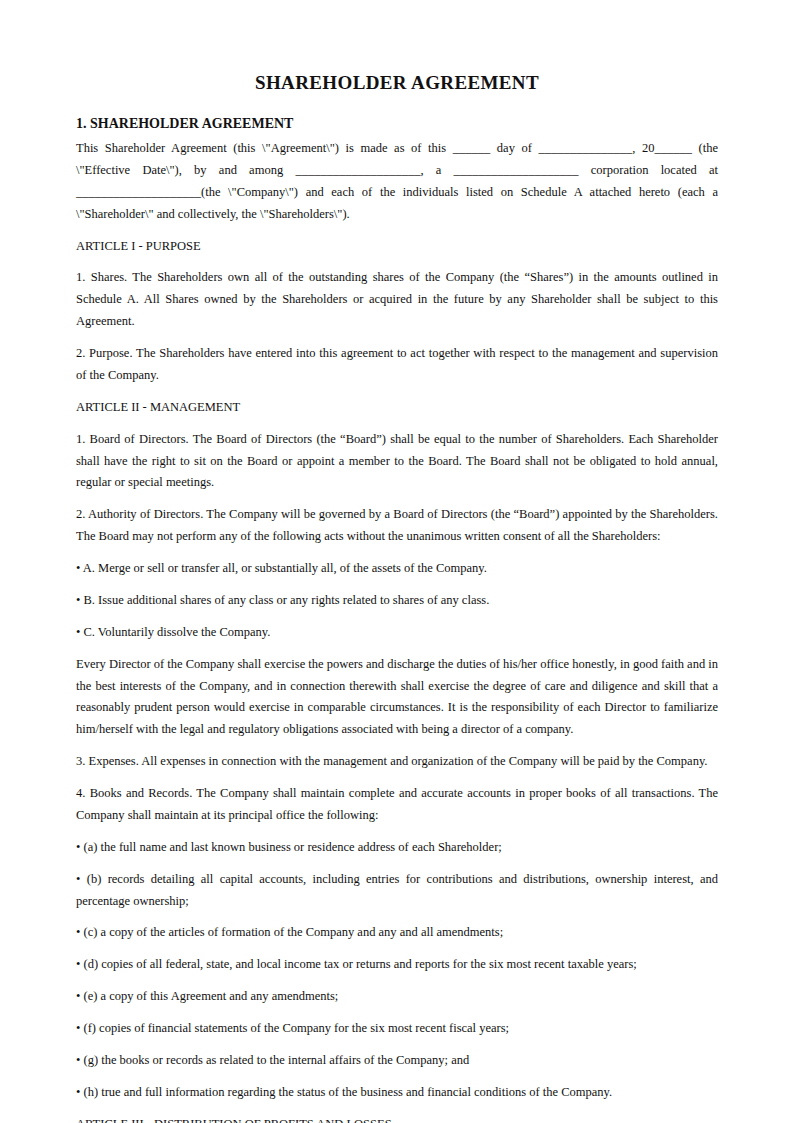
A shareholders agreement is a private contract between the owners of a company about how they will deal with each other.
It sits alongside the articles of association and does a different job. The articles are filed publicly and govern the company. This agreement is private and governs the shareholders: how profits are shared, how shares may be sold, what happens on a deadlock, and what protections minority holders have.
The privacy is deliberate. Commercial arrangements between owners, including who has what veto and how a departing shareholder is bought out, are not things most businesses want on a public register.
It matters most where there is more than one owner and their interests are not identical, which is every company with outside investors and most with two founders.
Who needs one
Companies with two or more shareholders, particularly where holdings are unequal.
Businesses taking on an investor, who will usually require one and will bring their own draft.
Family companies where shares may pass to people who did not build the business and may not want the same things from it.
Minority shareholders, who get little protection from company law alone and can be comprehensively outvoted without one.
Before you start
Think through the questions the agreement should answer, since this form is brief and the additional terms box carries most of the weight.
How profits are distributed and who decides.
Whether a shareholder wanting to sell must offer their shares to the others first.
What decisions need unanimous consent rather than a simple majority.
How the company breaks a deadlock.
And what happens when a shareholder dies, leaves the business or becomes unable to act.
The walkthrough
Filling in the form, step by step
Every question you will be asked, what it means, and an example of a good answer.
Step 1 of 3
Shareholder Agreement
Where the company is incorporated
The first question sets the legal framework.
For a Nigerian company that is CAMA 2020, which supplies the default rules on share transfers, pre-emption rights, minority protection and the conduct of meetings. This agreement then operates on top of those defaults, tightening them where the shareholders want more than the statute provides.
The distinction worth holding onto is that a shareholders agreement can bind the shareholders to each other, but it cannot override the company legislation or, generally, the articles where the two conflict. Where you want something to bind the company itself, the articles are often the right place for it, and the two documents should be drafted to work together rather than separately.
- The Company is Incorporated in which Country?
- The country of registration, for example Nigeria. It fixes the company law supplying the default rules on share transfers, pre-emption and minority protection, which this agreement then builds on top of.
Step 2 of 3
Shareholder Agreement
The company and how profits are shared
This step names the company and settles the dividend question, which is where most shareholder disagreements actually start.
The tension is predictable. A shareholder working in the business draws a salary and is content to reinvest profits. A shareholder who does not work there has only dividends, and sees reinvestment as being paid nothing while others are paid twice.
A dividend policy addresses that in advance. It can express a proportion of distributable profit to be paid out, the circumstances in which no dividend is declared, and who decides. It need not be rigid, and even a stated intention is far better than leaving it entirely to whoever controls the board.
Under CAMA, dividends may only be paid out of profits available for distribution, so whatever policy you write operates within that constraint.
- Name of the Company
- The registered name of the company, exactly as on the certificate of incorporation, since this agreement concerns shares in that specific entity.
- Address of the Company
- The registered office address as recorded at the CAC. Notices under the agreement are commonly served here.
- Distribution of dividends
- How profits are shared: what proportion of distributable profit is paid out, when, and who decides. This is where most shareholder disputes begin, because working shareholders draw salaries and non working ones have only dividends. Note that CAMA permits dividends only out of profits available for distribution.
Step 3 of 3
Shareholder Agreement
Everything else worth agreeing
The final step is a yes or no and a free text box, and the box is where the real protections go.
This form is deliberately brief, so use the additional information to cover what a shareholders agreement is actually for.
Pre-emption rights come first: a shareholder wanting to sell must offer their shares to the existing holders before an outsider. Without it you can find yourself in business with somebody you have never met.
Reserved matters are next. These are decisions requiring unanimous or supermajority consent rather than a simple majority: issuing new shares, taking on significant debt, selling the business, changing what the company does. They are the main protection a minority shareholder has.
Then deadlock, which matters enormously in a fifty fifty company. Without a mechanism, two shareholders who cannot agree have a company that cannot act.
And finally exit: what happens when a shareholder dies, wants out, or stops contributing. Tag along and drag along provisions, and a valuation method for buying somebody out, belong here.
- Additional Information
- Choose Yes to add further terms, which for a shareholders agreement is almost always the right answer. The provisions that make this document worth having are not covered by the questions above.
- Company
- The additional terms. Cover pre-emption rights so shares are offered internally before going to an outsider; reserved matters requiring unanimous or supermajority consent, which is the main minority protection; a deadlock mechanism, essential in a fifty fifty company; and exit provisions dealing with death, departure and how a leaving shareholder is valued and bought out.
Ready to make yours?
Answer those questions in the builder and download a finished shareholder agreement in Word and PDF.
Start now, ₦10,000After you download it
Check it against the articles
The two documents must work together. Where the agreement provides something the articles contradict, you have created an argument about which governs.
Have every shareholder sign
A shareholders agreement binds those who sign it. A holder who never signed is not bound, which defeats the purpose of pre-emption and reserved matters.
Bind new shareholders as they join
Require anybody acquiring shares to sign up to the agreement as a condition of the transfer, otherwise it erodes with every new holder.
Keep the register accurate
The agreement assumes the shareholdings are what the company's register says. Where the register has drifted from reality, fix that first.
Questions people ask
What is a shareholders agreement?
A private contract between the owners of a company about how they deal with each other, covering dividends, share transfers, reserved decisions and exit. It sits alongside the public articles.
How is it different from articles of association?
Articles are filed publicly and govern the company. A shareholders agreement is private and governs the relationship between the owners, which is why sensitive commercial terms go there.
What are pre-emption rights?
The right of existing shareholders to be offered shares before they can be sold to an outsider. Without them you can end up in business with somebody you never chose.
What are reserved matters?
Decisions requiring unanimous or supermajority consent rather than a simple majority, such as issuing shares, taking on major debt or selling the business. They are the main protection a minority shareholder has.
What happens in a fifty fifty deadlock?
Whatever the agreement provides, which is why it needs a mechanism. Without one, two shareholders who cannot agree have a company that cannot make decisions at all.
Can dividends be paid whenever shareholders want?
Only out of profits available for distribution under CAMA. Within that constraint, the agreement can set a policy on what proportion is paid out and who decides.
Documents that go with this
Terms used on this page
Shareholders Agreement
A shareholders agreement is the private contract between the owners of a company covering how it is run, how shares move and what happens when they disagree. The articles do not do that job.
Dividend
A dividend is a share of company profit paid out to shareholders. It is declared by the company, not demanded by the shareholder, and it can only be paid out of profits.
Minority Shareholder
A minority shareholder holds too few shares to control anything. CAMA gives them remedies, and a shareholders agreement gives them protection, which is a different and better thing.
Share Capital
Share capital is the value of shares a company has issued or is permitted to issue. It is not cash in the bank, and the figure you declare at the CAC drives your registration cost.
Drag-Along
A drag-along right lets a majority selling the company compel the minority to sell too, on the same terms. It exists because most buyers want all of a company, not most of it.
Tag-Along
A tag-along right lets a minority join a sale by the majority on the same terms. Without it, the majority can sell and leave the minority holding shares in a company owned by a stranger.
Quorum
A quorum is the minimum number of people who must be present for a meeting to make valid decisions. Without it, whatever the meeting decides can be challenged and set aside.
Share Transfer
A share transfer is the sale or gift of shares from an existing shareholder to somebody else. It is not complete when the money is paid. It is complete when the company enters the new owner in its register of members.
Read more on this
Founders Vs. Shareholders
When building a company, it’s important to understand the distinct roles of founders and shareholders and the legal documents that formalize their relationships. Founders: Globally, roughly 40 million startup companies a…
5 REASONS WHY YOU NEED A FOUNDERS AGREEMENT
What Is a Founders Agreement? A founders agreement is a legally binding contract entered into by the original owners of a business. It sets out the rights, obligations, and expectations of each founder from the outset. W…
11 Essential and Protective Documents Needed by a Startup Company
Business Plan Certificate of Incorporation, Memart, Art. of association, Status Report Founders’ Agreement Service Level Agreements Non-Disclosure Agreement Employee Contracts Intellectual Property Agreements Shareholder…
Step by step guides for every document on LegalDoc
Browse all guides