
How to Write a Tenancy Agreement in Nigeria
A tenancy agreement sets out who is renting what, for how long, and on what terms. Here is what each question on the form is asking, and what a good answer looks like.
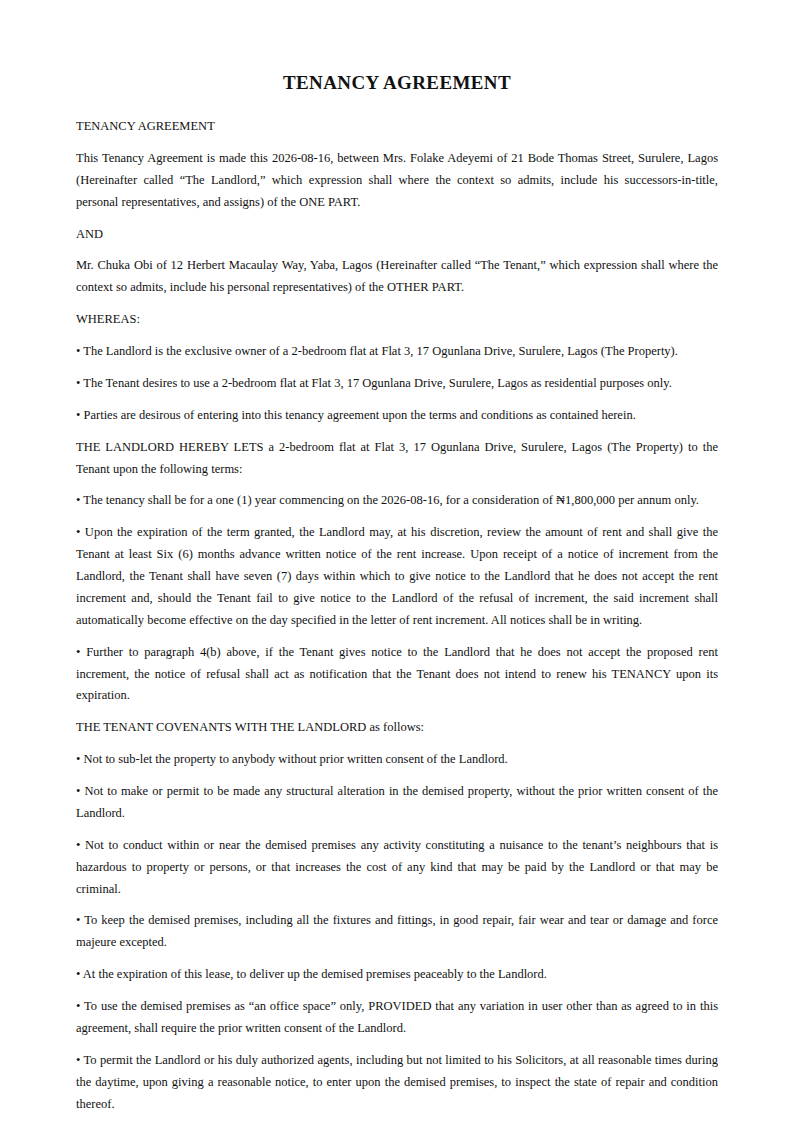
What a tenancy agreement is
A tenancy agreement is the written contract between a landlord and a tenant. It records the property, the rent, how long the tenancy runs, and what each side has agreed to do.
Nigerian law does not require a tenancy to be written down. A verbal letting is still a tenancy. What the written agreement does is settle in advance the things people argue about later: what the rent covers, who repairs what, whether the tenant may sublet, and how much notice ends the arrangement.
Almost every tenancy dispute that reaches a Nigerian court turns on something that was never written down.
Who needs one
Landlords letting a flat, a house, a shop or an office to a tenant for a fixed period, most commonly a year.
Tenants who have been asked to sign something and want a proper agreement rather than a receipt.
Agents preparing the paperwork for a letting on behalf of an owner.
If the arrangement is commercial and runs for several years, a commercial lease is usually the better document, because it deals with rent review, service charge and reinstatement in a way a tenancy agreement does not.
Before you start
Have five things to hand and the form takes a few minutes.
The full names and addresses of the landlord and the tenant, spelled as they appear on identification.
The exact address of the property, including the flat or house number.
The rent figure and whether it is per year or per month.
The start date and the length of the tenancy.
The state the property sits in, because tenancy law is state law and the answer changes with it.
The walkthrough
Filling in the form, step by step
Every question you will be asked, what it means, and an example of a good answer.
Step 1 of 3
Tenancy Agreement
The landlord and the tenant
The first step establishes who is bound by the agreement and where each party can be reached.
Get the names right. A tenancy agreement naming a person who does not own the property, or misspelling the tenant, causes real difficulty if the arrangement later has to be enforced. Use full legal names as they appear on identification, and if the landlord is a company, use the registered company name rather than a trading name.
The addresses matter for a reason people often miss: they are where formal notices are sent. A quit notice served at the wrong address can be challenged, and that argument can add months to a recovery of possession.
- Date of this agreement
- The date the agreement is signed, not the date the tenant moves in. Those are often different, and the start date is asked separately in the next step. If both parties sign on different days, use the later date.
- Landlord's full name
- The person or company that owns the property and is letting it out. Use the full legal name. For a company, use the name on the certificate of incorporation, for example Adeyemi Properties Limited rather than Adeyemi Properties. Where the property is owned jointly, name every owner.
- Landlord's address
- Where notices to the landlord should be sent. This is the landlord's own address, not the property being rented, and it is where the tenant will send anything formal. If the landlord lives abroad or the property is managed by an agent, give an address inside Nigeria where post will actually be received.
- Tenant's full name
- The person renting the property. Name every adult who will be a tenant, not just the one paying, because a person who is not named on the agreement is not bound by it and cannot easily be held to the rent. For a company taking premises for staff, name the company.
- Tenant's current address
- Where the tenant lives now, before moving in. It identifies the tenant and gives the landlord a fallback address. If the tenant is moving from another rented property, the current address is fine.
Step 2 of 3
Tenancy Agreement
The property and the term
This step defines what is being let and for how long. It is the part of the agreement that decides most later disputes, so it rewards being specific.
A vague description of the property is the single most common defect in Nigerian tenancy agreements. Writing a flat in Surulere is not enough. If the building has several units, say which one. If the letting includes a boys quarters, a parking space or a share of the compound, say so, because anything not mentioned is arguable.
The length of the tenancy is equally consequential. It sets the notice each side must give to bring the tenancy to an end, and in Nigeria that notice period follows the type of tenancy rather than whatever the parties assume.
- Describe the property being rented
- Describe the type of property, the number of rooms and the full address, including the flat or house number. For example, a two bedroom flat at Flat 3, 17 Ogunlana Drive, Surulere, Lagos. Add anything included in the letting, such as a boys quarters, a parking space or fitted appliances, because what is not written down is what gets argued about.
- What may the property be used for?
- What the tenant may lawfully use the property for. Residential purposes only is the usual answer for a home. If the tenant will run a business from the premises, say so here, because a residential-only clause makes that a breach. Be honest about it rather than leaving it to be discovered.
- How long is the tenancy?
- How long the tenancy runs. One year is the norm in Nigeria. This answer decides the notice either side must give: a yearly tenant is generally entitled to six months notice to quit, a quarterly tenant to three months, a monthly tenant to one month and a weekly tenant to one week. Choosing a monthly term to keep things flexible also means the tenant can be asked to leave on a month.
- When does the tenancy start?
- The day the tenant may move in. The term above runs from this date, so a one year tenancy starting 1 March 2026 ends on 28 February 2027. Use the date possession is actually given, not the date the rent was paid, because letting a tenant in early can change what kind of tenancy exists.
Step 3 of 3
Tenancy Agreement
Rent and the governing law
The last two answers set the money and the law.
State the rent in full: the amount, and the period it covers. A figure with no period attached is ambiguous, and the difference between one million naira per year and per month is the entire agreement.
The governing state matters more in Nigeria than people expect. Tenancy is state law, so notice periods, the recovery process and the limits on what a landlord may demand in advance all change from state to state. Lagos has its own Tenancy Law, and it does not apply uniformly across the whole state: several areas are excluded from parts of it. Choose the state where the property physically sits.
- Rent payable
- The amount and the period it covers, written out clearly. For example, one million eight hundred thousand naira per annum. State whether it is per annum or per month, since that single word decides what the tenant owes. If a caution fee or deposit is also being paid, that is dealt with separately in the agreement rather than folded into the rent figure.
- Which state's law governs this agreement?
- Normally the state where the property is located. Tenancy law differs by state and Lagos has its own Tenancy Law with its own notice periods and its own limits on rent collected in advance. Naming a state where the property is not situated creates a conflict you do not want to have to argue.
Ready to make yours?
Answer those questions in the builder and download a finished tenancy agreement in Word and PDF.
Start now, ₦5,000After you download it
Both parties sign, and witnesses sign
The landlord and the tenant each sign, and each signature is witnessed. Keep a signed original for each side. A tenancy agreement signed by only one party is evidence of very little.
Get it stamped
Tenancy agreements attract stamp duty, assessed on the rent. Stamping is what makes the document readily admissible in evidence, and an unstamped agreement can be objected to at exactly the moment you need to rely on it.
Register it if the term is long
A letting of three years or more is generally registrable as a land instrument in the state where the property sits. A one year tenancy ordinarily is not. If you have agreed a long term, take advice on registration before the term begins.
Record the condition of the property
Photograph every room on the day the tenant takes possession and attach a short schedule listing the fixtures and their condition. It costs an afternoon and it settles the argument about damage when the tenancy ends.
Questions people ask
What is a tenancy agreement?
The written contract between a landlord and a tenant recording the property, the rent, the length of the tenancy and the terms each side has agreed. A tenancy can exist without one, but almost every dispute turns on something that was never written down.
Does a tenancy agreement have to be written?
No. A verbal letting is still a tenancy and the law still protects the tenant. Writing it down settles the things people argue about later, which is why it is worth doing even between people who trust each other.
How much notice must a landlord give a tenant in Nigeria?
It follows the type of tenancy rather than what the parties assume. A yearly tenant is generally entitled to six months notice, a quarterly tenant to three months, a monthly tenant to one month and a weekly tenant to one week. The state matters, and Lagos has its own Tenancy Law.
How long can a tenant stay after the rent expires?
A tenant whose term has ended does not automatically become a trespasser. They must be given the correct notice to quit, then a notice of the owner's intention to recover possession, and only a court can order them out. A landlord who changes the locks instead is acting unlawfully.
What is a caution fee?
A refundable deposit held against damage or unpaid bills, common in Nigerian lettings. It is not rent and it should not be treated as the last month's rent. State the amount in the agreement and state what it can be deducted for.
Should the agreement be stamped?
Yes. Stamp duty is assessed on the rent, and stamping is what makes the agreement readily admissible in evidence. An unstamped agreement can be objected to when you most need to rely on it.
Do I need a tenancy agreement or a commercial lease?
A tenancy agreement suits a residential letting, usually for a year. A commercial lease suits business premises taken for several years, because it deals with rent review, service charge, alterations and reinstatement, which a tenancy agreement does not.
Documents that go with this
Terms used on this page
Tenancy Agreement
A tenancy agreement is the contract between a landlord and a tenant setting out the rent, the term, and what each side must do. It is what decides most disputes, including how much notice you get.
Landlord
A landlord is the person who grants somebody else the right to occupy their property in exchange for rent. The role carries rights to rent and possession, and duties that Nigerian law enforces.
Tenant
A tenant is a person who occupies property belonging to somebody else in exchange for rent. Nigerian law gives tenants real protections, including proper notice and the right to a refund of the caution fee.
Rent
Rent is what a tenant pays for the right to occupy a property. In Nigeria it is normally paid in advance, and how far in advance a landlord may demand is limited by law in some states.
Quit Notice
A quit notice is the written notice a landlord serves to end a tenancy. How much notice you must give depends on the tenancy type, unless the tenancy agreement fixes a different period.
Caution Fee
A caution fee is a refundable deposit a tenant pays at the start of a tenancy, held by the landlord against damage or unpaid bills. If you leave the place in good condition, you are entitled to get it back.
Holding Over
Holding over is a tenant staying on after the tenancy has ended. They are no longer a tenant paying rent, they are an occupier who may owe mesne profits until they leave.
Lease
A lease is a grant of exclusive possession of property for a fixed term, in exchange for rent. It creates an interest in the land itself, which is what separates it from a mere permission to occupy.
Read more on this
8 Essential Clauses Every Tenancy Agreement Should Contain
8 Essential Clauses Every Tenancy Agreement Should Contain Renting property in Nigeria is often straightforward at the beginning. A landlord has a space to let, a tenant needs accommodation, and both parties are eager to…
Tenancy Relationships: The Different Types of Tenants
Tenancy Relationships: The Different Types of Tenants If you rent property in Nigeria—or you own one—you’ve probably used the word “tenant” casually. But in law, not all tenants are the same. The type of tenancy relation…
Tenancy Agreement vs Commercial Lease Agreement
Tenancy Agreement vs Commercial Lease Agreement Choosing the right agreement for occupying property in Nigeria is more than just a paperwork exercise. Whether you are renting a flat, opening a shop, or taking a warehouse…
Step by step guides for every document on LegalDoc
Browse all guides