
How to Write an Employee Handbook
A handbook answers the questions staff ask repeatedly: when is payday, how do I book leave, what do I wear. Writing it once saves answering it forever.
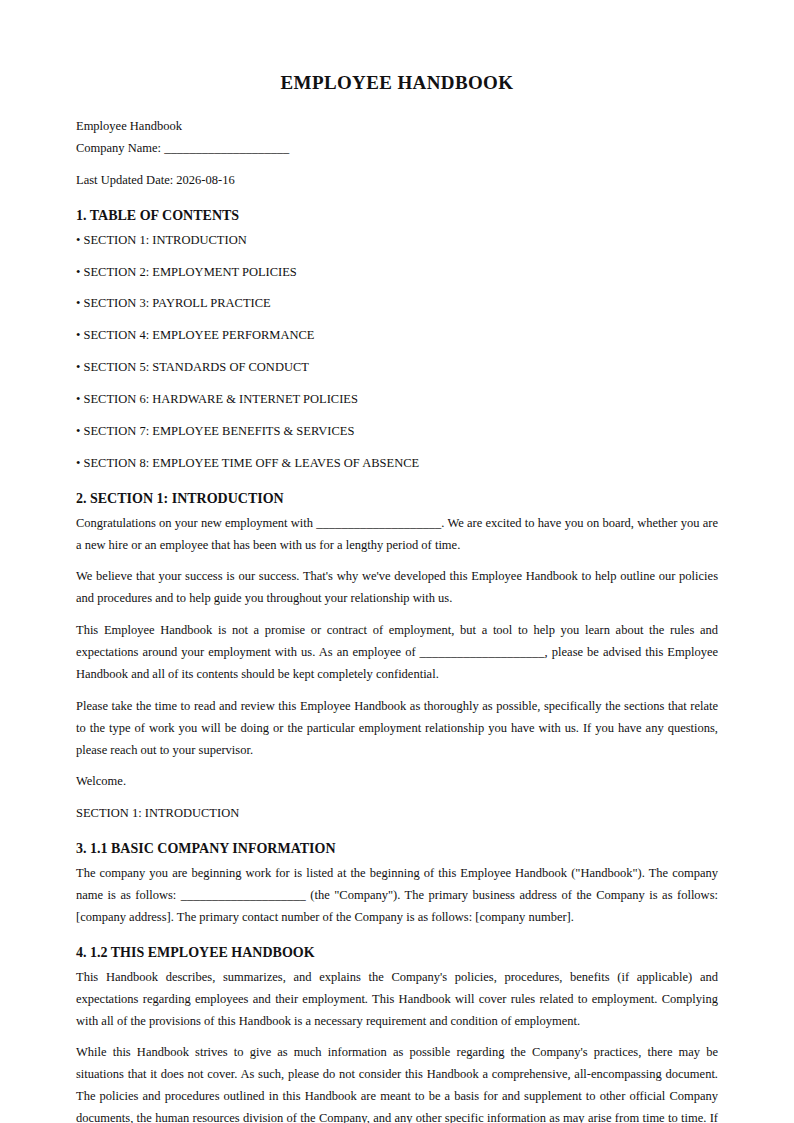
What a employee handbook is
An employee handbook collects the rules and routines of working somewhere into one document.
It is not the employment contract. The contract is the individual agreement setting out that person's terms. The handbook is the shared reference explaining how things work for everybody: when salaries are paid, how leave is requested, what the dress code is, what benefits exist.
That distinction has a practical consequence. A handbook is usually easier to update than a contract, because it is a statement of policy rather than a negotiated term. Employers often want it that way, and it is worth saying in the handbook itself which parts are policy and which are contractual.
For a growing business it is mostly a time saver. The same six questions come from every new hire, and answering them once in writing is more efficient than answering them individually forever.
Who needs one
Businesses past their first few employees, where consistency starts to matter and the founder can no longer answer everything personally.
Companies formalising after a period of informal growth, where different staff have somehow ended up on different arrangements.
Anybody hiring their first human resources person, who will ask for this on day one.
Even a small team benefits, because a written policy is what makes treatment consistent, and inconsistent treatment is where grievances begin.
Before you start
Decide the policies before you document them, since writing down something you have not settled just moves the confusion.
Probation length, and what happens at the end of it.
How often performance is reviewed and by whom.
The payday, exactly.
Annual leave entitlement and how far ahead it must be requested.
Whether you provide health or life cover, and what the arrangement actually is rather than what you hope to offer later.
The walkthrough
Filling in the form, step by step
Every question you will be asked, what it means, and an example of a good answer.
Step 1 of 2
Employee Handbook
The company and the date
The handbook opens with the company identity and the date of the version.
The date is doing more work than it appears. Handbooks are living documents and they get revised, so a dated version tells staff which set of rules applies and lets you show what the policy was at a particular time. That matters if a decision made two years ago is questioned now.
Use the registered company name and address, since the handbook forms part of the employment framework alongside the contract, and the entity should be consistent across both.
A phone number belongs here for the practical reason that handbooks are read by new starters who do not yet know who to ring.
- Date of this Handbook
- The date of this version. Handbooks are revised over time, so dating it tells staff which rules currently apply and lets you demonstrate what the policy was at any given point.
- Name of the Company
- The registered name of the employing company. Keep it consistent with the name on employment contracts, since the two documents work together.
- Registered Address of the Company
- The company's registered or principal office address, so the handbook reads as an official document of the business rather than an internal note.
- Company Phone Number
- A main company number. New starters read this document before they know who to contact about anything, so a general number is genuinely useful here.
Step 2 of 2
Employee Handbook
The policies staff actually ask about
This is the substance, and it is worth answering each question as the business genuinely operates rather than as you would like it to.
Probation and performance review should connect. If probation is three months, somebody should review the person at three months, and the handbook saying so is what makes that happen.
Payday should be an actual date. On or before the 22nd is a policy. Around month end is not, and staff budget around this more closely than employers usually realise.
On leave, two numbers matter: how many days, and how far in advance a request must be made. The second is the one that prevents a team being simultaneously empty in December.
The insurance questions should describe what you actually have in place. A handbook promising group health cover that was never arranged creates an expectation the business will have to answer for, and staff make decisions on the strength of it.
Dress code is minor but frequently disputed, and a sentence here prevents an awkward conversation later.
- Name of the Employee
- The employee receiving this copy. Personalising it records who was issued the handbook and when, which is useful evidence that somebody was told the rules.
- Probation period for employees
- The standard probation length, for example three months. State what happens at the end of it, since a probation nobody formally concludes tends to drift into permanence unnoticed.
- Performance Review
- How often performance is formally reviewed, for example quarterly. Align the first review with the end of probation so the two processes support each other rather than running separately.
- Pay day
- The exact payday, for example the 22nd day of each month. Staff budget around this closely, so give a date rather than a vague reference to month end.
- Leave Days
- Annual paid leave in days. This should match what employment contracts say, since a handbook contradicting the contract creates an argument about which one governs.
- Dress code for all employee
- What staff are expected to wear, for example business casual with formal dress on client meeting days. It is a small policy that prevents an uncomfortable individual conversation.
- Insurance
- Tick the cover the business actually provides. Only tick what is genuinely in place, since staff rely on stated benefits and an unfunded promise is one the business will have to answer for.
- Group Health Insurance
- If you provide health cover, describe it: who is covered, from when, whether dependants are included, and any limits. Vagueness here produces claims staff expect to be met and the policy does not cover.
- Group Life Insurance
- If you provide life cover, describe the benefit and who is eligible. Note that Nigerian employers have separate statutory obligations around group life cover, which are worth confirming rather than assuming this handbook satisfies.
- How many number of days in advance shall an employee submit his/ her application for leave?
- The notice required for a leave request, for example fourteen days. This is what stops an entire team booking the same fortnight, and it should be realistic enough that people actually follow it.
Ready to make yours?
Answer those questions in the builder and download a finished employee handbook in Word and PDF.
Start now, ₦15,000After you download it
Give every employee a copy
Issue it at induction and record that you did. A policy nobody was shown is difficult to rely on when somebody breaches it.
Say what is policy and what is contractual
Policies can be updated; contractual terms cannot be changed unilaterally. Making the distinction clear protects your ability to revise the handbook.
Keep it consistent with the contracts
Where the handbook and the employment contract say different things about leave or notice, you have created an argument about which one wins.
Revise it and date the revision
Reissue when policies change, with a new date. Staff should be able to tell which version applies, and so should you.
Questions people ask
What is the difference between a handbook and an employment contract?
The contract is the individual agreement setting out one person's terms. The handbook is the shared reference explaining how things work for everybody, and it is usually easier to update.
Is an employee handbook legally required in Nigeria?
No, but the Labour Act does require a written statement of particulars of employment within three months, which the contract provides. The handbook supports it rather than replacing it.
Can I change the handbook whenever I like?
Policies, generally yes, with notice. Anything contractual cannot be changed unilaterally, which is why the handbook should say which parts are which.
How much leave notice should I require?
Enough to plan cover, commonly around two weeks for ordinary leave. Make it realistic, since a requirement nobody can meet is one nobody follows.
Should I promise benefits in the handbook?
Only benefits actually in place. Staff rely on what a handbook states, and describing cover that was never arranged creates an expectation the business has to answer for.
Do employees need to sign the handbook?
An acknowledgement of receipt is worth having. It records that the person was given the rules, which matters if they later breach one and say they were never told.
Documents that go with this
Terms used on this page
Employee Handbook
An employee handbook sets out the rules of the workplace: conduct, leave, discipline, grievances and benefits. For a Nigerian employer it is the document that proves a fair process was followed.
Contract of Employment
A contract of employment is the agreement between an employer and an employee setting out the job, the pay and the terms. Nigerian law expects it in writing within three months of starting.
Probation Period
A probation period is an agreed stretch at the start of employment during which either side can end the relationship more easily. In Nigeria it is contractual, and it does not suspend an employee's rights.
Annual Leave
Annual leave is paid time off an employee earns by working. The Labour Act sets a minimum of six working days after twelve months of continuous service, and most Nigerian employers give considerably more.
Sick Leave
Sick leave is paid absence for illness. The Labour Act gives workers within its scope a modest statutory entitlement, and anything beyond that comes from the contract.
Grievance
A grievance is a formal complaint an employee raises about their treatment at work. A written procedure for handling one is what stops a problem becoming a claim.
Pension
Pension in Nigeria is the contributory scheme under the Pension Reform Act, where employer and employee both pay monthly into the employee's retirement savings account.
Employee
An employee works under a contract of service, meaning the employer controls how the work is done. The label on the contract does not decide it, and getting the classification wrong is expensive for the employer.
Read more on this
Employment Contracts: Key Clauses and Compliance Guide
Employment Contracts: Key Clauses and Compliance Guide An employment contract is one of the most important documents in any Nigerian workplace, yet it is also one of the most neglected. Many businesses, especially small…
Difference Between an Offer Letter and an Employment Contract in Nigeria
Difference Between an Offer Letter and an Employment Contract in Nigeria What Is an Offer Letter? An offer letter is a preliminary document issued by an employer to a prospective employee after a successful recruitment p…
11 Essential and Protective Documents Needed by a Startup Company
Business Plan Certificate of Incorporation, Memart, Art. of association, Status Report Founders’ Agreement Service Level Agreements Non-Disclosure Agreement Employee Contracts Intellectual Property Agreements Shareholder…
Step by step guides for every document on LegalDoc
Browse all guides