
How to Write an Employment Contract in Nigeria
Nigerian law requires a written statement of terms within three months of starting. This is that document, and these are the questions behind it.
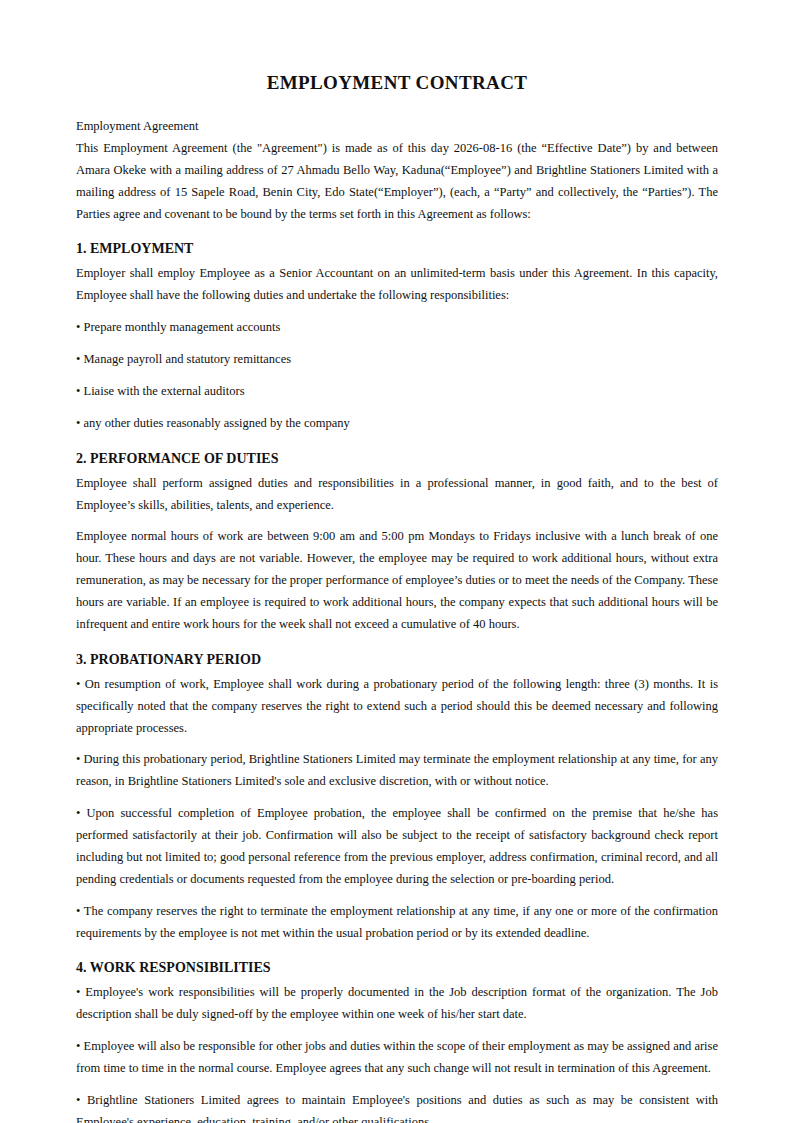
What a employment contract is
An employment contract sets out the terms on which somebody works for you.
It names the parties, the role, the hours, the pay, the leave and the duties, and it fixes the law that governs the relationship.
In Nigeria this is not optional housekeeping. The Labour Act requires an employer to give a worker a written statement of the particulars of employment within three months of the start of the engagement. Businesses that hire on a handshake are behind the law from the first day.
The practical value is separate from the legal duty. Most employment disputes are arguments about what was agreed, and a contract is the answer to that question written down before anybody had a reason to remember it differently.
Who needs one
Any business taking on staff, from the first hire onwards.
Employers formalising people who have been working informally, which is common and worth correcting.
Employees who have been working for months with nothing in writing and want their terms recorded.
If the person is genuinely running their own business and serving other clients, an independent contractor agreement is the correct document instead. Calling somebody a contractor to avoid employment obligations does not work, because the substance of the relationship decides the question rather than the label on the paperwork.
Before you start
Settle the terms of the job first.
The title, and honestly what the role involves day to day.
The hours per week, and whether the role requires more at certain times.
The paid leave entitlement. The Labour Act sets a floor of at least six working days after twelve months of continuous service, and most employers offer well above it.
The salary and when it is paid.
And whether there is a probation period, which is worth agreeing before the person starts rather than after.
The walkthrough
Filling in the form, step by step
Every question you will be asked, what it means, and an example of a good answer.
Step 1 of 3
Employment Contract
The dates and the employer
The contract opens with two dates and the employer's identity, and the two dates do different jobs.
The date of the contract is when it is signed. The start date is when work begins. They are frequently different, and the gap matters: a contract signed in advance gives the employee something to rely on when resigning from another job, which is exactly when they need it.
Name the employing entity properly. If a registered company employs the person, the company is the employer and its registered name belongs here rather than a trading name or a director's name. Employees who sue name the entity on their contract, and an entity that does not exist creates an argument nobody benefits from.
- Date of this contract
- The date the contract is signed. Where the parties sign on different days, use the later one. This is normally earlier than the start date, and issuing it in advance gives the employee something firm before they resign elsewhere.
- Employment start date
- The first day of work. Continuous service runs from here, which matters for leave entitlement, notice periods and any length of service condition later in the relationship.
- Company name
- The registered name of the employing entity, for example Brightline Stationers Limited. Use the name on the certificate of incorporation rather than a trading name, since the entity named here is the one that carries the employment obligations.
- Company address
- The company's registered or principal office address. Formal correspondence about the employment goes here, so it should be current and monitored.
Step 2 of 3
Employment Contract
The employee, the role and the hours
This step describes who is being employed and on what basic terms.
The job title carries more weight than people assume. It signals seniority, it frames what duties can reasonably be assigned, and it appears on references for years afterwards. Choose one that describes the job rather than flattering it.
Hours per week set the baseline for overtime and for what counts as normal working. Where the role genuinely requires evening or weekend work at times, the contract should reflect that rather than stating forty hours and relying on goodwill.
On leave, the Labour Act provides a minimum entitlement after twelve months of continuous service, and it is a low floor. Whatever you offer, state the number here so the position is fixed, and remember that public holidays are separate from annual leave.
- Employee's full name
- The employee's full legal name as it appears on their identification. It should match their bank account and pension records, since a mismatch causes problems with payroll and statutory remittances.
- Employee's address
- The employee's home address. This is where formal correspondence about the employment is sent, including anything relating to discipline or termination, so keep it updated if they move.
- Job title
- The role being filled, for example Senior Accountant. Pick a title that describes the actual job, since it frames what duties can reasonably be assigned and it follows the employee into future references.
- Working hours per week
- Normal working hours per week, for example 40. Where the role genuinely involves evening or weekend work at busy periods, say so rather than stating a figure the job does not respect.
- Paid leave days per year
- Paid annual leave in days. The Labour Act sets a statutory floor after twelve months of continuous service, and most employers offer considerably more. State the figure so it is not a matter of custom later.
Step 3 of 3
Employment Contract
The duties and the governing law
The final step records what the person will actually do and which law applies.
The three duty fields are worth completing with care rather than filling with generalities. Specific duties tell the employee what success looks like and give the employer something concrete to measure against. Where performance later becomes an issue, a contract listing real responsibilities supports the conversation and a vague one does not.
The catch all for other duties is standard and it is not unlimited. It covers duties reasonably assigned within the scope of the role, and it does not entitle an employer to redeploy somebody into a completely different job.
On governing law, use the Nigerian state where the employee actually works. The National Industrial Court has jurisdiction over employment matters in Nigeria, and the contract sitting under Nigerian law is what keeps that route available.
- Main duty
- The main responsibility of the role, for example preparing monthly management accounts. Make it specific enough to measure, because this is the duty everything else is judged against.
- Second duty
- The next significant duty, for example managing payroll and statutory remittances. Naming it prevents the argument later that a core task was never part of the job.
- Third duty
- A third responsibility, for example liaising with external auditors. Three concrete duties give a much clearer picture of the role than a paragraph of general description.
- Any other duties
- The catch all, usually any other duties reasonably assigned by the company. It provides flexibility within the role, and it does not stretch to moving somebody into a substantially different job.
- Which law governs this contract?
- The law governing the contract, normally the Nigerian state where the employee works, for example Lagos State, Nigeria. Employment disputes in Nigeria go to the National Industrial Court, and this keeps the contract within that framework.
Ready to make yours?
Answer those questions in the builder and download a finished employment contract in Word and PDF.
Start now, ₦10,000After you download it
Issue it within three months
The Labour Act requires a written statement of the particulars of employment within three months of the start. Issuing it on day one is better, and it costs nothing extra.
Both sides keep a signed copy
The employee should have their own signed original. An employer holding the only copy is in a weak position when the terms are later disputed.
Register the statutory deductions
Employment brings PAYE, pension contributions and other statutory obligations. The contract is the start of the relationship, not the whole of the compliance.
Update it when the job changes
A promotion, a pay rise or a change of duties should be recorded in writing. Otherwise the contract slowly stops describing the job the person actually does.
Questions people ask
Is a written employment contract required in Nigeria?
The Labour Act requires an employer to give a worker a written statement of the particulars of employment within three months of the start. Hiring on a handshake leaves you behind the law immediately.
How much annual leave must a Nigerian employee get?
The Labour Act sets a statutory minimum after twelve months of continuous service, which is a low floor. Most employers offer considerably more, and whatever you offer should be stated in the contract.
What is the difference between an employee and a contractor?
The substance of the relationship, not the label. Control over how the work is done, integration into the business and exclusivity all point to employment, whatever the document is called.
Can I put someone on probation?
Yes, and the period should be agreed before they start rather than introduced afterwards. State its length and what happens at the end of it.
Which court hears employment disputes in Nigeria?
The National Industrial Court has jurisdiction over employment and labour matters, which is one reason the contract should be governed by Nigerian law.
What happens if the job changes?
Record the change in writing. A contract that no longer describes what the person does is of limited use to either side when something goes wrong.
Documents that go with this
Terms used on this page
Contract of Employment
A contract of employment is the agreement between an employer and an employee setting out the job, the pay and the terms. Nigerian law expects it in writing within three months of starting.
Employee
An employee works under a contract of service, meaning the employer controls how the work is done. The label on the contract does not decide it, and getting the classification wrong is expensive for the employer.
Notice Period
A notice period is how much warning either side must give before ending an employment. The Labour Act sets minimums based on length of service, and the contract can give more but not less.
Gratuity
Gratuity is a lump sum paid to an employee on leaving after long service. In Nigeria it is contractual rather than automatic, so whether you get it depends on what your contract or handbook says.
Probation Period
A probation period is an agreed stretch at the start of employment during which either side can end the relationship more easily. In Nigeria it is contractual, and it does not suspend an employee's rights.
Termination
Termination is the ending of a contract on its terms. In employment it means the relationship ends, normally with notice or payment in lieu, and it does not imply that anybody did anything wrong.
Annual Leave
Annual leave is paid time off an employee earns by working. The Labour Act sets a minimum of six working days after twelve months of continuous service, and most Nigerian employers give considerably more.
Pension
Pension in Nigeria is the contributory scheme under the Pension Reform Act, where employer and employee both pay monthly into the employee's retirement savings account.
Read more on this
Employment Contracts: Key Clauses and Compliance Guide
Employment Contracts: Key Clauses and Compliance Guide An employment contract is one of the most important documents in any Nigerian workplace, yet it is also one of the most neglected. Many businesses, especially small…
Difference Between an Offer Letter and an Employment Contract in Nigeria
Difference Between an Offer Letter and an Employment Contract in Nigeria What Is an Offer Letter? An offer letter is a preliminary document issued by an employer to a prospective employee after a successful recruitment p…
11 Essential and Protective Documents Needed by a Startup Company
Business Plan Certificate of Incorporation, Memart, Art. of association, Status Report Founders’ Agreement Service Level Agreements Non-Disclosure Agreement Employee Contracts Intellectual Property Agreements Shareholder…
Step by step guides for every document on LegalDoc
Browse all guides