
How to Write an Independent Contractor Agreement
This is the agreement for somebody who works for you without being your employee. Get the substance right, because the label alone does not decide it.
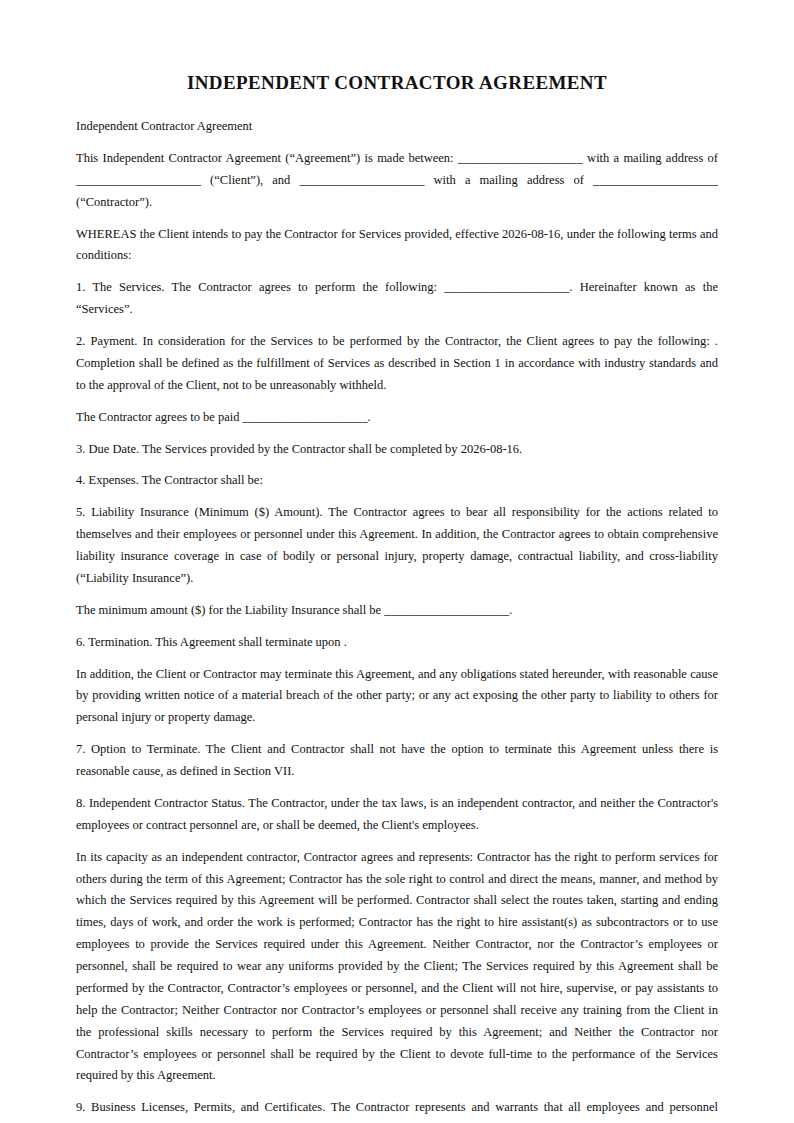
What a independent contractor agreement is
An independent contractor agreement engages somebody to deliver a service without making them an employee.
The contractor runs their own business. They decide how the work is done, supply their own equipment, take other clients, and handle their own tax and pension. In exchange they receive none of the protections an employee gets: no notice entitlement beyond the contract, no leave, no severance.
The critical point is that this status is determined by how the relationship actually works, not by the title on the document. A person who works set hours, uses your equipment, takes daily direction and has no other clients is an employee whatever the agreement calls them.
Getting that wrong is expensive. Misclassification exposes a business to unpaid PAYE, pension contributions and employment claims from somebody it believed was a contractor.
Who needs one
Businesses engaging specialists for defined work: developers, designers, trainers, technicians and installers.
Companies using contractors for project work or seasonal peaks.
Contractors who want their independence recorded, since it protects their own position on tax and on working for other clients.
Where the person will work under your direction on your premises indefinitely, an employment contract is the honest document. Where the engagement is a short defined project for an individual, a freelance agreement is usually simpler.
Before you start
Be clear about four things.
The service, defined by outcome rather than by hours, since directing the method points towards employment.
How payment is structured, and whether it is monthly, fixed or commission based.
Who pays expenses, which is a real cost that surfaces later if unstated.
And whether the contractor needs insurance, particularly where they will be on your premises or handling anything of value.
The walkthrough
Filling in the form, step by step
Every question you will be asked, what it means, and an example of a good answer.
Step 1 of 4
Independent Contractor Agreement
The client, the contractor and the date
The agreement names both businesses, and the second word there matters.
A contractor is a business, even where it is one person. Where they trade through a registered company or business name, use it, because contracting with an entity rather than an individual supports the independence the arrangement depends on.
The client should be the entity paying. Contracting in a director's personal name when the company is engaging the contractor creates a confusion about who owes the fee.
Date it from when the arrangement genuinely begins. Where a contractor has already been working informally, that history is relevant to their status, so do not paper over it with a later date.
- Client's Name
- The business engaging the contractor, using the registered company name. This should be the entity that pays the invoices, since it is the party carrying the obligations under the agreement.
- Client's Address
- The client's business address, used for notices and for the contractor's invoicing records.
- Contractor's Name
- The contractor, named as they trade. Where they operate through a registered company or business name, use that rather than the individual, since contracting with a business supports the independent status the arrangement relies on.
- Contractor's Address
- The contractor's business address. A contractor with a business address separate from your premises is one more indicator that the arrangement is genuinely independent.
- Agreement Date
- When the agreement takes effect. Where the contractor has already been working for you informally, use the honest date, since that history is relevant if their status is ever examined.
Step 2 of 4
Independent Contractor Agreement
The service, the money and the deadline
This step describes what is being bought and how it is paid for.
Describe the service by result rather than by activity. Deliver a working inventory module tested against the current stock file is an outcome. Work on the software system Monday to Friday is a job description, and describing the engagement that way undermines the independence the agreement is meant to establish.
The payment structure has the same effect. A monthly amount looks like a salary and, on its own, is one of the things that makes a contractor arrangement look like employment. It is not fatal, particularly for a long retained engagement, but a fixed fee tied to deliverables or a commission is cleaner where the work allows it.
Set the completion date against the deliverable rather than the calendar where you can, and make it conditional on anything you have to supply.
- Description of the Service
- What the contractor will deliver, described by outcome rather than by daily activity. Defining the result supports their independence; describing the hours they will work undermines it and points towards employment.
- Payment arrangement
- Choose how payment is structured. A fixed fee or commission reads as genuinely contractual. A monthly amount resembles a salary and, combined with other factors, is one of the things that makes an arrangement look like employment.
- Amount per month?
- If paying monthly, the amount. Use this for genuinely retained engagements, and be aware that a fixed monthly sum paid indefinitely is among the strongest indicators that a relationship is really employment.
- How much is the fixed fee?
- If paying a fixed fee, the total for the whole engagement. State whether it includes expenses and any applicable tax, since those assumptions differ between parties and surface at invoicing.
- How much is the commission?
- If paying commission, the rate and what it is calculated on, and when it is earned. Commission arrangements need a clear trigger, otherwise the argument is about whether the contractor caused the result.
- When would the contractor be paid?
- The payment terms, for example within fourteen days of invoice. Contractors carry their own cash flow with no salary behind them, so realistic terms here are part of getting good ones to work with you.
- Completion Date for the service.
- When the work is due. Tie it to the deliverable where you can, and make it conditional on anything the client must supply, since projects run late most often because material never arrived.
Step 3 of 4
Independent Contractor Agreement
Expenses, insurance and how it ends
This step allocates cost and risk, and the expenses question is worth more attention than it usually gets.
A contractor bearing their own expenses is behaving like a business, which supports the classification. A client covering everything looks more like an employer. Beyond the classification point it is simply a real cost: travel, materials and software licences add up, and an unstated position means an argument at the first invoice.
Liability insurance is the risk answer. Where the contractor will be on your premises, handle equipment or do anything that could cause loss, requiring cover protects you against being the only solvent party when something goes wrong. Set an amount proportionate to the work rather than a figure that prices small contractors out.
On termination, ending on completion suits a defined project and a fixed date suits a retained arrangement. Either way it should be stated, since an agreement with no end is one nobody can leave cleanly.
- Who shall be responsible for the expenses?
- Choose who bears costs such as travel, materials and software. A contractor carrying their own expenses is behaving as a business, which supports their independent status as well as settling a real cost.
- The contractor
- If the contractor bears expenses, list what that covers so there is no argument at the first invoice: travel, equipment, materials, software licences, and anything else the work requires.
- The Client
- If the client bears expenses, state which ones, whether prior approval is needed, and any cap. An open ended commitment to reimburse is one you will regret on a long engagement.
- Liability Insurance Amount
- The cover the contractor must hold. Require it where they will be on your premises, handle equipment, or do work that could cause loss. Set a figure proportionate to the risk rather than one that excludes smaller contractors.
- Termination
- Choose whether the agreement ends on completion of the service or on a fixed date. Completion suits a defined project; a fixed date suits a retained arrangement with ongoing work.
- completion
- If ending on completion, describe what completion means. Delivery, acceptance and final payment are different moments, and saying which one ends the agreement prevents a disagreement about when obligations stopped.
- Termination Date
- If ending on a fixed date, state it. Set it far enough out to allow for final invoicing, since an agreement that expires on the delivery date leaves no framework for collecting payment.
Step 4 of 4
Independent Contractor Agreement
Anything else, and the governing law
The final step is a free text box and a choice of law, and the box is more useful than it looks.
This form does not ask about intellectual property, and for most contractor work that is the single most important omission. Without a term saying otherwise, the position on who owns what the contractor produces is not what most clients assume. If the client is paying for software, designs or written material and expects to own them, say so here.
Other things worth adding: confidentiality, whether the contractor may subcontract, and whether they may work for competitors during the engagement.
On governing law, name the Nigerian state where the work is done or where the client is based. Contractual disputes go to the ordinary courts rather than the National Industrial Court, which is another consequence of the arrangement being contractual rather than employment.
- Additional Terms
- Use this for anything the form has not asked. Intellectual property is the important one: if the client is to own the software, designs or material produced, say so here, because the default position is not what most clients assume. Confidentiality, subcontracting and working for competitors also belong here.
- Governing Law of what state?
- Which Nigerian law applies, for example Lagos State. Because this is a commercial contract and not employment, any dispute goes to the ordinary courts rather than the National Industrial Court.
Ready to make yours?
Answer those questions in the builder and download a finished independent contractor agreement in Word and PDF.
Start now, ₦10,000After you download it
Let the contractor control the method
The agreement is only worth what the working relationship supports. Directing daily activity and setting hours turns a contractor into an employee whatever the document says.
Deal with intellectual property
The form does not ask, so add it. Who owns the work produced is the question that surfaces later, usually when the relationship has already ended.
Deduct withholding tax correctly
Payments to contractors commonly attract withholding tax, and the client is responsible for deducting and remitting it. Get this right from the first invoice.
Keep the invoices
A contractor invoicing you is behaving like a business. That paper trail is part of what demonstrates the arrangement was genuinely contractual.
Questions people ask
What is the difference between a contractor and an employee?
The substance of the relationship. Control over how the work is done, set hours, your equipment and no other clients all point to employment, whatever the agreement is titled.
What happens if I misclassify a contractor?
Exposure to unpaid PAYE and pension contributions, and potentially employment claims from somebody you treated as a contractor. It is one of the more expensive mistakes a growing business makes.
Should I pay a contractor monthly?
You can, but a fixed monthly sum paid indefinitely resembles a salary and is among the indicators that a relationship is really employment. A fee tied to deliverables is cleaner where the work allows.
Who owns the work a contractor produces?
Not automatically the client, which surprises people. If you are paying for software, designs or written material and expect to own it, put that in the additional terms.
Do I deduct tax from a contractor's payment?
Payments to contractors commonly attract withholding tax, which the client deducts and remits. Confirm the applicable rate for the type of service rather than assuming.
Should a contractor carry insurance?
Where they will be on your premises, handle equipment or do work that could cause loss, yes. Otherwise you may be the only solvent party when something goes wrong.
Documents that go with this
Terms used on this page
Independent Contractor
An independent contractor is engaged to deliver work under a contract for services rather than employed under a contract of service. They control how the work is done and carry their own tax and risk.
Contract of Employment
A contract of employment is the agreement between an employer and an employee setting out the job, the pay and the terms. Nigerian law expects it in writing within three months of starting.
Withholding Tax
Withholding tax is tax deducted at source from certain payments and remitted to the tax authority by the payer. It is an advance payment of the recipient's tax, not an extra charge.
Vicarious Liability
Vicarious liability makes an employer answerable for wrongs their employee commits at work, even where the employer did nothing wrong. It is why the classification of workers matters commercially.
Indemnity
An indemnity is a promise to cover somebody else's loss if a defined thing goes wrong. It is a primary obligation, which makes it stronger than a guarantee and heavier to give.
Insurance
Insurance is paying a premium so somebody else carries a risk you cannot afford to carry yourself. It is a contract of utmost good faith, which means what you did not disclose matters as much as what you did.
Work for Hire
Work for hire is the question of who owns something created by somebody you paid. For employees the answer usually favours the employer. For freelancers it usually does not.
Outsourcing
Outsourcing is paying another business to perform a function instead of doing it in house. In Nigeria it is used heavily for staffing, and the National Industrial Court looks at who really employs the worker.
Read more on this
The Unpopular but Essential Document Called a Consulting Agreement in Nigeria
The Unpopular but Essential Document Called a Consulting Agreement Most business relationships don’t fall apart at the beginning—they unravel somewhere in the middle. At the start, everything feels clear. The consultant…
Employment Contracts: Key Clauses and Compliance Guide
Employment Contracts: Key Clauses and Compliance Guide An employment contract is one of the most important documents in any Nigerian workplace, yet it is also one of the most neglected. Many businesses, especially small…
Service Level Agreements: What Small Businesses Need to Avoid Disputes
Service Level Agreements: What Small Businesses Need to Avoid Disputes Running a small business in Nigeria often involves working with other businesses, vendors, consultants, freelancers, and service providers. A graphic…
Step by step guides for every document on LegalDoc
Browse all guides