
How to Write a Job Offer Letter
An offer letter is what a candidate reads before resigning from their current job. Make it complete enough that they can decide on it.
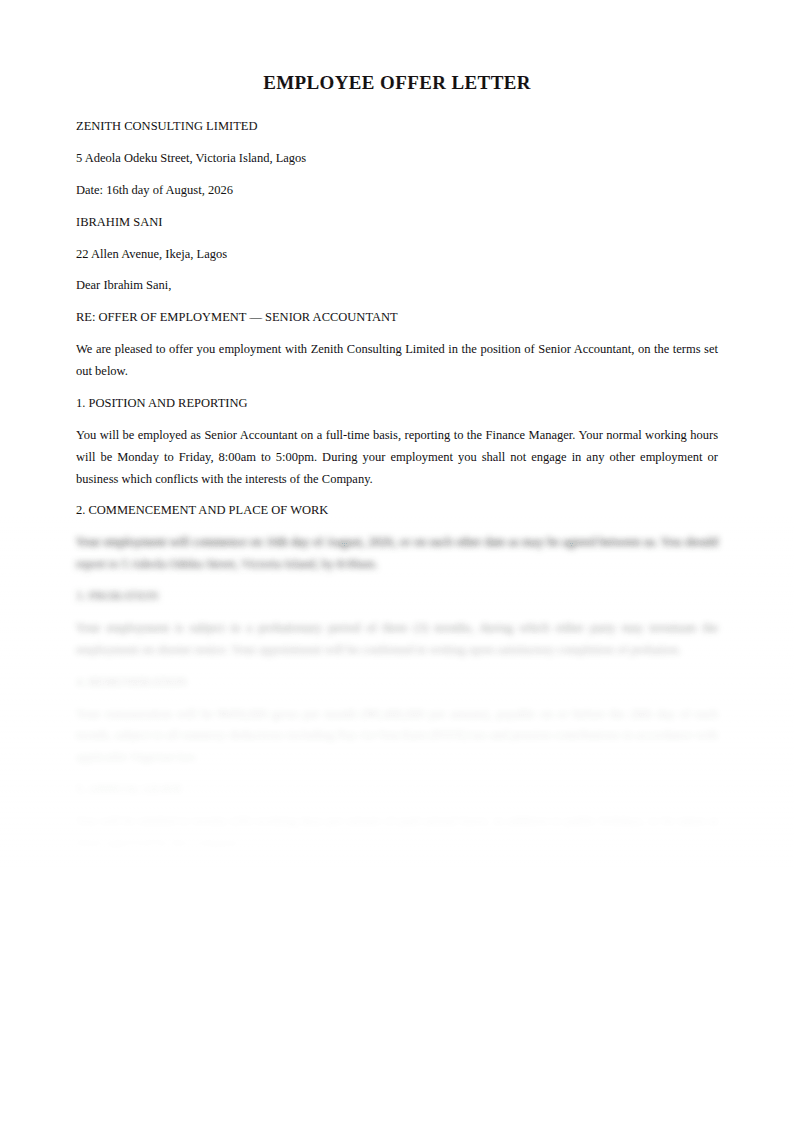
What a employee offer letter is
An offer letter is the document extending a job to a candidate, on stated terms, for them to accept or decline.
It comes before the employment contract and does a different job. The contract governs the relationship once it begins; the offer is what persuades somebody to leave a job they already have.
That is worth remembering while writing it. A candidate is about to resign on the strength of this letter, so anything material and unstated is a problem waiting to surface in the first month.
An accepted offer letter creates a binding agreement in itself, which is why the terms in it should match the contract that follows rather than differing from it.
Who needs one
Employers making an offer to a chosen candidate.
Businesses that want the terms fixed in writing before the person resigns elsewhere, so there is no argument about what was promised.
Anybody who has previously made a verbal offer and had a candidate arrive expecting a different salary.
The offer letter and the employment contract are separate documents. Issue the offer, get acceptance, then issue the contract on matching terms.
Before you start
Have the package finalised and approved internally before you send anything.
The salary, gross, and when it is paid.
Whether there is a probation period and how long.
The reporting line, the hours, and where the person actually works.
Any bonus, and whether it is discretionary or contractual, which is a meaningful difference.
And the date the offer lapses, because an open ended offer leaves you holding a role for a candidate who is using it to negotiate elsewhere.
The walkthrough
Filling in the form, step by step
Every question you will be asked, what it means, and an example of a good answer.
Step 1 of 3
Employee Offer Letter
The candidate, the role and your company
The opening step names who is being offered what, and by whom.
Use the candidate's name exactly as they gave it on their application, since this letter tends to become the reference point for their personnel file, payroll and pension registration.
The job title should match what you intend to put in the contract. Candidates notice a discrepancy between the title in the offer and the title in the contract, and it starts the relationship with a question about whether the employer is being careless or clever.
Name your company by its registered name. This is a document a candidate may rely on to resign from another job, so it should identify the employer without ambiguity.
- Candidate's full name
- The candidate's full name as given on their application and identification. This letter usually seeds the personnel file, payroll and pension records, so accuracy here saves administrative work later.
- Candidate's address
- The candidate's home address, where the offer is sent. It also confirms the commute the candidate is accepting, which is worth both sides being clear about.
- Job title being offered
- The job title being offered, for example Senior Accountant. Keep it identical to the title that will appear in the employment contract, since candidates notice when the two differ.
- Company address
- The company's address. Where the candidate will work somewhere else, that location is asked separately below, so this is the company's own address.
- Your company name
- Your registered company name, for example Zenith Consulting Limited. The candidate may resign from another job on the strength of this letter, so the employer should be identified precisely.
Step 2 of 3
Employee Offer Letter
Start date, terms and salary
This is the step a candidate reads first and most carefully, because it contains the answer to whether they will take the job.
Be complete on money. State the gross salary and the period, and say when it is paid. A candidate seeing a monthly figure needs to know whether it is gross or net, because in Nigeria the difference after PAYE and pension is substantial and an unpleasant surprise on the first payslip damages the relationship immediately.
Probation should be stated plainly: how long, and what happens at the end. Candidates rarely object to a probation period; they object to discovering one they were not told about.
The reporting line matters more than employers think. Who somebody reports to tells them where the role sits, and a candidate who accepts expecting to report to the Finance Manager and arrives reporting to an assistant has been misled, whether or not anybody intended it.
- Start date
- The proposed first day. Allow for the candidate's notice period at their current employer, which in Nigeria is commonly a month, and confirm the date once they have accepted rather than assuming it.
- Probation period
- How long probation lasts, for example three months. State it here rather than leaving it to the contract, because a candidate who learns about probation after resigning elsewhere has a fair grievance.
- Is this full-time or part-time?
- Choose which applies. It affects hours, pay basis and how leave accrues, so it should be settled in the offer rather than negotiated after the person starts.
- Who will they report to?
- Who the person answers to, for example the Finance Manager. Give the role rather than only a name, since people move on and the reporting line is what tells a candidate where the job actually sits in the business.
- Full time
- If full time, set out what that means here: the standard working week and any expectation of additional hours at busy periods. Being straightforward now prevents resentment later.
- Part time
- If part time, state the days or hours expected and how pay is calculated. Part time arrangements go wrong most often because the pattern was never written down.
- Working hours
- The working pattern, for example Monday to Friday, 8:00am to 5:00pm. Include any shift or weekend requirement, since a candidate is entitled to know the shape of the week before accepting.
- Where should they report on day one?
- Where the person reports on day one and where they will normally work. Where the role is hybrid or remote, say so here, because commute is one of the things candidates weigh most heavily.
- Salary
- The salary, stated as gross and with the period, for example a gross monthly figure with the annual equivalent. Say plainly that it is gross, since the difference after PAYE and pension deductions surprises people otherwise.
- When is salary paid?
- The pay date, for example on or before the 28th of each month. Candidates budget around this, and a vague answer is a poor start to the relationship.
Step 3 of 3
Employee Offer Letter
Leave, bonus, notice and the offer deadline
The final step covers the remaining terms and closes the offer.
On bonus, the word discretionary is doing real work. A discretionary bonus is a possibility; a contractual one is an entitlement the employee can enforce. Employers frequently write the first and behave as though they promised the second, which creates an expectation that is expensive to disappoint. Say which you mean.
The notice period after confirmation should match the employment contract. A month is common in Nigeria for salaried roles, and it cuts both ways: the same period the employee must give is the period they are entitled to receive.
The expiry date protects you. Without it an offer sits open indefinitely while a candidate negotiates with somebody else using your letter as leverage. Two weeks is usually enough for a considered decision.
- Annual leave
- Annual paid leave, for example twenty working days per annum. State whether public holidays are additional, since they are separate from annual leave and candidates assume differently.
- Is a bonus offered?
- Answer Yes only if a bonus genuinely forms part of the package. A vague suggestion of one creates an expectation you may not intend to be held to.
- Describe the bonus
- If yes, describe it and be explicit about whether it is discretionary or contractual. A discretionary bonus is a possibility; a contractual one is an entitlement, and the difference matters when the year is difficult.
- Who is signing the offer?
- Who signs the offer and their role, for example the Head of Human Resources. Signing at an appropriate level tells the candidate the offer is authorised rather than provisional.
- Date of this letter
- The date the offer is issued. It is the reference point for the expiry date below, so the two should be consistent.
- Notice period after confirmation
- The notice required once employment is confirmed, for example one month. Keep it identical to the employment contract, and remember it binds the employer as much as the employee.
- Offer valid until
- When the offer lapses if not accepted. Two weeks is usually sufficient. Without a deadline the role stays held open while the candidate negotiates elsewhere using your letter.
Ready to make yours?
Answer those questions in the builder and download a finished employee offer letter in Word and PDF.
Start now, ₦5,000After you download it
Get the acceptance in writing
A signed and returned copy, or a clear written acceptance. An accepted offer is a binding agreement, and you want evidence of the moment it was accepted.
Issue the contract on matching terms
The employment contract should reflect what the offer said. Terms that quietly change between the two are the fastest way to lose a new hire's trust.
Do not withdraw casually
A candidate who has resigned in reliance on an accepted offer is in a serious position if you pull it. Treat an accepted offer as a commitment.
Start the onboarding paperwork
Pension registration, tax details and bank information all take time. Beginning them at acceptance rather than on day one avoids a delayed first salary.
Questions people ask
What is the difference between an offer letter and an employment contract?
The offer extends the job on stated terms for the candidate to accept. The contract governs the relationship once it begins. Both should say the same things.
Is an offer letter legally binding in Nigeria?
An accepted offer creates a binding agreement, which is why the terms in it should match the contract that follows rather than differing from it.
Should the salary be stated as gross or net?
State it as gross and say so. In Nigeria the difference after PAYE and pension deductions is substantial, and a candidate who assumed net is disappointed on the first payslip.
Can I withdraw a job offer?
Before acceptance, generally yes. After acceptance it is a commitment, and a candidate who has already resigned in reliance on it is in a strong position to complain.
How long should an offer stay open?
Around two weeks is usually enough for a considered decision. Without an expiry date, the role stays held while the candidate negotiates elsewhere using your offer.
Is a bonus discretionary or guaranteed?
Whichever you say it is, so say. A discretionary bonus is a possibility, a contractual one is an entitlement, and writing the first while behaving like the second creates a problem.
Documents that go with this
Terms used on this page
Offer Letter
An offer letter is the document offering somebody a job, stating the role, the pay and the start date. Once accepted it can be a binding contract, which is why what it leaves out matters.
Contract of Employment
A contract of employment is the agreement between an employer and an employee setting out the job, the pay and the terms. Nigerian law expects it in writing within three months of starting.
Probation Period
A probation period is an agreed stretch at the start of employment during which either side can end the relationship more easily. In Nigeria it is contractual, and it does not suspend an employee's rights.
Notice Period
A notice period is how much warning either side must give before ending an employment. The Labour Act sets minimums based on length of service, and the contract can give more but not less.
Employee
An employee works under a contract of service, meaning the employer controls how the work is done. The label on the contract does not decide it, and getting the classification wrong is expensive for the employer.
Annual Leave
Annual leave is paid time off an employee earns by working. The Labour Act sets a minimum of six working days after twelve months of continuous service, and most Nigerian employers give considerably more.
PAYE
PAYE, Pay As You Earn, is the system by which your employer deducts income tax from your salary each month and remits it to your state revenue service. The obligation to remit is the employer's, not yours.
Pension
Pension in Nigeria is the contributory scheme under the Pension Reform Act, where employer and employee both pay monthly into the employee's retirement savings account.
Read more on this
Difference Between an Offer Letter and an Employment Contract in Nigeria
Difference Between an Offer Letter and an Employment Contract in Nigeria What Is an Offer Letter? An offer letter is a preliminary document issued by an employer to a prospective employee after a successful recruitment p…
Employment Contracts: Key Clauses and Compliance Guide
Employment Contracts: Key Clauses and Compliance Guide An employment contract is one of the most important documents in any Nigerian workplace, yet it is also one of the most neglected. Many businesses, especially small…
11 Essential and Protective Documents Needed by a Startup Company
Business Plan Certificate of Incorporation, Memart, Art. of association, Status Report Founders’ Agreement Service Level Agreements Non-Disclosure Agreement Employee Contracts Intellectual Property Agreements Shareholder…
Step by step guides for every document on LegalDoc
Browse all guides