
How to Write Terms and Conditions
Terms and conditions are the contract between you and everybody who uses your site or app. Below, every question on the form, in order, with the reasoning behind it.
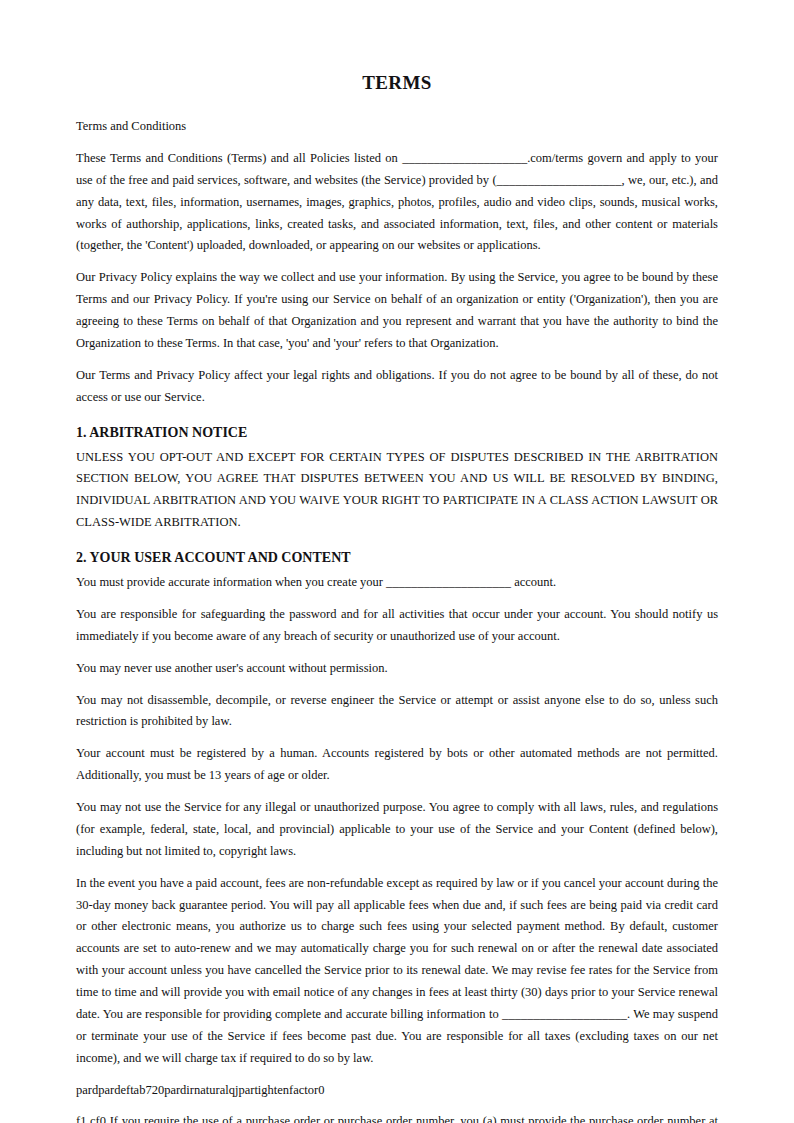
What a terms is
Terms and conditions are the agreement a visitor accepts when they use your website or app.
They set out what people may and may not do, what you promise and what you do not, who owns the content, how disputes get handled, and when you can suspend somebody.
The name varies. Terms of service, terms of use, user agreement: they are the same document doing the same job.
Without them, the relationship between you and your users is governed by whatever a court decides was implied. With them, it is governed by what you wrote down and they accepted.
Who needs one
Anybody running a website or app where people do more than read.
Stores taking orders and payments. Platforms where users create accounts. Anything with subscriptions or free trials. Sites carrying user submitted content.
Payment processors ask to see them before approving a merchant account, and app stores require a terms link at review.
Even a simple brochure site benefits, because the sections limiting liability and protecting your content are worth having before somebody tests them.
Before you start
Settle four questions before you open the form.
Whether users can register accounts, because that brings suspension and termination into play.
Whether you sell anything, and whether it is physical, digital or both.
Whether you run subscriptions or free trials, since automatic renewal is the clause customers complain about most.
And which country's law you want to govern the agreement, which is usually where your business actually operates.
The walkthrough
Filling in the form, step by step
Every question you will be asked, what it means, and an example of a good answer.
Step 1 of 4
Terms
Website or app
The opening question sets the vocabulary for everything that follows.
Terms written for a website talk about visitors, pages and browsing. Terms written for an app talk about users, devices, installation and the app stores you distribute through. App terms also need to sit alongside the store's own rules, which apply on top of yours and which you cannot override.
If you run both a site and an app on the same business, choose the surface where people actually transact and link the same terms from the other.
- Terms and Conditions for?
- Choose Website if people reach you through a browser, including a Shopify or WordPress store. Choose App if this covers a mobile application distributed through an app store. Where you have both, pick the one carrying the transactions and link the same document from the other.
Step 2 of 4
Terms
Your address on the web, and your country
These two answers pin the terms to a real place.
The country is the important one. It decides which law governs the agreement and which courts hear a dispute, and it should be where your business genuinely operates rather than wherever you would prefer to be sued.
Naming a country you have no connection to is a common mistake in copied templates. A Nigerian business running terms that name Delaware has an agreement its own customers cannot practically enforce and that it cannot practically rely on either.
- What is your website URL?
- The address people actually visit, for example www.yourbusiness.com. Use the live domain rather than a staging or admin address. For an app with no website, use your store listing or landing page.
- Enter the Country
- The country whose law will govern these terms, normally where your business operates from. A Nigerian business should enter Nigeria. This decides which courts hear a dispute, so it should reflect reality rather than aspiration.
Step 3 of 4
Terms
Who the agreement is with
Terms are a contract, and a contract needs two identifiable parties. This step names your side of it.
Getting this right matters more than it looks. If your terms name a business that does not exist, or a trading name rather than the registered company, the person on the other side can reasonably ask who they actually contracted with. That is an awkward question to face in a dispute over a refund.
Use the entity that takes the money and issues the receipts.
- Pick One
- Choose I am a Business or Startup where the site is operated through a registered business name or company. Choose I am an Individual if you operate in your own name. Answer honestly, because claiming a registration you do not hold is a misrepresentation inside your own contract.
- Name of Business/ Startup
- The registered name of the entity behind the site, for example Lumen Digital Limited. If you trade under a different name, use the registered one here so the contracting party matches the entity that invoices customers.
- Address of Business
- A real address for the business, with street, city and state. This is where formal notices under the terms would be sent, so use somewhere post is genuinely received rather than a placeholder.
Step 4 of 4
Terms
What people can do on your site
This step decides which sections your terms actually contain. Each answer switches on a block of wording, so answer for the site you run today rather than the one you are planning.
Accounts bring in registration, password responsibility, suspension and termination. Selling brings in orders, pricing, availability and the interaction with your refund policy. Subscriptions bring in renewal and cancellation, which is where most consumer complaints start.
Free trials deserve particular care. A trial that rolls into a paid subscription without a clear warning is the single most complained about pattern in online commerce, and consumer protection regulators look at it closely. If you offer one, say plainly in your terms when it ends and what happens next.
- Do you offer subscription plans?
- Answer Yes if customers pay you on a recurring basis, whether monthly or annually. This adds wording on renewal, price changes and how a customer cancels. Answer No for one off purchases only.
- Can visitors/ users buy goods (physical, digital)?
- Answer Yes if anything is sold through the site, physical or digital. This brings in ordering, pricing, availability and delivery, and connects the terms to your refund and shipping policies.
- Can visitors/users create accounts?
- Answer Yes if people register and log in. This adds the sections on account security, acceptable use, and your right to suspend or close an account that breaches the terms.
- How can visitors/users contact you as regards your terms and conditions
- Tick every channel you will genuinely monitor. You can pick more than one. This is the address for formal notices under the agreement, so an unwatched channel here is worse than one fewer option.
- Phone No.
- A number that reaches you, if you ticked phone. Include the country code where you have customers abroad, for example +234 801 234 5678. Use a business line rather than a personal one you screen.
- The address for questions about the terms, if you ticked email. Something like legal@yourbusiness.com or support@yourbusiness.com reads better than a personal address and survives a change of staff.
- Link
- The page people should use to reach you, if you ticked that option, for example www.yourbusiness.com/contact. Test the link before you publish, because a dead contact link inside a contract is a bad look.
- Do you offer free trials?
- Answer Yes if people can use the service free before paying. The terms then explain how long the trial runs, what happens when it ends, and how to cancel before being charged. Be generous with clarity here; it prevents chargebacks.
Ready to make yours?
Answer those questions in the builder and download a finished terms in Word and PDF.
Start now, ₦5,000After you download it
Link them where people accept them
Put the link in your footer, and at signup and checkout next to the button people click. Terms nobody was shown before agreeing are much harder to rely on later.
Record acceptance
A tick box that says the user agrees, with the date stored against the account, is worth far more than a link buried in a footer if you ever need to prove somebody accepted.
Keep them next to your other policies
Terms, privacy, refunds and shipping work as a set and refer to each other. Publish them together so a customer answering one question does not have to hunt for the next.
Revisit when the business changes
Adding subscriptions, accounts or a new product type changes what your terms need to cover. Update them at that point rather than at the point somebody complains.
Questions people ask
How do I write terms and conditions for a website?
Decide four things first: whether users create accounts, whether you sell anything, whether you run subscriptions or free trials, and which country's law governs. Those answers determine which sections the document needs.
Are terms and conditions legally binding?
They can be, provided the user had a genuine opportunity to read and accept them before using the service. Terms shown at signup or checkout are far stronger than a link hidden in a footer.
What is the difference between terms and conditions and terms of service?
Nothing meaningful. Terms of service, terms of use and user agreement all describe the same document. Pick one name and use it consistently across the site.
Do I need terms and conditions for a small business?
If people can buy, register or submit anything, yes. Payment processors commonly ask for them before approving a merchant account, and app stores require a terms link at review.
Which country should govern my terms?
Normally the one your business actually operates from. A Nigerian business naming a foreign jurisdiction in copied terms creates an agreement neither side can practically enforce.
Do free trials need special wording?
Yes. Say clearly when the trial ends, what happens next, and how to cancel before being charged. Trials that roll silently into paid subscriptions generate most consumer complaints in this area.
Documents that go with this
Terms used on this page
Unfair Contract Terms
Unfair contract terms are provisions in a consumer agreement that are unreasonable or one sided. Nigerian consumer protection law allows them to be challenged even though the consumer signed.
Consumer Protection
Consumer protection law gives buyers rights against sellers: honest information, safe goods, and redress when something is wrong. In Nigeria it is enforced by the FCCPC.
Limitation of Liability
A limitation of liability clause caps what a party can be made to pay and excludes defined categories of loss. Between businesses it is enforceable, and it is the clause that decides the real risk in a contract.
Indemnity
An indemnity is a promise to cover somebody else's loss if a defined thing goes wrong. It is a primary obligation, which makes it stronger than a guarantee and heavier to give.
Data Protection
Data protection is the law governing how you collect, store and use other people's personal information. In Nigeria it is the Nigeria Data Protection Act 2023, and it applies to far smaller businesses than most owners assume.
Intellectual Property
Intellectual property is the legal ownership of things you create rather than things you can touch, including trademarks, copyright, patents and designs. In Nigeria each type has its own registry and its own rules.
Read more on this
What Should I Write in My Terms and Conditions? Guide and Template
What Should I Write in My Terms and Conditions Most people see terms and conditions as a long legal document sitting at the bottom of a website. Many users click “agree” without reading it. Yet behind that simple checkbo…
NDPA 2023: Why Every Nigerian Website — Even Your Instagram Shop — Now Needs a Privacy Policy
The Nigeria Data Protection Act 2023 (NDPA) is not theoretical. It is being enforced. And if you run any business that collects personal data from Nigerians...
Where to Get Legal Documents Online in Nigeria
Where to Get Legal Documents Online in Nigeria Running a business or managing personal affairs often requires legal documentation. Whether you are starting a company, hiring a freelancer, creating a partnership agreement…
Step by step guides for every document on LegalDoc
Browse all guides