
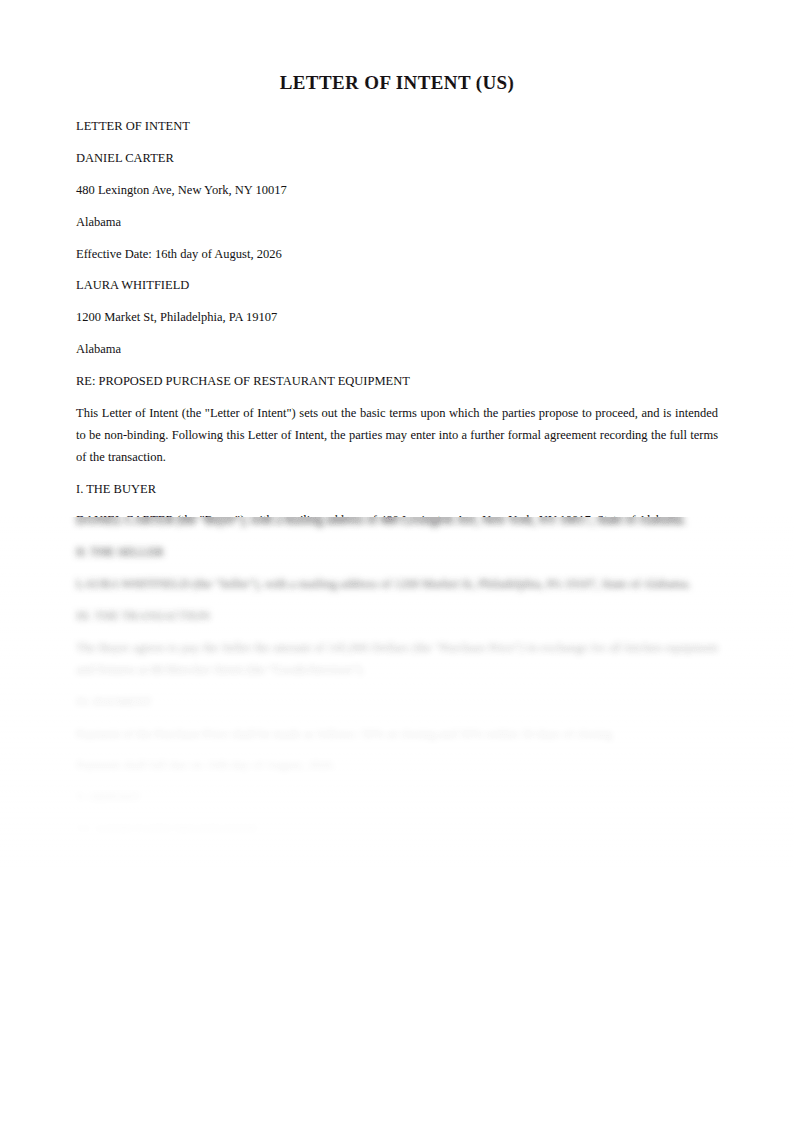
Letter of Intent (United States Form)
This is the United States version of a letter of intent, a document recording what two parties have agreed in principle before the definitive contract is drafted. It is used in mergers and acquisitions, commercial real estate, distribution arrangements and joint ventures.
For a deal between Nigerian parties, or one governed by Nigerian law, use our Nigerian letter of intent instead, and the property purchase version where land is involved. Much of the thinking below applies to both, but the enforceability discussion and the governing law choices are specifically American.
What It Does
A letter of intent records the shape of a deal at the point where both sides are serious enough to spend money on it but not yet ready to sign a definitive agreement.
It gives the buyer comfort to fund due diligence, gives the seller comfort to open the books, and gives both a written reference for the commercial terms so nobody relitigates the price three weeks later. It also flushes out disagreement early, which is cheaper than discovering it at the drafting stage.
Some transactions skip it. A straightforward asset purchase or a small commercial deal can go straight to the definitive agreement, and adding a letter of intent simply adds a round of negotiation.
The Binding and Non-Binding Split
Most of a letter of intent is intended not to bind. Some of it is. The document has to say which is which, in terms, and this is where American practice is particularly unforgiving.
Typically non-binding: purchase price, deal structure, timetable, the scope of what is being bought, employee and management arrangements.
Typically binding: confidentiality, exclusivity or no-shop, expenses, governing law, and any break fee.
Write an express provision naming the binding paragraphs and stating that the remainder does not create legally enforceable obligations and is subject to execution of a definitive agreement. Then keep the rest of the drafting consistent with that. Using mandatory language throughout a document you describe as non-binding invites exactly the argument you are trying to avoid.
Why US Courts Sometimes Enforce These
American law does not simply take the label at face value, and this is the reason to draft carefully.
New York and Delaware courts, whose law governs a large share of US commercial deals, distinguish between a preliminary agreement where the parties have agreed all material terms and intended to be bound even before a formal document, and one where they have committed only to negotiate the open terms in good faith. The first is enforceable as a contract. The second imposes a real obligation to negotiate in good faith, which can be breached by walking away for an improper reason or by reopening terms already agreed.
So a party that treats a letter of intent as meaningless can find it is not. The practical drafting points are to state expressly that no obligation arises until a definitive agreement is signed, to state that either party may terminate discussions for any reason, and to avoid saying anything that suggests an obligation to complete rather than an obligation to try.
Exclusivity, No-Shop and Break Fees
The no-shop is usually the buyer's main reason for wanting a letter of intent at all. It commits the seller not to solicit or negotiate with other buyers for a defined period, commonly thirty to ninety days, and it is binding.
Sellers should keep the period short and tie it to the buyer making progress, for example by requiring the definitive agreement to be delivered by a date or the exclusivity lapses. An open ended no-shop takes the business off the market while the buyer takes its time and costs the seller its negotiating leverage.
A break fee, payable if a party walks away in defined circumstances, is more common in larger transactions. Where one is included it must be a genuine allocation of risk rather than a penalty, and it should say precisely what triggers it.
Due Diligence and the Route to Signing
Set out what access the buyer gets and for how long: documents, data room, premises, management, customers and employees, with sensible limits on contacting staff and customers before signing.
List the conditions that have to be satisfied before anybody signs the definitive agreement: satisfactory diligence, board approval, financing, third party consents, landlord consents on leases, and regulatory clearance. In the United States that last item can include antitrust notification for larger transactions, and where a foreign buyer is acquiring a US business with sensitive technology or data, national security review may also apply. Both take time and should appear in the timetable rather than surfacing later.
Then say what the definitive documents will be, and that the letter is superseded by them on execution.
Frequently Asked Questions About US Letters of Intent
Is a letter of intent binding? Partly, by design. The commercial terms are usually expressed as non-binding and subject to a definitive agreement, while confidentiality, exclusivity, expenses and governing law are binding. Saying clearly which paragraphs bind is the single most important part of the drafting.
Can a US court enforce a non-binding letter of intent? It can enforce an obligation to negotiate in good faith, and it can find a preliminary agreement fully binding where all material terms were agreed and the parties intended to be bound. New York and Delaware case law draws that distinction, which is why loose drafting is risky.
How long should exclusivity last? Thirty to ninety days is normal, and a seller should tie it to the buyer hitting milestones so it lapses if the deal stalls. Open ended exclusivity removes the seller's leverage entirely.
What is the difference between a letter of intent and a term sheet? Very little in substance. A term sheet is usually a bulleted list of terms and a letter of intent is written as a letter. What governs is whether the document states which parts are binding, not which format it uses.
Should I use this form for a Nigerian deal? No. Use the Nigerian letter of intent, which is drafted for Nigerian law and deals with matters such as stamping and Nigerian governing law and jurisdiction.
Getting Your Letter of Intent Right
The clauses that decide whether this document helps or hurts are the binding and non-binding split, the exclusivity period and the express statement that nothing completes until a definitive agreement is signed.
Answer a few questions and you will have a US letter of intent prepared, ready to download in Word and PDF. For a Nigerian transaction, use the Nigerian version.