

Applying for the label? Get the founders’ paperwork straight first
Equity split, vesting, who owns the IP and what happens when a founder leaves, in a founders agreement.
Draft a founders agreementWhen the Nigeria Startup Act was signed in October 2022, it was celebrated as the moment the government finally took technology founders seriously. Tax incentives, a dedicated fund, help with intellectual property, a council chaired by the President himself.
Years on, founders still ask the same questions. Does my company qualify? How do I get labelled? And once I have the label, what does it actually do for me? This guide answers all three, honestly, including the parts the launch coverage skipped.
The short answer
The Startup Act gives benefits to technology companies that are "labelled" through the official startup portal. To qualify, you broadly need to be a limited company under CAMA 2020, no more than ten years old, built around digital technology, with Nigerian founders holding at least a third of the shares. The label opens eligibility for tax incentives, a seed fund and other support. It is not funding in itself, and it does not replace the legal groundwork every startup needs anyway.
What the Act set up
The Act created a framework rather than a single benefit. At its centre is the National Council for Digital Innovation and Entrepreneurship, chaired by the President, with the National Information Technology Development Agency acting as its secretariat. Around that sit a startup portal for applications, a startup investment seed fund, tax and other incentives for labelled startups, and a consultative forum meant to give founders a voice in policy.
The key concept is the label. The incentives in the Act are not available to every tech company. They are available to companies that have applied and been labelled as startups under the Act.
Who qualifies
The criteria are set out in the Act. In plain terms:
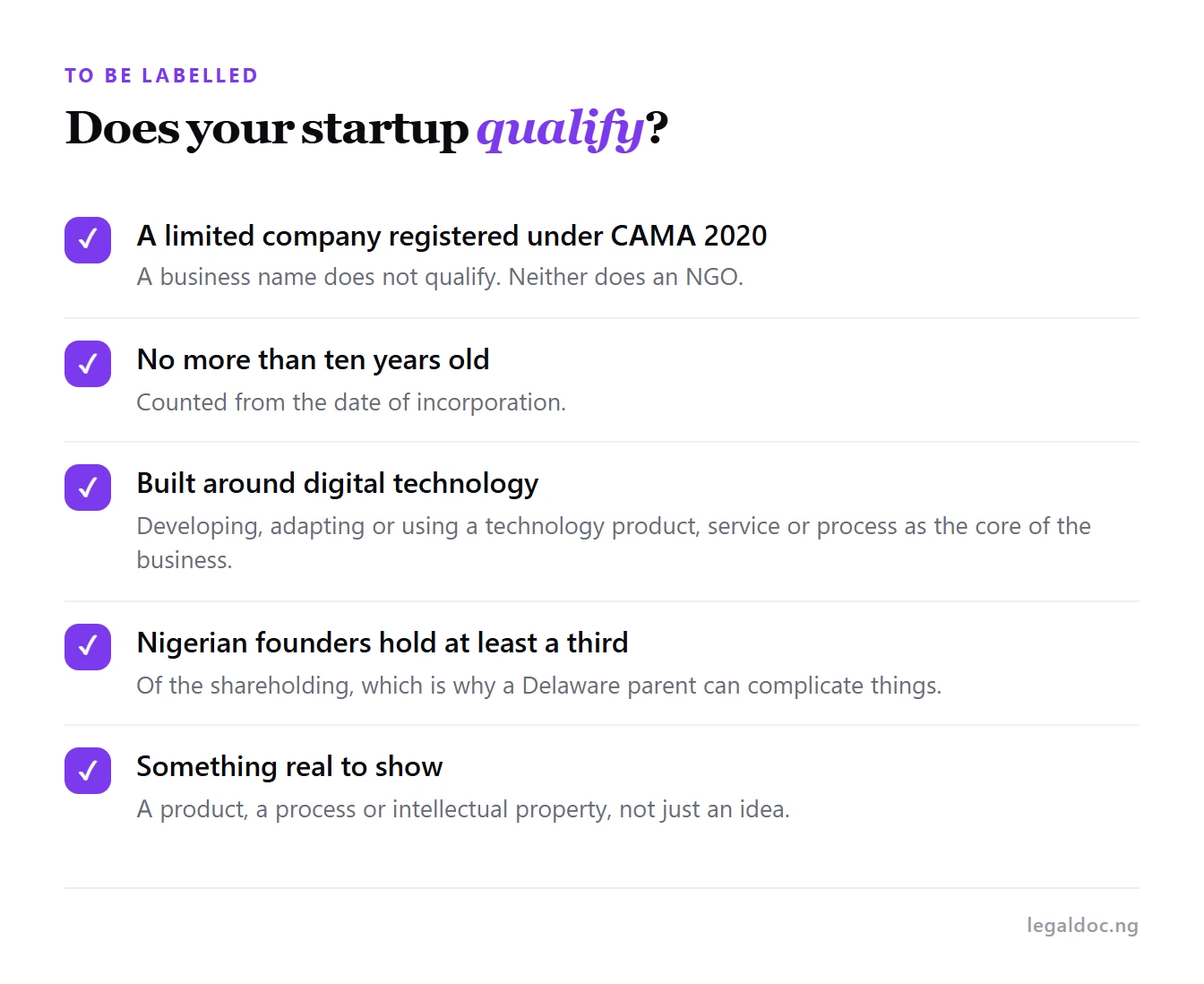
A summary of the criteria. Check the current requirements on the portal before you apply.
Three of these catch founders out.
It has to be a limited company. A lot of early-stage founders are still trading as a business name, or not registered at all. Neither can be labelled. If you are at that stage, incorporating a company is the first step, and the difference is explained in business name against limited company.
The ten-year limit runs from incorporation. Not from when the product launched or when you started taking it seriously. A company registered years ago for a different purpose and later repurposed for a tech product may already be older than you think.
The Nigerian shareholding requirement. Nigerian founders must hold at least a third of the shares. This bites hardest on startups that have raised from foreign investors, and especially on those that have "flipped" into a foreign holding company, where the Nigerian company is wholly owned by a parent abroad. If that is your structure, work out where you stand before you assume the label is available.
How to get labelled
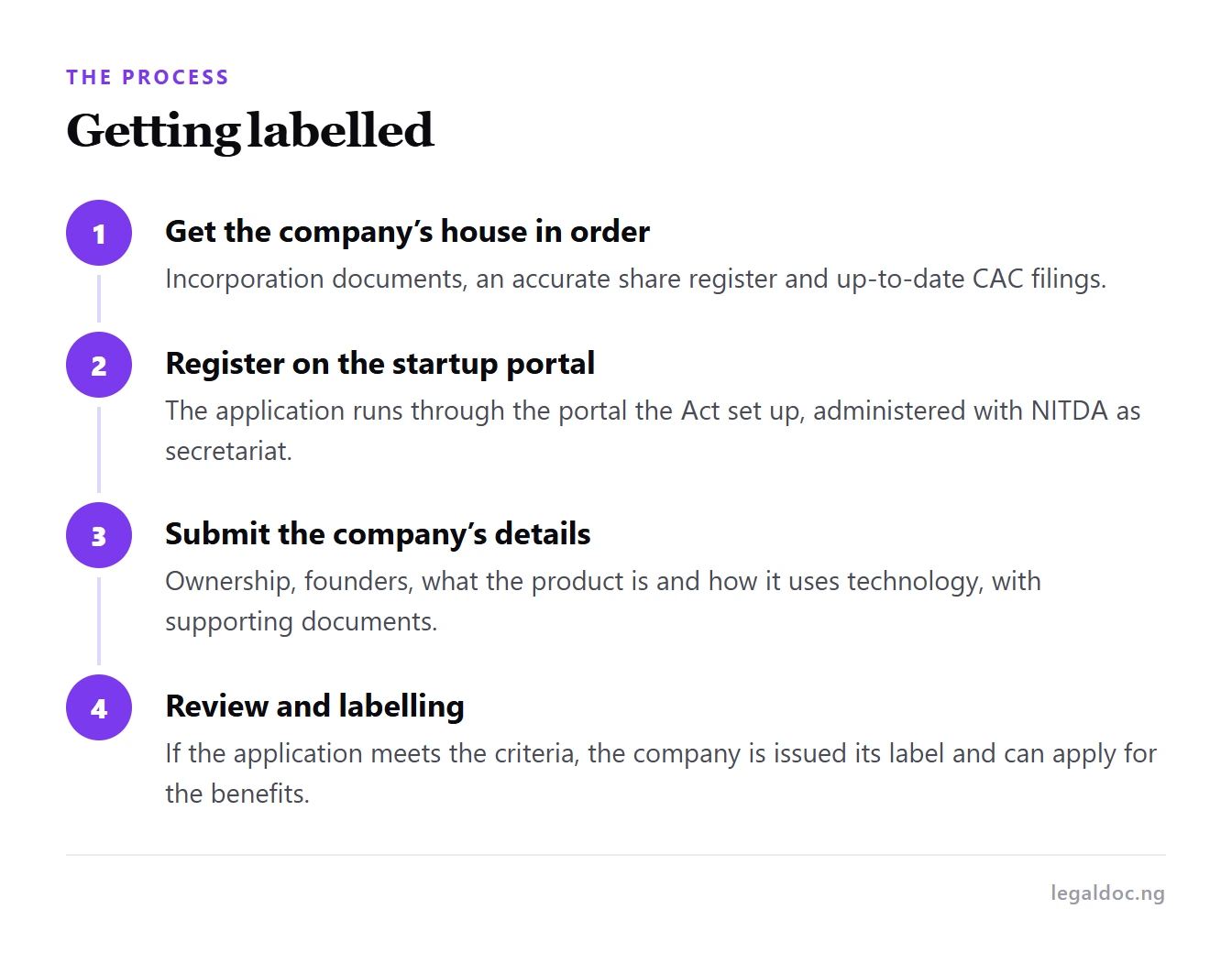
Applications run through the official startup portal.
The step people skip is the first one. An application is much harder to get through if the company's own records are a mess: a share register that does not match the CAC, annual returns outstanding, founders who never signed anything. Sort those out before you apply, not after a query comes back. If your filings have lapsed, start with annual returns for Nigerian companies, and make sure the CAC knows who your persons with significant control are.
What the label gets you
The benefits the Act makes available to labelled startups fall into a few groups.
Does your startup qualify for the label? Ask before you apply
Describe your company and LegalDoc+ checks it against the Startup Act’s eligibility conditions.
Ask about eligibility- Tax incentives. The Act makes labelled startups eligible for tax reliefs, and provides incentives for those who invest in them.
- The seed fund. A startup investment seed fund intended to provide early capital to labelled startups.
- Intellectual property support. Help with protecting the startup's intellectual property.
- Training and programmes. Access to capacity-building, incubation and other government support.
- Recognition. A label that investors, partners and government bodies understand.
We have deliberately not quoted rates, amounts or periods here. The detail of how each incentive works sits largely with the Council and the agencies responsible, it has moved since 2022, and the 2025 tax reforms changed the wider tax picture that the startup incentives sit inside. Get the current position from the portal and from your tax adviser before you plan around a particular figure.
What the label does not do
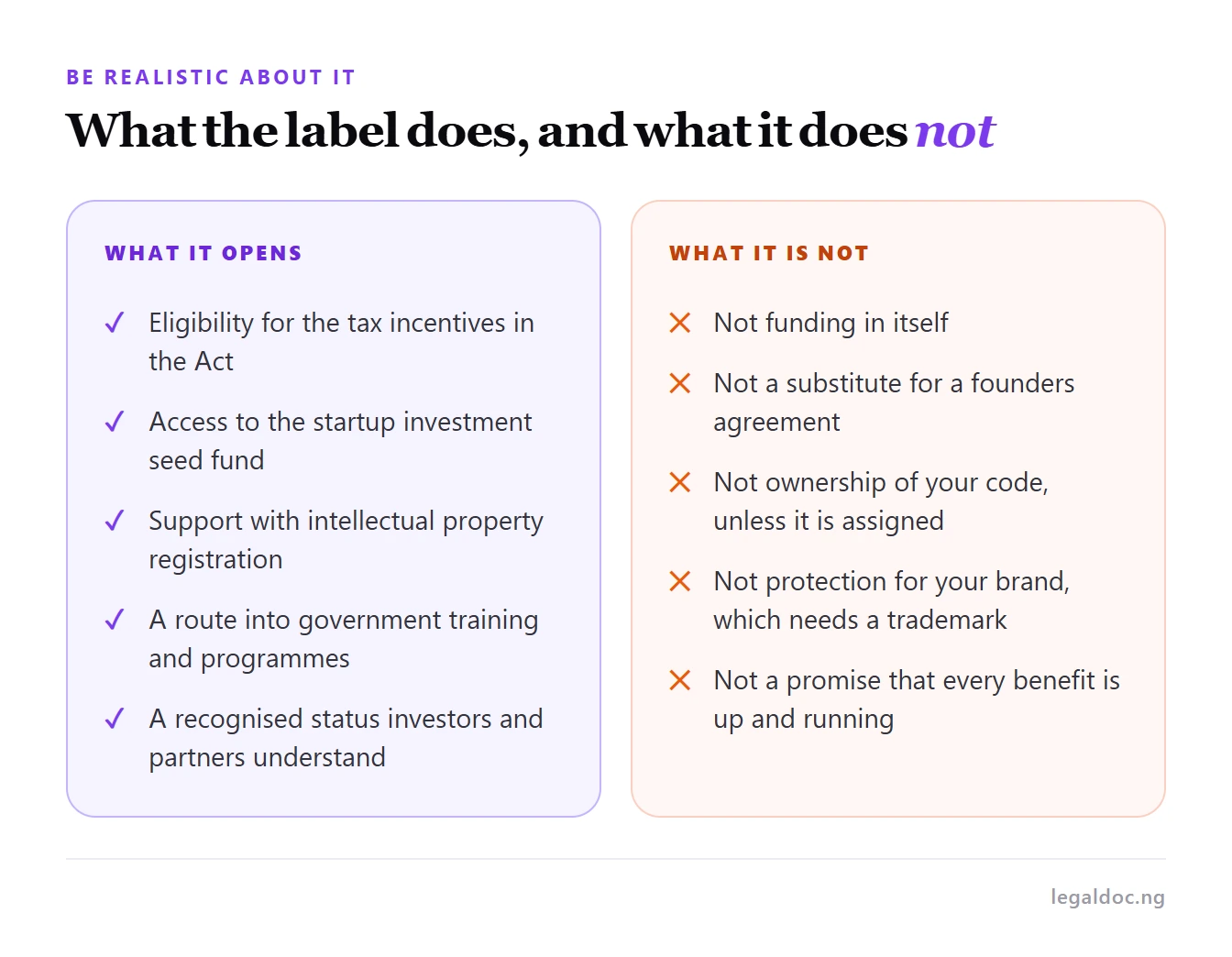
The label is a door, not a destination.
It is worth being clear-eyed about this, because the launch coverage often was not.
It is not funding. Being labelled makes you eligible to apply for things. It does not put money in your account.
It is not instant. How quickly any benefit reaches you depends on the bodies administering it, and founders have found implementation slower and more uneven than the headlines suggested. Build your plan around the business, and treat the incentives as a bonus if and when they arrive.
It does not fix your own paperwork. This is the part that matters most, and the next section is about it.
The groundwork the label will not do for you
Labelled or not, a startup that wants to raise money, hire well and survive a falling-out needs the same legal foundations. Investors check these long before they care about your label.
A founders agreement. Who owns what, how equity vests, and what happens when a founder leaves. Without vesting, a founder who walks away after four months keeps their full share, and that dead equity is the first thing a serious investor will refuse to accept. A founders agreement settles it now, while everybody still agrees.
The company owns the code. Under the Copyright Act 2022, the person who writes code or designs a product owns the copyright unless it is assigned in writing. Founders, early employees and freelance developers all need to have assigned their work to the company. An intellectual property support programme cannot help you protect something the company does not actually own.
The brand is protected. A CAC registration protects the company name on the register, not the brand in the market. That takes a trademark.
Contracts with your team. Employment contracts for staff, and proper contractor agreements for freelancers, so you are not accidentally creating employment relationships you did not intend.
The legal documents every startup in Nigeria needs covers the full list.
Frequently Asked Questions About the Nigeria Startup Act
Who qualifies as a startup under the Nigeria Startup Act? Broadly, a limited company registered under CAMA 2020, no more than ten years old, whose business is built around digital technology, with Nigerian founders holding at least a third of the shares, and with a product, process or intellectual property to show.
Can a business name be labelled as a startup? No. The label is for limited companies. A founder trading under a business name would need to incorporate a company first.
Does the startup label come with funding? Not automatically. It makes a startup eligible to apply for the seed fund and other benefits. Whether and when money arrives depends on those programmes, not on the label itself.
Can a startup with a foreign holding company be labelled? It depends on the shareholding. The Act requires Nigerian founders to hold at least a third, so a Nigerian company wholly owned by a parent abroad may not qualify without changes to the structure. Check before you apply.
Do I still need a founders agreement if I am labelled? Yes. The label says nothing about how equity is split, how it vests or what happens when a founder leaves. Investors will ask for a founders agreement regardless.
Where this leaves you
If your company qualifies, apply. There is little downside, and the label is recognised. But do it with your own house in order, and do not let it distract from the work that actually determines whether the startup can raise money: clean records, a proper founders agreement, and a company that owns its own product.