

Register your company with the right share capital
We ask who the shareholders are, where they are based and what the company will do, then handle the CAC filing.
Register my companySomewhere on the company registration form there is a box for share capital. Most founders type in ₦1,000,000 because that is what a friend used, or ₦10,000,000 because it sounds more serious. Then they never think about it again.
It deserves a little more thought than that. Your share capital affects what registration costs, whether a regulator or a foreign partner will accept your company, and what the shareholders could owe if the company ever fails. And once it is set, reducing it is far harder than increasing it. Here is how to choose the right figure the first time.
The short answer
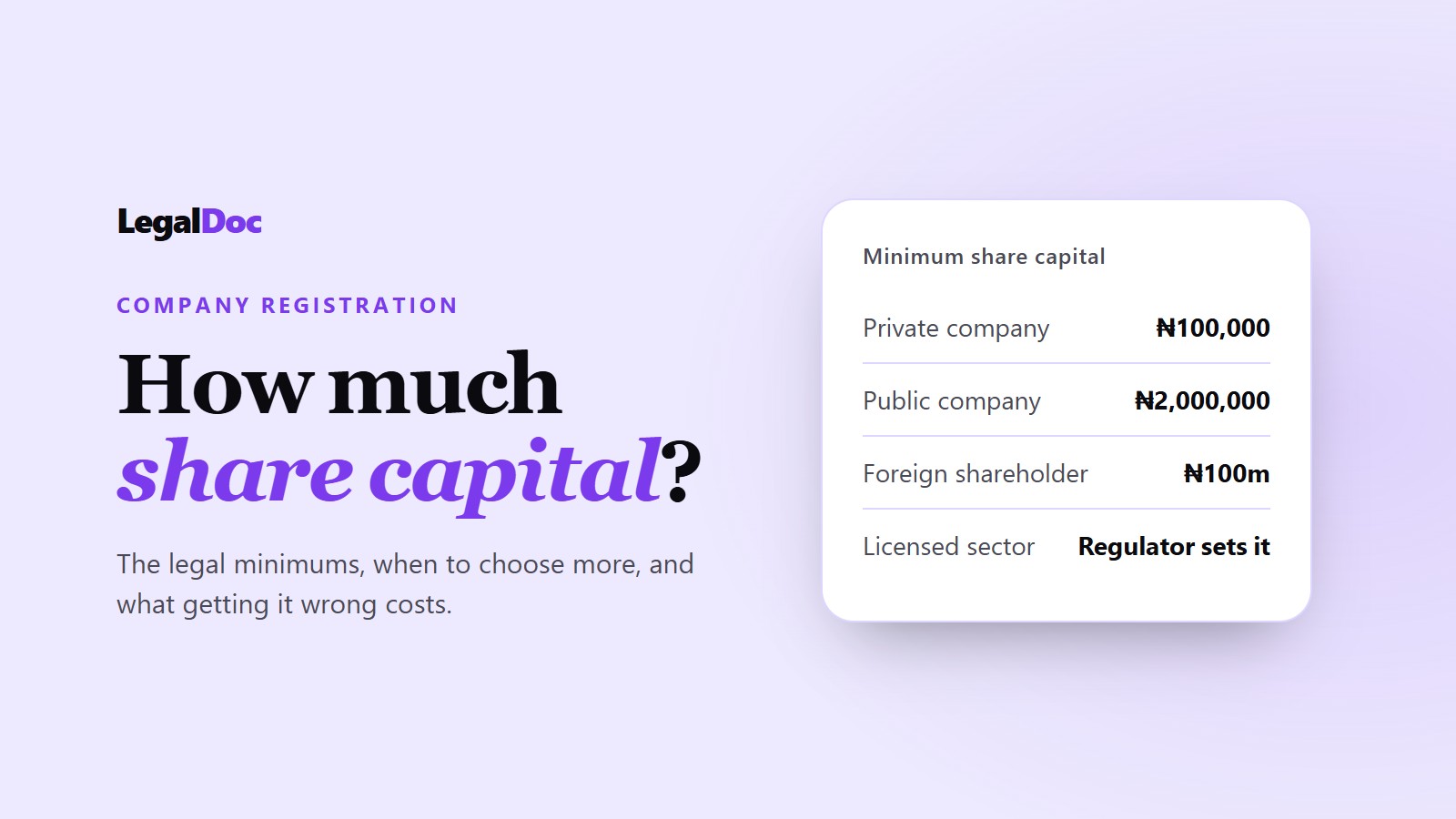
For an ordinary private company owned by Nigerians, the legal minimum share capital is ₦100,000, and for most small businesses that is enough. Choose more if a client, lender, regulator or immigration rule requires it, or to reflect what the shareholders are genuinely putting in. If any shareholder is foreign, plan for at least ₦100 million. Banks, insurers, payment companies and other regulated businesses have their own, much higher minimums. Remember that unpaid share capital is a debt the shareholders owe the company, and money put in as share capital is hard to take back out.
What share capital actually is
Share capital is the total value of the shares the company has issued to its shareholders. A company with 100,000 shares of ₦1 each has a share capital of ₦100,000. Each shareholder owns a slice in proportion to the shares they hold, and agrees to pay the company for those shares.
Since CAMA 2020, the figure you state is issued share capital: shares that actually belong to somebody. The old idea of a large "authorised" capital sitting mostly unissued has gone, so every naira of the figure you choose is allocated to a shareholder from the start.
Share capital is not a deposit. The CAC does not ask to see the money in a bank account when an ordinary Nigerian-owned company is registered. But it is not imaginary either. Each shareholder owes the company the price of their shares, whether they pay at once or when the company calls for it.
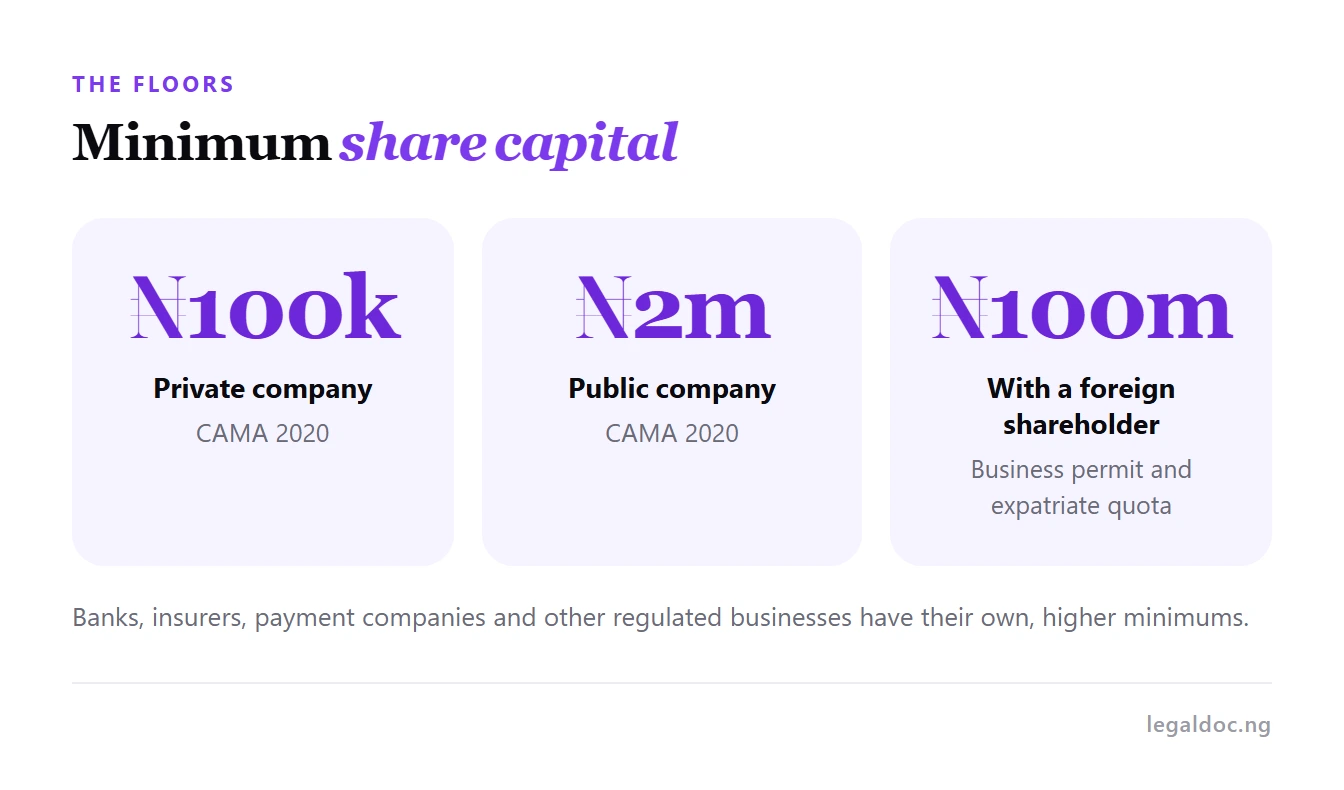
These are floors, not targets. Regulated sectors set their own, higher figures.
How much share capital to choose
The right figure depends mostly on two questions: who owns the company, and what it does.
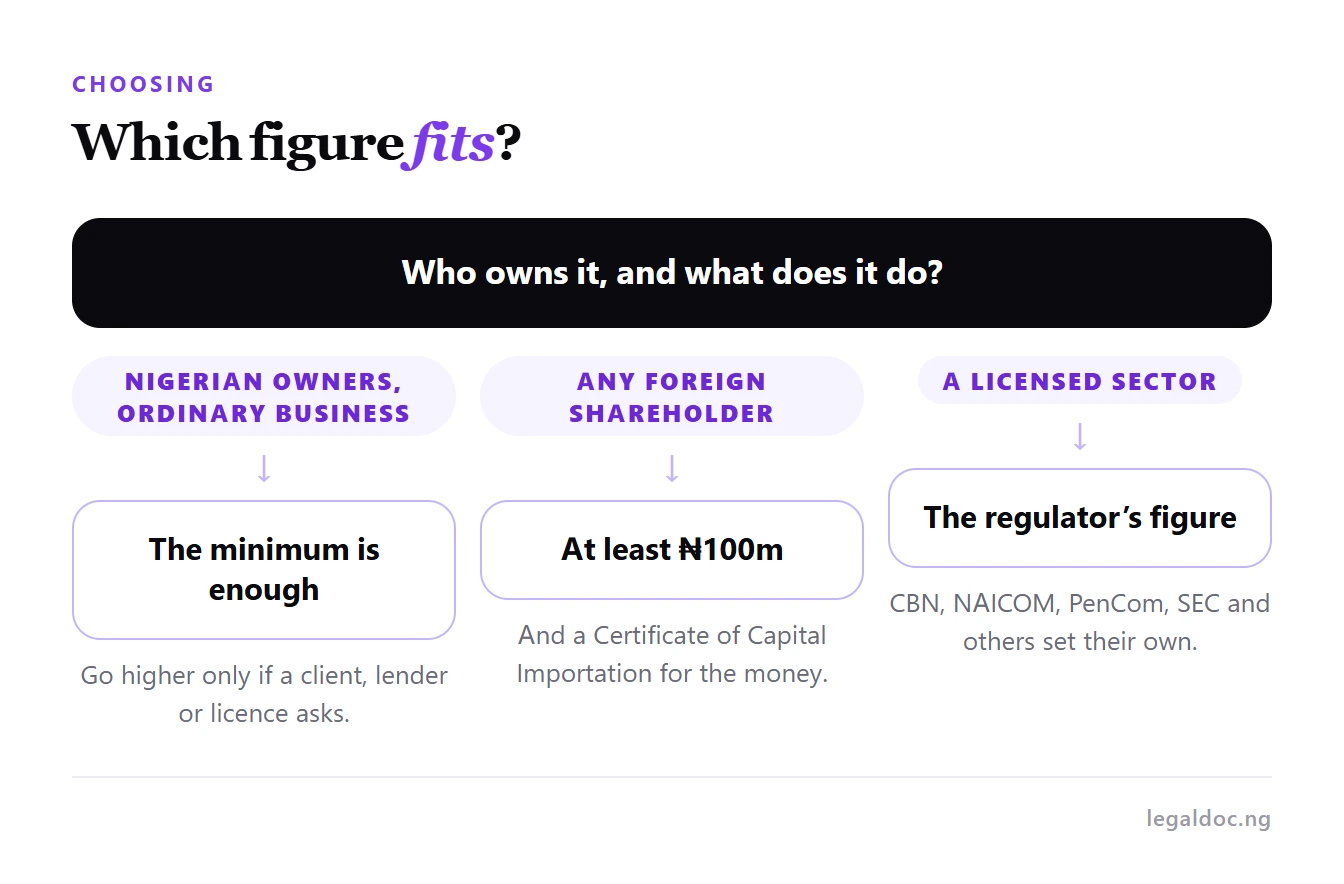
Most new Nigerian businesses sit in the first column.
When the minimum is enough
For a Nigerian-owned business in an unregulated sector, such as trading, consulting, a creative agency, a restaurant or a tech start-up before investment, the ₦100,000 minimum is perfectly respectable. Nobody serious judges a company by its share capital alone, and a higher figure brings costs without much benefit. Many founders choose a round ₦1,000,000 to make share splits tidy, which is also reasonable.
When to choose more
Choose a higher figure when somebody outside the company will ask for it. Some government tenders, large corporate clients and lenders look at share capital as a rough sign of substance. Some licences and permits require a minimum. And if the shareholders are genuinely putting in more money, it can make sense for the share capital to reflect it.
If any shareholder is foreign
Plan for at least ₦100 million. The Ministry of Interior's expatriate quota rules require that much paid-up capital before a company can obtain a business permit or employ foreign staff, and it has become the expected minimum for companies with foreign shareholders generally. Foreign-owned companies also register with the Nigerian Investment Promotion Commission. When foreign money comes in to pay for shares, make sure it arrives through a Nigerian bank that issues a Certificate of Capital Importation, because that certificate is what lets the investor later send dividends and capital back out through official channels.
If you are registering from abroad, our guides for founders in the UK, the USA and Canada cover the rest of the process.
Foreign co-founder or investor coming in? Ask what capital you need
Describe who owns the company and what it does, and LegalDoc+ explains the share capital rules that apply to you.
Ask about share capitalRegulated businesses
Banks, microfinance banks, insurers, pension operators, payment and fintech companies, bureaux de change and several other sectors have minimum capital set by their regulator, often far above anything in CAMA, and these figures change with each recapitalisation. If your business needs a licence from the CBN, NAICOM, PenCom, the SEC or a similar body, check the regulator's current requirement before you register, and register with that figure in mind.
The cost of getting it wrong
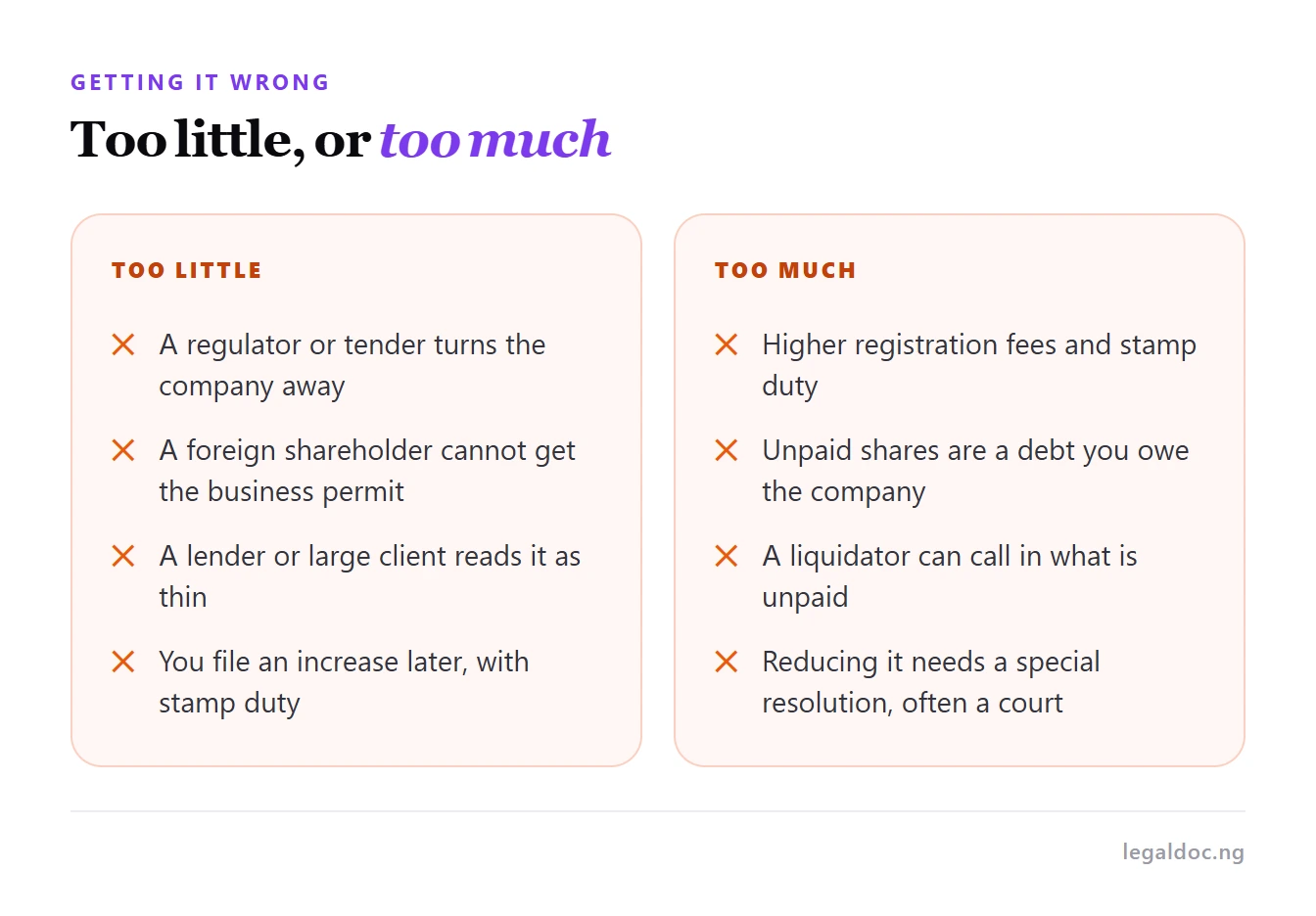
Too low is easy to fix. Too high is not.
The asymmetry matters. Increasing share capital later is routine. Reducing it needs a special resolution of the shareholders and, in most cases, the approval of the court, because creditors are entitled to rely on the capital being there. So if you are unsure, start sensibly and increase later.
And do not inflate the figure to look bigger than you are. If you register with ₦50 million of share capital and the shareholders have not paid for those shares, that ₦50 million is a debt they owe the company. If the company is ever wound up, a liquidator can call it in from them personally. The "limited" in limited liability means limited to what you agreed to pay for your shares, so the figure you choose is the size of that promise.
Share capital or a loan to the company?
Share capital is not the same as the money the business needs to run. If you are putting ₦5 million into the company to buy stock and equipment, you do not have to make it all share capital. Many founders keep share capital modest and lend the rest to the company under a written loan agreement.
The difference is what happens later. A loan can be repaid to you as the company earns, and if the company fails you stand in line as a creditor. Share capital generally stays in the company: it comes back to shareholders only through dividends paid from profit, or in a winding up after every creditor has been paid.
Dividing the shares between founders
The share capital is also how ownership is split. With two founders and a ₦1,000,000 share capital in ₦1 shares, a 60:40 split is 600,000 and 400,000 shares. The CAC records who holds what, and that record is what counts if there is ever a dispute.
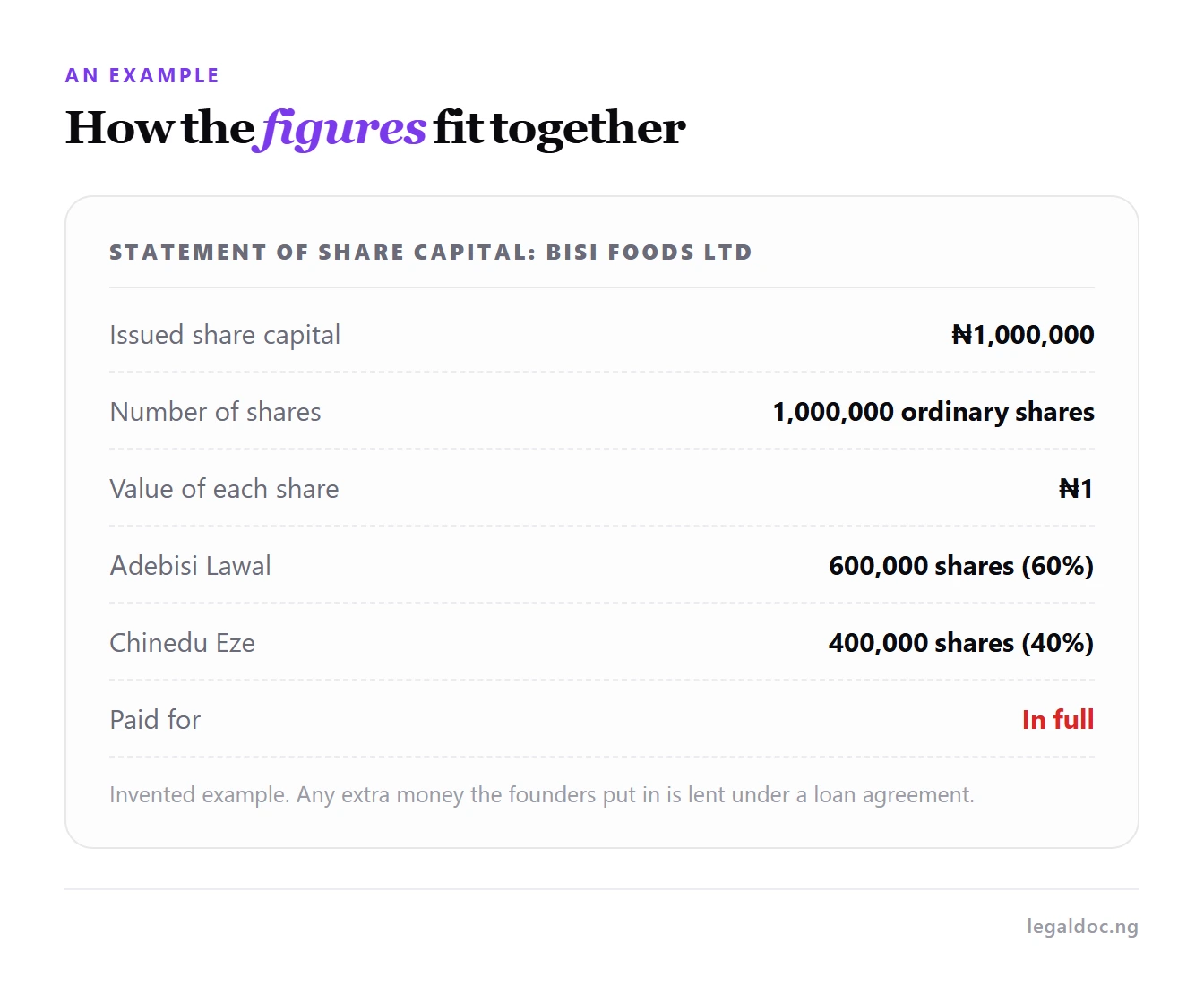
An invented example of how the figures fit together.
What the CAC record does not cover is what happens when a founder leaves, wants to sell, or stops contributing. That belongs in a founders' agreement or a shareholder agreement, signed before the shares are issued. If somebody will hold shares on another person's behalf, a nominee shareholder agreement records the arrangement. Our guide to founders' and shareholders' agreements explains how the two fit together.
Increasing share capital later
When you bring in an investor or need a higher figure for a contract, the shareholders pass a resolution approving the allotment of new shares, and the company notifies the CAC within 15 days, filing a return of allotment and paying stamp duty and filing fees on the increase. The CAC will also want the directors to confirm that the existing shares have been paid for. A company resolution is the starting point for the paperwork.
Get it right from the start
When LegalDoc registers your company, we ask the questions that decide the right share capital, including who the shareholders are, where they are based and what the company will do, so the figure fits your business rather than your friend's. If your situation has a twist, such as a foreign co-founder, a planned investment round or a licence you will need later, ask LegalDoc+ and get an answer that names the rule it turns on. And if you are moving an existing business across, read our guide to going from business name to limited company.
Frequently Asked Questions About Share Capital in Nigeria
What is the minimum share capital for a company in Nigeria? Under CAMA 2020, ₦100,000 for a private company and ₦2,000,000 for a public company. Companies with foreign shareholders and regulated businesses need considerably more.
Do I have to deposit the share capital in a bank before registration? Not for an ordinary Nigerian-owned company. The shareholders do owe the company the price of their shares, and foreign investors should bring their money in through a bank that issues a Certificate of Capital Importation.
What share capital does a company with a foreign shareholder need? Plan for at least ₦100 million. It is required for a business permit and expatriate quota, and is the expected minimum for foreign-owned companies generally.
Can I increase my share capital later? Yes. The shareholders approve the allotment of new shares and the company notifies the CAC within 15 days, paying stamp duty on the increase. Reducing share capital is much harder.
Is share capital the money the business needs to run? Not necessarily. Many founders keep share capital modest and lend the rest of their investment to the company under a loan agreement, which can be repaid.
Where this leaves you
For most Nigerian-owned businesses, a modest share capital is the right answer. Go higher when a regulator, a foreign shareholder, a client or a lender needs you to, never just to look impressive, and put any extra money in as a documented loan. Choose with care at the start and the figure will quietly do its job for years.