

Ready to become a limited company?
We handle the CAC registration for you, from the name search to the certificate of incorporation, while you keep trading.
Register my companyMost Nigerian businesses start the same way. You register a business name with the CAC, open an account, and get on with it. For years that is all you need. Then a large client sends a vendor form asking for your RC number, a bank wants to know who else owns the business before it will lend, or somebody offers to invest and asks how many shares they would get.
That is usually the moment to go from business name to limited company. The registration itself is the easy part. What catches people out is everything that has to move across afterwards: the contracts, the bank account, the staff, the brand. This guide covers both, in the order you will need them.
The short answer
You cannot edit a business name into a limited company. You register a new private company with the CAC, usually with the same name and "Limited" added if it is available, and then move the business into it: the bank account, contracts, equipment, staff, licences and brand. Once customers have stopped paying into the old name, you close the business name or keep it as a separate registration. Debts the business name ran up before the switch stay with you personally unless the creditor agrees otherwise.
Signs it is time to upgrade
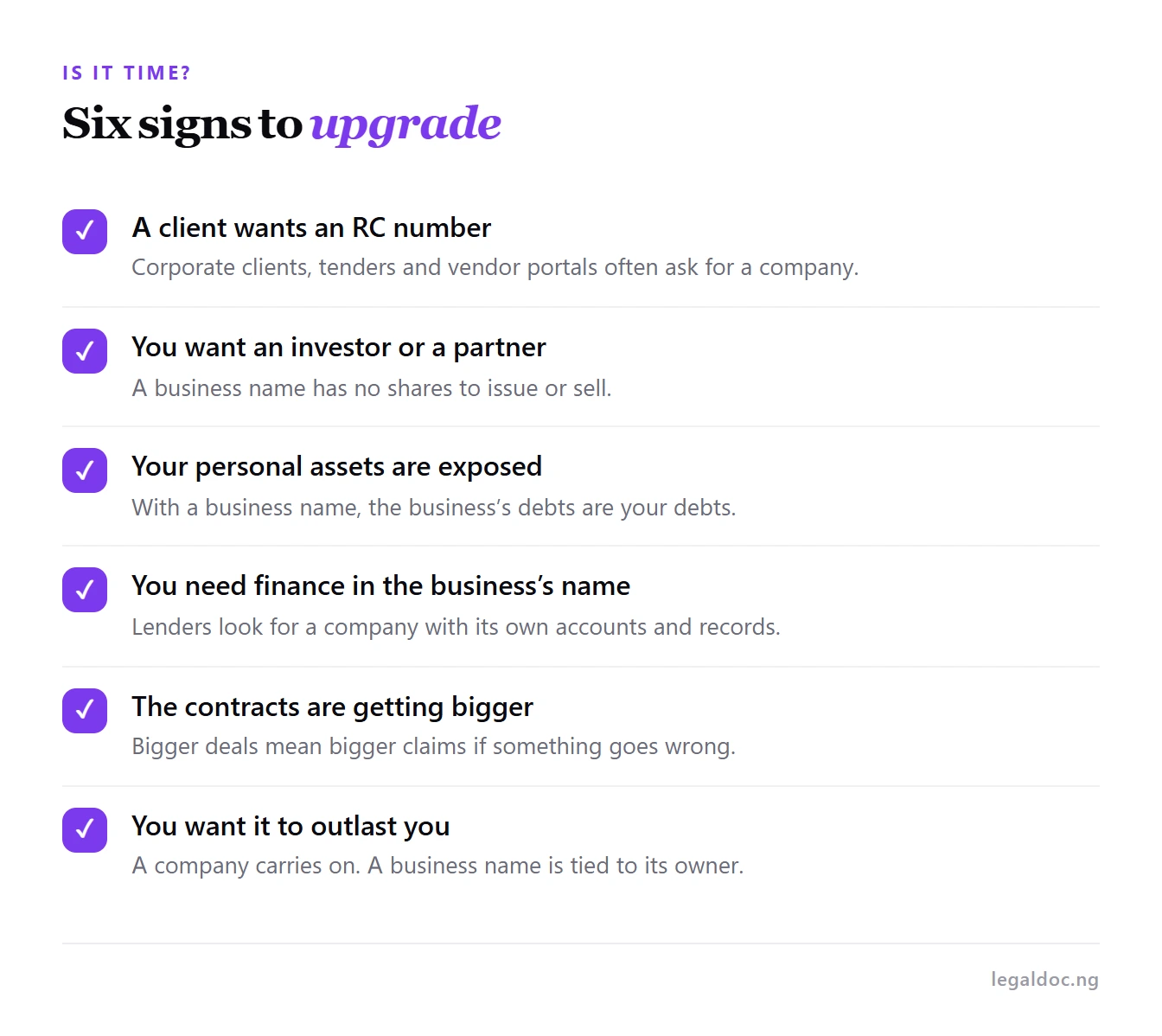
One of these is a reason to think about it. Two or more is a reason to do it.
None of this means a business name was the wrong choice. It is quick, simple and cheap to run, and for many sole traders it remains the right structure for years. If you are still deciding whether to switch at all, our comparison of business name vs limited liability company sets the two side by side. This guide is for when you have decided.
What actually changes when you incorporate
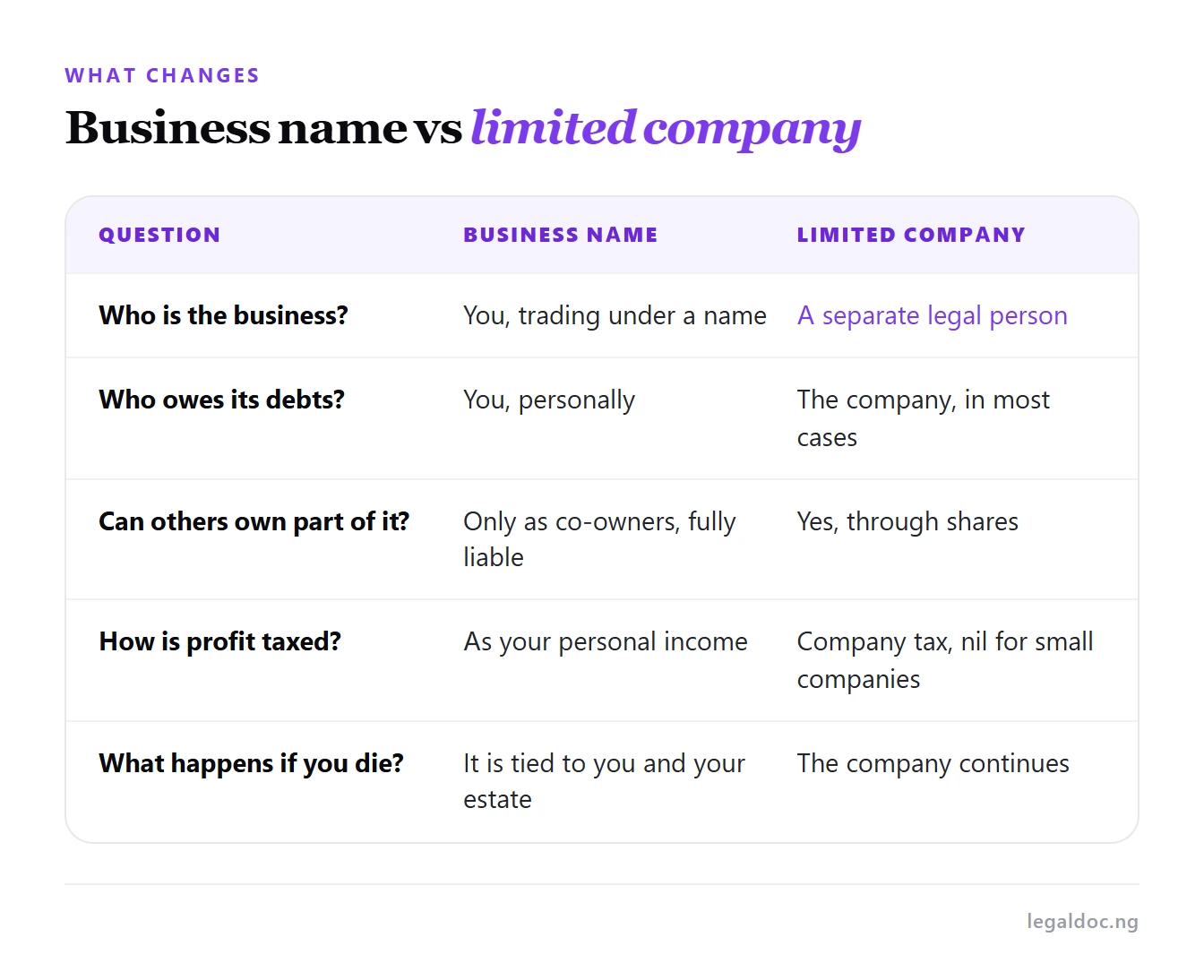
The single biggest change is the first row. Everything else follows from it.
A business name is just you, trading under another name. A company is a separate person in law. It owns its own assets, signs its own contracts and owes its own debts. If a contract goes wrong, the claim is against the company, not against your house or your car, unless you have personally guaranteed the obligation. Banks often ask the directors of young companies for exactly that kind of guarantee, so read anything you are asked to sign in your own name carefully.
Tax changes too. A business name's profit is taxed as your personal income. A company pays company income tax on its own profit, and under the Nigeria Tax Act 2025 a small company, broadly one with turnover of ₦100 million or less and fixed assets of no more than ₦250 million, pays none at all, although professional services businesses are excluded. We cover the detail in the benefits of the new tax act.
How to move from business name to limited company, step by step
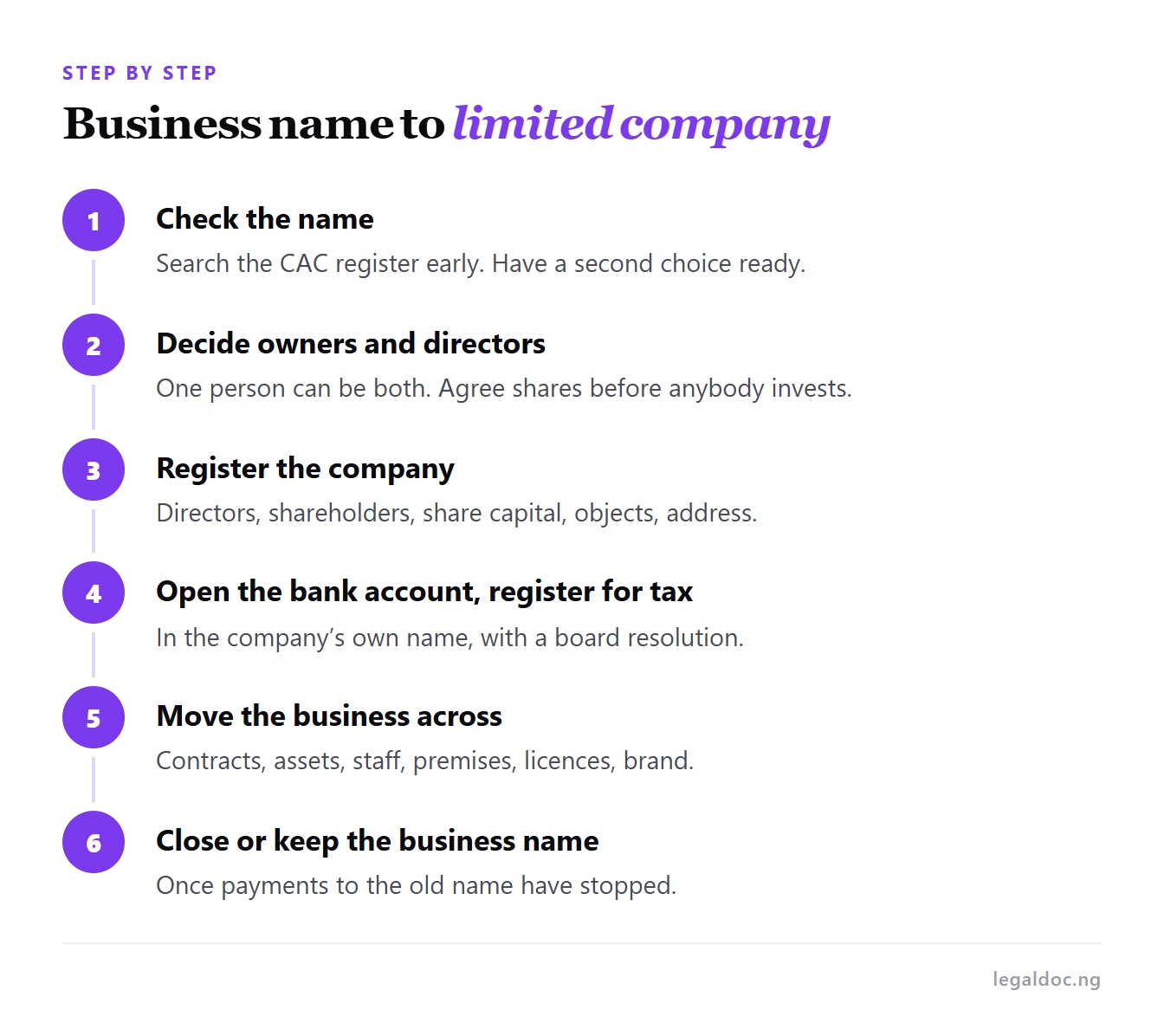
Steps one to four take days. Step five is where the care goes.
Check the name first
Owning a registered business name does not guarantee you the same name as a company. The company name has to pass the CAC's availability check like any other, and an existing company with a similar name can block it. Search early and have a second choice ready, often the same name with a word added. If your first choice is refused, our guide to what to do when the CAC rejects your name explains the usual reasons and the way round them.
Decide who owns and runs it
Since CAMA 2020, one person can form a private company and be both its only shareholder and its only director, so a sole trader can move across alone. A small private company does not have to appoint a company secretary either. If you are bringing in a partner or an investor, now is the time to settle who holds what, and to sign a shareholder agreement before anybody puts money in.
You will also state the company's issued share capital, which must be at least ₦100,000 for a private company, and declare anybody who controls it, under the persons with significant control rules. How much capital to choose is a real decision, and our guide to share capital in Nigeria walks through it.
Register the company
Registration happens on the CAC portal: the name, the registered address, what the company will do, the directors and shareholders with their identification, and the memorandum and articles of association. LegalDoc can register the company for you, name search included, so you keep running the business while it is done.
Moving to a limited company? Ask what has to move with you
Describe your business and LegalDoc+ lists the contracts, assets and licences to transfer, and drafts the novation agreements.
Ask LegalDoc+Open the company's bank account and register for tax
The company needs a corporate account in its own name. Banks will ask for the certificate of incorporation, the status report, the memorandum and articles, and a board resolution authorising the account and naming who can sign. A company resolution covers that. The company also needs its own tax registration, because the business name's tax records do not carry across.
The handover most people forget
Here is the part that causes the trouble later. Because a business name is not a separate person, everything the business owns and everything it signed is really yours. Registering a company does not move any of it. You have to move each item deliberately.
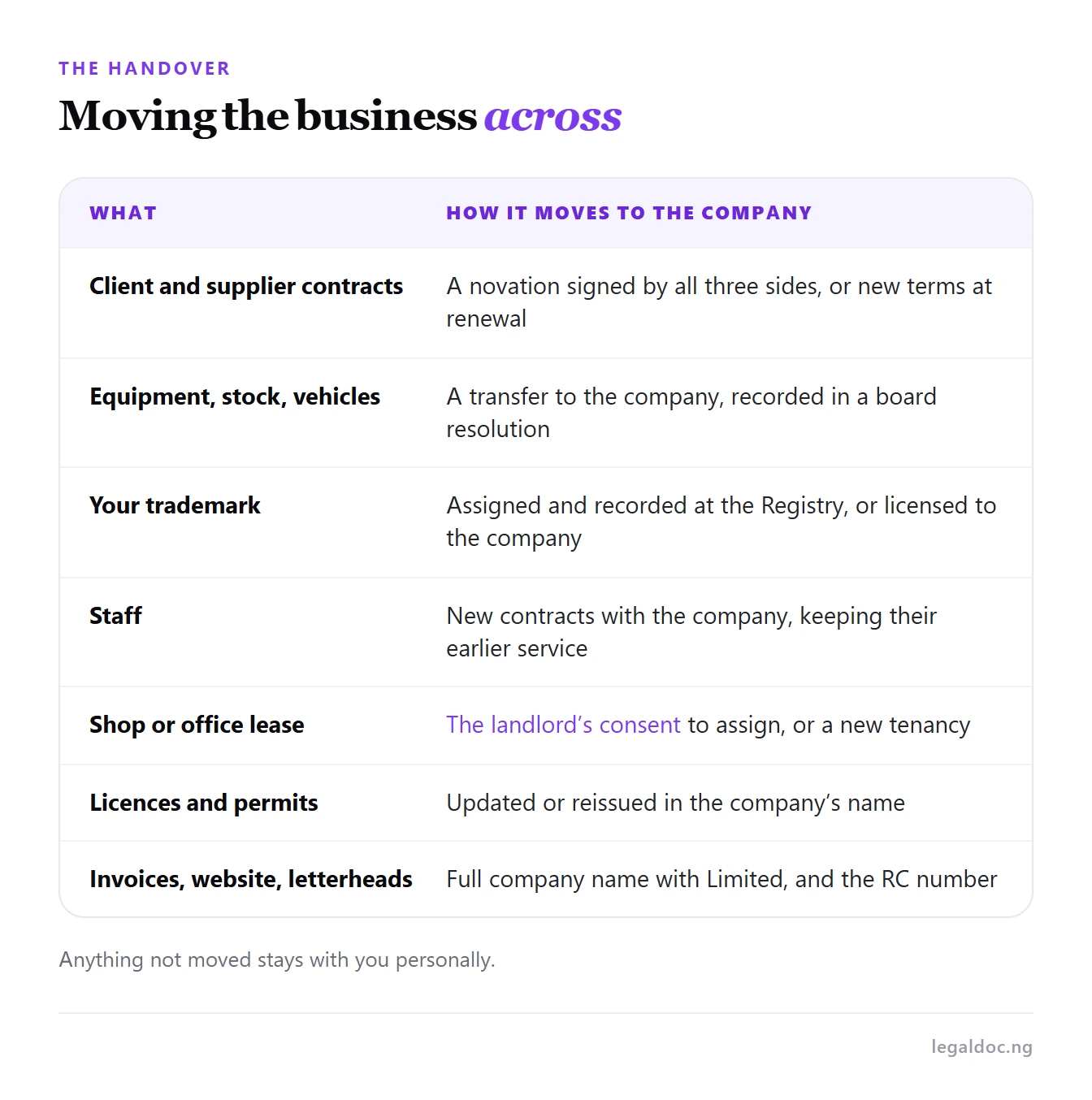
Anything not moved stays with you, along with the liability that comes with it.
Contracts with clients and suppliers
The company cannot simply take over a contract you signed. To move a contract across with both its rights and its obligations, you need the other side's agreement, usually in a short novation agreement signed by all three parties: you, the company and the client or supplier. For smaller relationships it is often simpler to sign fresh terms in the company's name at the next renewal. Either way, tell every client in writing which entity they are now dealing with and where to pay.
Equipment, stock and your brand
Equipment, stock, vehicles and intellectual property belong to you until you transfer them. Document the transfer, either as a sale to the company or in exchange for shares, and record it in a board resolution. If your trademark is registered in your own name, you can assign it to the company and record the assignment with the Trademarks Registry, or keep it and license it to the company. Both are legitimate. What matters is that it is in writing. If your brand is not registered yet, the move is a good moment to register the trademark in the company's name from the start.
Your staff
Your employees currently work for you personally. Give each of them a new employment contract with the company, and state that their earlier service counts, so nobody loses what they have built up in the move.
Premises, licences and paperwork
If the lease on your shop or office is in your name, you will usually need the landlord's consent to assign it to the company, or a new tenancy in the company's name. Approvals such as NAFDAC registrations, SON certification and state permits are issued to a named holder and generally need to be updated or reissued. Finally, change your invoices, letterheads, website and email signatures to show the company's full name, including "Limited", and its RC number.
Old debts stay with you
Incorporating protects you from the company's debts from the day it starts trading. It does not wipe out what the business name already owed. A supplier owed money under the business name can still pursue you personally for it, and the company is not liable unless it agrees to take the debt on. Clear old balances before the switch, or agree in writing with each creditor that the company will assume them.
Close the business name, or keep it
Once the company is trading and customers have stopped paying into the old name, you can notify the CAC that the business name has ceased. If you would rather keep it, perhaps because the name itself has value, remember that it carries its own annual returns, separate from the company's. What you should avoid is drifting along trading through both, because every sale made in the old name is still made by you personally.
How LegalDoc makes the switch simple
We register the company for you, and the documents for the handover are ready to complete in minutes: a shareholder agreement if others are coming in, a company resolution for the bank and the asset transfer, and employment contracts for your team.
For the documents that are specific to your move, such as a novation agreement for an important client contract or an agreement transferring your equipment to the company, LegalDoc+ drafts them to Nigerian law. It will also review each contract you are moving across, so you know exactly what obligations the new company is taking on before it signs.
Frequently Asked Questions About Business Name to Limited Company
Can I convert my business name into a limited company? Not directly. You register a new private company with the CAC and move the business into it, then close or keep the business name.
Can I keep the same name? Usually, with "Limited" added, but only if the name passes the CAC's availability check. Have an alternative ready in case a similar company name already exists.
Can I be the only shareholder and director? Yes. Under CAMA 2020, one person can form a private company and be its sole shareholder and director.
What happens to the contracts I signed as a business name? They stay with you until they are moved. Moving a contract to the company with its obligations needs the other party's agreement, usually through a novation agreement, or fresh terms at renewal.
Do I have to close my business name? No, but if you keep it, it needs its own annual returns, and anything sold in that name is still sold by you personally. Most owners close it once payments to the old name have stopped.
Where this leaves you
Going from business name to limited company is one of the best moves a growing Nigerian business can make, and the registration is quick. Do the handover with the same care: move the contracts, the assets, the staff and the brand, settle the old debts, and then decide what to do with the old name. Done properly, the business you have built ends up in a structure that can grow, borrow, take on investors and outlast you.