

Not sent a proper demand letter yet? Start there
The amount, the basis, a deadline and what happens next. Most debts are settled at this stage.
Draft a demand letterYou did the right thing. You stopped sending polite reminders on WhatsApp and wrote a proper demand letter: the amount, the basis, a deadline, and what would happen next. If you have not got that far yet, start with how to write a demand letter that actually gets you paid, because most debts are settled at that stage.
But some are not. The deadline came and went. Maybe they replied with a promise, maybe they went quiet. Either way, the money is still not in your account, and the letter said you would take further steps.
This is about what those steps actually are, what each one costs you, and how to choose between them.
The short answer
After an ignored demand letter, you can offer a written instalment plan, try mediation through a multi-door courthouse, or go to court: small claims for modest sums, a Magistrate Court within its limits, or the High Court's fast-track procedures for a clear debt with no real defence. If the contract has an arbitration clause, that usually comes first. Winning a judgment is not the same as being paid, so plan for enforcement. You generally have six years from when a contract debt fell due to sue.
First, check the clock
Under the limitation laws that apply across most of Nigeria, a claim on a simple contract has to be brought within six years of the date the money fell due. After that, the debtor can defeat the claim simply by pointing out that it is too late, however clearly they owe you.
Six years sounds generous until you realise how many business debts drift for three or four years while everybody hopes the relationship recovers. Work out when the money was actually due. If you are getting close, that decides your timetable for you.
One useful rule: a written acknowledgement of the debt, or a part-payment, can restart the limitation clock. Which is one more reason to get any promise to pay in writing.
The escalation, one step at a time
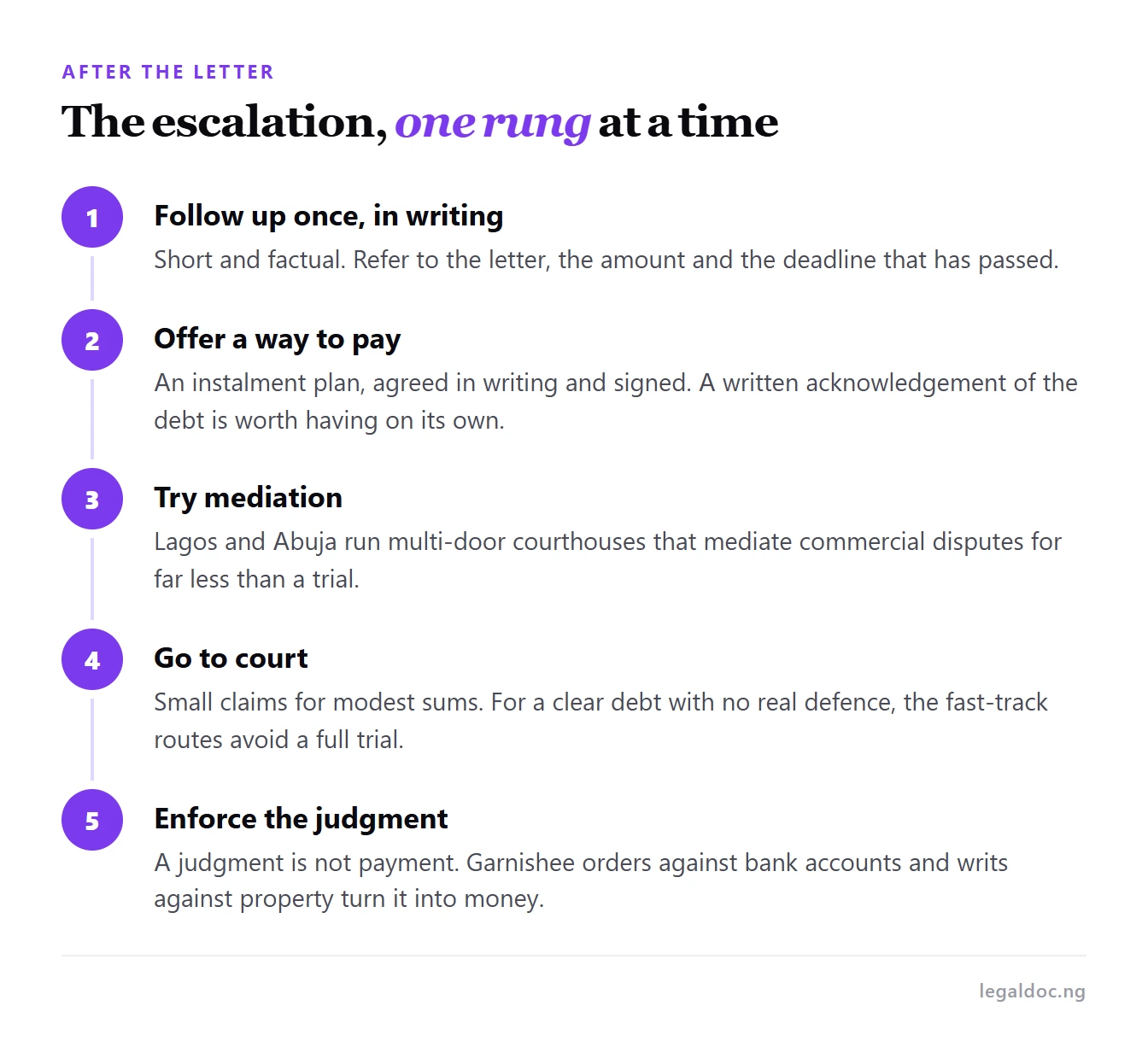
Most debts settle on the first three rungs. The last two cost the most.
Follow up once
One short written follow-up, referring to the letter, the amount and the deadline that has passed. Not a series of messages. The point is to make sure the silence is deliberate and to give one last clean opportunity before you spend money.
Offer a way to pay
A lot of debtors are not refusing to pay. They simply cannot pay all of it at once, and they are embarrassed. An instalment plan, agreed in writing and signed by both of you, often recovers more, faster, than a lawsuit.
Whatever you agree, get the debtor to sign something that states the full amount owed and the schedule. If they default on the plan, that signed document is excellent evidence, and it resets the limitation clock.
Try mediation
Lagos and Abuja both run multi-door courthouses that mediate commercial disputes. Mediation is faster and cheaper than a trial, it is private, and it lets you settle on terms a court could not order, such as a payment plan plus a continued business relationship. Several other states have similar centres.
Choosing the right forum
If talking has not worked, the next question is where the claim goes. That depends mostly on the contract and the amount.
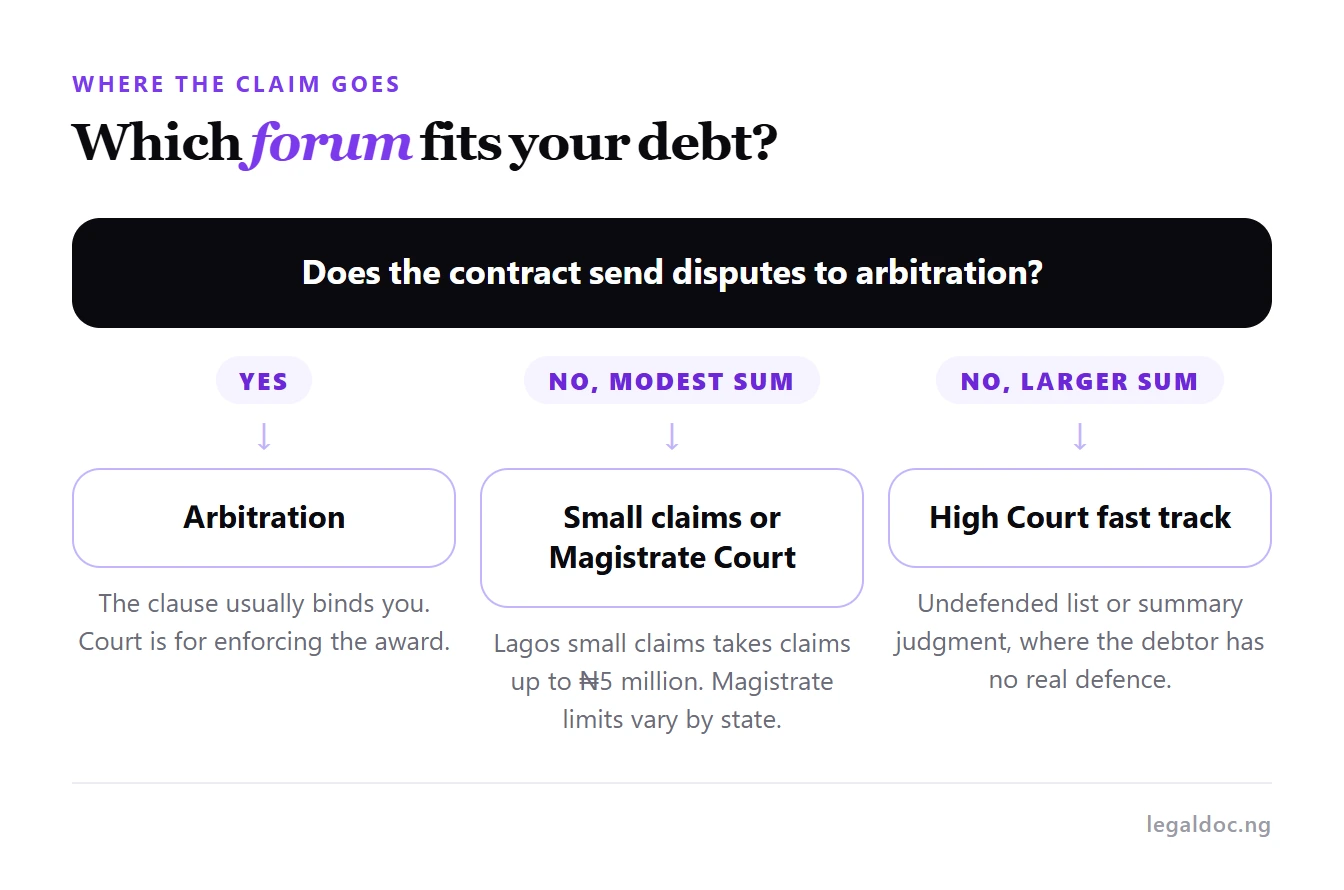
Check the contract for an arbitration clause before anything else.
Arbitration, if the contract says so
Many commercial contracts send disputes to arbitration. If yours does, a court will usually hold you to it. Arbitration under the Arbitration and Mediation Act 2023 is private and can be quick, but you pay the arbitrator, so for a small debt it can cost more than it recovers.
Small claims
Lagos has a dedicated small claims procedure in the Magistrate Courts for claims up to ₦5 million. It is designed to be quick and simple, with straightforward forms, and is built so that a business can bring a claim without a long trial. Several other states have introduced similar small claims procedures with their own limits.
Not sure which route to take for your debt? Ask
Describe the debt and the paperwork you have, and LegalDoc+ explains your options and what each one involves.
Ask about my debtFor a typical unpaid invoice, this is often the most cost-effective route there is.
Magistrate and High Court
Larger claims go to the Magistrate Court, within limits set by each state's law, or to the High Court. A full trial can take a long time. But where the debt is clear and the debtor has no genuine defence, the High Court has fast-track routes: the undefended list procedure used in the FCT and many states, and summary judgment under the Lagos rules. In both, if the debtor cannot show a real defence, judgment can be given without a full trial.
Debts evidenced by a signed contract, accepted invoices or a dishonoured cheque are exactly what these procedures exist for. If your debt involves a bounced cheque, read what to do when a cheque bounces as well, because the cheque gives you extra options.
The evidence that wins
Whatever route you take, the strength of your claim is the strength of your paperwork. Gather it before you file.
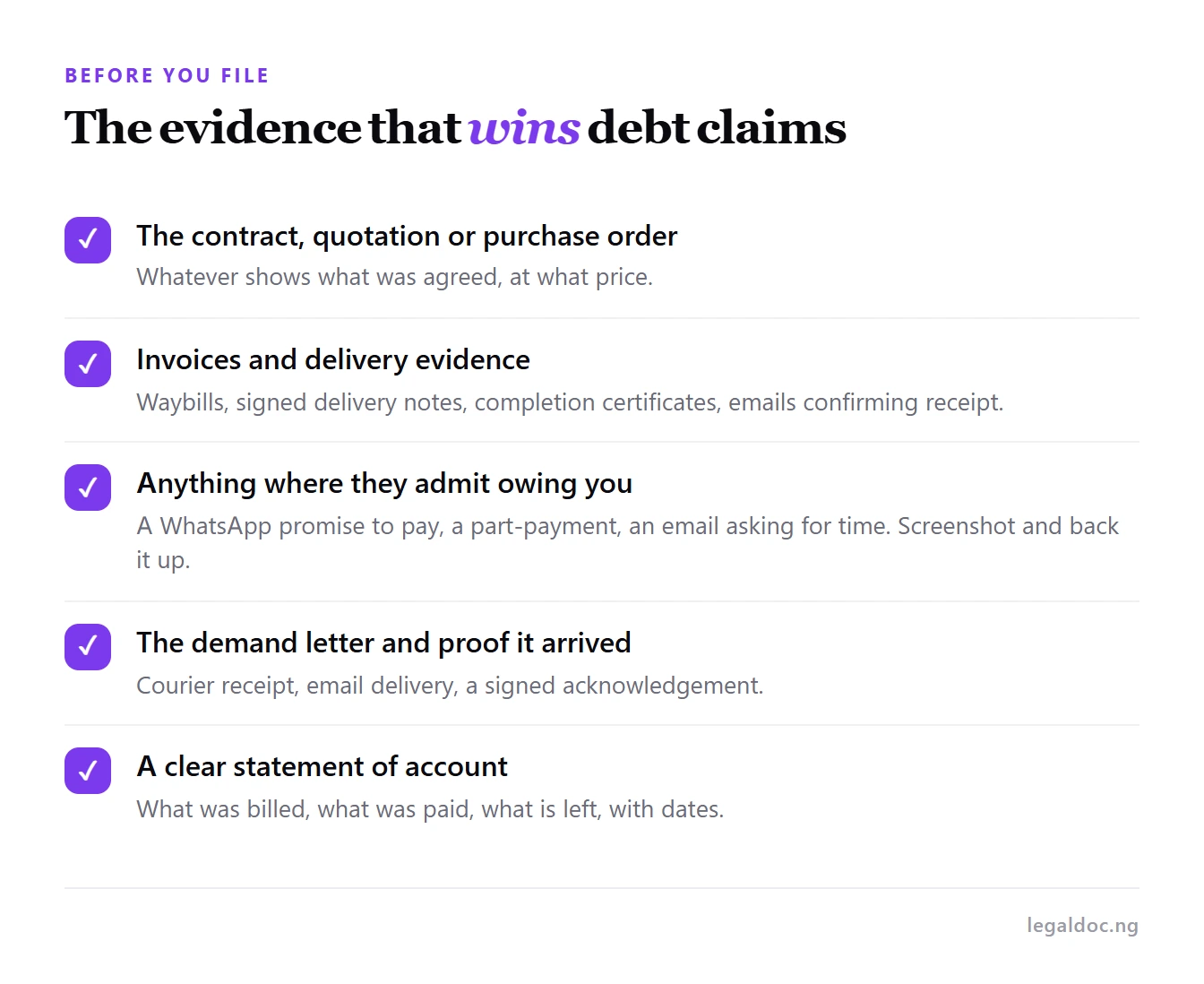
Admissions are gold. Screenshot them the day they arrive.
Winning is not the same as getting paid
This is the part people do not plan for. A judgment declares that the money is owed. It does not put it in your account. If the debtor still does not pay, you enforce.
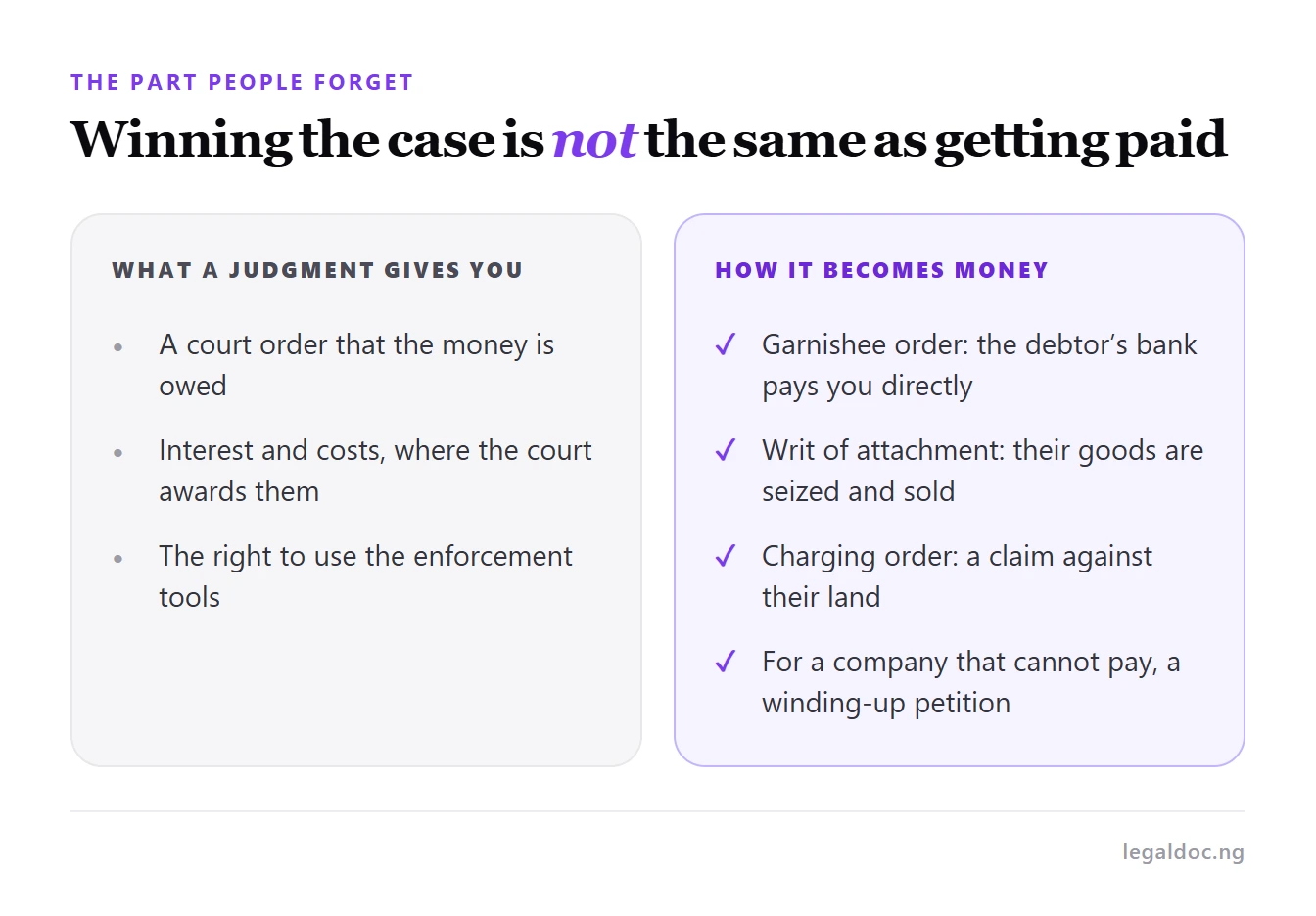
A garnishee order against the debtor's bank account is often the fastest of these.
Garnishee proceedings are the tool most worth knowing. Once you have a judgment, the court can order a bank holding the debtor's money to pay the judgment debt directly to you. Against a debtor with an active business account, that is often decisive.
Against a company that genuinely cannot pay its debts, a winding-up petition is the heavy option. It is not a debt collection tool for a debt that is honestly disputed, and courts dislike it being used that way. Take advice before threatening it.
What not to do
Do not involve the police in a civil debt. An unpaid invoice is a civil matter. Nigerian courts have repeatedly said the police are not debt collectors, and debtors have won damages against creditors who arranged their arrest over a commercial debt. A bounced cheque is different, because issuing one can be an offence in itself, but even then the aim should be honest reporting, not pressure.
Do not threaten what you will not do. If the demand letter said you would sue on a date, and you do not, the next letter carries less weight.
Do not let it drift. Every month that passes makes evidence harder to find, the debtor harder to locate, and the limitation deadline closer.
Is it worth it?
Do the arithmetic honestly. Filing fees, legal fees, your own time, and the chance that the debtor has nothing to enforce against. For a large debt against a solvent business, pursuing it is almost always worthwhile. For a small debt against somebody with no assets, a negotiated plan may be the best you will do.
Prevention is cheaper than any of this. A clear contract, staged payments and a deposit before work starts avoid most of these situations entirely. A freelance agreement or a loan agreement that sets out payment terms and what happens on default is the cheapest debt recovery tool there is.
Frequently Asked Questions About Debt Recovery in Nigeria
What do I do if someone ignores my demand letter? Follow up once in writing, offer a signed instalment plan, try mediation, and if that fails, take the claim to the right forum: arbitration if the contract requires it, small claims or a Magistrate Court for modest sums, or the High Court's fast-track procedures for a clear debt.
How long do I have to sue for a debt in Nigeria? Generally six years from when the money fell due on a simple contract. A written acknowledgement of the debt or a part-payment can restart that period.
What is the small claims court limit in Lagos? Claims of up to ₦5 million can go through the Lagos small claims procedure in the Magistrate Courts. Other states that have introduced small claims procedures set their own limits.
Can I involve the police to recover a debt? Not for an ordinary civil debt. Courts have held that the police are not debt recovery agents, and creditors who arrange arrests over commercial debts have been ordered to pay damages.
What happens if I win but they still do not pay? You enforce the judgment, for example through a garnishee order directing the debtor's bank to pay you, a writ to seize and sell their goods, or a charging order against their land.
Where this leaves you
An ignored demand letter is not the end of the road. It is a fork. Most debts can still be recovered by a written payment plan or mediation, and the ones that cannot have well-worn court routes, as long as you move before the six years run out and keep your evidence in order.