

Put the drawer on notice in writing
The cheque, the amount, the date it was returned and a clear deadline to pay, in a formal demand letter.
Draft a demand letterYou delivered the goods, or finished the job, or lent the money. They gave you a cheque. You paid it in, waited, and the bank sent it back with a slip that says the account did not have enough money in it.
It is a horrible feeling, partly because a cheque feels like such a solid promise. Somebody wrote the amount, signed it and handed it over. And in Nigerian law, a cheque is a solid promise. That is exactly why a bounced one gives you more options than an ordinary unpaid invoice.
This guide covers what to do immediately, when a dud cheque is a criminal offence, and the civil claim that is usually the quickest way to the money.
The short answer
Keep the original cheque and the bank's return slip. Write to the person who issued it and give them a short deadline to pay. Under the Dishonoured Cheques (Offences) Act, using a cheque to obtain goods, services or credit is an offence if it is presented within three months of its date and bounced for lack of funds, punishable by two years' imprisonment for an individual. Separately, you can sue on the cheque itself, and because a cheque is such clear evidence of a debt, it suits the courts' fast-track procedures.
The first 48 hours
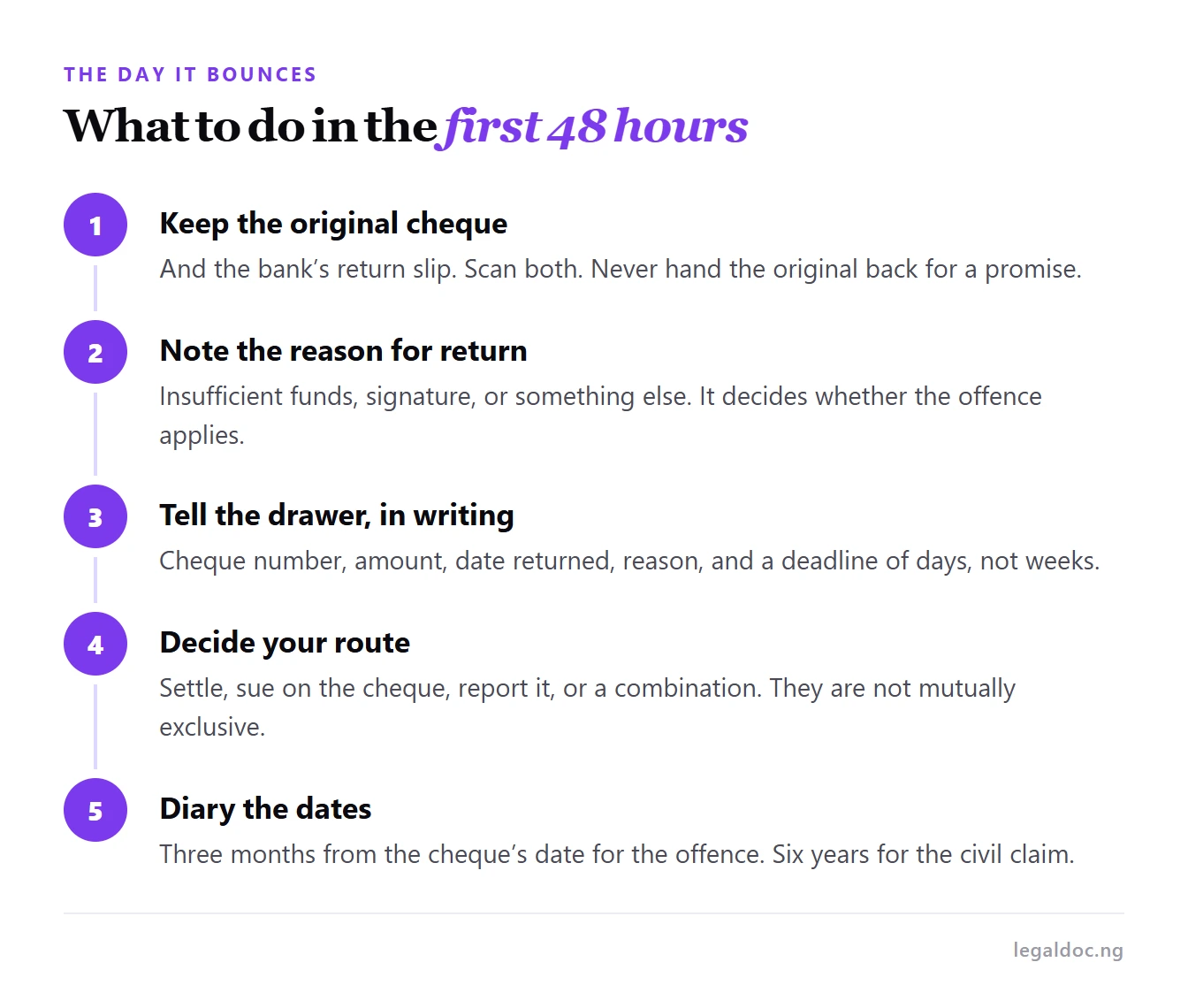
The original cheque is your evidence. Do not hand it back until you are paid.
Keep the cheque and the return slip
The bank returns the cheque with a reason, usually stamped or attached on a slip. That reason matters a great deal, as you will see below. Keep both safe, scan them, and do not give the original back to the drawer in exchange for a promise. People do this all the time, out of politeness, and lose their best piece of evidence.
Tell them, in writing
Send a short written message to whoever issued the cheque: the cheque number, the amount, the date it was returned and the reason the bank gave, and a deadline to pay, a few days rather than weeks. Keep it factual. Sometimes it really was a timing problem, and a clear message gets it sorted the same week.
If it does not, a formal demand letter is the next step, and we explain how to write one in how to write a demand letter that actually gets you paid.
Do not present it again and again
Re-presenting a cheque once, after the drawer tells you the funds are in, is reasonable. Paying it in every week in the hope it eventually goes through is not a strategy, and it can muddy the record of when it was dishonoured.
When a dud cheque is a crime
Nigeria is one of the countries where issuing a bad cheque can be a criminal offence in itself, not just a broken promise. The Dishonoured Cheques (Offences) Act makes it an offence to obtain goods, or anything else capable of being stolen, or to obtain credit, by means of a cheque that bounces for lack of funds.
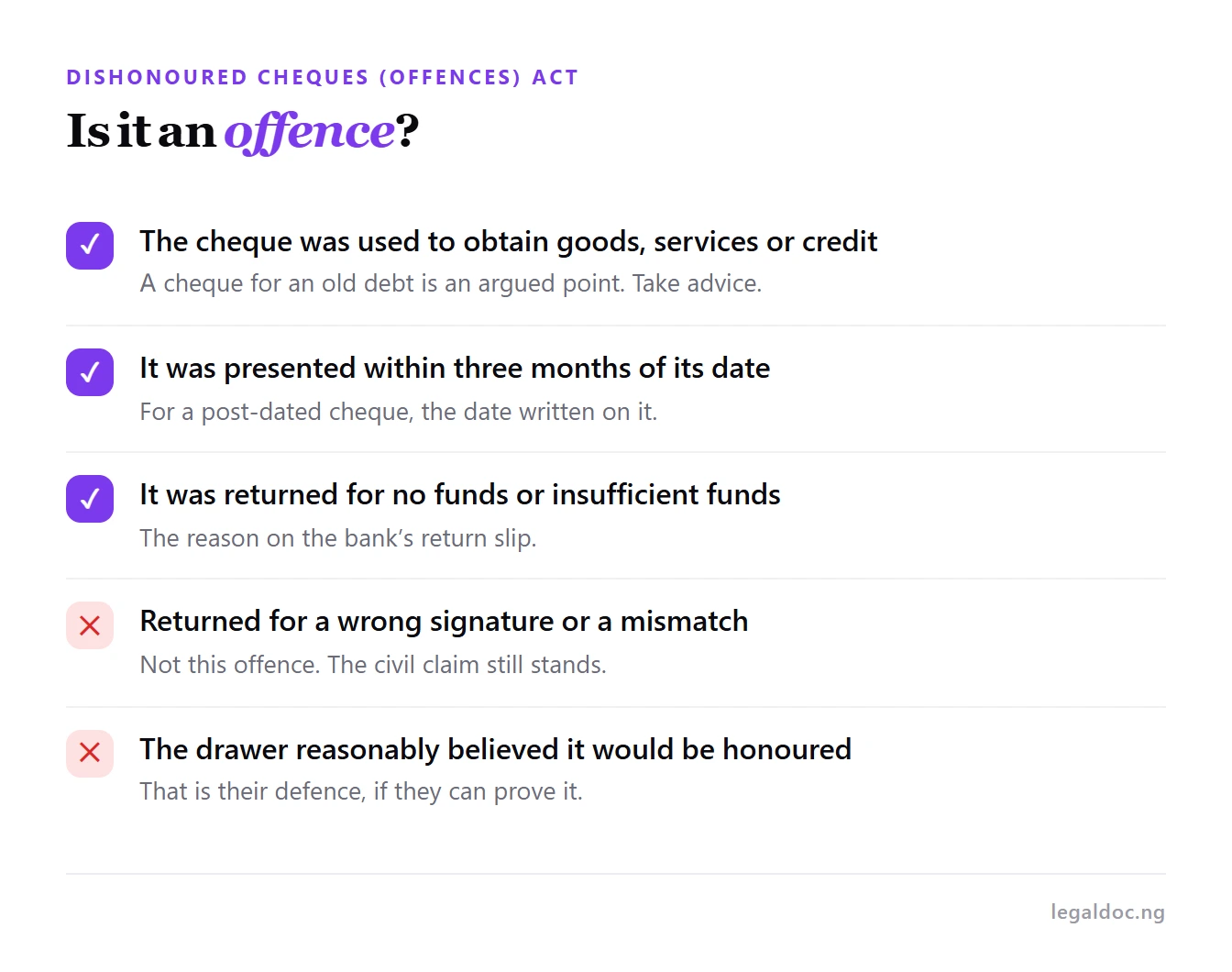
The reason on the bank's return slip decides a lot.
The three conditions
The cheque was used to get something. Goods, services or credit. A cheque given in exchange for a delivery, or as payment on a loan, is the classic case. Whether a cheque issued to settle an old debt fits within the offence is something lawyers argue about, so take advice before relying on the criminal route for that kind of cheque.
It was presented within three months of its date. The Act only bites on a cheque presented for payment no later than three months after the date written on it. So present promptly, and if you hold post-dated cheques as security, present each one on its date.
It bounced because there was not enough money. The offence is about cheques dishonoured because there were no funds, or insufficient funds, in the account. A cheque returned because the signature does not match, or the words and figures differ, is not this offence, though your civil claim is unaffected, and a deliberately defective cheque can raise other offences.
The penalty
For an individual, the Act provides for two years' imprisonment without the option of a fine. For a company, a fine, and directors or officers responsible for the company's conduct can be prosecuted too.
The defence
The drawer is not guilty if they can prove that, when they issued the cheque, they had reasonable grounds for believing, and did in fact believe, that it would be honoured when presented. A business that was expecting a large payment which then failed to arrive will often try to rely on this. Whether it works depends on the evidence.
Holding a bounced cheque? Ask what it means for your claim
Tell LegalDoc+ what the cheque was for and why it came back, and it explains the criminal and civil routes.
Ask LegalDoc+Two routes, two different goals
Once you know the cheque bounced for lack of funds, you have two routes, and you can use both. But it is worth being clear about what each one is for.
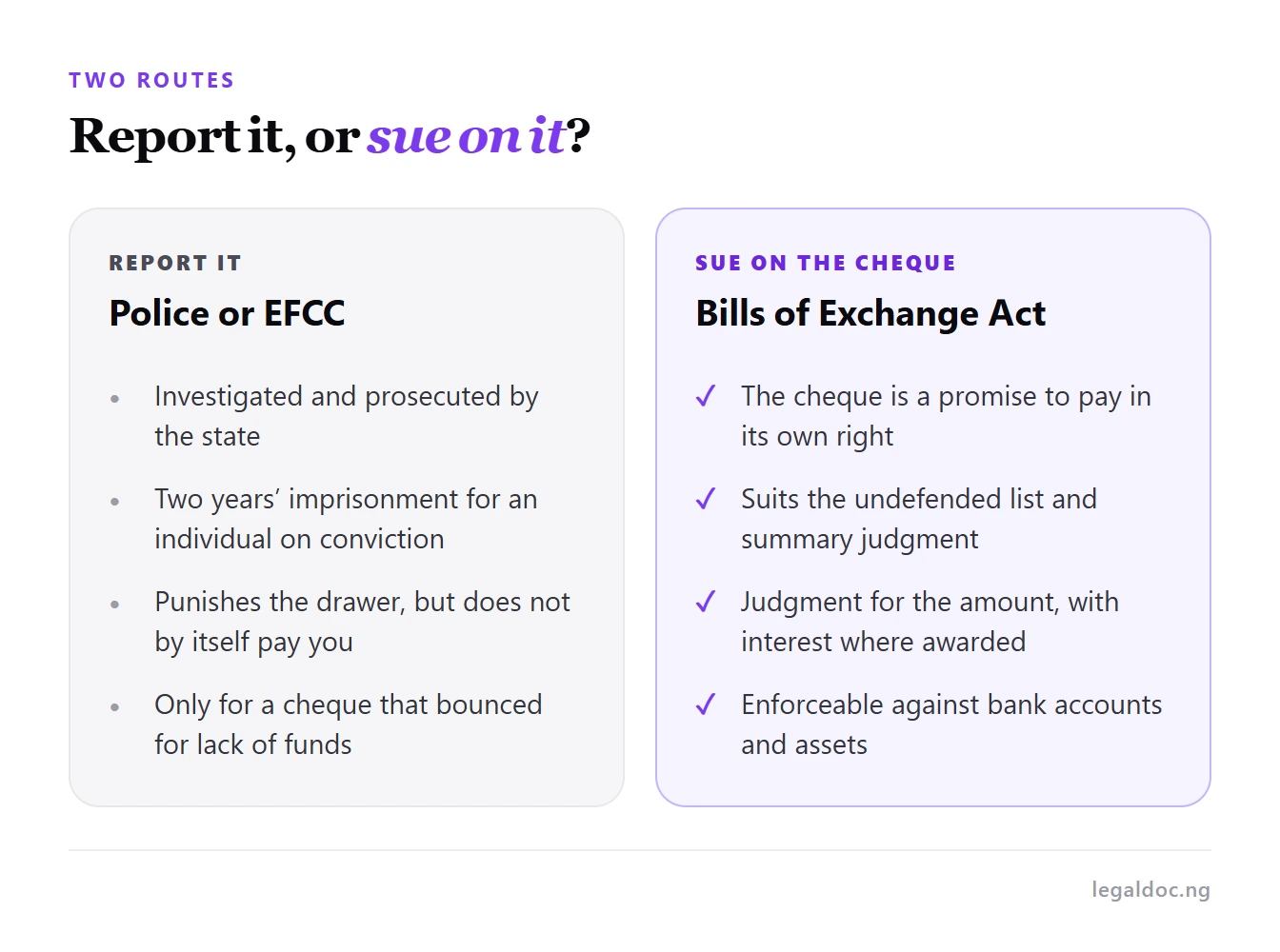
The criminal route punishes. The civil route is the one designed to pay you.
Reporting it
You can report a dud cheque to the police, or to the EFCC, which regularly prosecutes dud cheque cases, especially where larger sums or a pattern of fraud are involved. Bring the cheque, the return slip and the evidence of what it was given for.
Be realistic about what this achieves. A prosecution punishes the drawer; it does not, on its own, put money in your account. Courts do have powers to order a convicted person to compensate the victim, but that is not something to plan around. And reporting has to be honest: if the real dispute is about the quality of the goods or whether the money was owed at all, the police are not the place to resolve it.
Suing on the cheque
Under the Bills of Exchange Act, a cheque is a promise to pay that stands on its own, separate from the deal behind it. If it is dishonoured, you can sue the drawer on the cheque itself for the amount, with interest where the court awards it.
That matters because a signed cheque is about the clearest evidence of a debt there is. It is precisely the kind of claim that the High Court's undefended list and summary judgment procedures exist for, where judgment can be given without a full trial if the drawer has no real defence. Smaller sums can go to a Magistrate Court or, in Lagos, the small claims procedure. We walk through those routes, and how to enforce a judgment, in what happens after the demand letter.
A worked example
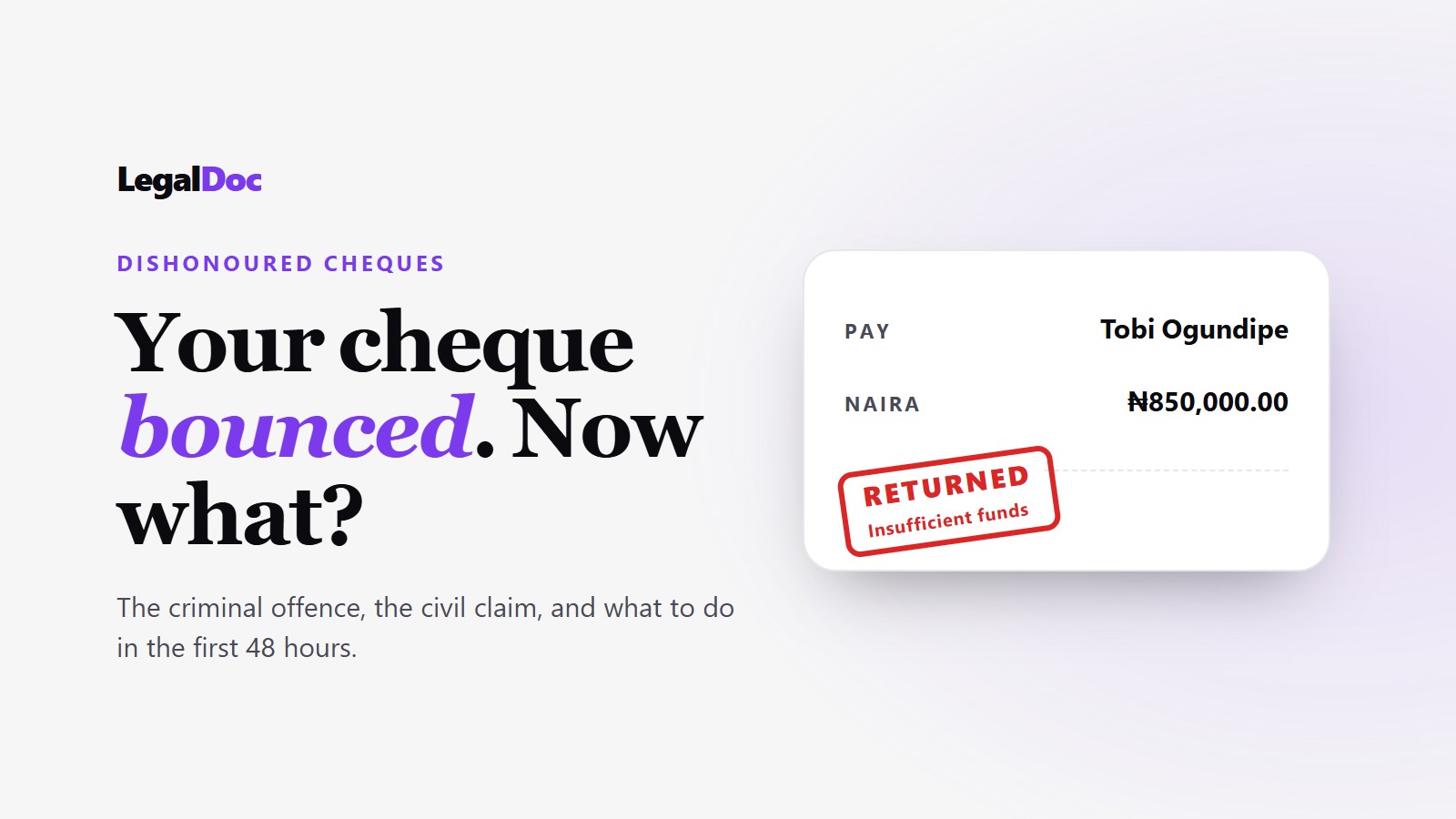
Here is what a typical returned cheque looks like when it comes back from the bank.
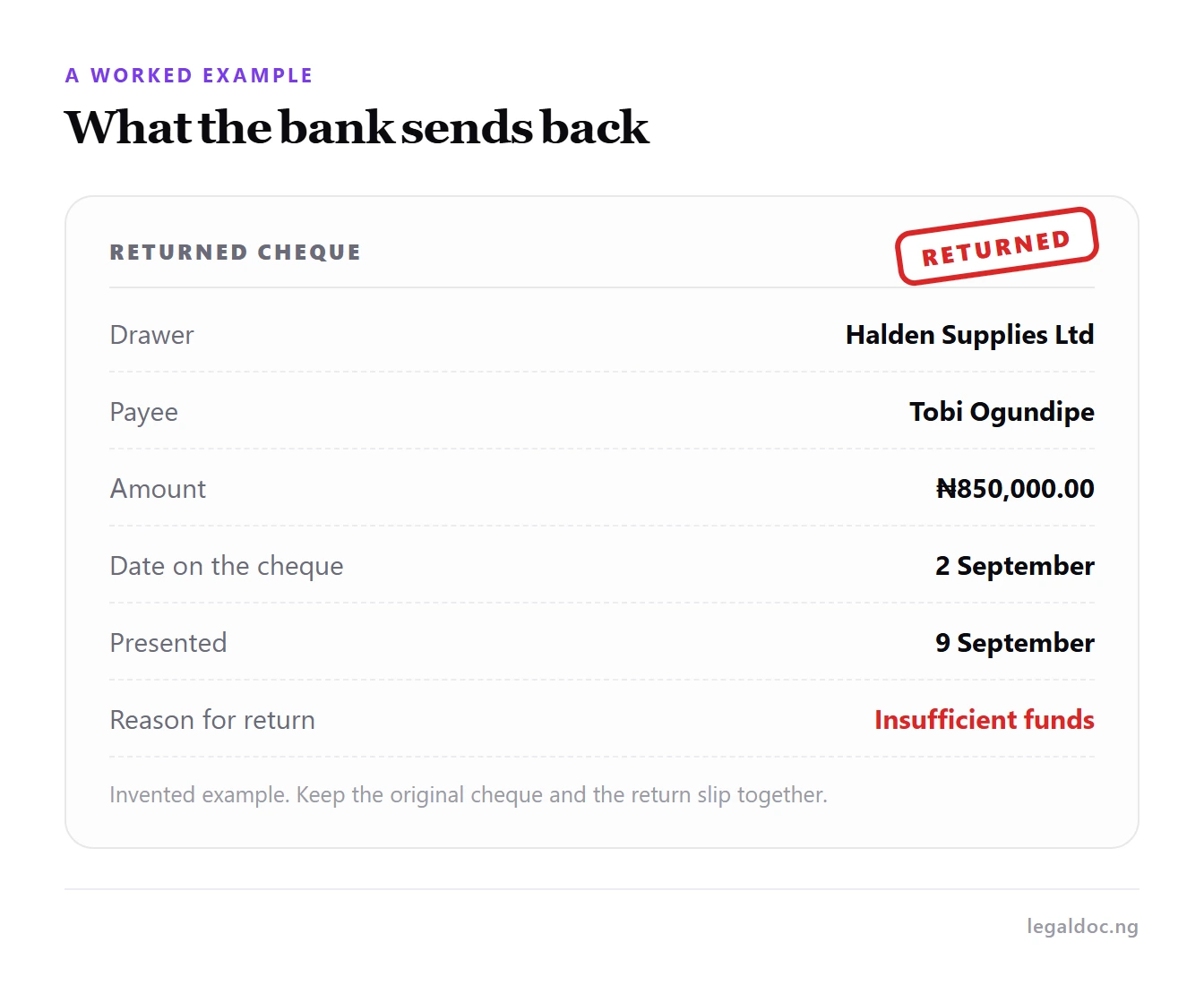
An invented example. The dates are what you need to note.
In this example the cheque was presented a week after its date, well within the three months, and returned for insufficient funds. Tobi has a straightforward civil claim on the cheque and, because he released the goods in exchange for it, a cheque that falls squarely within the Act. His first move is still the written message and a short deadline. Most drawers pay once they see the holder knows what the cheque means.
If you are the one who issued it
Sometimes the cheque that bounced is yours. Payments get delayed, a customer's transfer fails to land, and the account is short on the day.
Act fast. Call the holder before they call you, explain, and pay, either by transfer or by arranging for the cheque to be re-presented on a date you are sure of. Put any arrangement in writing. The defence of reasonable belief exists for genuine mistakes, but the best defence is never needing it.
And do not issue post-dated cheques you are not confident about. A post-dated cheque given as security for a loan is still a cheque, and the holder will present it on the day it says.
Preventing it next time
Do not release goods against a cheque until it has cleared. It feels slow and slightly rude, but it is standard practice, and anybody who objects to waiting for clearing is telling you something. For larger deals, ask for a transfer, a bank draft or a manager's cheque instead.
If you lend money, put the terms in a proper loan agreement rather than relying on post-dated cheques alone. The cheques are useful extra security, but the agreement is what spells out repayment dates, interest and what happens on default.
Frequently Asked Questions About Bounced Cheques in Nigeria
Is issuing a dud cheque a crime in Nigeria? It can be. Under the Dishonoured Cheques (Offences) Act, obtaining goods, services or credit with a cheque that is presented within three months of its date and bounced for lack of funds is an offence, unless the drawer reasonably believed it would be honoured.
What is the punishment for issuing a dud cheque? For an individual, two years' imprisonment without the option of a fine. For a company, a fine, and the directors or officers responsible can also be prosecuted.
Can I sue someone for a bounced cheque? Yes. A dishonoured cheque can be sued on in its own right under the Bills of Exchange Act, and because it is such clear evidence of the debt, it suits the undefended list or summary judgment procedures.
Should I go to the police or the EFCC? You can report a dud cheque to either, and the EFCC regularly prosecutes such cases. But a prosecution punishes rather than pays, so most holders also pursue, or start with, the civil claim.
Is a post-dated cheque covered? Yes. The three months run from the date written on the cheque, so a post-dated cheque should be presented on or soon after its date.
What if the cheque was returned for a wrong signature? That is not the offence under the Dishonoured Cheques Act, which is about lack of funds. You can still sue on the cheque, and a deliberately defective cheque may raise other offences.
Where this leaves you
A bounced cheque is not the end of the money. Keep the original, put the drawer on notice in writing, and note the dates. If they still do not pay, the cheque itself is one of the strongest debt claims you can bring, and the criminal law sits behind it for the cases that deserve it.