

Agree the limits before anything goes wrong
A service level agreement sets out the standard of service, what happens when it slips and how far each side is liable.
Draft a service level agreementA web designer takes a job worth a few hundred thousand naira. The client's contract is long, but it looks normal, and one clause near the end says the designer will "indemnify the Client against all losses, liabilities, costs and expenses howsoever arising". A year later the client's site is hacked, customer data leaks, and the client's lawyers point to that clause.
Two clauses decide how that story ends: the indemnity, and the limitation of liability. They sit near the back of almost every commercial contract, they are written in language that sounds like boilerplate, and between them they decide who pays when something goes wrong, and how much.
The short answer
An indemnity is a promise to cover the other side's losses if a particular thing happens, and it can reach further than an ordinary claim for breach. A limitation of liability caps what either side can be made to pay, and usually rules out certain kinds of loss, such as lost profits. A fair contract pairs them: indemnities limited to risks each side actually controls, a cap tied to the value of the contract, and an exclusion of indirect loss for both sides. An indemnity with no ceiling, on a small contract, is the clause to stop and question.
Two clauses that work as a pair
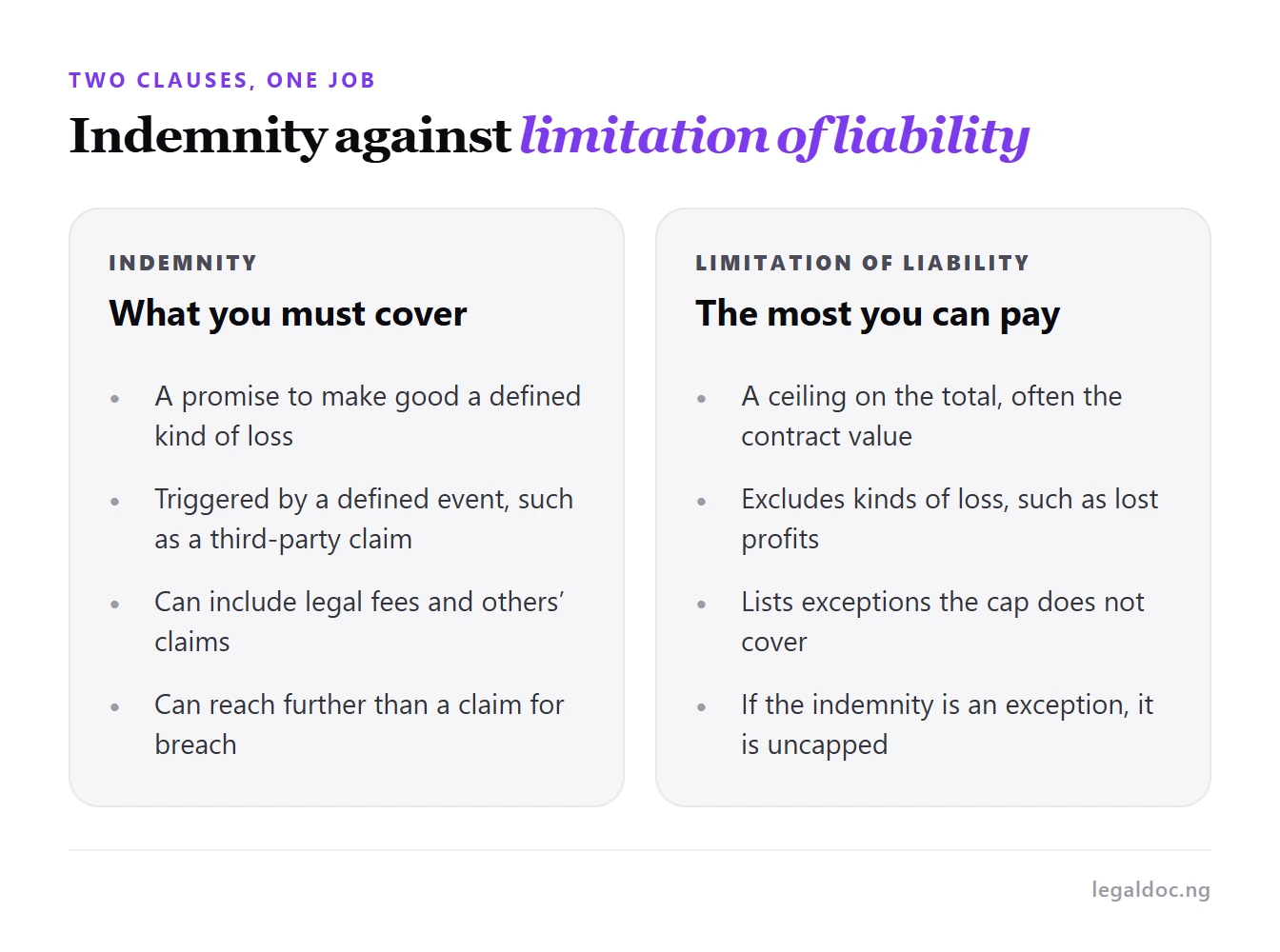
One decides what you must cover. The other decides the most you can ever pay.
What an indemnity does
Without an indemnity, if the other side suffers a loss because you broke the contract, they have to prove the breach, prove it caused the loss, and show the loss was the kind a court will compensate. An indemnity can shortcut all of that. It is a direct promise to make good a defined kind of loss when a defined event happens, often including legal fees and claims brought by third parties.
That is why indemnities are useful. A client is entitled to protection if your software infringes somebody else's copyright, because that risk sits with you. The problem is the indemnity that covers everything, "howsoever arising", including risks you have no control over.
What a limitation of liability does
A limitation of liability clause puts a ceiling on what one or both sides can be made to pay under the contract. It usually does two things: caps the total, often at the fees paid under the contract, and excludes particular kinds of loss altogether, typically indirect or consequential loss and loss of profit.
Then it lists exceptions, things the cap does not apply to, such as fraud or breach of confidentiality. And here is where the two clauses meet: if the indemnities are on that list of exceptions, they are uncapped, however carefully the rest of the clause is drafted.
The words to look for
These clauses are written in a recognisable vocabulary. Once you know what each phrase does, they are much easier to read.
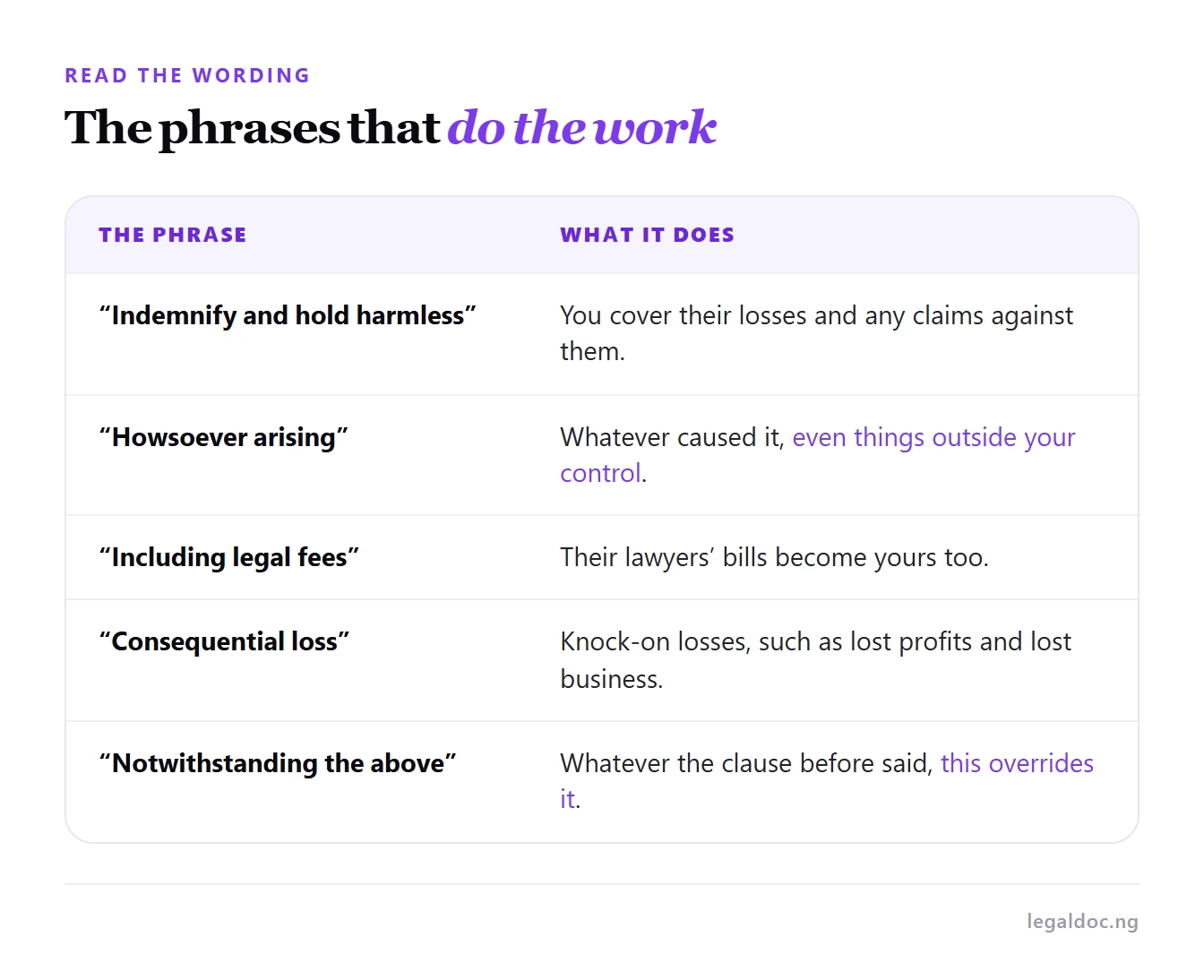
"Howsoever arising" is the phrase that turns a reasonable indemnity into an unreasonable one.
One-sided against balanced
A one-sided version is not necessarily drafted in bad faith. It is drafted by somebody whose job was to protect their own client. Your job, before you sign, is to bring it back to the middle.
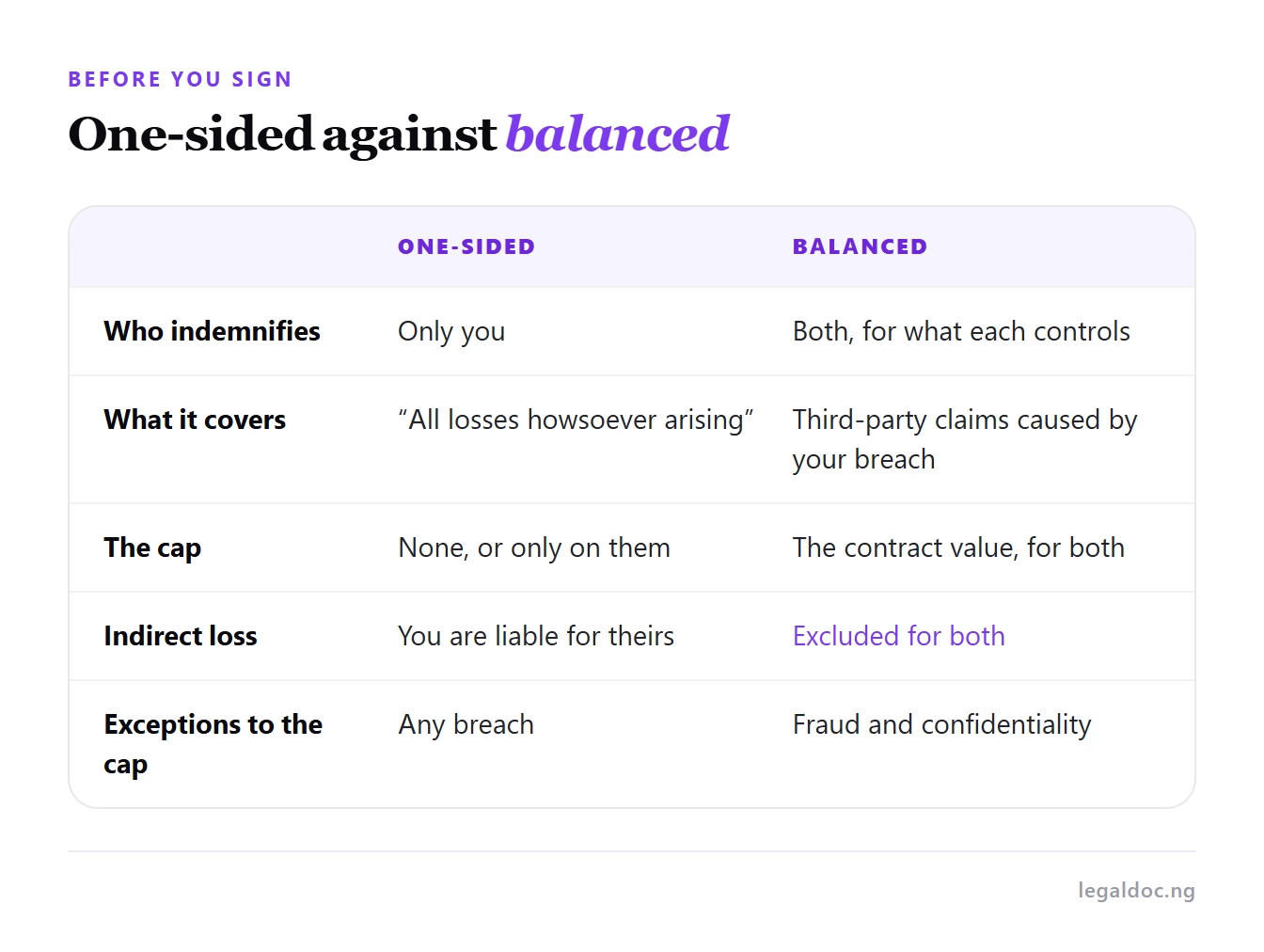
The balanced column is what most reasonable counterparties will accept.
How a claim actually plays out
When something goes wrong, the two clauses are applied in a particular order. It helps to walk through it before you sign, with the worst realistic event in mind.
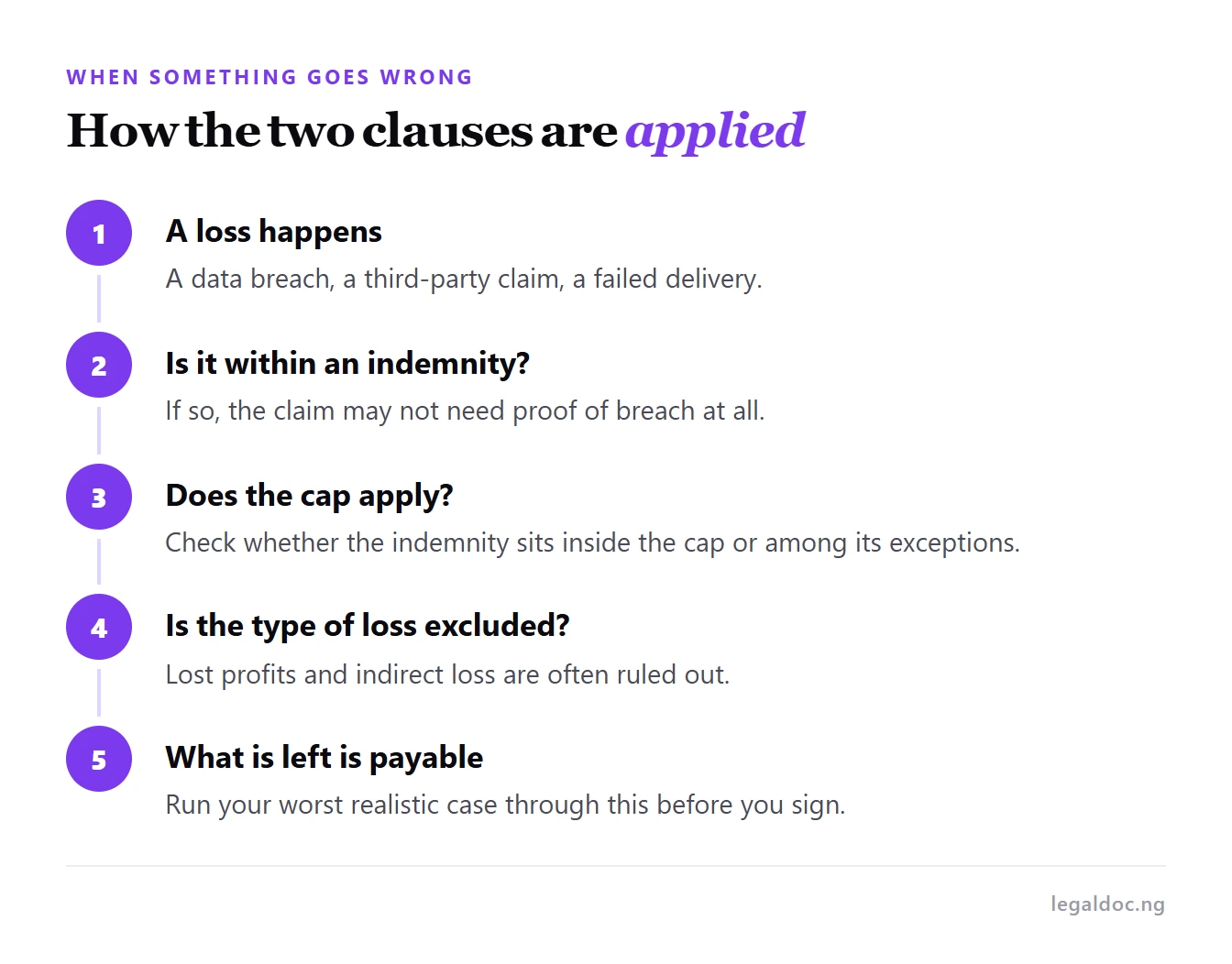
Run your worst-case scenario through these steps before you sign.
Is your liability capped? Ask before you sign
Upload the contract and LegalDoc+ finds the indemnity and limitation clauses, explains them and suggests fairer wording.
Ask about my contractLimitation of liability: what a fair cap looks like
There is no single right figure, but some reference points are widely accepted:
- Tie it to the deal. The total fees paid or payable under the contract, or the fees paid in the last twelve months, is the most common cap for service contracts.
- Make it mutual. If the cap protects them, it should protect you.
- Exclude indirect loss both ways. Neither side should be liable for the other's lost profits or knock-on business losses unless that has been specifically priced in.
- Keep the exceptions narrow. Fraud, deliberate wrongdoing and breach of confidentiality are normal exceptions. "Any breach of this Agreement" is not an exception, it is the whole contract.
A plain clause that does all of this can be short. For example: "Each party's total liability under this Agreement shall not exceed the fees paid or payable under it. Neither party is liable for indirect or consequential loss or loss of profit. Nothing in this clause limits liability for fraud."
Will a Nigerian court enforce these clauses?
Generally, yes, if they are clearly part of the contract and clearly worded. Nigerian courts apply the common-law approach: a clause that excludes or limits liability is read strictly, and any real ambiguity is resolved against the party relying on it. A clause meant to cover a party's own negligence usually has to say so plainly.
Consumer contracts are different. The Federal Competition and Consumer Protection Act protects consumers against unfair and unreasonable terms, so a business selling to the public cannot rely on sweeping exclusions the way two businesses negotiating with each other can.
The practical lesson is that a clause you dislike will probably be enforced if it is clear. Negotiate it before you sign rather than hoping a court will rescue you later.
What to ask for
Specific requests work better than general objections. These are the ones counterparties most often accept:
- "Please limit the indemnity to third-party claims caused by our breach or negligence."
- "Please make the indemnities mutual."
- "Please cap total liability at the contract value, with the indemnities inside the cap."
- "Please exclude indirect loss and loss of profit for both parties."
- "Please remove 'howsoever arising'."
If the other side insists on an uncapped indemnity for a genuine risk, consider whether insurance can carry it, and price the contract accordingly.
Spotting these clauses before they cost you
Indemnities are the clause people most often sign without understanding, because they are written to sound routine. LegalDoc+ flags them on its own: upload the contract and the free check lists each risky clause by severity, with an uncapped indemnity on a small contract near the top. The full review explains what the clause could cost you under Nigerian law and gives you the wording to propose instead.
If you are drafting the contract yourself, a LegalDoc service level agreement, consulting agreement or freelance agreement starts from balanced liability terms. For the other clauses worth checking before you sign, see our contract review checklist.
Frequently Asked Questions About Indemnity and Limitation of Liability
What is an indemnity clause? A promise by one party to cover the other's losses if a defined event happens, such as a third-party claim caused by its work. It can reach further than an ordinary claim for breach of contract, which is why its wording matters.
What is the difference between an indemnity and a limitation of liability? An indemnity decides which losses one side must cover. A limitation of liability caps the total either side can be made to pay and usually excludes certain kinds of loss. If an indemnity sits outside the cap, it is uncapped.
Is an unlimited indemnity enforceable in Nigeria? Between businesses, a clearly worded indemnity will generally be enforced, even if it is one-sided. Consumers have extra protection against unfair terms under the Federal Competition and Consumer Protection Act. Negotiate it before signing.
What is consequential loss? Indirect losses that flow from a breach, such as lost profits or lost business, rather than the immediate cost of fixing the problem. Most balanced contracts exclude it for both sides.
Should a limitation of liability be mutual? Usually, yes. A cap that protects only one side leaves the other fully exposed for the same contract.
Where this leaves you
Read the indemnity and the limitation of liability together, because they only make sense as a pair. Ask what the worst realistic event would cost you under them, and whether that is a risk you are being paid to carry. If it is not, ask for a cap, a mutual clause and a narrower indemnity before you sign.