

Sending the contract yourself? Start from a fair one
Service, supply, consultancy, loan and partnership agreements written for Nigerian law. Answer a few questions and download.
Browse the contractsIt usually arrives with a deadline. The supplier needs it back by Friday, the landlord has another tenant waiting, the new client wants to start on Monday. "It is our standard agreement," they say. "Everybody signs it."
So you skim it, sign it, and file it. Most of the time nothing happens. But when something does go wrong, a late payment, a cancelled order, a dispute about what was promised, that document you skimmed is the only thing anybody will look at. This contract review checklist is the ten minutes that stops you finding out what you agreed to at the worst possible moment.
The short answer
Before you sign any contract, check twelve things: who the parties are, what exactly is being delivered, the price and what it includes, when payment is due, how long the contract lasts and whether it renews itself, how either side can end it, who pays if something goes wrong, any penalties, what you cannot do afterwards, who owns the work, how disputes are resolved, and the small print at the end. Nigerian courts generally hold you to what you signed whether or not you read it, so read it first.
Why ten minutes matters
The rule that surprises most people is simple. If you sign a contract, you are bound by it, even if you did not read it and even if the clause that hurts you was in small print. Courts in Nigeria, like courts elsewhere, will rarely let somebody out of a signed agreement because they did not understand it.
That cuts both ways. A contract that protects you is enforceable too. The point of reviewing it is not suspicion of the other side. It is making sure the document says what you both actually agreed.
How to use this contract review checklist
Read the contract twice. The first time, read it straight through to understand the deal. The second time, go through the checks below in order. They start with the basics, who and what and how much, and move to the clauses that decide what happens when things go wrong.
Keep a pen, or a comment tool, ready. Every time something is unclear, missing or one-sided, mark it. You are building a list of questions, not deciding yet whether to sign.
The first six checks: who, what and how much
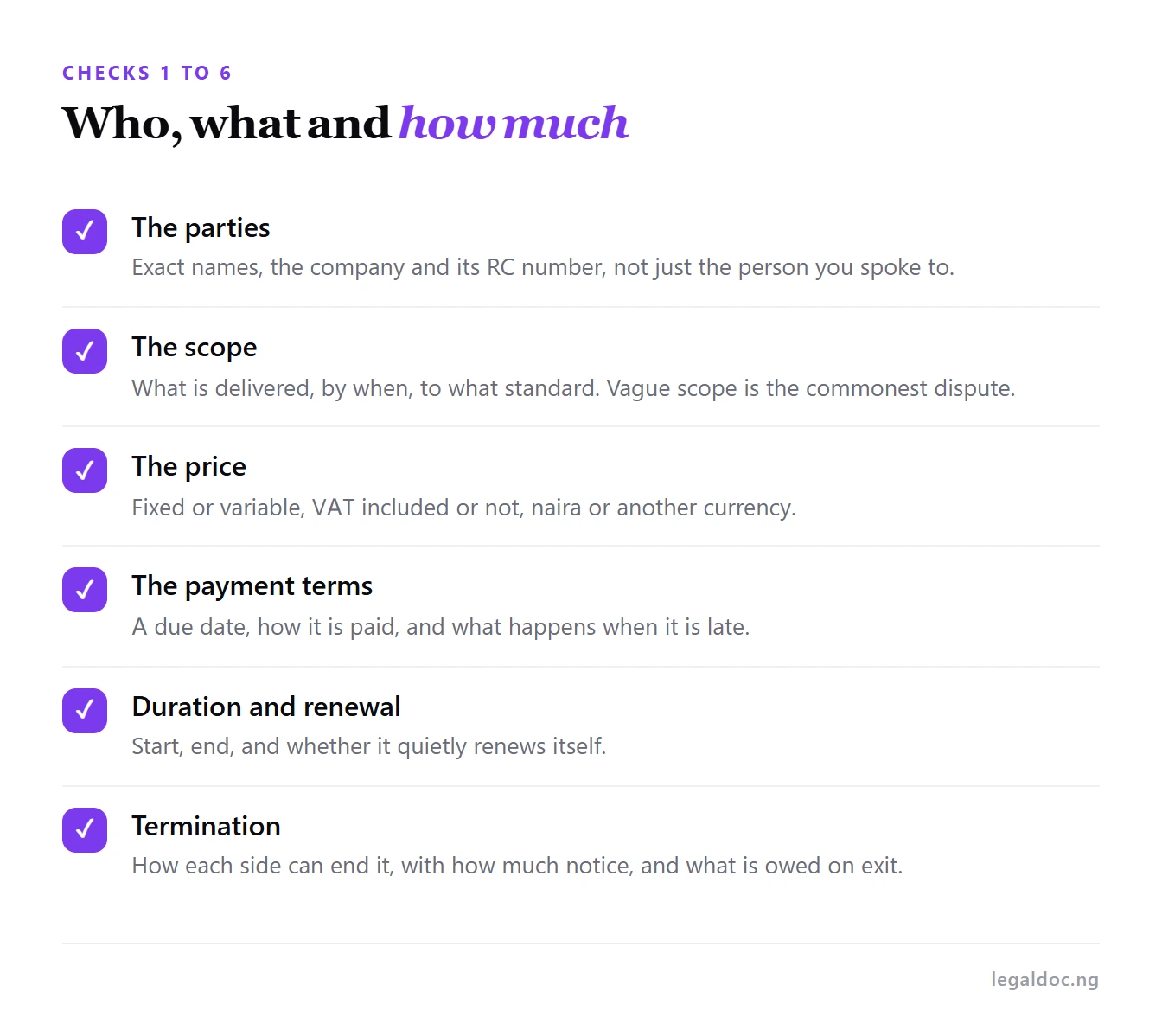
Most disputes start with one of these six being vague.
The parties
Check the exact names. If you are dealing with a company, the contract should name the company, with its RC number, not just the director you have been talking to. A contract with "Mr Ade of Swift Logistics" is a contract with Mr Ade, and you may struggle to hold the company to it. You can confirm the company exists on the CAC's public search.
The scope
What exactly is being delivered, by when, and to what standard? "Website design services" is not a scope. "A five-page website, mobile responsive, delivered by 30 November, with two rounds of revisions" is. Anything left vague will be argued about later.
The money
Is the price fixed? Does it include VAT? Is it in naira or another currency? When is it due, how is it paid, and what happens if it is late? A contract with no due date and no late-payment consequence is very hard to enforce, which is exactly why some are drafted that way.
Duration, renewal and the way out
When does it start, when does it end, and does it renew automatically? Then the most important question in the whole document: how can each side end it, with how much notice, and what is owed on the way out? A termination clause that lets them leave on thirty days while you are locked in for two years is not unusual, and not acceptable without good reason.
The next six checks: risk, restrictions and the small print
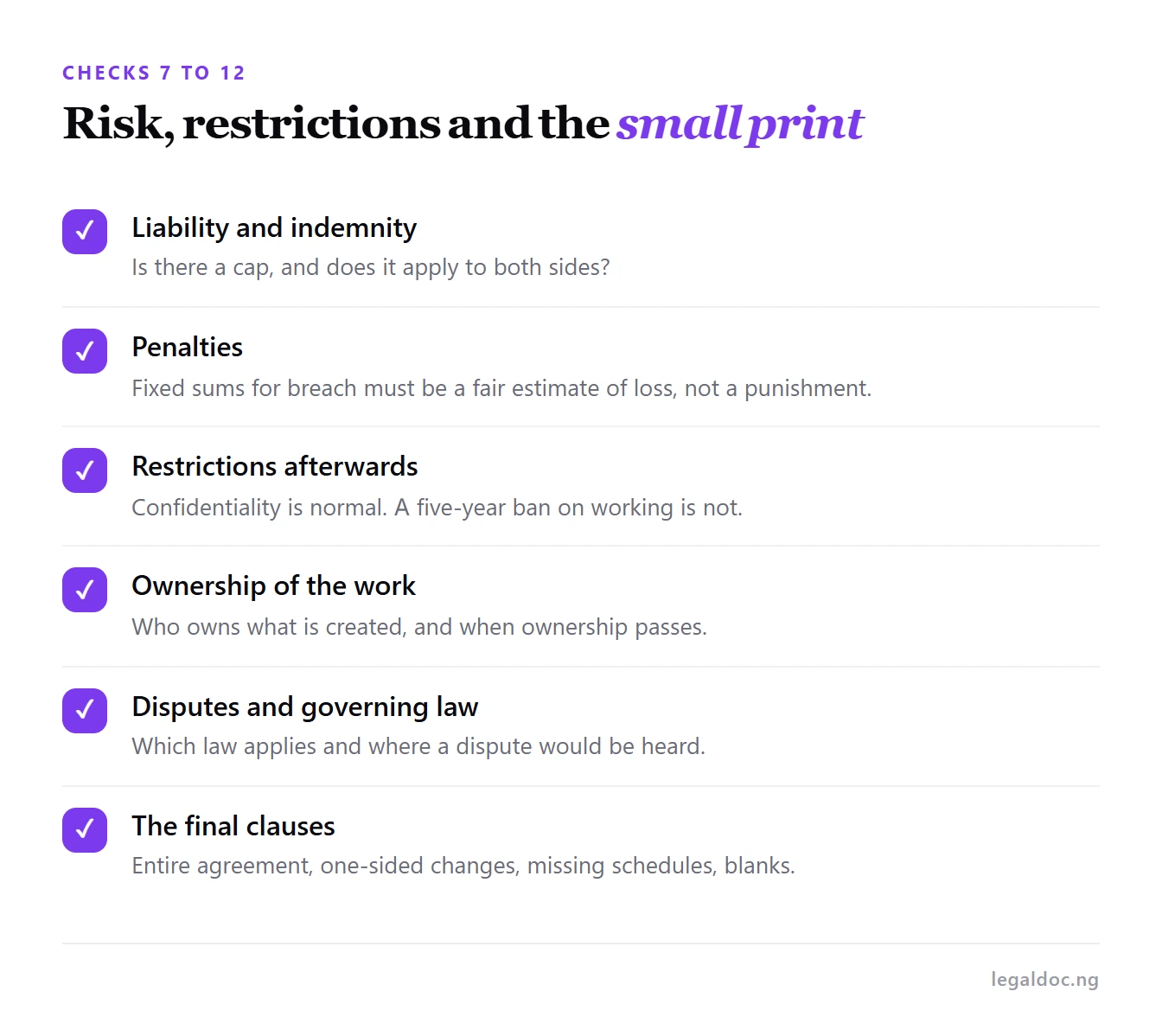
These decide who pays when something goes wrong.
Liability and indemnity
Look for any clause where you "indemnify" the other party or are "liable for all losses". An indemnity with no ceiling can make you responsible for losses far larger than the contract is worth. We explain how to read these clauses, and what to ask for instead, in indemnity and limitation of liability.
Penalties
Some contracts set a fixed sum payable if you breach, such as a charge for every day of delay. Nigerian courts will enforce an agreed sum that is a genuine estimate of the likely loss, but not one that is really a punishment. If the figure looks out of proportion, raise it before you sign rather than relying on a court later.
Got a contract to sign? Have it checked first
Upload it and see every clause worth knowing about, ranked by how serious it is, before you put your name to it.
Ask LegalDoc+ to check itRestrictions after the contract ends
Confidentiality obligations are normal. A clause stopping you working in your industry for five years is not. We cover what makes a restriction reasonable in the elements of a non-compete.
Who owns the work
If you are creating anything, designs, software, writing, photographs, check who owns it when the contract ends and whether you can use it in your portfolio. If you are paying for it, check that ownership actually passes to you on payment.
Disputes and governing law
Which law applies, and where would a dispute be heard? A Nigerian business signing a contract governed by English law, with arbitration in London, has agreed to a very expensive way of resolving a small disagreement. We look at this clause in the importance of a dispute resolution clause.
The small print at the end
Two clauses at the back deserve a careful read. An "entire agreement" clause means anything promised in conversation, emails or WhatsApp, but not written into the contract, does not count. And a clause letting one side "amend these terms from time to time" means the contract you sign may not be the contract you end up with. Finally, check that every schedule or annex mentioned is actually attached, and that no blanks are left to be filled in later.
Red flags that look harmless
Some of the most one-sided clauses are written in perfectly calm language. Here is what a few common ones actually mean.
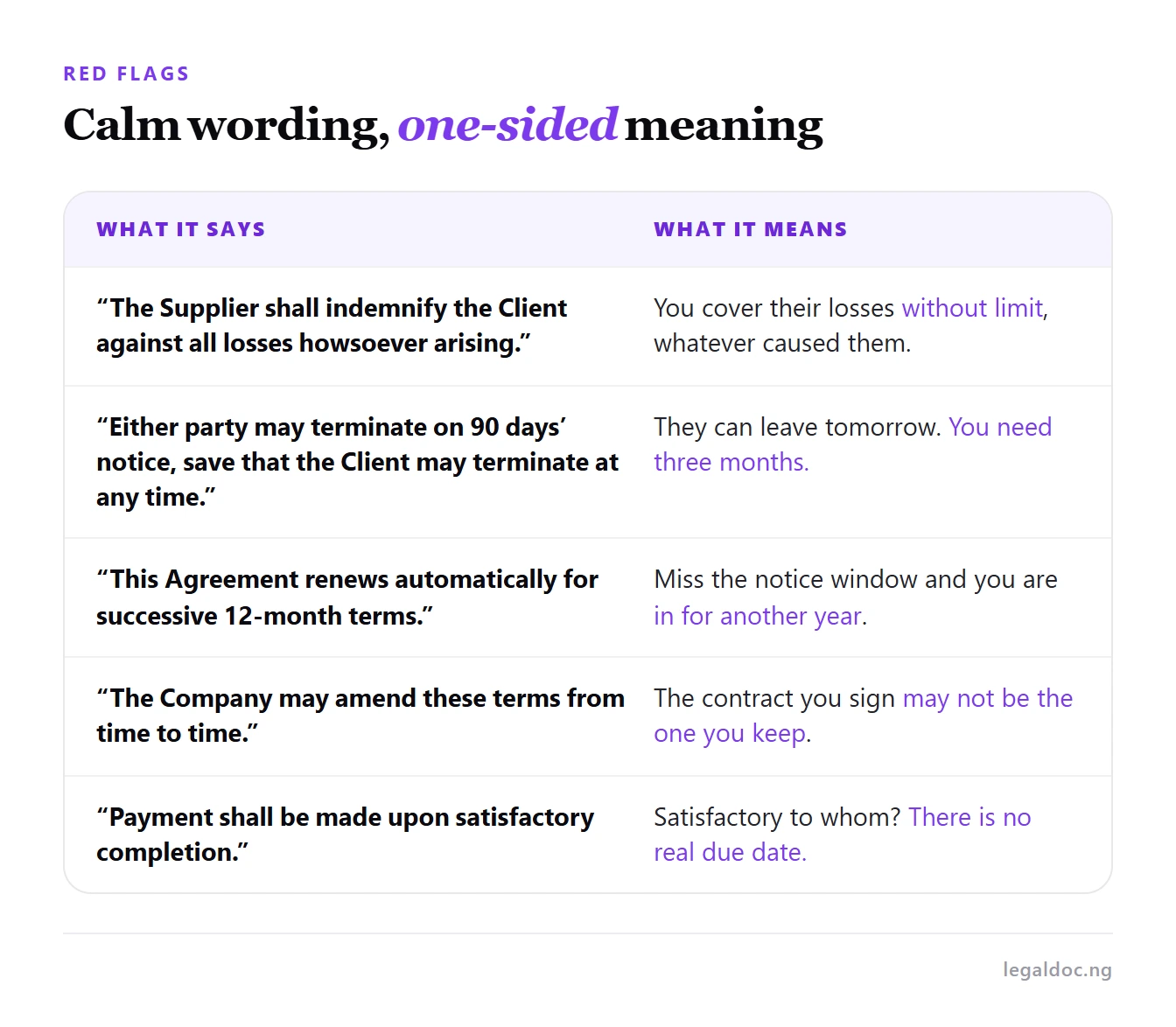
If a clause makes you uneasy when you read it slowly, it deserves a question.
"It is our standard contract"
Standard does not mean non-negotiable. It means this is where they would like to start. Large companies, banks and government agencies agree changes to their standard terms all the time, especially when the request is specific and reasonable: a cap on liability, a payment date, mutual rather than one-way termination.
The way you ask matters. "I am not comfortable with this contract" goes nowhere. "Clause 9 makes me liable without limit. Can we cap it at the contract value?" usually gets a sensible answer.
What to do when you find a problem
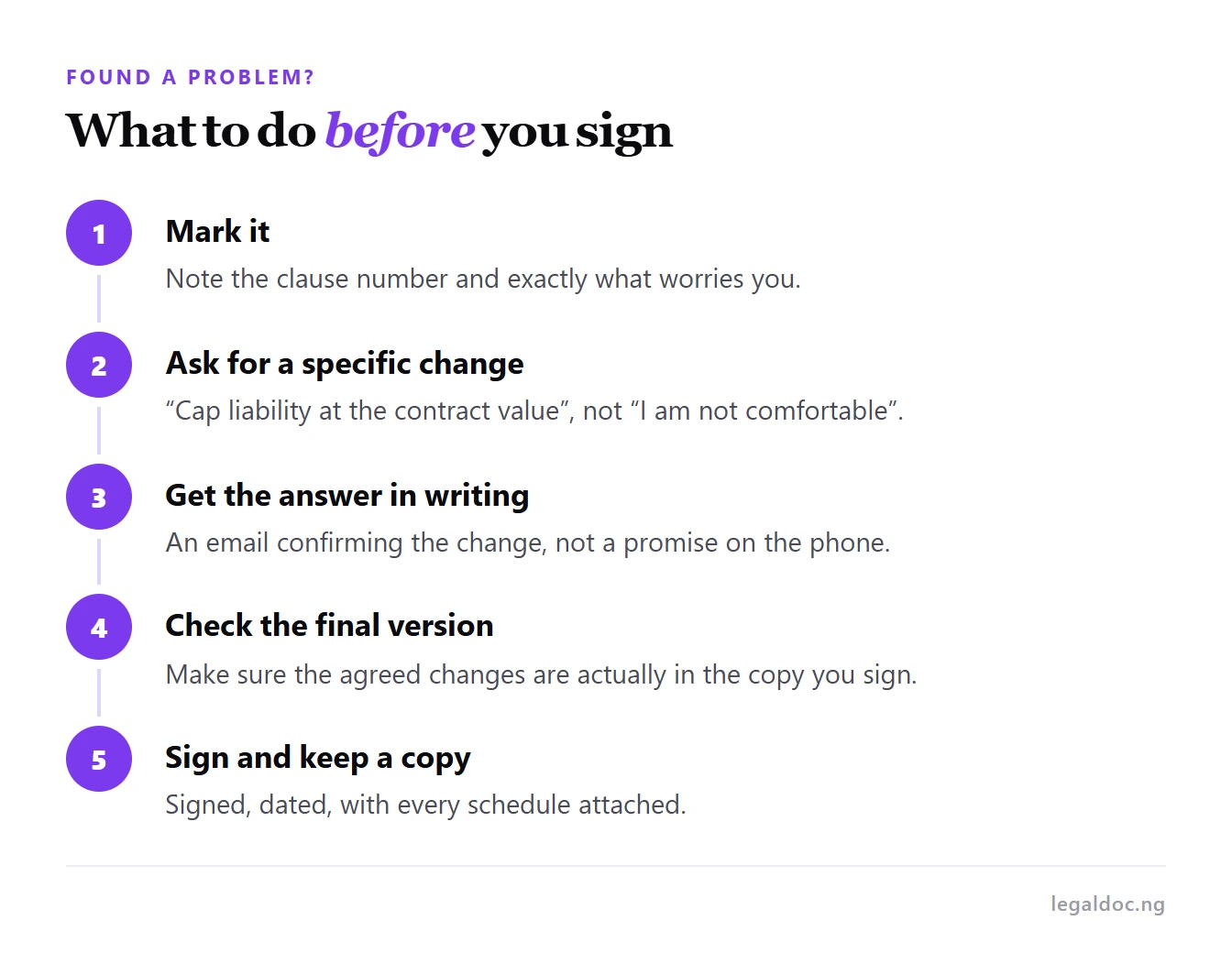
Never sign on the promise that a clause "will not be enforced".
If they say a clause is never used in practice, ask them to remove it. If it is never used, removing it costs them nothing. If they refuse, you have learned something important about the clause.
A second pair of eyes
For a short, low-value contract, this checklist may be all you need. For anything that matters, a lease, a supply deal, an employment contract, an investment, it is worth having it read properly.
That is what LegalDoc+ is for. Upload the contract as a PDF, Word file or photo, tell it what is worrying you, and within minutes it identifies the document and the parties and lists everything worth knowing, ranked by how serious it is. The full review then explains each finding under Nigerian law, what it could cost you, and the wording to ask for instead, so you go back to the other side with specific changes rather than a vague unease. We walk through a real review in how to review a contract in minutes.
And if you are the one preparing the contract, start from a document drafted for Nigerian law rather than one copied from the internet. A service level agreement, consulting agreement or sale of goods agreement from LegalDoc already covers the twelve checks above.
Frequently Asked Questions About Reviewing a Contract
What should I check before signing a contract? The parties, the scope, the price and payment terms, the duration and renewal, termination, liability and indemnity, penalties, restrictions after the contract ends, ownership of work, dispute resolution, and the final clauses on changes and the entire agreement.
Am I bound by a contract I did not read? Generally, yes. If you signed it, Nigerian courts will usually hold you to its terms whether or not you read them, which is why a review before signing matters.
Can I ask for changes to a standard contract? Yes. Standard terms are a starting point. Specific, reasonable requests such as capping liability or making termination mutual are often accepted, even by large companies.
What are the biggest red flags in a contract? Unlimited indemnities, termination that only one side can use, automatic renewal with a long notice period, a right for one side to change the terms, vague scope, and payment terms with no due date.
Do I need a lawyer to review a contract? For anything significant, a proper review is worth it. LegalDoc+ reviews a contract in minutes under Nigerian law and tells you what to ask for, and our team can help further where a matter needs it.
Where this leaves you
Ten minutes with a contract review checklist will not make you a lawyer, but it will stop you signing the obvious traps. Read it twice, mark what is unclear, ask for specific changes in writing, and sign only the version you have actually agreed. The time to negotiate a contract is before your name is on it.