

Agree what happens to a founder’s shares before anybody needs to
A shareholders agreement with a buy-out on death, a valuation method and how the buy-out is funded.
Draft a shareholders agreementNobody likes this question, which is exactly why so few founders have answered it.
You built the company. You are the director, the main shareholder, the only signatory on the bank account and the person who knows where everything is. Now imagine you are suddenly not there. Who pays the staff at the end of the month? Who signs the cheque for the supplier? Who decides anything at all?
In a surprising number of Nigerian businesses, the honest answer is nobody, for months. The company survives you, legally. Whether the business does is another matter, and it depends almost entirely on what you put in place while you were here.
The short answer
A limited company does not die with its owner. It carries on as a separate legal person, with its contracts, staff and assets. But your directorship ends at death and does not pass to your heirs, your shares become part of your estate and can only be dealt with once your executors or administrators obtain a grant, and the bank may restrict the account until a new mandate is in place. If you were the only director and the main shareholder, the business can be stuck until then. A second director, a shareholders' agreement with a buy-out on death, and a will that deals with your shares prevent most of this.
What carries on, and what stops
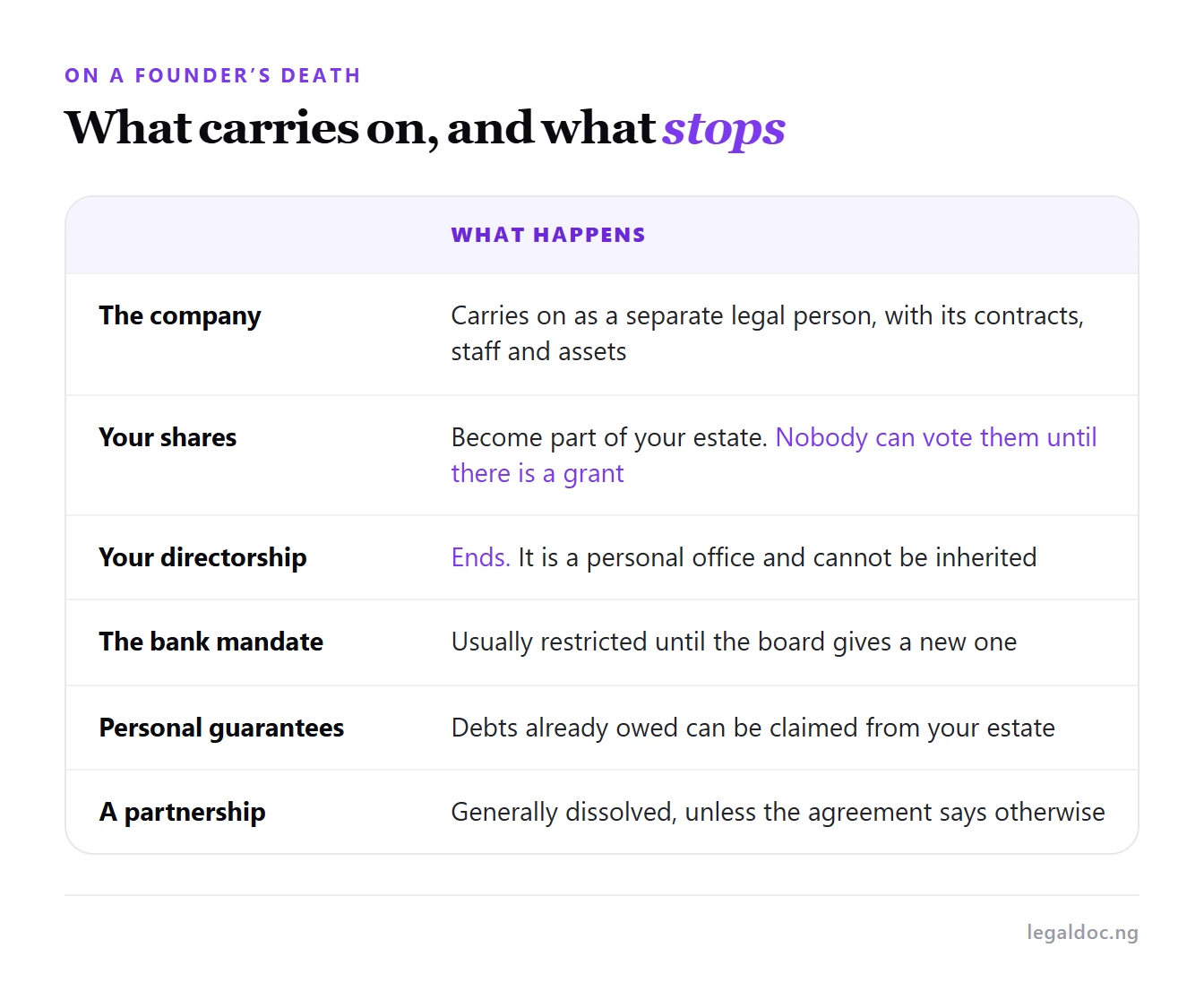
The company carries on. The person-shaped holes are the problem.
The company carries on
Under the Companies and Allied Matters Act 2020, a company is a legal person in its own right, with perpetual succession. Your death does not end its contracts, dismiss its staff or transfer its property. The lease is still the company's lease. The customer contracts are still the company's contracts.
Your directorship ends
Being a director is a personal office, not property. It cannot be left to anybody in a will, and your spouse or eldest child does not inherit it. New directors have to be appointed in the way the company's articles provide, usually by the remaining directors or by the shareholders.
Your shares go to your estate
Your shares, on the other hand, are property. They pass under your will, or under the rules of intestacy if you leave no will. But they do not pass the day you die. The company will recognise your executors or administrators only once they produce a grant of probate or letters of administration. Until then, nobody can vote your shares.
That gap is the danger. Getting a grant commonly takes several months, and longer where there is no will, as we explain in how letters of administration work.
The sole director problem
CAMA 2020 lets a small company operate with a single director, and many Nigerian founders do exactly that. It is convenient while you are alive. It can be paralysing when you are not.
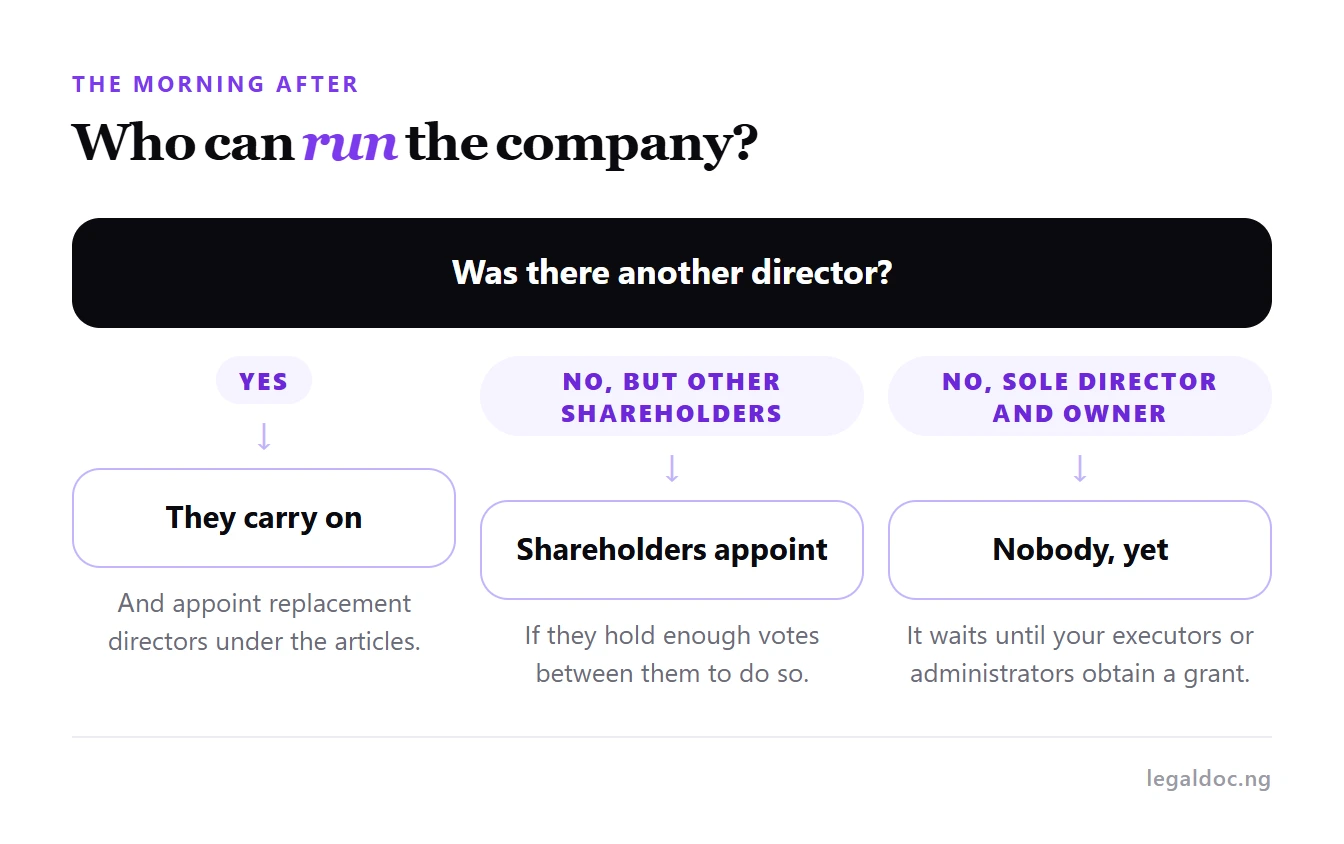
A one-person company has nobody to appoint the next person.
If you were the only director and the only or majority shareholder, there is no board left to act and nobody who can vote your shares to appoint a new one until the grant is issued. The bank will not accept new signatories without proper authority. Salaries, supplier payments, tax and pension remittances can all stop, and contracts the company cannot perform can start to fall away.
The simplest protection is a second director: somebody you trust, who knows the business, and who can keep it running and call a meeting when needed. If you want to stay the sole decision-maker in practice, the shareholders' agreement and the articles can still keep control where you want it while making sure there is always somebody legally able to act.
The bank account
Banks act on a mandate: the board resolution that says who may sign for the company. When a signatory dies, the bank will usually restrict the account until it receives a new mandate from the board. If you were the only signatory, that can mean nothing goes out at all.
Have at least two people on the mandate, with clear rules on who can approve what. It is a governance improvement anyway, long before it becomes a succession plan.
How your shares reach your family
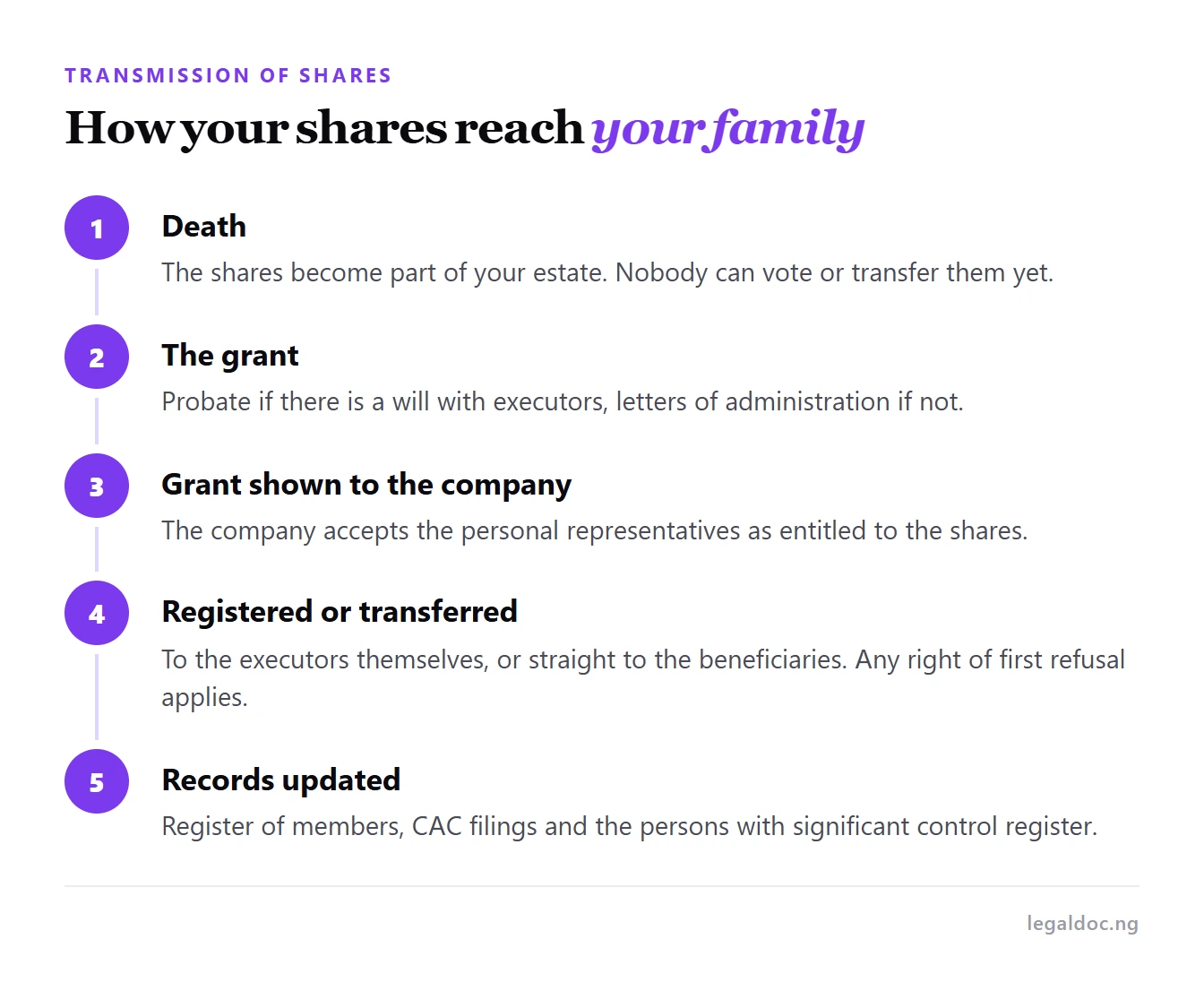
Nothing moves until the grant. Everything after it is paperwork.
Would your company survive you? Ask what is missing
Describe how your company is set up and LegalDoc+ points out the gaps in your succession plan.
Ask LegalDoc+Once your executors or administrators have the grant, they can either be registered as holders of your shares themselves, or transfer them to the people entitled under your will or the law. The company's register of members and its filings with the CAC are then updated, including its record of persons with significant control.
Two things can complicate this. The articles may give the other shareholders a right of first refusal before shares go to anybody outside the company. And your family may inherit a large stake in a business they do not understand and cannot run, while your co-founders find themselves in business with people they never chose.
The shareholders' agreement fixes most of it
This is where a well-drafted shareholders' agreement earns its keep. The usual solution is a buy-out on death:
- An option to buy. When a shareholder dies, the remaining shareholders, or the company, can buy the deceased's shares, and the estate can require them to.
- A fair price, agreed in advance. A valuation method fixed now, while everybody is alive and on good terms, not argued about at a funeral.
- Money to pay for it. Often life insurance on each founder, so that the surviving shareholders can actually afford to buy the shares.
The family receives cash at a fair value, which is usually what they need. The business stays with the people who run it. Nobody has to negotiate in grief. We cover what else belongs in the agreement in founders' and shareholders' agreements.
Your will, and what it should say
Your will decides who receives your shares if they are not bought out, and it names the executors who will deal with them. For a business owner, that choice matters. An executor who understands companies, or who will take advice, can get the grant and deal with the shares far faster than one who does not know where to start.
Say specifically what happens to your shares. Consider whether they should go to one person who will be involved in the business, or be shared, with a buy-out providing cash for the others. And make sure your executors can find the company's documents. Our will template lets you deal with business interests directly.
One common misunderstanding: a power of attorney is not a substitute. A power of attorney ends when the person who gave it dies, so it cannot be used to run your company after your death.
If the business is not a limited company
A business name. A sole proprietorship registered as a business name is not a separate legal person. Its assets are simply your assets, so they form part of your estate, and the business continues only if somebody inherits it and registers the change with the CAC.
A partnership. Under the partnership laws, a partnership is generally dissolved when a partner dies, unless the partnership agreement says otherwise. A partnership agreement that provides for the surviving partners to continue and buy out the deceased's share avoids an automatic winding up.
Personal guarantees
Many founders have personally guaranteed the company's loans or its office lease. Debts already owed under a guarantee you signed can be claimed from your estate. Keep a list of the guarantees you have given, and make sure your executors know about them.
Six things to put in place this year
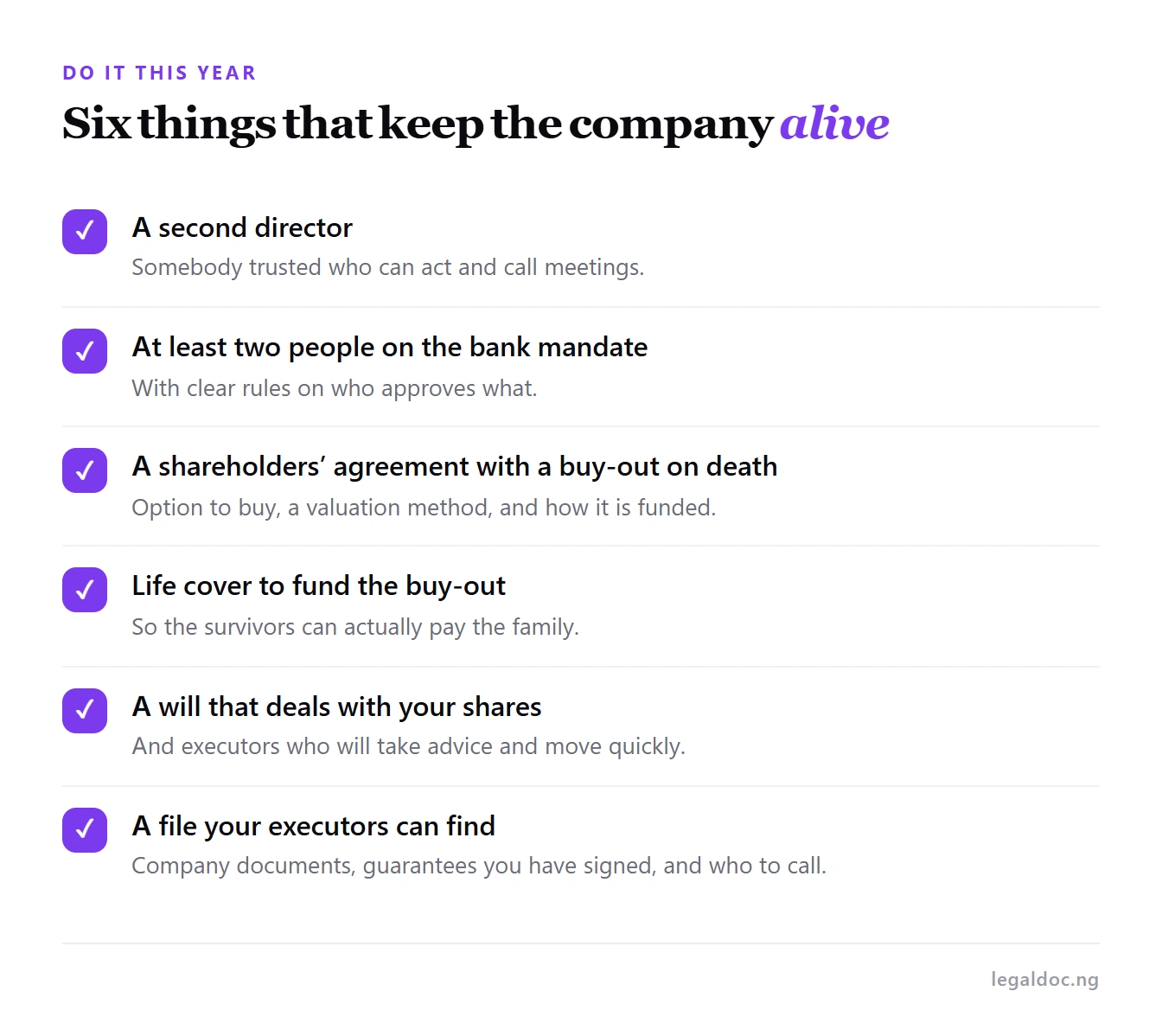
None of these takes long. All of them are harder to do in a hurry.
Frequently Asked Questions About a Founder's Death in Nigeria
What happens to a company when the owner dies in Nigeria? The company continues as a separate legal person. The owner's directorship ends, and their shares become part of their estate, to be dealt with by their executors or administrators once they obtain a grant of probate or letters of administration.
Can I leave my directorship to my child in my will? No. A directorship is a personal office, not property. You can leave your shares, and the shareholders can then appoint your child as a director if they choose.
What happens if the sole director of a company dies? There is nobody left to act for the company until new directors are appointed, and if the deceased also held the controlling shares, that may have to wait until their personal representatives obtain a grant. A second director prevents this.
Does a company bank account freeze when a director dies? Banks usually restrict the account when a signatory dies, until the board provides a new mandate. If the deceased was the only signatory, payments can stop entirely.
How do shareholders buy out a deceased shareholder? Through a buy-out provision in the shareholders' agreement, setting out the option to buy, the valuation method and how it is funded, often by life insurance on each shareholder.
Where this leaves you
Your company will outlive you. The question is whether it does so smoothly or spends six months frozen while your family and your co-founders try to work out who is allowed to do what. A second director, a sensible bank mandate, a shareholders' agreement with a buy-out, and a will that deals with your shares turn a crisis into an administrative task. Put them in place while it is still an uncomfortable thought rather than an urgent one.