

Protect the brand, however the logo was made
A registered trademark lets you stop others using a confusingly similar name or logo. We prepare and file the application.
Register my trademarkYour new logo came out of an image generator in thirty seconds. Your agency's blog posts are drafted by a chatbot and tidied up by a junior writer. The jingle on your radio advert was made with an AI music tool. Then a competitor starts using something almost identical, and you ask the obvious question: can I stop them?
The honest answer depends on how much of the work came from a person and how much came from the machine. So who owns AI generated content in Nigeria? This guide explains what the law protects, what it probably does not, and the practical steps that protect your business whatever the courts eventually decide.
The short answer
Nigeria's Copyright Act 2022 does not mention artificial intelligence. It protects literary, musical and artistic works only where enough effort has gone into giving them an original character, and it is written around human authors. Content produced entirely by an AI tool from a short prompt is therefore unlikely to be protected by copyright, while your own contribution, such as your writing, editing, selection and arrangement, usually is. No Nigerian court has ruled on this yet. In the meantime, contracts decide who owns what between you and the people you work with, and a trademark protects a brand name or logo however it was made.
Can AI generated content be copyrighted in Nigeria?
Copyright arises automatically in Nigeria. There is nothing to file. But section 2(2)(a) of the Copyright Act 2022 only protects a literary, musical or artistic work if sufficient effort has been expended on making it to give it an original character. Throughout, the Act assumes that effort comes from an author, and an author in the ordinary sense is a person.
That leaves output generated wholly by a machine in a difficult place. The tool made the creative choices, not you, and a tool cannot be an author. Most Nigerian commentators read the Act this way, and courts elsewhere have reached the same view. In the United States, the Court of Appeals confirmed in March 2025 that a work created entirely by an AI system cannot be registered for copyright, because the law requires a human author, and the Supreme Court declined to hear the appeal. Nigerian courts are not bound by American decisions, but they do look at them when Nigerian law has not yet answered a question.
What matters, then, is not whether AI was involved but how much of the final work came from you.
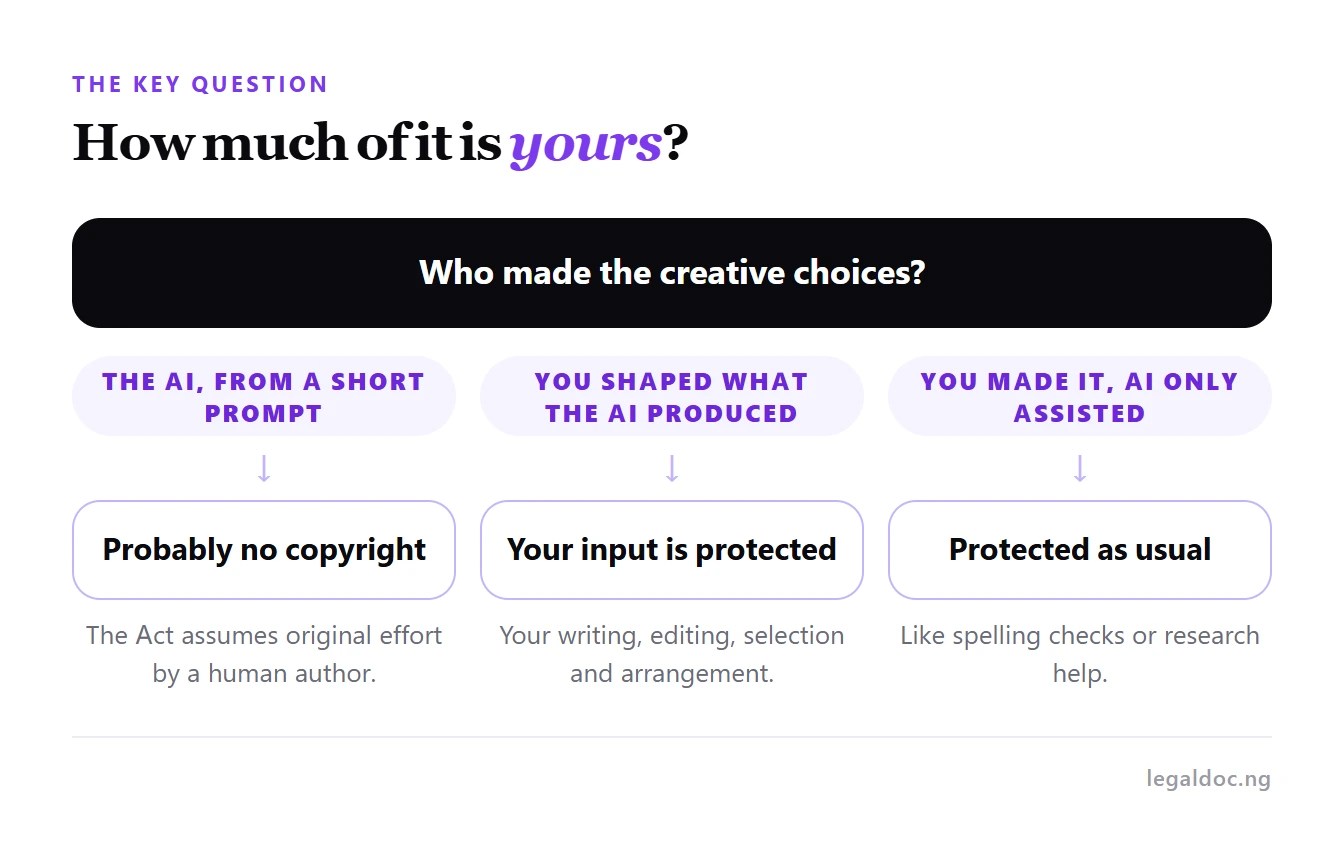
The more the creative choices are yours, the stronger your claim.
Who owns what, in practice
Here is how that plays out in situations Nigerian businesses meet every week. These are general positions, not rulings, because no Nigerian court has decided an AI copyright case yet.
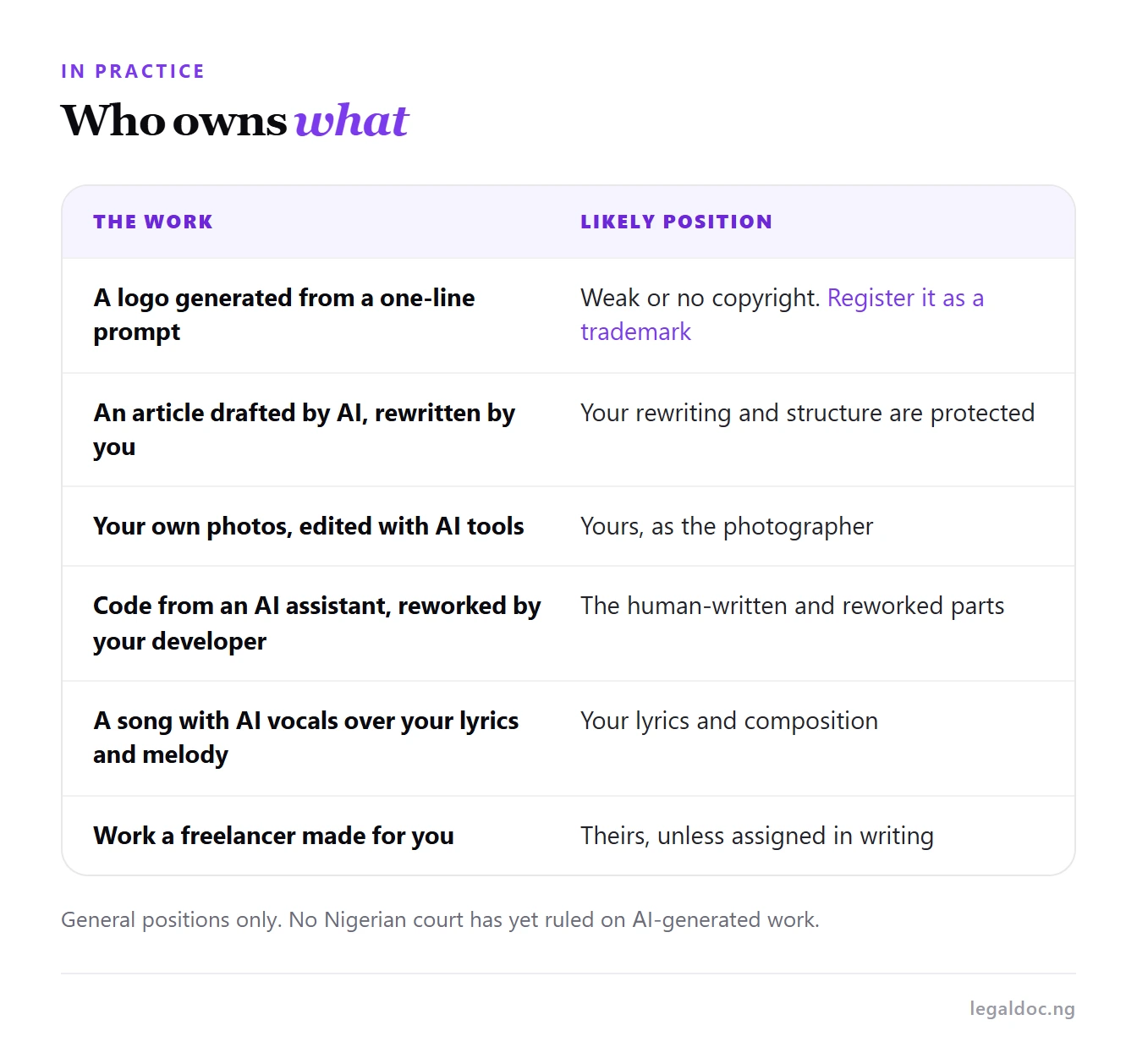
Where copyright is weak, a trademark or a contract often does the job instead.
What the AI tool's own terms say
Most of the large AI tools say in their terms that, as between you and them, you own what you generate. That is useful, because it means the tool's company is not claiming your logo. But it cannot create copyright where the law gives none. The tool can only hand over whatever rights it has, and if the law gives nobody copyright in a purely generated image, the terms do not change that. Other users can also receive very similar output from similar prompts.
Read the terms for two other things. Some tools reserve a licence to use what you upload and generate to train their systems. And uploading a client's confidential documents to a tool that does so may breach your non-disclosure agreement with that client and, where personal data is involved, the Nigeria Data Protection Act. If your business uses AI with customer information, your privacy policy should say so.
Contracts fill the gap
Because the law is unsettled, the contract between you and the people who create for you does most of the work. If you hire a designer, a writer, a developer or an agency, the agreement should deal with AI directly.
Who owns what your team makes with AI? Ask
Upload a client contract or an AI tool’s terms and LegalDoc+ explains ownership, originality promises and what happens to your uploads.
Ask LegalDoc+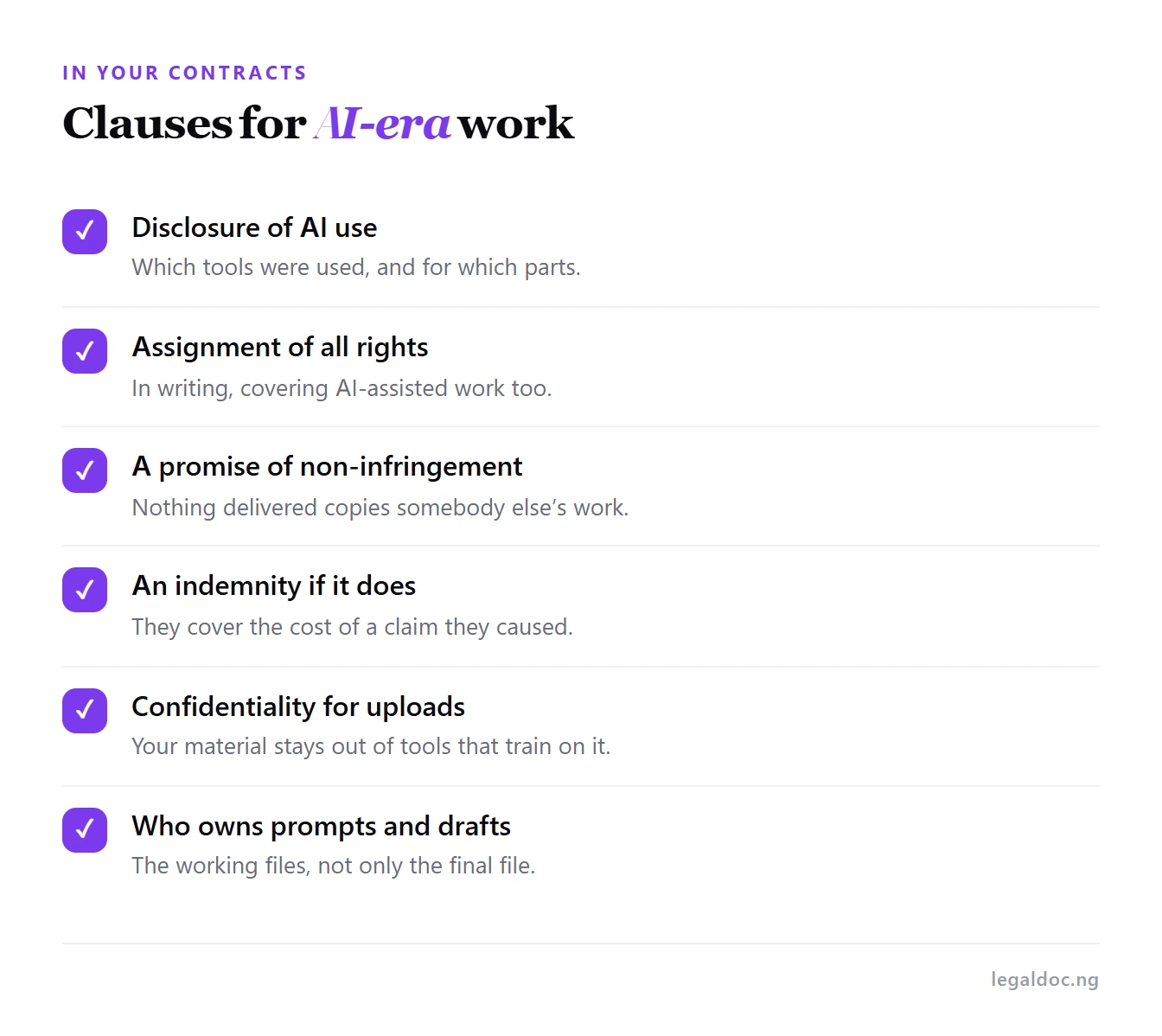
These belong in any agreement for creative or technical work in 2026.
The assignment clause matters most. Under Nigerian law, an assignment of copyright must be in writing, and a freelancer who creates work for you on commission keeps the copyright unless it is assigned. A freelance agreement, an independent contractor agreement or a consulting agreement should assign every right the creator has in the work, AI-assisted or not, and promise that nothing they deliver infringes somebody else's work. To license or transfer rights in work you already own, use a copyright licence agreement or a licensing agreement. For content made by influencers and creators, the brand influencer agreement covers who owns the posts.
If you are the freelancer, the same logic runs the other way. Tell clients when you use AI tools, and do not give a promise of originality you cannot keep. Clients increasingly ask, and a clear answer now avoids a dispute later.
Protect what you can
Whatever happens to the copyright question, these steps put you in a strong position.
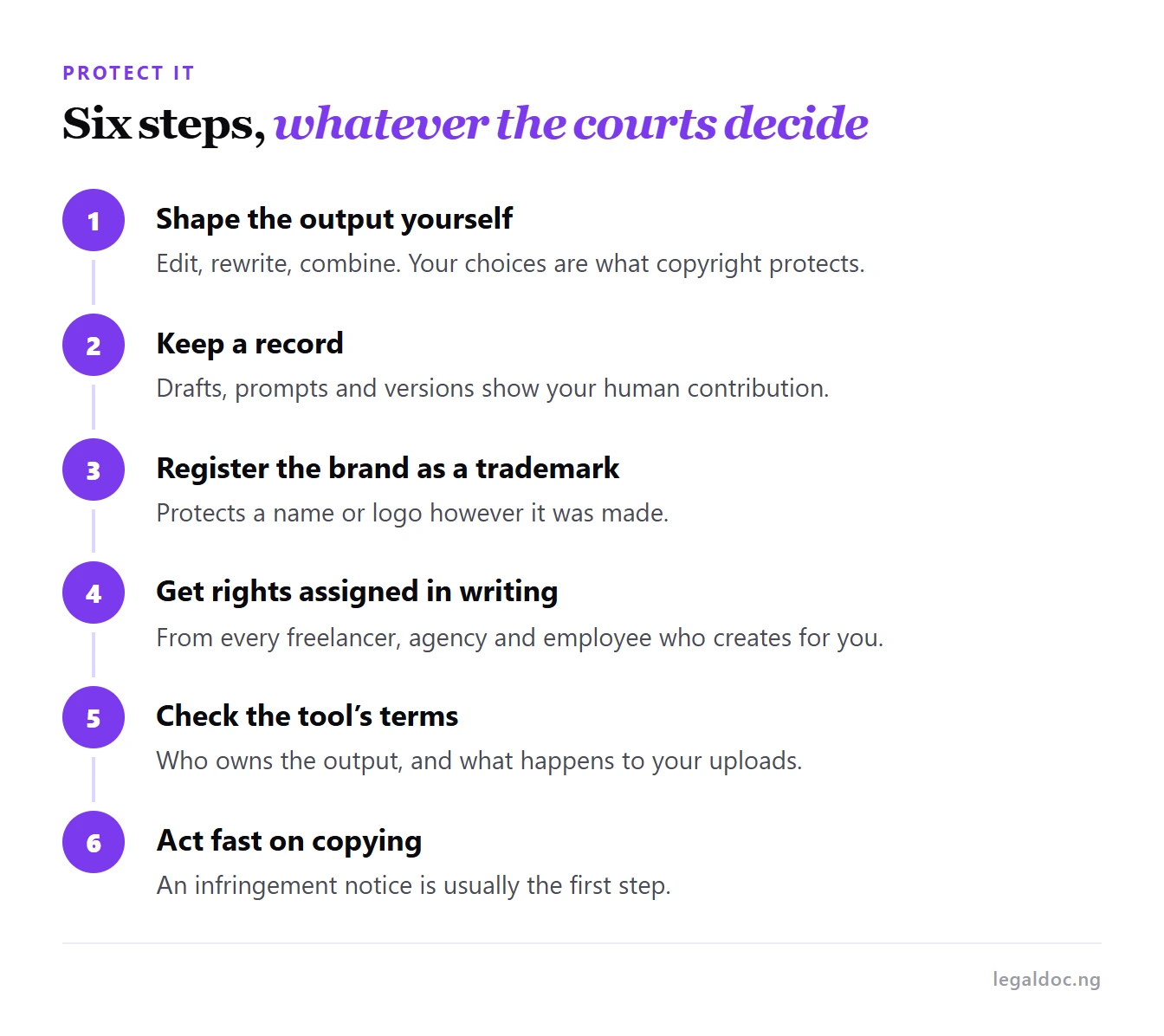
The trademark step is the one most businesses skip, and the one that matters most for a logo.
The trademark point deserves emphasis. Trademark law does not care who or what designed your logo. It cares whether the mark is distinctive and whether you were first to register it for your goods or services. A logo you cannot protect by copyright can still be registered as a trademark, and that registration lets you stop a competitor using something confusingly similar. LegalDoc can file your trademark application. Our guides to trademark or copyright and checking whether a mark is already registered explain the process.
When AI output gets you into trouble
AI tools learn from enormous amounts of existing work, and occasionally their output reproduces part of it closely: a recognisable character, a photographer's image, a passage of somebody's article. If you publish it, you are the one publishing it. Treat AI output the way you would treat a stock image from an unknown source: check it, change it, and do not use anything that looks like a copy of a known work.
If somebody copies work you do own, act quickly. A copyright infringement notice is usually the first step, and we explain how it works in copyright infringement notices in Nigeria.
Get your agreements right with LegalDoc+
Upload a client contract, an agency agreement or an AI tool's terms of service to LegalDoc+, and it will tell you who owns what is produced, what you are promising about originality, and what happens to the material you upload, all under Nigerian law. It can draft an AI use policy for your team, setting out which tools staff may use and what they must never paste into them, and it will answer specific questions, such as whether your new logo is better protected by copyright or by trademark.
Frequently Asked Questions About AI Generated Content in Nigeria
Can AI generated content be copyrighted in Nigeria? Content produced entirely by an AI tool is unlikely to be protected, because the Copyright Act 2022 requires original effort and assumes a human author. Your own contribution, such as writing, editing, selection and arrangement, can be protected.
Who owns content I create with ChatGPT or another AI tool? Most tools' terms say you own the output as between you and them. Whether anybody owns copyright in it depends on how much of the final work is your own creative contribution.
Can I trademark an AI-generated logo in Nigeria? Yes, if it is distinctive and nobody has registered a similar mark for the same goods or services. Trademark registration does not depend on who designed the logo.
Do freelancers have to tell me if they used AI? Only if your contract says so. Add a clause requiring disclosure of AI use, an assignment of all rights, and a promise that the work does not infringe anybody else's.
Can I be sued for publishing AI generated content? Yes, if it copies somebody else's protected work. The person who publishes infringing material is responsible for it, however it was produced.
Where this leaves you
AI is a powerful tool, but copyright still rewards human creativity. Put real effort into shaping what the tools produce and keep a record of it, register your brand as a trademark, and make sure every contract with the people who create for you says who owns the result. Do that, and you are protected whichever way Nigerian courts eventually rule.