

Lending to a business you know? Put it in writing
A loan agreement sets out the amount, the interest, the repayment dates and what happens if payments stop.
Draft a loan agreementIt always starts well. A colleague shows you the app on her phone: she put in ₦500,000 three months ago and has already withdrawn more than that. The returns are paid every week, the dashboard looks professional, and there is a WhatsApp group full of people posting screenshots of their profits. All you have to do is sign up.
Nigerians have seen how a Ponzi scheme like this ends, from MMM in 2016 to CBEX in April 2025, when a platform promising steady returns from automated crypto trading froze withdrawals and left a great many investors unable to get their money out. Each time, the warning signs were there, and many of them were written into the very agreement people clicked "accept" on. This guide shows you how to read an investment agreement for the signs of a Ponzi scheme, before your money goes in.
The short answer
A Ponzi scheme pays existing investors with money from new investors, not from real profits, and collapses when new money slows down. The agreement usually gives it away: guaranteed or very high fixed returns, a vague explanation of how the money is made, no registered company or regulator you can verify, bonuses for recruiting others, and withdrawal terms that let the operator delay or refuse payment. Under the Investments and Securities Act 2025, running a Ponzi scheme is a crime carrying a fine of at least ₦20 million, at least ten years in prison, or both. Check the company, check the regulator, and read the agreement before you pay anything.
How a Ponzi scheme works
The mechanics are simple. Early investors are paid "returns" out of the deposits of later investors. Because those early payments are real, the people receiving them become the scheme's best salespeople, and their screenshots bring in the next wave. The scheme survives as long as more money comes in than goes out. When recruitment slows, or too many people try to withdraw at once, the operator announces a "system upgrade", a "regulatory review" or a "temporary pause", and the money is gone.
That is why your friend being paid proves nothing. In a Ponzi scheme, early payouts are part of the design.
The red flags hiding in the agreement
Most people never read the terms of an investment platform. Those who do often find the operator has told them, in writing, exactly what it can do with their money.
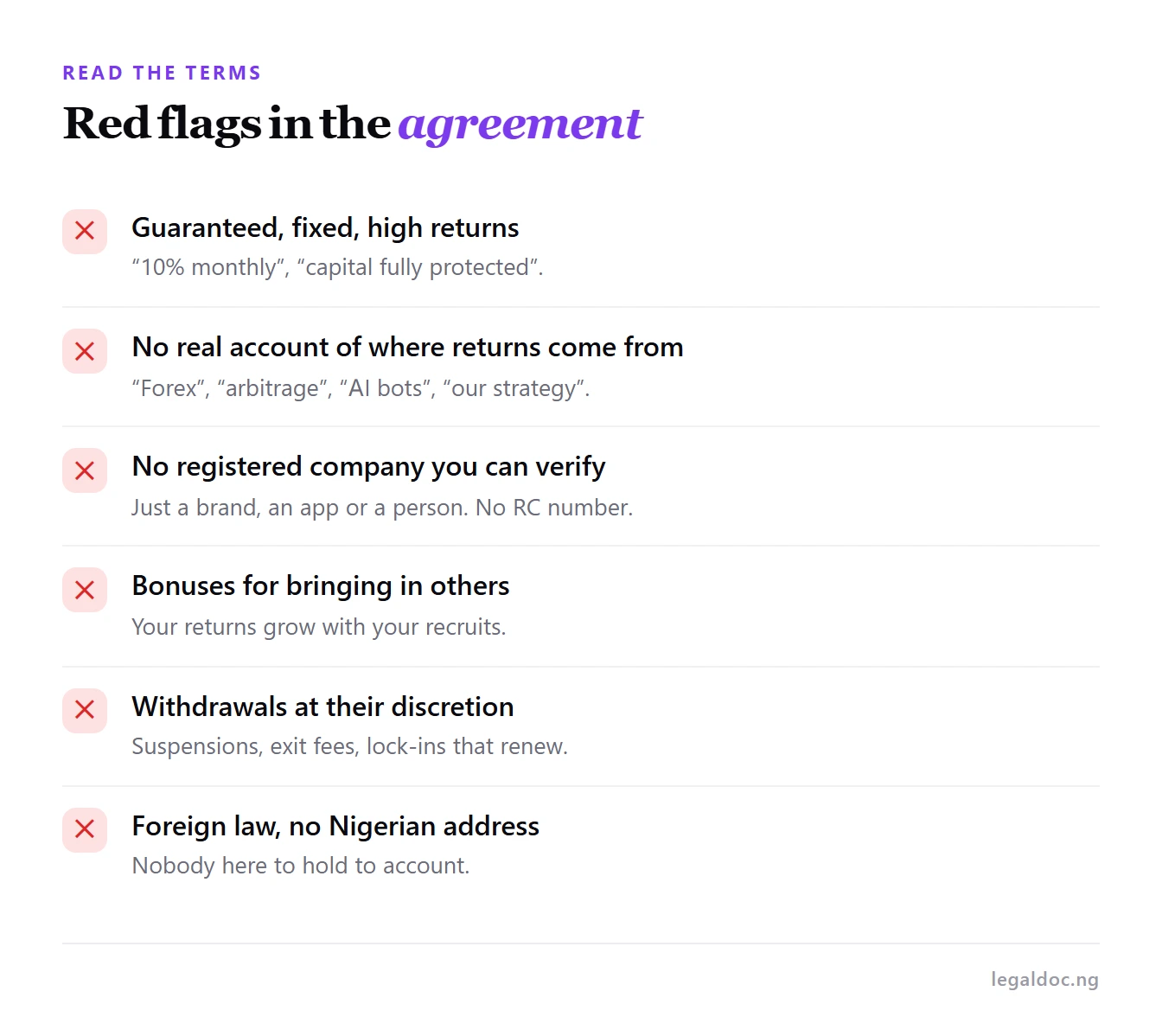
One of these is a reason to ask hard questions. Several together is a reason to walk away.
Returns that are guaranteed, fixed and high
Real investments carry risk, and a genuine agreement says so. A promise of "guaranteed 10% monthly" or "30% in 90 days, capital fully protected" is the single clearest sign of trouble. No legitimate business can promise that, because no legitimate business earns it reliably.
No clear account of where the money goes
A real agreement says what your money buys: shares in a named company, a loan to a business at a stated rate, a share of a specific property or farm. A Ponzi scheme says "forex trading", "arbitrage", "AI trading bots" or "our proprietary strategy", and never shows you the trades, the assets or the accounts.
Nobody you can actually hold to account
Look at who you are contracting with. If the agreement names only a brand, an app or an individual, gives no RC number and no registered address, or names a company registered somewhere far from where it operates, you may have nobody to sue when things go wrong.
Terms that let them keep your money
Read the withdrawal clause carefully. Rights to "suspend withdrawals at our discretion", heavy exit fees, long lock-ins that renew automatically, or a rule that your balance becomes "investment credit" rather than money, are all ways of writing the collapse into the contract in advance.
A Ponzi scheme against a real investment
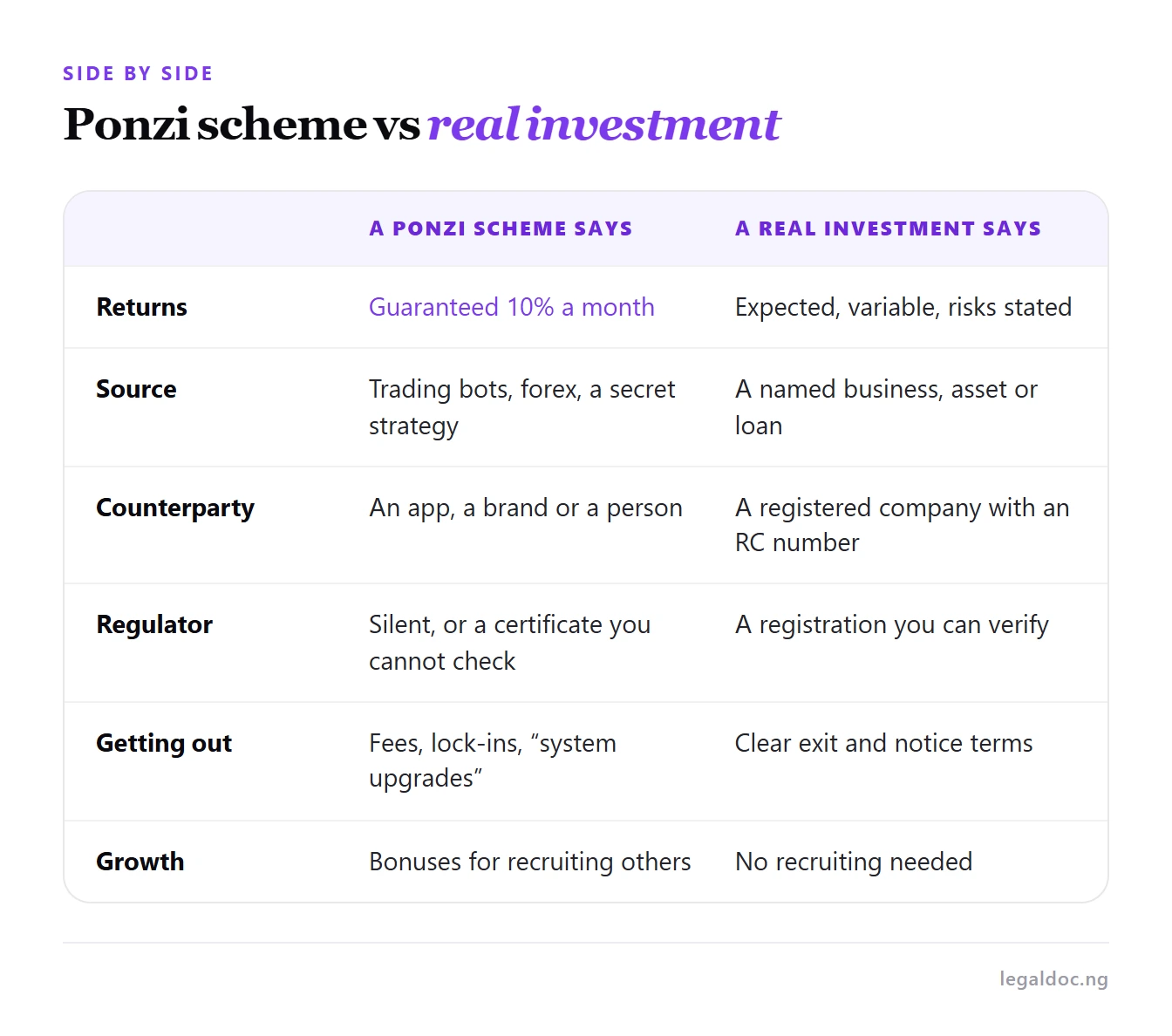
Real investments look less exciting on paper. That is the point.
Offered an investment? Have the agreement read first
Upload the terms, even screenshots from an app, and see the red flags ranked by how serious they are.
Ask LegalDoc+ to check itWhat the law says
The Investments and Securities Act 2025 replaced the 2007 Act and, for the first time, deals with Ponzi schemes by name. Running one is a criminal offence, with a minimum fine of ₦20 million, a minimum of ten years' imprisonment, or both. The Act also brings digital assets within the Securities and Exchange Commission's oversight, so a crypto investment platform taking money from Nigerians generally needs SEC registration in the same way as any other investment business.
Collecting money from the public as an investment is regulated activity. A business offering it should be able to show you its registration, and you should be able to confirm it independently on the SEC's own records.
How to check before you invest
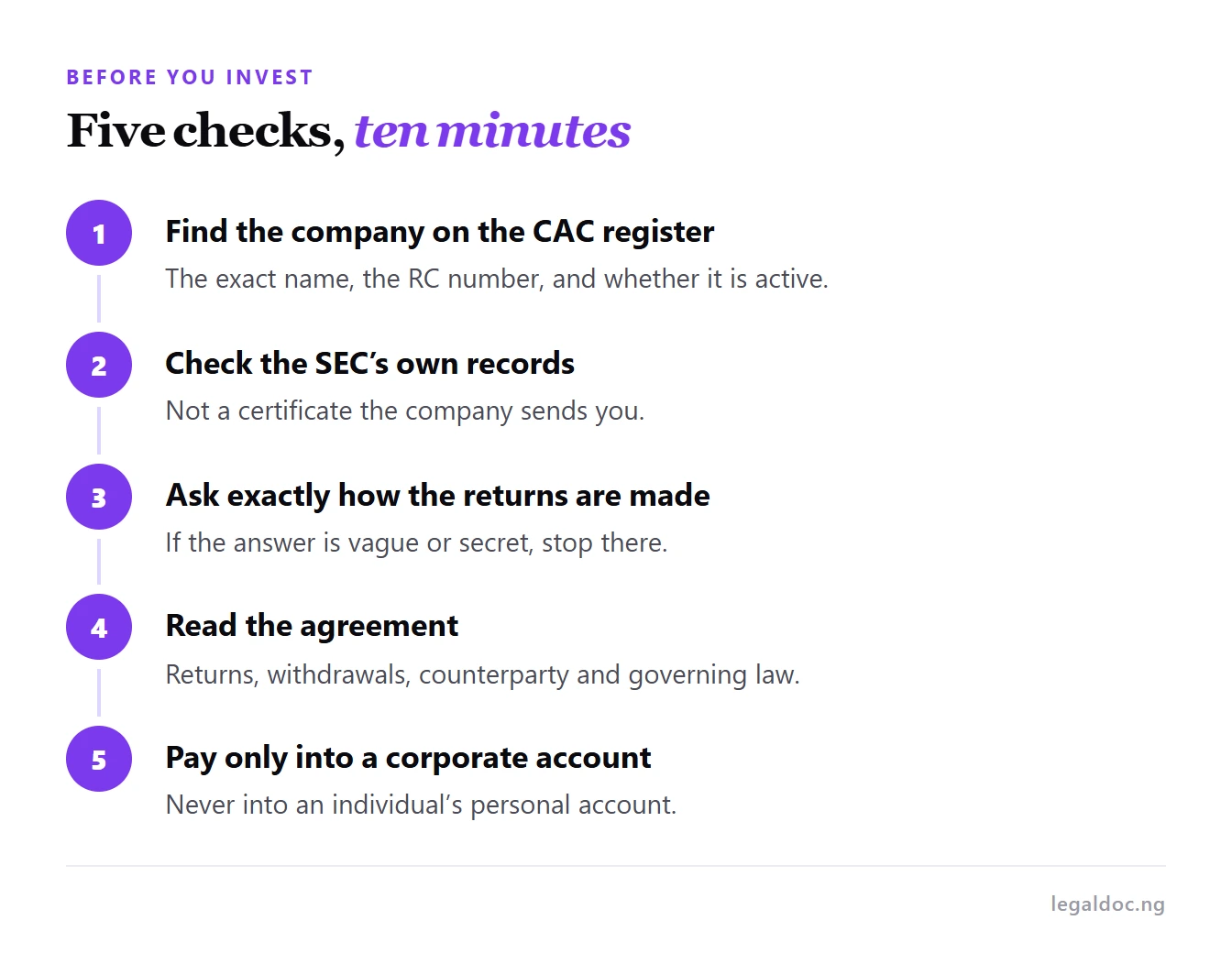
Ten minutes of checking has saved more money than any return has ever made.
The last check matters more than people think. Paying into an individual's personal account, rather than the company's own corporate account, removes most of the protection you have if the scheme fails.
Lending to a business you know? Put it in writing
Not every private investment is a scam. Lending money to a friend's business, putting capital into a relative's farm, or joining a partner in a property project can all be perfectly sound, but only if the terms are written down. A proper loan agreement sets out the amount, the interest, the repayment dates and what happens if payments stop. A personal guarantee gives you somebody to pursue if the business cannot pay. For a share in the business itself, a shareholder agreement or a joint venture agreement records what you own and how you get out. Our guide to why every loan needs a proper agreement explains more.
If you are already in
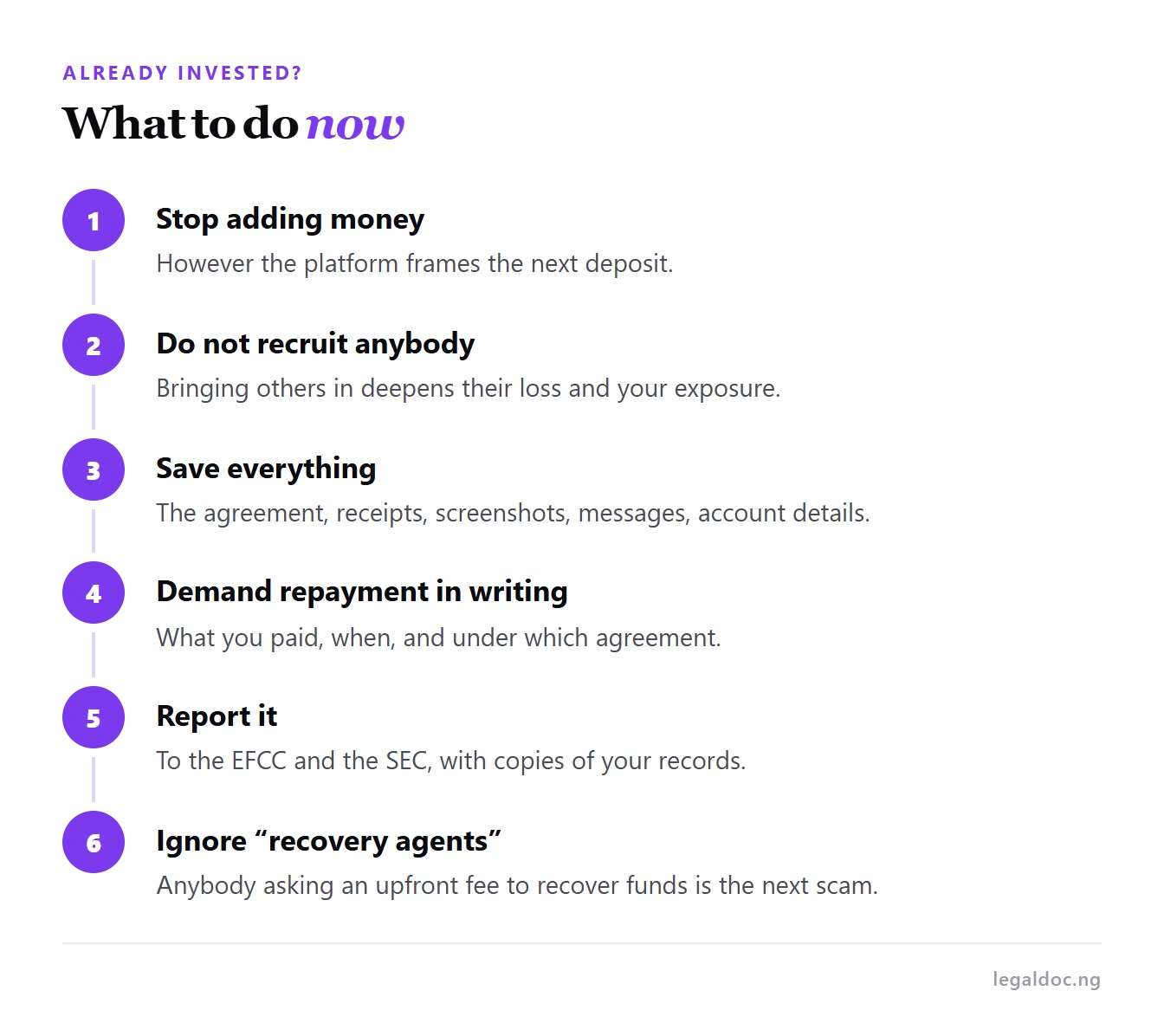
The second loss, to a fake recovery agent, is often the one that hurts most.
Put your demand for repayment in writing. A clear demand letter setting out what you paid, when, and under which agreement, creates a record that matters in any later claim or report. Report the scheme to the EFCC and the SEC, with copies of the agreement, receipts and messages. And be very wary of anybody who contacts you offering to recover your money for an upfront fee. That is a well-known second scam aimed at people who have already lost.
Read it with LegalDoc+ before you sign
You do not have to read an investment agreement alone. Upload it to LegalDoc+, whether it is a PDF, a Word file or screenshots of the terms in an app, and the free check tells you what the document actually is, who you would be contracting with and what is wrong with it, ranked by how serious it is. Guaranteed returns, missing registration details, one-sided withdrawal terms and foreign governing law are exactly the things it is built to flag. The full review explains each finding under Nigerian law, including the Investments and Securities Act 2025, so you can decide with your eyes open.
Frequently Asked Questions About Ponzi Schemes in Nigeria
How can I tell if an investment is a Ponzi scheme? Look for guaranteed or very high fixed returns, a vague explanation of how money is made, no verifiable registration, bonuses for recruiting others, and terms that let the operator delay or refuse withdrawals.
Is running a Ponzi scheme illegal in Nigeria? Yes. The Investments and Securities Act 2025 makes it a criminal offence, with a fine of at least ₦20 million, at least ten years' imprisonment, or both.
My friend has been paid. Does that mean it is genuine? No. Paying early investors with later investors' money is how a Ponzi scheme builds trust. Early payouts prove nothing about the scheme's future.
How do I check whether an investment company is registered? Confirm the company exists on the CAC register and check the SEC's own records for its registration. Do not rely on certificates the company sends you.
What should I do if I have already invested in a Ponzi scheme? Stop adding money, do not recruit anybody, keep every record, demand repayment in writing, report to the EFCC and the SEC, and avoid anybody offering recovery for an upfront fee.
Where this leaves you
The next scheme will look different from the last one. It may be crypto, it may be agriculture, it may be property or "AI trading". But the agreement will give it away in the same places: the promised returns, the missing explanation, the faceless counterparty and the escape hatch in the withdrawal clause. Read those four things before you invest, and you will walk past most of them.