
How to Write a Caregiver Agreement
Somebody is being trusted with a vulnerable person, their home and sometimes their money. The employment status question decides who carries what.
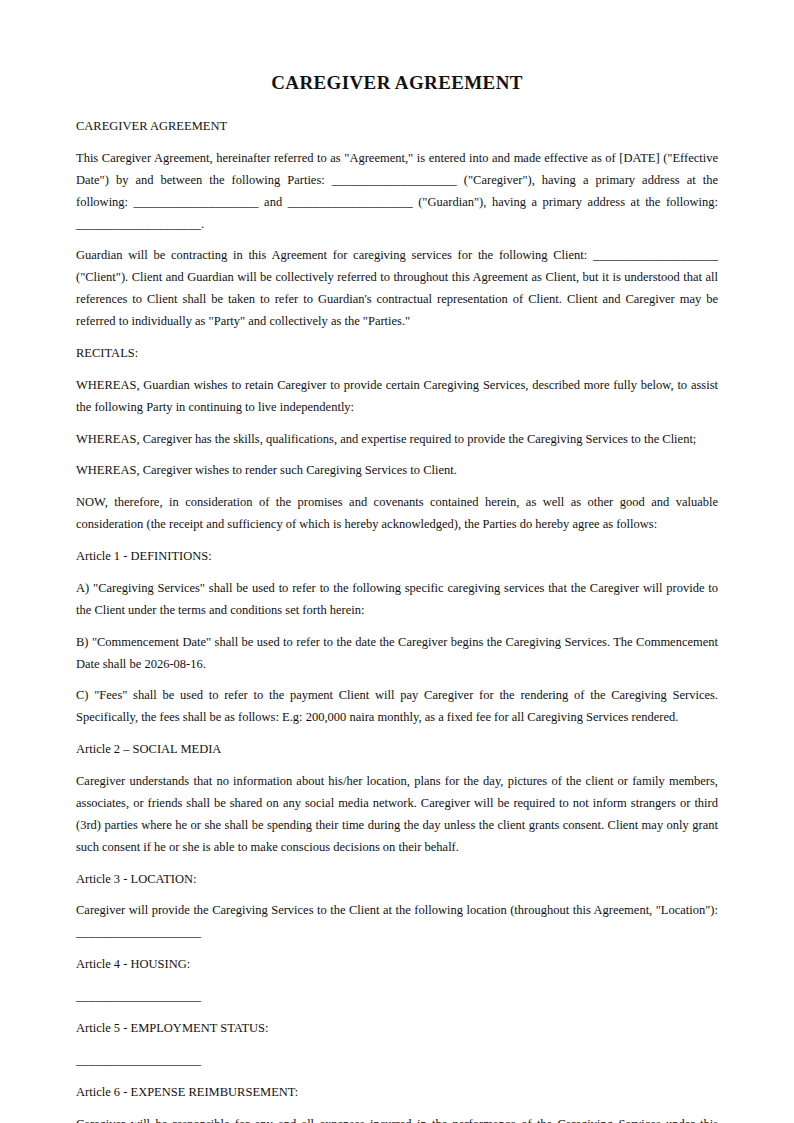
What a caregiver agreement is
A caregiver agreement sets out the terms on which somebody provides care for a person who needs help at home.
The arrangement is unusual in how much trust it involves. A caregiver has access to somebody's home, their medication, sometimes their bank card, and to a person who may not be able to report a problem. The agreement is a small part of managing that, alongside references, checks and supervision, and it should not be the only thing relied on.
There are three parties in this document rather than two. The caregiver provides the service, the client receives it, and the guardian or family member arranges and usually pays for it. That third party is there because the client may lack capacity to contract, which is frequently why care is needed in the first place.
The status question, employee or independent contractor, decides a great deal: who deducts tax, who carries liability, and whether the family owes employment obligations.
Who needs one
Families arranging home care for an elderly or unwell relative.
Caregivers who want their hours, duties and pay recorded rather than assumed.
Guardians organising care on behalf of somebody who cannot arrange it themselves.
Anybody whose informal arrangement has expanded until the carer is effectively full time with no written terms.
Where care is arranged through an agency, that agency imposes its own contract, and this document suits a direct engagement between a family and an individual.
Before you start
Do these before anybody starts work.
Take and actually check references, and verify identity properly.
Decide what the caregiver will and will not do, particularly regarding medication and money.
Work out the hours honestly, including nights if live in.
Decide whether this is employment or a contractor arrangement, and be honest about which it really is.
And where the caregiver will handle the client's finances, take advice, because that requires a separate and carefully limited authority.
The walkthrough
Filling in the form, step by step
Every question you will be asked, what it means, and an example of a good answer.
Step 1 of 3
Caregiver Agreement
The caregiver, the guardian and the client
This step names all three parties, and the distinction between guardian and client is the point.
The client is the person receiving care. The guardian is the family member or appointed person arranging it, usually because the client cannot contract for themselves. Where the client does have capacity, they should be a party in their own right, and the guardian's role is different.
That capacity question is worth pausing on. Where somebody genuinely lacks capacity to make decisions, arranging their affairs requires proper authority, and a family member acting informally may be doing so without any legal basis. Where significant decisions or money are involved, take advice about what authority is actually needed rather than assuming a family relationship is enough.
Name the caregiver with their full legal name as on their identification, and verify it. This is a person being given access to a vulnerable individual, and identity verification is not a formality here.
- Caregiver's Full name
- The caregiver's full legal name as it appears on their identification, which should be verified rather than taken on trust. This is somebody being given access to a vulnerable person and their home.
- Caregiver's Address
- The caregiver's home address, confirmed independently. Where they will live in, this is still worth recording as their permanent address.
- Guardian's Full name
- The family member or appointed person arranging the care, who is usually the one paying and directing. Where they are acting for somebody without capacity, consider what authority they actually hold, since a family relationship alone may not be enough for significant decisions.
- Guardian's Address
- The guardian's address, which is often different from where the care is provided and is where invoices and correspondence go.
- Client's Full name
- The person receiving care. Where they have capacity to contract, they should be a party in their own right rather than being arranged for, and the guardian's role becomes supportive rather than substitutive.
Step 2 of 3
Caregiver Agreement
The services, the start, the fee and the location
This step defines the work, and two of the service options carry particular weight.
Medication administration is a serious responsibility. A caregiver giving the wrong dose or the wrong drug can cause real harm, and the agreement should record what medication is involved, at what times, and how it is recorded. A written medication log is standard practice and worth requiring here.
The client's finances option is the one to think hardest about, and the form itself notes it may require a power of attorney. That is right, and the wider point is that handing somebody control of a vulnerable person's money is where care arrangements most often go badly wrong. If the caregiver will handle money at all, limit it: a small float for shopping with receipts kept, rather than access to accounts. Anything more should be a separate, narrow, written authority, and the family should be checking it.
Be specific about housework, meals and errands too, since the most common source of friction in care arrangements is a caregiver hired to look after a person who finds themselves cleaning a house.
The fee should state the period and the basis: hourly, daily or monthly, and what it covers.
- The services to be rendered by the caregiver
- Tick the services the caregiver will provide. Be honest and specific: the most common friction in care arrangements comes from a caregiver hired to look after a person who finds themselves cleaning a house.
- Housework
- If housework is included, describe exactly what: which rooms, what tasks, how often. Distinguish light tidying around the client from general cleaning of the whole house, since those are different jobs.
- Meals
- If meals are included, say how many, whether shopping is involved, and any dietary requirements the client has. Where a medical diet applies, record who provides the guidance.
- Medication
- If medication is administered, record which medications, at what times, and how administration is logged. A written medication record is standard practice and should be required, since a wrong dose can cause real harm.
- Errands
- If errands and transport are included, say what: shopping, appointments, collections. Where driving is involved, confirm the caregiver is licensed and that insurance covers the use.
- finance
- If the caregiver will handle the client's money, limit it tightly. A small float for shopping with receipts retained is very different from access to accounts. Anything more needs a separate narrow written authority, and this is where care arrangements most often go seriously wrong, so the family should be checking regularly.
- Start Date
- When the caregiver begins. Complete references, identity checks and any handover before this date rather than after.
- Fee to be paid to the caregiver
- What the caregiver is paid, with the basis and period stated: hourly, daily or monthly, and what the figure covers. Where accommodation and meals are provided as part of the arrangement, note that alongside the cash figure.
- Location of where the services is to be rendered
- Where care is provided, normally the client's home. Give the full address, since it is also where the caregiver will be working and, if living in, staying.
Step 3 of 3
Caregiver Agreement
Living in, employment status and the schedule
The final step covers the arrangements that determine the legal shape of the relationship.
The live in question changes everything about hours. A caregiver living in the client's home is not working twenty four hours a day, but neither are they free, and the agreement should distinguish working hours from time off and from nights on call. Live in arrangements without defined off duty periods are how caregivers end up exhausted and how families end up with a resentful carer looking after their relative.
The employee or contractor question is the substantive one. An employee brings PAYE, pension obligations, notice requirements and the Labour Act framework, including the written statement of particulars within three months. A genuine independent contractor handles their own tax and carries their own liability.
The honest answer is usually employee. A caregiver working set hours in the family's home, using their equipment, taking direction, with no other clients, is an employee whatever the paperwork says, and the substance decides it rather than the label. Families choosing contractor to avoid obligations are taking a risk that lands on them.
The schedule should be written out properly: days, hours, breaks, and what happens on public holidays and when the caregiver is unwell. Cover arrangements matter, because a vulnerable person cannot simply be left.
- Is the caregiver moving into the location where the services is to be provided?
- Whether the caregiver lives in. It changes the whole shape of the arrangement, particularly around hours, and requires clear off duty periods rather than an assumption of constant availability.
- Yes
- If living in, describe the accommodation, whether meals are provided, and critically the off duty periods: which hours are free, which days off, and what applies at night. Live in arrangements without defined time off produce exhausted caregivers and poor care.
- No
- If not living in, confirm it and state the daily arrival and departure times, along with the position on travel to and from the client's home.
- Is the caregiver an employee or independent contractor?
- The substantive legal question. An employee brings PAYE, pension, notice and the Labour Act framework. A contractor handles their own tax and liability. Be honest: a caregiver working set hours in your home under your direction with no other clients is an employee whatever the paperwork says, and choosing contractor to avoid obligations is a risk that lands on the family.
- Employee
- If an employee, note the obligations that follow: a written statement of particulars within three months under the Labour Act, PAYE deductions, pension contributions, paid leave and notice on termination.
- Independent contractor
- If a contractor, record the basis honestly: that they control how the work is done, invoice for it, and are responsible for their own tax. If that does not describe the arrangement, the answer above is wrong.
- Schedule for the caregiver
- The working pattern in detail: days, hours, breaks, and what applies on public holidays. Include cover arrangements for when the caregiver is unwell or on leave, since a vulnerable person cannot simply be left without care.
- The state where the care service is to be provided
- The Nigerian state where the care is provided, which governs the agreement and, where this is employment, determines the applicable framework alongside the Labour Act.
Ready to make yours?
Answer those questions in the builder and download a finished caregiver agreement in Word and PDF.
Start now, ₦10,000After you download it
Check references properly
Speak to previous employers rather than reading letters. This is somebody being given access to a vulnerable person, their home and often their medication.
Keep money separate and checked
A small float with receipts retained, reviewed regularly by the family. Financial abuse in care arrangements is common and it starts with unchecked access.
Keep a medication log
Written, dated, signed. It protects the client from error and the caregiver from an accusation, which is why it is standard practice.
Meet the employment obligations
Where the caregiver is an employee, the written statement, PAYE, pension and leave all apply. Calling them a contractor does not remove them.
Questions people ask
Is a caregiver an employee or a contractor?
Usually an employee. Somebody working set hours in your home, under your direction, using your equipment and with no other clients is an employee whatever the paperwork says.
What obligations does employing a caregiver create?
A written statement of particulars within three months under the Labour Act, PAYE deductions, pension contributions, paid leave and proper notice on termination.
Should a caregiver handle the client's money?
Keep it tightly limited. A small float with receipts retained is reasonable; access to accounts is not, and anything more requires a separate narrow written authority with family oversight.
What if the client cannot make decisions for themselves?
The guardian arranging care should consider what authority they actually hold, since a family relationship alone may not be sufficient for significant decisions or for handling money.
How should live in hours work?
With defined off duty periods. A live in caregiver is not working around the clock, and arrangements without stated time off produce exhausted carers and poor care.
What about medication?
Record which medications, at what times, and keep a written log. It protects the client against error and the caregiver against an accusation, and giving a wrong dose can cause real harm.
Documents that go with this
Terms used on this page
Contract of Employment
A contract of employment is the agreement between an employer and an employee setting out the job, the pay and the terms. Nigerian law expects it in writing within three months of starting.
Independent Contractor
An independent contractor is engaged to deliver work under a contract for services rather than employed under a contract of service. They control how the work is done and carry their own tax and risk.
Guardianship
Guardianship is legal responsibility for a child who is not your own, or for an adult who cannot manage their own affairs. For parents, the point of it is naming in advance who takes care of your children if you are not there.
Power of Attorney
A power of attorney is a document giving somebody legal authority to act for you, on property, money or personal matters. It is used constantly by Nigerians abroad who need someone at home to sign on their behalf.
Employee
An employee works under a contract of service, meaning the employer controls how the work is done. The label on the contract does not decide it, and getting the classification wrong is expensive for the employer.
Notice Period
A notice period is how much warning either side must give before ending an employment. The Labour Act sets minimums based on length of service, and the contract can give more but not less.
Next of Kin
Next of kin is the person you name on a form as your closest relative and first point of contact. In Nigeria it is widely believed to decide who inherits your property. It does not.
Vicarious Liability
Vicarious liability makes an employer answerable for wrongs their employee commits at work, even where the employer did nothing wrong. It is why the classification of workers matters commercially.
Read more on this
Caregiver/ Nanny Agreement in Nigeria: Template and A-Z Guide
Employment Contracts: Key Clauses and Compliance Guide
Employment Contracts: Key Clauses and Compliance Guide An employment contract is one of the most important documents in any Nigerian workplace, yet it is also one of the most neglected. Many businesses, especially small…
Power of Attorney in Nigeria: When You Need One and the Mistakes That Make It Useless
Step by step guides for every document on LegalDoc
Browse all guides