
How to Write a Commercial Lease Agreement
A commercial lease covers business premises, where the money is bigger and the terms run longer. These are the questions that decide what it costs you.
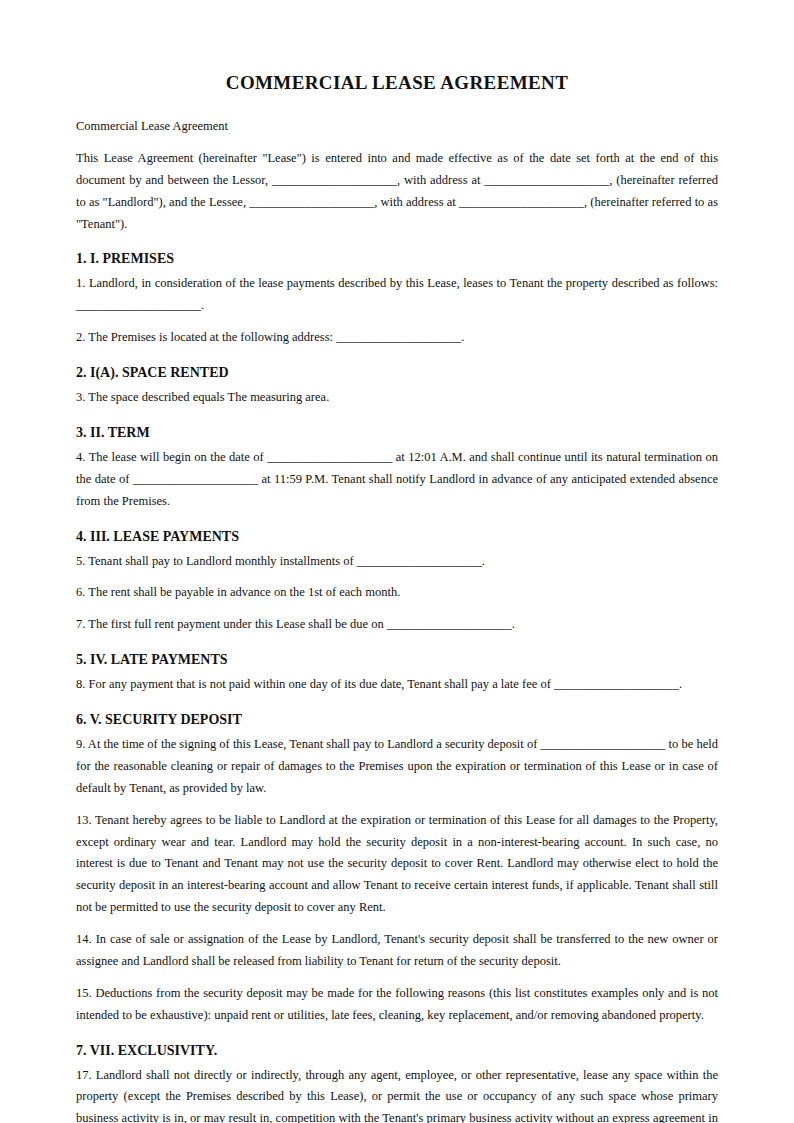
What a commercial lease agreement is
A commercial lease is the agreement under which a business occupies premises: a shop, an office, a warehouse or a workshop.
It does the same basic job as a residential tenancy agreement and then a good deal more. Commercial terms run longer, the sums are larger, and the arrangement has to deal with things a home letting never faces: what happens at renewal, who pays for what, and what it costs to leave early.
Commercial tenants also get less statutory protection than residential ones. The bargain in the document is closer to the whole story, which is exactly why the document deserves attention.
Who needs one
Businesses taking premises, and landlords letting them.
Retailers, offices, clinics, restaurants, workshops and warehouses.
Anybody who has been occupying business premises on an informal arrangement and wants it recorded before a dispute forces the issue.
If you are letting a room or desk without giving exclusive possession, a licence is usually the better structure. If you are letting a home, use a tenancy agreement instead.
Before you start
Agree the commercial terms before you draft, because the document only records them.
The exact space, including whether parking, storage or a share of common areas is included.
The term, and whether there is a renewal right and on what basis.
The rent, when it is paid, and what happens if it is late.
The deposit and what it can be deducted for.
And the cost of leaving early, which is the clause tenants regret not negotiating.
The walkthrough
Filling in the form, step by step
Every question you will be asked, what it means, and an example of a good answer.
Step 1 of 3
Commercial Lease Agreement
Landlord and tenant
Commercial leases are between businesses more often than individuals, and getting the entities right matters more here than in a residential letting.
If the tenant is a company, name the company, not the director. That is the point of trading through a company: the obligations sit with the entity. A landlord who wants the director personally on the hook should ask for a separate personal guarantee rather than quietly naming an individual as tenant.
Use registered names as they appear on the certificate of incorporation. Trading names are not legal entities and cannot hold a lease.
Addresses here are for formal notices, which in a commercial lease can include rent demands, breach notices and termination.
- Landlord's name
- The full legal name of the owner. For a company, the registered name from the certificate of incorporation. Where the property is jointly owned, name every owner, because a lease granted by one of several co owners is open to challenge.
- Landlord's address
- The landlord's address for service of notices, not the leased premises. Rent demands and breach notices are sent here, so it must be somewhere post is genuinely received.
- Tenant's name
- The business taking the premises. Name the company or registered business, not the director personally. If the landlord wants an individual on the hook as well, that belongs in a separate personal guarantee.
- Tenant's address
- The tenant's registered or head office address, which is where notices reach them. It is usually different from the premises being leased and should be kept up to date during the term.
Step 2 of 3
Commercial Lease Agreement
The premises and the term
This step defines what the tenant is paying for and for how long.
Commercial space needs describing more carefully than a flat. Say which part of the building, on which floor, and give the measured area. Then say what comes with it: parking bays, storage, signage rights, access to shared facilities, and the hours during which the tenant may use the premises.
Anything not written down is not included, and the argument usually surfaces when the tenant tries to put up a sign or bring a delivery in at seven in the morning.
On the term, be aware of a Nigerian point that catches businesses out. A lease of three years or more is generally registrable as a land instrument in the state where the property sits, which brings stamping and registration costs. A term set just under three years is often chosen for that reason, and it should be a deliberate decision rather than an accident.
- Address of the Property
- The full address of the building, including street, area, town and state. Where the building has several units, identify the specific one being let rather than the building as a whole.
- Description of the Property
- What kind of premises this is: a ground floor retail unit, a first floor office suite, a warehouse. It frames what the space is suitable for and supports any permitted use restriction later in the lease.
- Description of the space
- The measured area and the precise extent of what is demised. State the square metres and say whether parking, storage, signage or shared facilities are included. Anything omitted here is not part of the letting.
- Start date (for the lease)
- When the tenant may take occupation. Where fit out is needed before trading, consider whether the rent should start on the same date or later, because a rent free fitting out period is a normal thing to negotiate.
- End date (for the lease)
- When the term expires. Note that a term of three years or more is generally registrable as a land instrument, with the stamping and registration costs that follow, so the length should be a deliberate choice.
Step 3 of 3
Commercial Lease Agreement
Rent, deposit, renewal and exit
This is the commercial heart of the lease, and each answer is a number the parties will live with.
State the rent with its period attached, and say when the first payment falls due. In Nigeria commercial rent is frequently demanded annually in advance, sometimes for more than one year, and a tenant should understand the total cash requirement at the outset rather than at signing.
The late fee has to be a genuine estimate of the cost of late payment. A penalty set high enough to punish rather than compensate is vulnerable, and a landlord relying on it may find it unenforceable when it matters.
The deposit should have its purpose stated: what it covers, when it is returned, and what can be deducted. Deposits are the most common source of end of lease disputes, and the fix is one sentence written at the start.
Renewal and early termination are the two clauses tenants most regret leaving vague. A renewal right with no mechanism for setting the new rent is close to worthless, and an early exit with no stated cost invites an argument at the worst possible moment.
- Rent
- The amount and the period it covers, stated in full, for example four million naira per annum. Say clearly whether it is annual or monthly, and whether it includes service charge or any other outgoing, since assumptions differ between landlords.
- When will the first rent be due?
- The date the first payment is required, and how much of the term it covers. Where the landlord expects a year or more in advance, that should be plain here rather than emerging at signing.
- Fee for late payment
- What is charged when rent is late. Keep it a genuine estimate of the cost of late payment rather than a punishment, since a figure set to punish is open to challenge exactly when the landlord wants to rely on it.
- Security Deposit
- The amount held against damage, arrears and unpaid outgoings. State what it may be deducted for and when the balance is returned. Deposits cause more end of lease disputes than any other term, and stating this at the outset prevents most of them.
- Renewal period
- Whether the tenant may renew and for how long. A renewal right is only useful if it says how the new rent is fixed, whether by agreement, by a stated increase or by valuation. Without a mechanism it is an invitation to disagree.
- Fee for early termination
- What it costs to end the lease before the term expires. Tenants should negotiate this before signing rather than discovering it during a downturn, and landlords should keep it proportionate to the loss actually suffered.
- The agreement is to be governed by which State?
- The state where the premises are located. Property law and the recovery process are state matters, so this should follow the property rather than the convenience of either party.
Ready to make yours?
Answer those questions in the builder and download a finished commercial lease agreement in Word and PDF.
Start now, ₦10,000After you download it
Record the condition at the start
Photograph the premises and agree a schedule of condition before fit out begins. At the end of a commercial lease, dilapidations claims turn entirely on what the space looked like on day one.
Stamp it, and register if the term requires
Stamp duty applies. A term of three years or more is generally registrable as a land instrument in the state where the property sits, so budget for both.
Agree fit out and reinstatement in writing
Say what the tenant may install and what must be removed at the end. Those two obligations pull against each other and are expensive to resolve after the fact.
Diary the renewal date
Renewal rights and break options usually have to be exercised within a window. Businesses lose them by missing the date, not by choosing to.
Questions people ask
What is the difference between a commercial lease and a tenancy agreement?
A tenancy agreement is the residential document, normally granted for a year. A commercial lease governs business premises, runs for a longer term, and has to deal with renewal, service charge, fit out and the cost of leaving early.
Should the lease be in my company name or my own?
The company's, if a company is trading from the premises. That is the point of the corporate structure. A landlord wanting the director on the hook should ask for a separate personal guarantee.
Does a commercial lease need to be registered in Nigeria?
A term of three years or more is generally registrable as a land instrument in the state where the property sits. Shorter terms usually are not, which is why many leases are set just under three years.
How much can a landlord charge as a late fee?
It should be a genuine estimate of the cost of late payment. A figure set to punish rather than compensate is open to challenge, which defeats the purpose of including it.
What should a renewal clause say?
How the new rent is determined, not merely that renewal is possible. A right to renew with no mechanism for fixing rent is close to worthless in practice.
Who pays for repairs in a commercial lease?
Whatever the lease says, which is why it should say. Commercial leases commonly put more repair obligation on the tenant than residential ones, so read that clause before signing.
Documents that go with this
Terms used on this page
Lease
A lease is a grant of exclusive possession of property for a fixed term, in exchange for rent. It creates an interest in the land itself, which is what separates it from a mere permission to occupy.
Rent
Rent is what a tenant pays for the right to occupy a property. In Nigeria it is normally paid in advance, and how far in advance a landlord may demand is limited by law in some states.
Service Charge
Service charge is what tenants or residents pay towards the running of shared parts of a property, such as security, generator diesel, cleaning and water. It is not rent, and it should be accounted for.
Dilapidation
Dilapidation is disrepair a tenant is responsible for under the lease. At the end of a commercial term a landlord can claim the cost of putting it right, and the bill surprises tenants.
Deposit
A deposit is money paid to secure a transaction. Whether you get it back if the deal falls through depends on whether it was a true deposit or a part payment, and most people never ask.
Landlord
A landlord is the person who grants somebody else the right to occupy their property in exchange for rent. The role carries rights to rent and possession, and duties that Nigerian law enforces.
Licence
A licence is permission to be on somebody else's property without any interest in it. It is revocable, it gives no exclusive possession, and calling something a licence does not make it one.
Assignment of Lease
Assigning a lease transfers the whole remaining term to somebody else. Unless the landlord releases you, you can remain liable for the rent after the new tenant stops paying.
Read more on this
Tenancy Agreement vs Commercial Lease Agreement
Tenancy Agreement vs Commercial Lease Agreement Choosing the right agreement for occupying property in Nigeria is more than just a paperwork exercise. Whether you are renting a flat, opening a shop, or taking a warehouse…
8 Essential Clauses Every Tenancy Agreement Should Contain
8 Essential Clauses Every Tenancy Agreement Should Contain Renting property in Nigeria is often straightforward at the beginning. A landlord has a space to let, a tenant needs accommodation, and both parties are eager to…
Landlord Rights in Nigeria
Landlord Rights in Nigeria: What Every Property Owner Needs to Know Being a landlord in Nigeria is one of those ventures that looks straightforward from the outside and reveals its complexities only after you’re already…
Step by step guides for every document on LegalDoc
Browse all guides