
How to Write a Consulting Agreement
Consultants sell advice, which is harder to define and easier to dispute than a deliverable. This agreement is where you make it concrete.
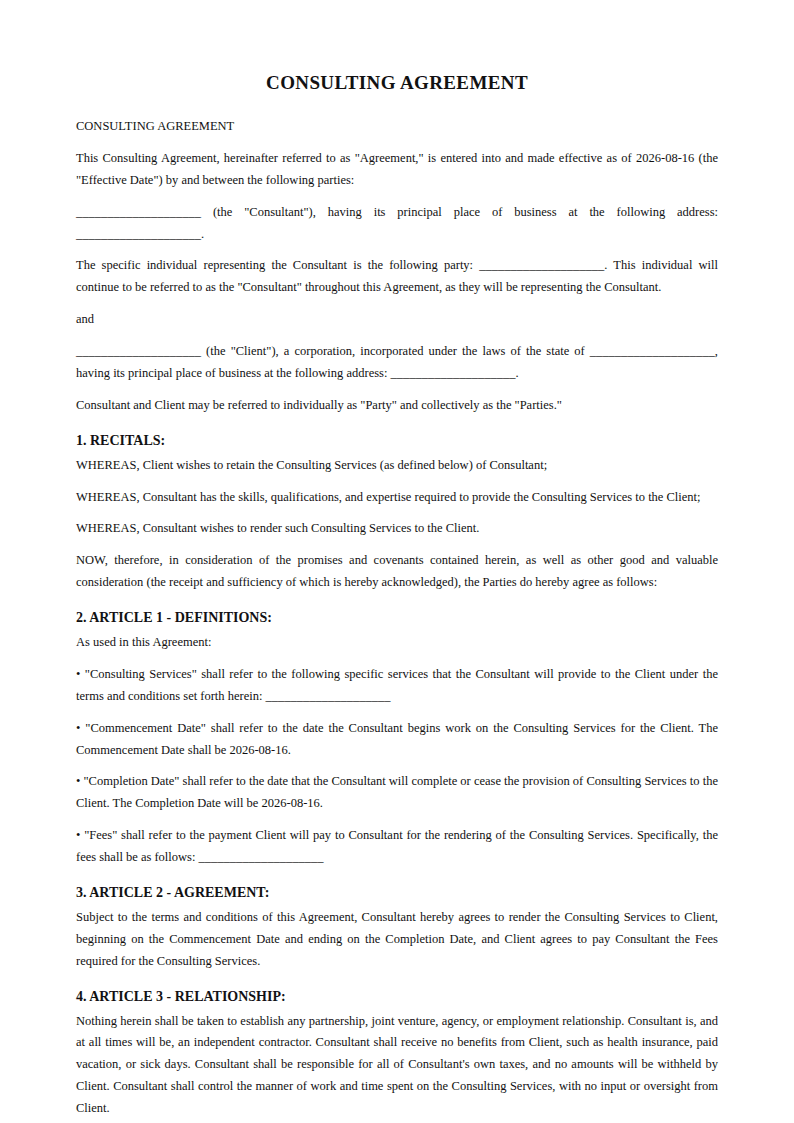
What a consulting agreement is
A consulting agreement engages somebody to provide expertise rather than to produce a thing.
That difference shapes the whole document. A contractor building a website has an obvious deliverable and an obvious moment of completion. A consultant advising on a market entry strategy has neither, which is why consulting engagements are disputed more often and about vaguer things.
The agreement earns its keep by making the intangible concrete: what the consultant will actually do, over what period, for what fee, and how that fee is calculated when the work is measured in time rather than output.
It also sets the payment discipline. Consultants invoice and wait, and the terms in this document decide how long the waiting is.
Who needs one
Independent consultants and advisory firms engaging with clients.
Businesses buying strategic, technical, financial or management advice.
Anybody moving from full time employment into consulting, where the same client is now a customer rather than an employer and the relationship needs different paperwork.
Where the engagement produces a defined deliverable, an independent contractor agreement may fit better. Where it is genuinely advisory and time based, this is the document.
Before you start
Settle these before drafting.
What the consultant is actually engaged to do, described in a way both sides would recognise afterwards.
The period the engagement runs.
The fee basis: fixed for the engagement, or by hour, day, week or month.
How long the client has to pay an invoice.
And what happens when they do not, since interest on late payment is the only leverage a consultant has short of stopping work.
The walkthrough
Filling in the form, step by step
Every question you will be asked, what it means, and an example of a good answer.
Step 1 of 3
Consulting Agreement
The parties and where the client is registered
The agreement opens by naming the consultant and the client.
One question here is unusual and useful: the state where the client is registered. For a company client that is the jurisdiction of incorporation, and it matters for enforcement. A consultant who is not paid needs to know where the client actually exists as a legal entity, since that is where a claim is brought and where any assets sit.
Name the consultant as they invoice. Where you consult through a company, use the company, since that keeps the contractual and the tax position consistent.
The client should be the entity paying rather than the individual who engaged you, which in a larger organisation are frequently different people.
- Date on the Agreement
- The date the engagement is agreed. Where advisory work has already begun on an informal basis, use the date terms were actually settled rather than backdating to the first conversation.
- Name of the Consultant
- The consultant, named as they invoice. Where you consult through a limited company, use the company name so the contract, the invoice and the tax treatment line up.
- Full Address of the Consultant
- The consultant's business address, for notices and for the client's own records of who they engaged.
- Name of the Client
- The entity engaging the consultant, using the registered name. In a larger organisation the person who briefed you and the entity that pays are often different, and it is the payer who belongs here.
- Which state is the client registered (applicable to companies)
- For a company client, where it is registered. This matters for enforcement: an unpaid consultant needs to know where the client exists as a legal entity, since that is where a claim is brought.
- Full Address of the Client
- The client's business address, where invoices and formal correspondence are sent. Confirm which address handles accounts payable, since the registered office is often not where invoices get paid.
Step 2 of 3
Consulting Agreement
The services, the period and the fee basis
This step defines the engagement, and the services description is the part that decides how it goes.
Advice is hard to pin down, so pin down what you can: the areas covered, the outputs the client will receive, the meetings or reports involved, and what falls outside. Advise on expansion into the northern market, delivering a written assessment and two review sessions is something both sides can measure. General business advisory support is not, and it is how a fixed fee engagement becomes an unlimited one.
The fee basis should follow how well the work is understood. Fixed suits a defined piece of advisory work. Hourly and daily suit open ended engagements where the extent is genuinely unknown. Weekly and monthly suit retained arrangements.
Whichever you pick, complete only the matching amount field, and consider stating an estimate or cap alongside a time based rate, since clients agree to rates and then query totals.
- The services to be rendered by the consultant to the client.
- What the consultant will do, in terms both sides would recognise later: the areas covered, the outputs, the meetings or reports, and what falls outside. Vague advisory descriptions are how fixed fee engagements become unlimited ones.
- Start Date for the performance of the consulting service
- When the engagement begins. For time based fees this is when the clock starts, so it should be a date rather than an understanding.
- End Date
- When the engagement ends. Even open ended advisory work benefits from a review date, since an arrangement with no end quietly becomes permanent on terms nobody has revisited.
- Fee to be paid to the Consultant
- Choose the basis. Fixed suits defined advisory work; hourly and daily suit engagements of unknown extent; weekly and monthly suit retained arrangements. Match it to how well the work is actually understood.
- Fixed Fee to be paid to the Consultant
- If fixed, the total for the engagement described above. This only works where the scope is genuinely defined, otherwise you have agreed a capped fee for uncapped work.
- Hourly Fee
- If hourly, the rate. Consider stating an estimated total or a cap alongside it, since clients agree readily to an hourly rate and then query the invoice that follows from it.
- Daily Fee
- If daily, the rate and what constitutes a day. Half day treatment and travel time are the two things that cause arguments, so settle them here.
- Weekly Fee
- If weekly, the rate and the expected commitment. State how many days a week the fee assumes, otherwise the client may expect five and you may have priced for two.
- Monthly Fee
- If monthly, the retainer amount and what it covers. Say what happens to unused time and whether work beyond the retainer is charged separately, which is the most common retainer dispute.
Step 3 of 3
Consulting Agreement
Invoicing, late payment and governing law
The final step is about getting paid, which for consultants is the whole battle.
The payment window should be realistic and stated. Thirty days from invoice is common in Nigerian commercial practice, and consultants who leave it unstated routinely wait considerably longer with no basis for complaint.
Interest on late payment is your only real leverage short of stopping work. Two questions set it: the percentage, and the period it is charged over. A rate charged monthly is very different from the same rate charged daily, and the form asks both because the combination is what matters. Keep it a genuine reflection of the cost of being kept out of your money rather than a penalty, since an excessive rate is open to challenge exactly when you want to rely on it.
Name the governing state with enforcement in mind: somewhere connected to the client, ideally where they are registered.
- Within how many days shall the client pay the consultant after receiving the invoice?
- The payment window, for example thirty days from receipt of invoice. State it. Consultants who leave payment terms unwritten wait far longer and have no basis on which to press.
- Payment shall be made in what form?
- How payment is made, for example bank transfer to a named business account. Specify one method and keep the account details consistent with your invoices.
- How many percentage shall be the interest on late payment?
- The interest rate on overdue invoices. Keep it a genuine reflection of the cost of late payment, since a rate set to punish is open to challenge at the moment you need to enforce it.
- The percentage shall be charged daily, weekly, monthly?
- The period the rate is applied over. This is as important as the rate itself: the same percentage charged daily rather than monthly produces a completely different figure, so make the combination deliberate.
- The law of which state shall govern the terms of this agreement?
- The Nigerian state governing the agreement. Choose with enforcement in mind, ideally somewhere connected to the client, since that is where an unpaid consultant would bring a claim.
Ready to make yours?
Answer those questions in the builder and download a finished consulting agreement in Word and PDF.
Start now, ₦10,000After you download it
Invoice on the terms you agreed
Reference the agreement on the invoice and apply the stated payment window. Terms you negotiated and then do not follow stop being terms.
Record advice in writing
Consulting disputes are usually about what was advised. A short written summary after each significant discussion protects both sides.
Address confidentiality separately
Consultants see the inside of a business. Where the engagement involves sensitive information, an NDA alongside this agreement is worth having.
Apply the interest when it is due
A late payment clause nobody enforces teaches the client that the payment window is optional. Applying it once usually fixes the behaviour.
Questions people ask
What should a consulting agreement include?
The scope of the advice, the period, the fee basis and rate, the invoice payment window, and what happens when payment is late. Scope and payment terms cause almost all consulting disputes.
How should consultants charge?
Fixed fees suit defined advisory work. Hourly and daily rates suit engagements of unknown extent. Retainers suit ongoing relationships, provided you say what the retainer covers.
What payment terms are normal in Nigeria?
Thirty days from invoice is common in commercial practice. Whatever you agree, state it, because unwritten terms mean waiting indefinitely with no basis to press.
Can I charge interest on late payment?
Yes, if the agreement provides for it. Set both the rate and the period it is charged over, and keep it a genuine reflection of the cost rather than a penalty.
What is the difference between a consultant and a contractor?
A consultant sells expertise and advice; a contractor delivers a defined output. The distinction matters because completion is obvious for one and needs defining for the other.
Should a consultant sign an NDA?
Frequently yes. Consultants see commercially sensitive information, and where they do, a separate confidentiality agreement alongside this one is sensible.
Documents that go with this
Terms used on this page
Independent Contractor
An independent contractor is engaged to deliver work under a contract for services rather than employed under a contract of service. They control how the work is done and carry their own tax and risk.
Invoice
An invoice is a document requesting payment for goods or services already delivered. It records what was supplied, what is owed, and when payment falls due.
Withholding Tax
Withholding tax is tax deducted at source from certain payments and remitted to the tax authority by the payer. It is an advance payment of the recipient's tax, not an extra charge.
Retainer
A retainer is an ongoing arrangement engaging a professional, usually for a monthly fee covering defined work. The disputes are never about the fee. They are about what the fee covered.
Termination for Convenience
Termination for convenience is a right to end a contract without anybody being in breach, simply on notice. Where a contract has one, it is usually the safest way out.
Limitation of Liability
A limitation of liability clause caps what a party can be made to pay and excludes defined categories of loss. Between businesses it is enforceable, and it is the clause that decides the real risk in a contract.
Good Faith
Good faith means dealing honestly and not undermining the purpose of the bargain. Nigerian law does not imply a general duty of it into every commercial contract, so where you want it, write it in.
Breach of Contract
A breach of contract happens when one side fails to do what the agreement says they would do. The other side can then claim damages, and in serious cases walk away from the contract entirely.
Read more on this
The Unpopular but Essential Document Called a Consulting Agreement in Nigeria
The Unpopular but Essential Document Called a Consulting Agreement Most business relationships don’t fall apart at the beginning—they unravel somewhere in the middle. At the start, everything feels clear. The consultant…
Service Level Agreements: What Small Businesses Need to Avoid Disputes
Service Level Agreements: What Small Businesses Need to Avoid Disputes Running a small business in Nigeria often involves working with other businesses, vendors, consultants, freelancers, and service providers. A graphic…
How to Terminate a Contract the Right Way
How to Terminate a Contract the Right Way How do you end a contract properly without creating bigger problems? Because terminating a contract is not just about walking away. If done carelessly, it can expose you to claim…
Step by step guides for every document on LegalDoc
Browse all guides