
How to Write a Copyright Infringement Notice
Somebody is using your work without permission. This notice tells them to stop, and it is the step that resolves most infringements without a court.
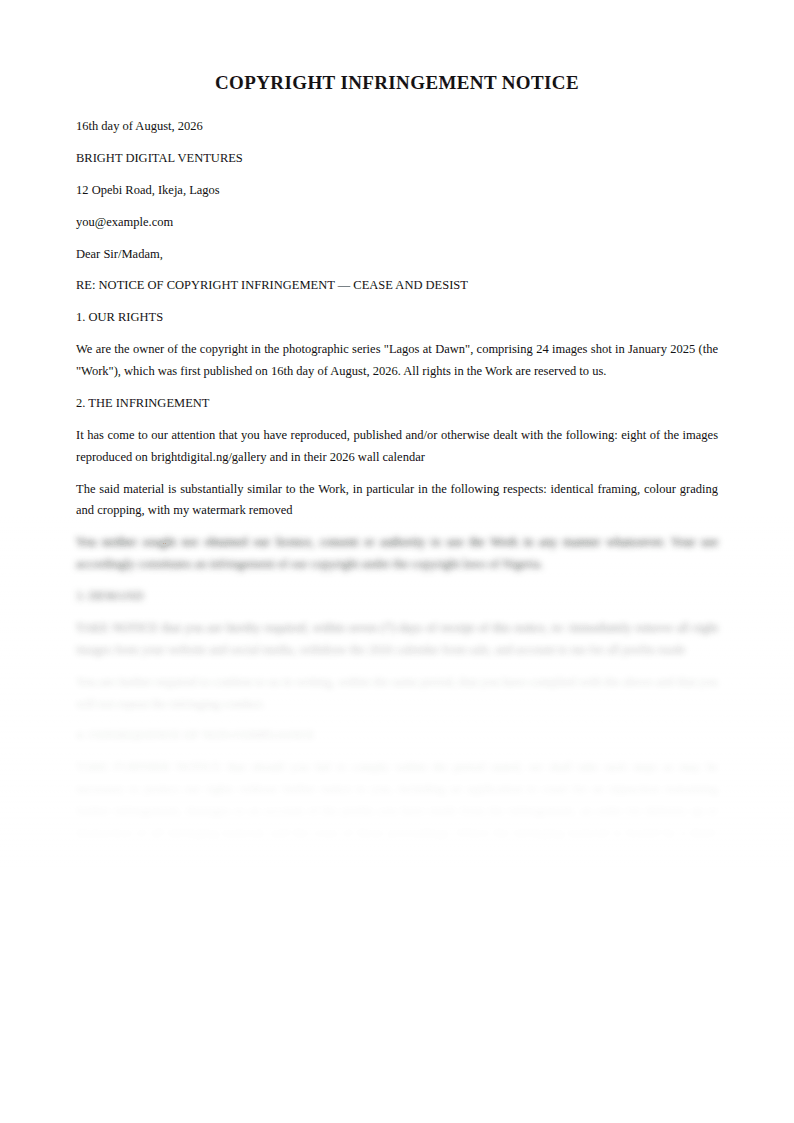
What a copyright infringement notice is
A copyright infringement notice is a formal demand that somebody stop using your work without permission.
It sets out what you own, what they are doing with it, why that infringes, and what you want them to do about it.
It works more often than people expect. A good proportion of infringement is careless rather than deliberate: an image taken from a search result, text copied by a junior staff member, a track used because nobody checked. A clear notice from an identifiable owner frequently ends it within days.
Where it does not, the notice becomes the foundation of everything that follows. It establishes that you asserted your rights, on a date, and that the other side chose to continue. Copyright in Nigeria is governed by the Copyright Act, and remedies include damages, an injunction and an account of profits.
Who needs one
Photographers, writers, musicians, designers and film makers whose work is being used without permission.
Businesses whose marketing material, product photography or website copy has been lifted by a competitor.
Anybody who has found their work reproduced on a website, in a publication or in an advertisement.
Rights holders who need to demonstrate they took steps to protect their work, which matters if the infringement continues.
Where the infringement is on a platform such as a social network or a marketplace, that platform will usually have its own takedown process, and using it alongside this notice is often faster.
Before you start
Gather your evidence before writing.
Proof that you created the work and when: original files with metadata, drafts, dated correspondence, publication records.
Evidence of the infringement: screenshots with dates and URLs, photographs of printed material, copies of the offending publication.
A clear account of what is similar and how.
Any registration you hold with the Nigerian Copyright Commission.
And a decision about what you actually want: removal, payment, credit, or all three.
The walkthrough
Filling in the form, step by step
Every question you will be asked, what it means, and an example of a good answer.
Step 1 of 3
Copyright Infringement Notice
You and the infringer
The notice opens by identifying both sides.
Name yourself as the copyright owner. Where the work belongs to your company rather than you personally, the company is the owner and should send the notice, because the party asserting the right has to be the party that holds it.
Giving your contact details is not a courtesy here. A meaningful proportion of infringers respond by offering to pay a licence fee or to credit you properly, and an owner who cannot be reached converts a solvable problem into a dispute.
Identify the infringer as precisely as you can. Where it is a registered business, name the company, since that is the entity liable. Where you only have a website or a social media account, say so and describe how you identified them, and consider a search of the business register to find the entity behind it.
- Your name (the copyright owner)
- Your name as copyright owner. Where the work belongs to your company rather than to you personally, the company should send the notice, since the party asserting the right must be the one that holds it.
- Your address
- Your address, which establishes you as a real and locatable rights holder rather than an anonymous complaint.
- Your email and/or phone number
- Your email and phone number. A good proportion of infringers respond by offering to pay or to credit you properly, and an owner who cannot be reached turns a solvable problem into a dispute.
- Date of this notice
- The date of the notice. It starts the compliance period and it is the date from which continued use is deliberate rather than merely careless.
- Who is infringing? (their name)
- Who is infringing. Where it is a registered business, name the company, since that is the entity liable. If you only have a website or account name, say so and describe how you identified them.
- Their address
- Their address. For a company, the registered office is the safe choice, since that is where formal correspondence is deemed to reach them.
- Their email address
- Their email address. For online infringement this is often the fastest route, and it produces a delivery record you can rely on later.
Step 2 of 3
Copyright Infringement Notice
What they are using and what you own
This step is the substance of the claim, and specificity is what makes it credible.
Describe the infringing use precisely: which images, on which pages, in which publication, from what date. Eight images on a named gallery page and in a named calendar is a claim somebody can verify and act on. Using my photographs is not, and it invites a reply asking which ones.
Describe your own work with the same precision, including when and how it was created. This is where you establish that the work is yours and that it came first.
The similarities section is where you explain why this is infringement rather than coincidence. Identical framing, colour grading and cropping, with a watermark removed, is compelling. It shows copying rather than independent creation, which is the question at the heart of any copyright claim.
Name the country whose law applies. Copyright is territorial, and for a Nigerian owner whose work is used in Nigeria, the Copyright Act governs.
- What are they using?
- What they are using, identified precisely: which items, on which pages or in which publication, and since when. A specific list can be verified and acted on, while a general complaint invites a reply asking which works you mean.
- Describe your original work
- Your work, described with the same precision, including when and how it was created. This is where you establish both that the work is yours and that it existed first.
- How is it similar to yours?
- Why this is copying rather than coincidence. Identical framing, cropping, colour treatment, or a removed watermark are the details that demonstrate copying, which is the question at the heart of the claim.
- Which country's copyright law applies?
- The country whose copyright law applies, for example Nigeria. Copyright is territorial, and for a Nigerian owner whose work is used in Nigeria, the Copyright Act governs.
Step 3 of 3
Copyright Infringement Notice
Your claim to the work, your demand and the deadline
The final step establishes your ownership and says what you want.
The first publication date matters because copyright protects the earlier work. Establishing when yours was published, and showing it predates theirs, is what converts an assertion into a case.
A registration number, if you have one, is useful evidence of ownership and date. Its absence is not a problem: copyright arises automatically in Nigeria on creation, and registration with the Nigerian Copyright Commission is evidentiary rather than constitutive. Say you have none rather than leaving it blank.
Be specific and realistic in your demand. Remove the images from the website and social media, withdraw the calendar from sale, and account for profits is a demand somebody can comply with. Demanding an unspecified large sum invites them to ignore you and take advice.
Consider what outcome you actually want. Where the infringement was careless and the user is willing, converting it into a paid licence is frequently better business than pursuing damages.
Seven to fourteen days is a normal compliance period. Long enough to act, short enough to convey that you mean it.
- When was your work first published?
- When your work was first published. Copyright protects the earlier work, so establishing that yours predates theirs is what turns an assertion into a case.
- Copyright registration number (if any)
- Your Nigerian Copyright Commission registration number if you have one. It is useful evidence of ownership and date. If you have none, say so, since copyright arises automatically on creation and registration is not required.
- What do you want them to do?
- What you want them to do, stated so they can actually comply: remove specified material, withdraw a product from sale, account for profits, or pay a licence fee. Where the infringement was careless, converting it into a paid licence is often better business than pursuing damages.
- How many days do they have to comply?
- The compliance period, commonly seven to fourteen days. Long enough for them to act, short enough to show you are serious. Diary the date, because a deadline you do not follow up teaches them the next one is optional.
Ready to make yours?
Answer those questions in the builder and download a finished copyright infringement notice in Word and PDF.
Start now, ₦5,000After you download it
Preserve the evidence now
Screenshot the infringing use with dates and URLs before sending. Infringers frequently remove material on receipt, which is the outcome you want and destroys your proof.
Use the platform takedown too
Where the infringement sits on a social network or marketplace, their own process is often faster than correspondence and works alongside this notice.
Consider a licence instead
Much infringement is careless. A user willing to pay for what they took converts a dispute into a customer, which is frequently the better commercial outcome.
Follow up on the deadline
If the date passes and nothing happens, act. Remedies under the Copyright Act include damages, an injunction and an account of profits.
Questions people ask
Do I need to register copyright to enforce it in Nigeria?
No. Copyright arises automatically on creation of an original work. Registration with the Nigerian Copyright Commission is optional and provides useful evidence of ownership and date.
What should the notice actually contain?
Precisely what they are using, precisely what you own, why the two are similar enough to be copying, when yours was first published, and what you want them to do by when.
How long should I give them to comply?
Seven to fourteen days is normal. Long enough to act on, short enough to convey seriousness, and you should diary the date and follow up when it passes.
What if they ignore the notice?
Remedies under the Copyright Act include damages, an injunction to stop further use, and an account of profits. The notice establishes that you asserted your rights on a date.
Should I ask for money or just removal?
Depends on the outcome you want. Where the infringement was careless and the user is willing, converting it into a paid licence is frequently better business than pursuing damages.
What if the infringement is on social media?
Use the platform's own takedown process as well as this notice. It is usually faster, and the two work alongside each other rather than instead of one another.
Documents that go with this
Terms used on this page
Copyright
Copyright is the automatic right you get over original work you create, such as writing, music, film, photographs and software. It protects the expression, not the underlying idea.
Infringement
Infringement is using somebody's intellectual property without permission. What you have to prove, and what you can recover, depends on which right was infringed.
Intellectual Property
Intellectual property is the legal ownership of things you create rather than things you can touch, including trademarks, copyright, patents and designs. In Nigeria each type has its own registry and its own rules.
Injunction
An injunction is a court order requiring somebody to do something or, more often, to stop doing something. It is the remedy you seek when damages after the fact would come too late.
Damages
Damages are money a court awards to compensate you for a loss somebody else caused. The aim is to put you where you would have been if the wrong had never happened, not to punish the other side.
Passing Off
Passing off is the claim you bring when somebody trades on your reputation using a name or look you never registered. It works, and it is harder than enforcing a registered trademark.
Work for Hire
Work for hire is the question of who owns something created by somebody you paid. For employees the answer usually favours the employer. For freelancers it usually does not.
Moral Rights
Moral rights are an author's personal rights in their work: to be credited as its creator, and to object to it being treated in a way that damages their reputation. They stay with the author even after the copyright is sold.
Read more on this
What to Do When Someone Else Trademarks Your Brand
What to Do When Someone Else Trademarks Your Brand Few things are more frustrating for a business owner than discovering that someone else has registered a trademark that looks suspiciously similar to the brand you have…
How to Write a Demand Letter That Actually Gets You Paid (With a Template)
How to Trademark a Catchphrase or Slogan
How to Trademark a Catchphrase or Slogan A catchphrase or slogan is often the most memorable part of a brand. Short, distinctive phrases such as advertising taglines, campaign slogans, or promotional expressions help con…
Step by step guides for every document on LegalDoc
Browse all guides