
How to Write a Deed of Assignment in Nigeria
A deed of assignment is what actually transfers land from a seller to a buyer. Every answer here ends up on the document a court or a registry will read.
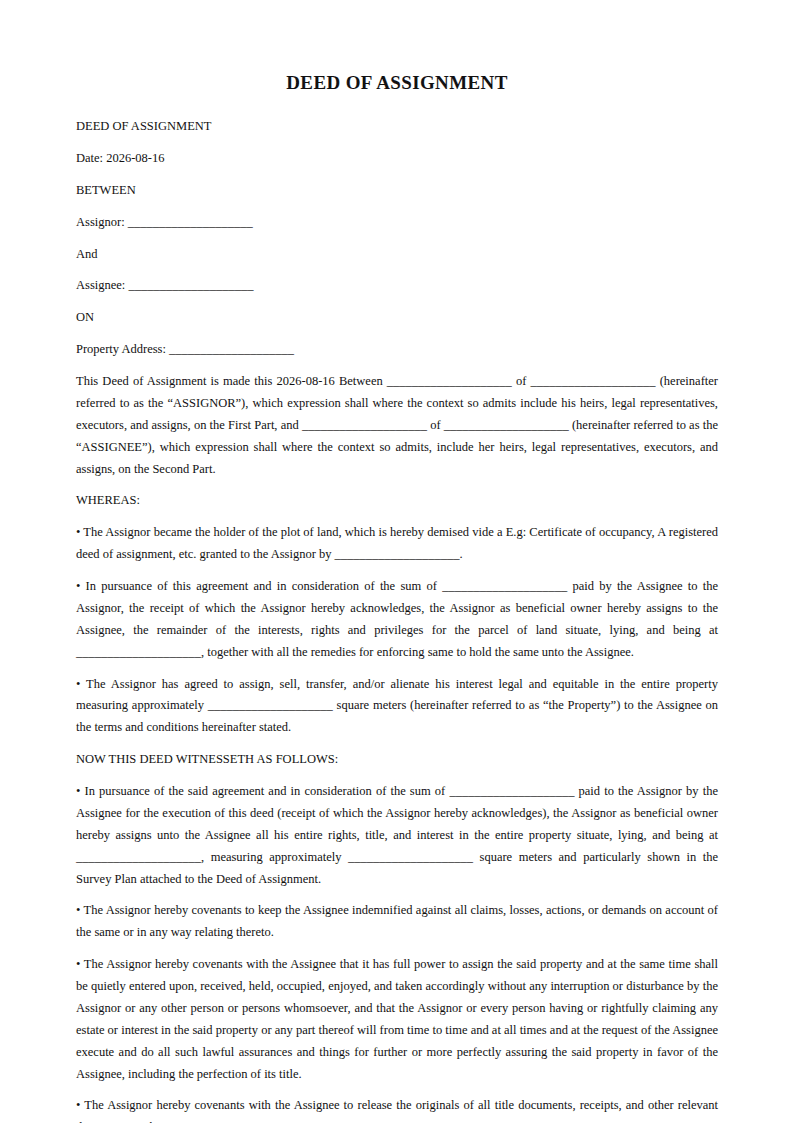
What a deed of assignment is
A deed of assignment is the document that transfers a seller's interest in land to a buyer.
It is the conveyance. A contract of sale records the bargain and a receipt records the payment, but the deed is what moves the interest from one person to the other.
It is executed as a deed, which means signed, sealed and delivered, and witnessed. Then it has to be perfected: stamped, taken for the Governor's consent where the Land Use Act requires it, and registered at the state land registry.
That last part is where Nigerian buyers most often stop, and an unperfected deed leaves the buyer exposed in ways they usually do not discover until they try to sell or borrow against the land.
Who needs one
Buyers and sellers completing a sale of land or a house.
Anybody taking land by way of gift or transfer within a family, where the same instrument is used.
Developers assigning plots to purchasers.
If you are being offered a power of attorney instead of a deed, be careful. A power of attorney authorises somebody to act; it does not transfer ownership, and Nigerian courts have said so repeatedly.
Before you start
Do the investigation before the drafting, because a deed cannot fix a defective title.
Conduct a search at the land registry and satisfy yourself the seller owns what they are selling.
Collect the seller's title documents and trace how they acquired it.
Confirm whether the land is subject to any government acquisition or committed to any overriding interest.
Agree the price and the payment arrangement in writing.
And budget for the perfection costs, which are a real part of the purchase and not an afterthought.
The walkthrough
Filling in the form, step by step
Every question you will be asked, what it means, and an example of a good answer.
Step 1 of 2
Deed of Assignment
The parties and the date
A deed names two parties and it names them exactly. The assignor is the seller, transferring their interest. The assignee is the buyer, receiving it.
Use full legal names as they appear on identification and, critically, as they appear on the seller's own title documents. Where the certificate of occupancy names Adebayo Ogundimu and the deed names Bayo Ogundimu, you have created a discrepancy the registry will query and a future buyer will find.
Where land is held by more than one person, every owner must be named and every one must execute. A deed signed by one of three co owners transfers one third of the picture at best.
For a company, use the registered name and note that execution follows the company's own requirements.
- Date on the Deed of Assignment
- The date the deed is executed by both parties. Where they sign on different days, use the later date, since that is when the deed takes effect. This date also starts the clock on stamping, which attracts penalties if left too long.
- Assignor's Name
- The full legal name of the seller, exactly as it appears on their title documents. Any difference between the name on the certificate of occupancy and the name on this deed will be queried at the registry and will worry the next buyer.
- Assignor's Address
- The seller's current address. It identifies them and gives the buyer somewhere to send correspondence if a question arises after completion, which it often does during perfection.
- Assignee's Name
- The full legal name of the buyer, spelled as on their identification and as they intend it to appear on the registered title. Where the property is being bought jointly, name every buyer, because anybody left off has no legal interest.
- Assignee's Address
- The buyer's address for correspondence. Registry notices and consent documents go here, so use somewhere post reliably arrives.
Step 2 of 2
Deed of Assignment
The property, the price and the root of title
This step describes what is being transferred and proves the seller had it to transfer.
The description has to identify one specific piece of land and no other. Address plus area, tied to a survey plan, is the standard. Land disputes in Nigeria frequently come down to whether two documents describe the same parcel, and a vague description is what makes that arguable.
The price should be the true consideration. Understating it to reduce stamp duty is common and it is a false statement in a deed. It also caps what the buyer can prove they paid if the transaction later unwinds.
Root of title is the part buyers skim and lawyers care about. Naming the seller's title documents and the previous owner shows the chain: how the seller got it, from whom. A deed that asserts ownership without showing the chain gives a future buyer nothing to verify.
- The address of the property to be sold
- The full address and location of the land, precise enough to identify this parcel and no other. Include the plot or house number, street, area, town and state, and refer to the survey plan by its number where you have one.
- How many square meters is the property to be sold?
- The measured area, taken from the survey plan rather than estimated. The figure should match the survey exactly, because a discrepancy between the deed and the plan is the kind of thing that stalls a registration.
- Price. The amount the property is to be sold for.
- The actual price paid, written in full. State the true figure. Understating consideration to reduce duty is a false statement in a deed and it limits what the buyer can later prove they paid.
- The assignor's title documents
- What the seller holds, for example a certificate of occupancy, a registered deed of assignment, or a governor's consent. Give the document type and its registration particulars. This is the root of title, and it is what a future buyer will trace.
- Name of the previous owner (pre-assignor)
- Who the seller acquired the land from. It continues the chain backwards, which is what makes the title verifiable rather than merely asserted.
- State whose laws binds this deed of assignment.
- The state where the land is situated. Land is governed by the law of the state it sits in, and that state's registry handles the consent and registration, so this is not a matter of preference.
Ready to make yours?
Answer those questions in the builder and download a finished deed of assignment in Word and PDF.
Start now, ₦10,000After you download it
Execute it properly
Both parties sign, seal and deliver, with witnesses. A company executes according to its own constitution. An improperly executed deed is not a deed.
Stamp it promptly
Stamp duty is assessed on the consideration and attracts penalties if you delay. An unstamped deed is also difficult to put in evidence when you need it most.
Obtain the Governor's consent
The Land Use Act requires the Governor's consent to a transfer of a right of occupancy. A transfer without consent is exposed, and this is the step most Nigerian buyers skip.
Register at the land registry
Registration is what makes the transfer effective against the rest of the world. An unregistered deed leaves you holding paper the registry has never heard of.
Questions people ask
What is a deed of assignment?
The document that transfers a seller's interest in land to a buyer. It is the conveyance itself, distinct from the contract of sale, which only records the bargain.
Is a deed of assignment enough to own land in Nigeria?
Not on its own. It must be executed as a deed, stamped, taken for the Governor's consent where required, and registered. Until then the buyer's position is incomplete.
Can I use a power of attorney instead?
No. A power of attorney authorises somebody to act on another's behalf and transfers no ownership. Nigerian courts have said so repeatedly, and a seller offering one instead of a deed usually has a title problem.
What is root of title?
The chain showing how the seller came to own the land: their title documents and who they acquired it from. It is what allows a buyer to verify ownership rather than take it on trust.
Should I state the real price?
Yes. Understating the consideration to reduce stamp duty is a false statement in a deed, and it limits what you can prove you paid if the transaction is later challenged.
What happens if I never register the deed?
You hold a document the registry has no record of. It becomes difficult to sell, to use as security, and to defend against somebody who registers a competing interest.
Documents that go with this
Terms used on this page
Deed of Assignment
A deed of assignment is the document that actually transfers land or property from a seller to a buyer in Nigeria. Without it, properly executed and registered, you have paid for land you cannot prove is yours.
Perfection of Title
Perfection of title is what you do after buying Nigerian land: obtain the Governor's consent, stamp the deed and register it. Skip it and you hold a receipt rather than a title.
Governor's Consent
Governor's consent is the state governor's approval of a transfer of land held under a statutory title. Under Section 22 of the Land Use Act, a transfer made without it risks being void.
Title Search
A title search is the check you run at the lands registry before buying land, to find out who actually owns it and what is registered against it. It is the cheapest part of any Nigerian property purchase.
Certificate of Occupancy
A Certificate of Occupancy, usually called a C of O, is the document a state governor issues confirming your right to occupy a piece of land for a fixed term, normally 99 years. It is the strongest ordinary title most Nigerians can hold.
Stamp Duty
Stamp duty is a tax on certain documents and transactions. In Nigeria it applies to instruments such as deeds, leases and share capital, and an unstamped document can be inadmissible in court.
Survey Plan
A survey plan is the drawing that fixes exactly where a piece of land is, produced by a licensed surveyor and lodged with the state. Without one, nobody can say with certainty which land your deed is talking about.
Right of Occupancy
A right of occupancy is the interest Nigerians actually hold in land, granted under the Land Use Act. It is a right to occupy for a term, not outright ownership of the land itself.
Read more on this
Title Perfection in Nigeria: From Search to Deed of Assignment to Registered Title
Title Perfection in Nigeria: From Search to Deed of Assignment to Registered Title and Consent There is a phrase that comes up often in Nigerian property circles: “the title is not perfected.” Sellers say it casually. Bu…
Unregistered Deed of Assignment: Do You Actually Own the Land?
Registration is not what transfers ownership; your deed does that. So an unregistered deed doesn't mean you own nothing.
REAL ESTATE: Buyer’s Guide
Introduction: Real estate is one of the biggest investments most people make in their lifetime. Therefore, it is important to make an informed decision when buying a property. This guide will help you understand the key…
Step by step guides for every document on LegalDoc
Browse all guides