
How to Write a Founders Agreement
A founders agreement settles equity, roles and what happens when somebody leaves, while everybody still likes each other. That is the only time it can be written.
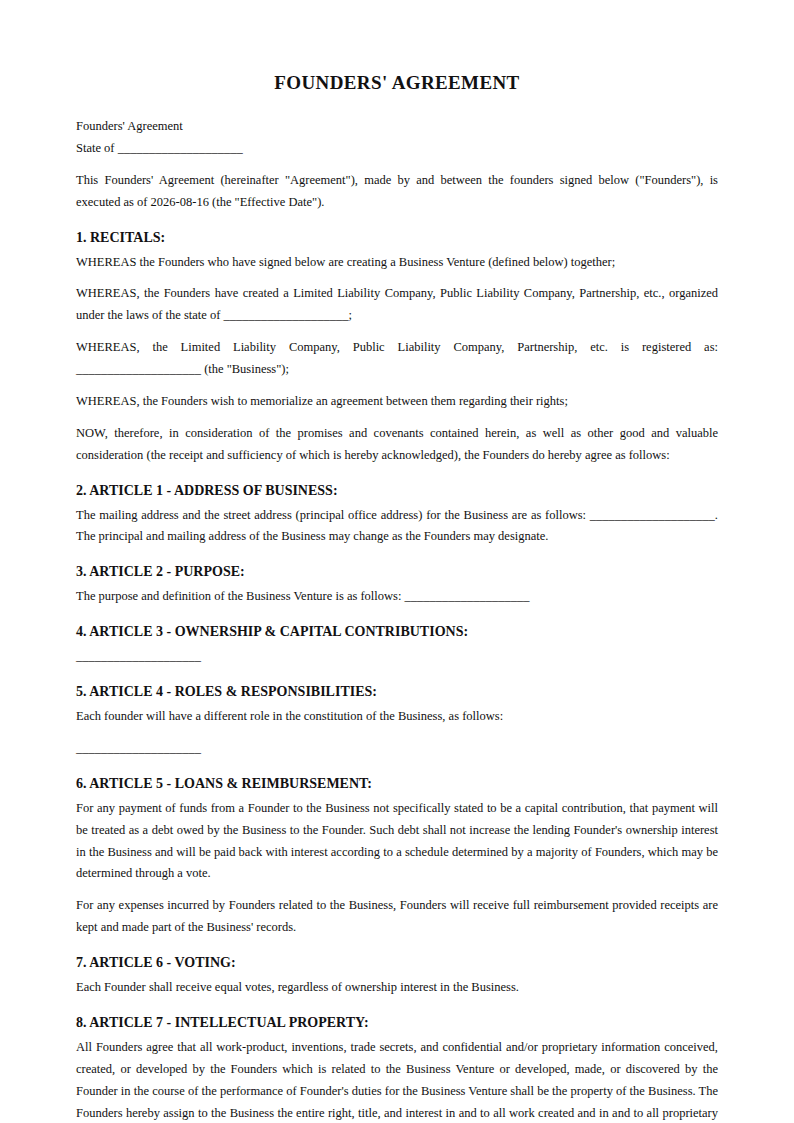
What a founders' agreement is
A founders agreement is the contract between the people starting a business together.
It records who owns what, what each person is contributing, what they are responsible for, and what happens to their shares if they leave.
The last of those is the one that matters most and gets written least. Startups fail from founder disputes more often than from bad products, and the disputes are nearly always about the same thing: one founder left early and kept a large stake, while the others continued building the value that stake now represents.
Vesting is the answer to that, and it only works if it is agreed at the start. Nobody can propose vesting eighteen months in without it sounding like an accusation.
Who needs one
Any business started by more than one person, at the point they decide to work together rather than at the point they disagree.
Founding teams about to incorporate, since the agreement shapes how shares are issued.
Existing teams operating on an informal understanding, which is common and worth correcting before an investor asks to see the cap table.
A sole founder does not need one, though they should still document any equity promised to early contributors.
Before you start
Have the difficult conversations before drafting, because the document only records what you agreed.
How equity is split, and on what basis.
What each founder is contributing: cash, time, intellectual property, existing customers.
Who decides what, particularly where the split is even.
What happens if somebody stops contributing.
And whether founders may work on anything else while building this.
The walkthrough
Filling in the form, step by step
Every question you will be asked, what it means, and an example of a good answer.
Step 1 of 3
Founders' Agreement
Where the company is and when you agreed
The agreement opens with the jurisdiction and the date.
The country of incorporation sets the company law backdrop. For a Nigerian company that is CAMA 2020, which governs how shares are issued and transferred, and those mechanics matter to everything this agreement provides for.
The date is worth being honest about. Founders frequently work together for months before documenting anything, and the agreement often needs to account for contributions already made. Record the date you actually signed and deal with the earlier period expressly rather than pretending the arrangement began today.
Where the company is not yet incorporated, this agreement can still be made between the founders personally, with provision for the shares to be issued once the company exists.
- The Company is incorporated in which country?
- Where the company is or will be registered, for example Nigeria. It sets the company law that governs how shares are issued and transferred, which underpins the vesting and lock-in provisions below.
- Date of the Agreement
- The date the founders sign. Where you have already been working together, use the real date and address the earlier period expressly, since contributions made before this date usually need recognising.
Step 2 of 3
Founders' Agreement
The company and what it is for
This step describes the venture itself.
The type of company matters for how the rest works. A Nigerian private company limited by shares is the usual startup structure, and it brings the CAMA rules on share transfers, pre-emption and director duties with it. A partnership is a different animal with different consequences for personal liability.
The purpose of the business is worth stating with some care, because it defines the venture the founders owe their commitment to. Where a founder later starts something adjacent, the question of whether it competes with this business is answered against this description.
If the company is not yet incorporated, describe the intended structure and note that shares will be issued on incorporation.
- Name of the Company
- The company name, or the intended name where incorporation has not happened yet. Where it is registered, use the exact name on the certificate of incorporation.
- Address of the Company
- The registered or principal address of the business. Where founders work remotely, use the registered office rather than a founder's home unless that is genuinely the registered address.
- Type of Company
- The structure, for example a private company limited by shares. This determines the rules on share transfers, pre-emption rights and director duties that everything below depends on.
- Purpose of business?
- What the business does. State it with some care, because it defines the venture founders owe their commitment to, and it is the reference point if somebody later starts something adjacent.
Step 3 of 3
Founders' Agreement
Equity, roles, lock-in and vesting
This is the substance of the agreement and the reason it exists.
On contribution, record what each founder is actually putting in and the equity it corresponds to. Cash is easy. Time, existing intellectual property and customer relationships are harder and should still be written down, because the founder who contributed the idea and the founder who contributed six months of unpaid work will remember the relative value differently in two years.
Roles matter for a practical reason beyond clarity: where equity is split evenly, decision making needs a mechanism, otherwise the company deadlocks the first time two founders disagree fundamentally.
Lock-in prevents a founder selling or transferring shares for a stated period. It stops an early exit that puts a stranger on your cap table.
Vesting is the important one. It means shares are earned over time rather than owned outright from day one, typically over three or four years with a one year cliff, so a founder leaving after two months takes very little. Without it, the person who leaves earliest is often the best rewarded relative to their contribution, which is the single most common cause of founder disputes and the thing investors check first.
- Founders and capital contribution
- Each founder, what they are contributing, and the equity that corresponds to it. Record non cash contributions such as time, intellectual property or customer relationships explicitly, since founders remember their relative value very differently later.
- Founders' roles and responsibilities.
- What each founder is responsible for and who decides what. Where equity is split evenly, include a decision mechanism, otherwise the company deadlocks the first time two founders genuinely disagree.
- Lock-in-period
- How long founders must hold their shares before transferring them, for example two years. It prevents an early sale putting an outsider on the cap table before the business has taken shape.
- Vesting Period
- The period over which shares are earned rather than simply owned, commonly three or four years with a one year cliff. This is the provision that prevents a founder leaving after a few months with a stake the others spend years building value for.
Ready to make yours?
Answer those questions in the builder and download a finished founders' agreement in Word and PDF.
Start now, ₦10,000After you download it
Reflect it in the share issue
The agreement is between founders; the shares are issued by the company. Make sure what is actually issued and recorded at the CAC matches what you agreed here.
Assign intellectual property to the company
Work founders created before incorporation belongs to them personally unless assigned. Investors check this, and fixing it later requires the cooperation of whoever has left.
Add a shareholders agreement as you grow
A founders agreement covers the founding team. Once outside investors join, a shareholders agreement covers the wider group and usually supersedes parts of this one.
Revisit when roles change
Founder responsibilities shift as a company grows. An agreement describing roles nobody performs any more is worth less than one kept current.
Questions people ask
What is a founders agreement?
The contract between people starting a business together, recording equity splits, contributions, roles, and what happens to somebody's shares if they leave.
What is founder vesting?
Shares earned over time rather than owned outright from day one, commonly over three or four years with a one year cliff. It prevents an early leaver keeping a stake the others spend years building value for.
Should founders split equity equally?
Only if contributions genuinely are equal. What matters more than the split is vesting, since an even split with no vesting is how one departing founder ends up owning half a business they no longer build.
What is a lock-in period?
A period during which founders cannot sell or transfer their shares. It stops an early exit putting an outsider onto the cap table before the business has established itself.
Do we need this if we already incorporated?
Yes, and sooner rather than later. Many teams operate on an informal understanding until an investor asks to see the arrangements, which is a bad moment to discover you disagree.
What happens to intellectual property created before incorporation?
It belongs to the founder personally unless assigned to the company. Investors check this during due diligence, and fixing it later needs the cooperation of anybody who has since left.
Documents that go with this
Terms used on this page
Promoter
A promoter is somebody who takes the steps to bring a company into existence. They owe duties to the company before it exists, and they cannot quietly profit from that position.
Vesting
Vesting is equity earned over time rather than given all at once. It is how startups make sure a founder or employee who leaves in year one does not keep a share meant to reward years of work.
Share Capital
Share capital is the value of shares a company has issued or is permitted to issue. It is not cash in the bank, and the figure you declare at the CAC drives your registration cost.
Shareholders Agreement
A shareholders agreement is the private contract between the owners of a company covering how it is run, how shares move and what happens when they disagree. The articles do not do that job.
Drag-Along
A drag-along right lets a majority selling the company compel the minority to sell too, on the same terms. It exists because most buyers want all of a company, not most of it.
Tag-Along
A tag-along right lets a minority join a sale by the majority on the same terms. Without it, the majority can sell and leave the minority holding shares in a company owned by a stranger.
Director
A director is a person appointed to manage a company and make decisions on its behalf. The role comes with legal duties owed to the company, and with personal exposure when those duties are ignored.
Intellectual Property
Intellectual property is the legal ownership of things you create rather than things you can touch, including trademarks, copyright, patents and designs. In Nigeria each type has its own registry and its own rules.
Read more on this
5 REASONS WHY YOU NEED A FOUNDERS AGREEMENT
What Is a Founders Agreement? A founders agreement is a legally binding contract entered into by the original owners of a business. It sets out the rights, obligations, and expectations of each founder from the outset. W…
Founders Vs. Shareholders
When building a company, it’s important to understand the distinct roles of founders and shareholders and the legal documents that formalize their relationships. Founders: Globally, roughly 40 million startup companies a…
10 Legal Documents Every Startup in Nigeria Needs
10 Legal Documents Every Startup in Nigeria Needs Starting a business in Nigeria is exciting. Entrepreneurs launch new ventures every day—technology startups, creative agencies, e-commerce platforms, consulting firms, an…
Step by step guides for every document on LegalDoc
Browse all guides