
How to Write a Freelance Agreement
A freelance agreement settles scope, money and deadlines before the work starts. Freelancers who skip it end up arguing about all three.
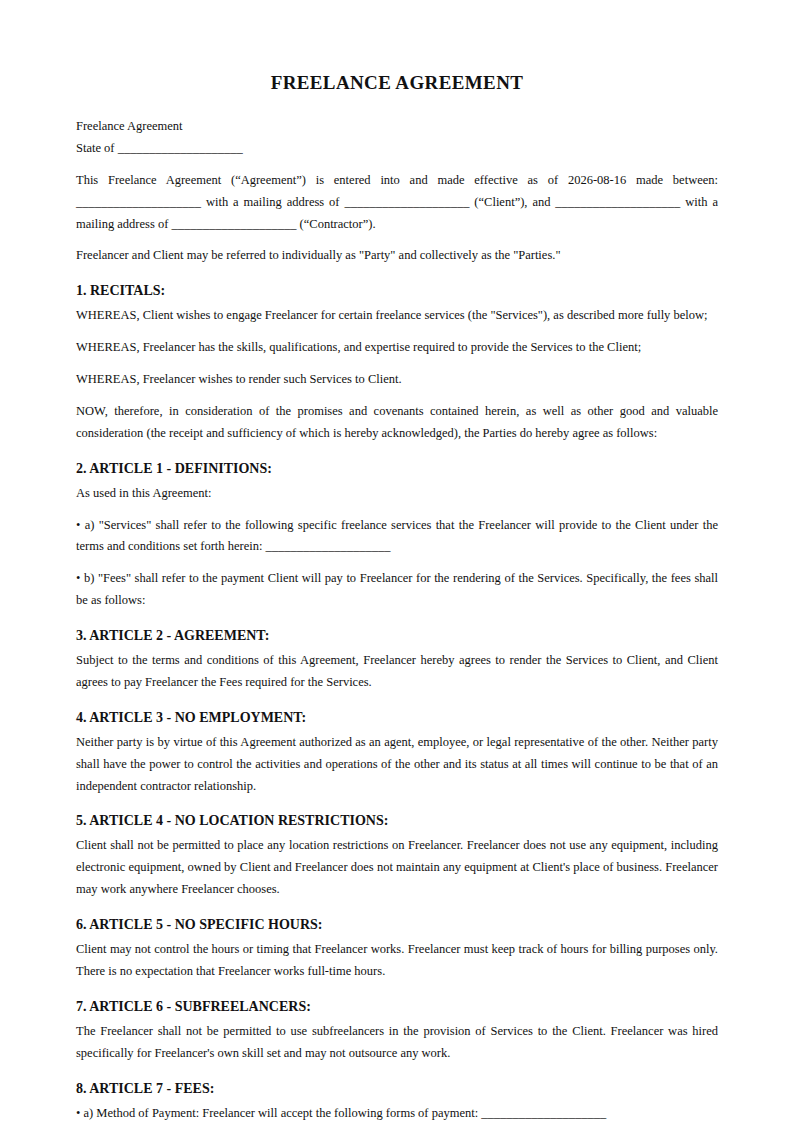
What a freelance agreement is
A freelance agreement is the contract between an independent worker and a client for a defined piece of work.
It covers what is being delivered, what it costs, when it is paid, and when it is due. Those four things account for essentially every freelance dispute, which is why the document is worth the twenty minutes it takes.
A freelancer is not an employee. They control how the work is done, use their own tools, serve other clients, and carry their own tax and pension obligations. That independence is the point, and it is also why the client owes none of the protections an employee would receive.
The agreement is what replaces those protections with commercial ones.
Who needs one
Freelancers of every kind: designers, developers, writers, photographers, consultants and tradespeople.
Clients engaging individuals for project work who want the deliverable and the deadline recorded.
Anybody who has done work on a verbal brief and then had a disagreement about what was included, which is most freelancers at least once.
Where the relationship is ongoing and the client controls how the work is done, that may be employment rather than freelancing, and the substance decides it rather than the paperwork.
Before you start
Agree the commercial shape before drafting.
Exactly what is being delivered, and just as importantly what is not.
Whether the fee is fixed for the whole job or calculated on time spent.
When payment falls due, and whether any of it is payable up front.
The deadline, and whether it depends on the client providing anything.
And who owns the work when it is finished, since that is the question this form does not ask and freelancers most often forget.
The walkthrough
Filling in the form, step by step
Every question you will be asked, what it means, and an example of a good answer.
Step 1 of 3
Freelance Agreement
The client, the freelancer and the date
The agreement opens by naming both sides.
For freelancers, name yourself as you invoice: your own name if you trade personally, or your registered business name if you have one. Consistency between the agreement, the invoice and the account receiving payment matters, because a client querying an invoice from a name that does not appear on the contract has a legitimate question.
Name the client entity that will actually pay. Engaging with a marketing manager is fine, but the contracting party should be the company, since that is who owes the fee and who you would pursue.
The date sets when the agreement takes effect, which is worth being accurate about where work has already started.
- Client's Name
- The person or company engaging you, using the registered company name where it is a business. Name the entity that will actually pay the invoice rather than the individual who briefed you.
- Client's Address
- The client's business address. It identifies them and is where any formal correspondence about the work or an unpaid invoice would be sent.
- Freelancer's Name
- Your name as you invoice: your own name if you trade personally, or your registered business name. Keep it consistent with your invoices and your bank account, since a mismatch invites payment queries.
- Freelancer's Address
- Your address for correspondence. Where you work from home and would rather not publish it, a registered business address is a reasonable alternative.
- Agreement Date
- The date the agreement takes effect. Where work has already begun informally, use the date the parties actually agreed terms rather than backdating to the start of the work.
Step 2 of 3
Freelance Agreement
The work and the money
This step is the core of the agreement, and the scope description is where freelancers protect themselves.
Write what is included and, explicitly, what is not. Three logo concepts with two rounds of revision is a scope. Design a logo is an invitation to an indefinite number of revisions at no extra cost. Scope creep is the most common way freelance work becomes unprofitable, and it is almost always traceable to a vague description written at the start.
On fees, a fixed fee suits well defined work and shifts the risk of it taking longer onto you. A prorated fee, calculated on time spent, suits work whose extent is genuinely unknown and shifts that risk to the client. Choose according to how well you understand the job.
The late fee gives an unpaid invoice consequences. It should reflect the real cost of being paid late rather than serving as a punishment, and having one stated makes chasing payment a matter of applying the contract rather than asking a favour.
- Service to be rendered
- What you will deliver, in detail, including what is excluded. Three logo concepts with two rounds of revision is a scope you can hold somebody to. Design a logo is an open ended commitment, and scope creep is what makes freelance work unprofitable.
- Payment arrangement
- Choose Fixed Fee for well defined work, where you carry the risk of it taking longer than expected. Choose Prorated Fee where the extent is genuinely unknown, which puts that risk on the client instead.
- How much is the fixed fee?
- If fixed, the total amount for the whole scope described above. State whether it includes expenses and any applicable tax, since those assumptions differ and surface at invoicing.
- Prorated Fee
- If prorated, the rate and the unit, for example a daily or hourly rate. Consider stating an estimated total or a cap, because open ended time based billing makes clients nervous and disputes more likely.
- Payment Method
- How you are paid, for example bank transfer to a named account, and the payment terms such as within fourteen days of invoice. Freelancers who leave payment terms unstated wait considerably longer to be paid.
- Late Fee Penalty
- What is charged on overdue invoices. Keep it a genuine reflection of the cost of late payment. Having one stated turns chasing an invoice into applying the contract rather than asking a favour.
Step 3 of 3
Freelance Agreement
Milestones, deadlines and governing law
The closing step sets the timetable and the legal frame.
Milestones are worth using even on modest projects, because they let you tie payment to progress. Fifty per cent on acceptance of the first draft, the balance on delivery, is a structure that protects both sides: the client sees progress before paying in full, and you are not carrying the whole project unpaid.
The two dates do different things. The completion date is when the work is delivered. The termination date is when the agreement itself ends, which may be later, allowing for revisions, final payment and any wrap up. Setting them to the same day leaves no room for the payment you are still owed.
Write deadlines that depend on the client's input as depending on it. Where a project stalls because a client did not supply content, an agreement that made the deadline conditional protects you and one that did not makes the delay look like yours.
- Milestones to be met
- The stages of the work and, ideally, what is paid at each. Tying payment to milestones protects both sides, and where a stage depends on the client supplying something, say so, so a delay on their side does not read as yours.
- Date for Completion of the Service.
- When the work is due. Make it conditional on the client providing whatever you need from them, since projects most often run late because material never arrived.
- Termination Date
- When the agreement itself ends, which should be after the completion date to allow for revisions and final payment. Ending the agreement on the delivery date leaves no framework for collecting what you are owed.
- Governing law of what state?
- The Nigerian state whose law governs the agreement, for example Lagos State. Choose somewhere at least one party is genuinely based, since that is where a claim for unpaid fees would realistically be brought.
Ready to make yours?
Answer those questions in the builder and download a finished freelance agreement in Word and PDF.
Start now, ₦10,000After you download it
Take a deposit
Payment up front or on the first milestone is standard freelance practice. It filters out clients who were never going to pay and funds the early work.
Settle who owns the work
This form does not ask, so raise it separately. Whether copyright transfers on final payment or you retain it and license the use should be agreed rather than assumed.
Put changes in writing
When the client asks for something beyond the scope, confirm the extra cost by email before doing it. That message is what makes the additional invoice payable.
Keep your own tax in order
Freelancers carry their own tax obligations, and clients may deduct withholding tax from your fee. Factor that in rather than being surprised by the amount that arrives.
Questions people ask
What should a freelance agreement include?
What is being delivered and what is not, the fee and how it is calculated, when payment falls due, and the deadline. Those four things account for almost every freelance dispute.
Fixed fee or hourly rate?
A fixed fee suits well defined work and puts the risk of overrun on you. An hourly or daily rate suits work of unknown extent and puts that risk on the client.
How do I avoid scope creep?
Write what is excluded as well as what is included, state the number of revision rounds, and confirm any extra request and its cost by email before starting it.
Who owns the work I produce?
Whatever you agree, so agree it. Copyright can transfer on final payment or you can retain it and license the use, and this form does not ask, so raise it separately.
Am I a freelancer or an employee?
The substance decides it. Controlling how you work, using your own tools and serving other clients points to freelancing. A client controlling your hours and methods points the other way.
What if the client pays late?
A stated late fee turns chasing an invoice into applying the contract. Combine it with a deposit and milestone payments so you are never carrying the whole project unpaid.
Documents that go with this
Terms used on this page
Independent Contractor
An independent contractor is engaged to deliver work under a contract for services rather than employed under a contract of service. They control how the work is done and carry their own tax and risk.
Withholding Tax
Withholding tax is tax deducted at source from certain payments and remitted to the tax authority by the payer. It is an advance payment of the recipient's tax, not an extra charge.
Invoice
An invoice is a document requesting payment for goods or services already delivered. It records what was supplied, what is owed, and when payment falls due.
Intellectual Property
Intellectual property is the legal ownership of things you create rather than things you can touch, including trademarks, copyright, patents and designs. In Nigeria each type has its own registry and its own rules.
Work for Hire
Work for hire is the question of who owns something created by somebody you paid. For employees the answer usually favours the employer. For freelancers it usually does not.
Termination for Convenience
Termination for convenience is a right to end a contract without anybody being in breach, simply on notice. Where a contract has one, it is usually the safest way out.
Consideration
Consideration is what each side gives up in a contract. Without something moving in both directions, you generally have a promise rather than an agreement a court will enforce.
Breach of Contract
A breach of contract happens when one side fails to do what the agreement says they would do. The other side can then claim damages, and in serious cases walk away from the contract entirely.
Read more on this
The Unpopular but Essential Document Called a Consulting Agreement in Nigeria
The Unpopular but Essential Document Called a Consulting Agreement Most business relationships don’t fall apart at the beginning—they unravel somewhere in the middle. At the start, everything feels clear. The consultant…
Service Level Agreements: What Small Businesses Need to Avoid Disputes
Service Level Agreements: What Small Businesses Need to Avoid Disputes Running a small business in Nigeria often involves working with other businesses, vendors, consultants, freelancers, and service providers. A graphic…
10 Legal Documents Every Startup in Nigeria Needs
10 Legal Documents Every Startup in Nigeria Needs Starting a business in Nigeria is exciting. Entrepreneurs launch new ventures every day—technology startups, creative agencies, e-commerce platforms, consulting firms, an…
Step by step guides for every document on LegalDoc
Browse all guides