
How to Write a Letter of Intent
A letter of intent records a deal in principle before the contract exists. Whether it binds you is a question you answer, not one you discover.
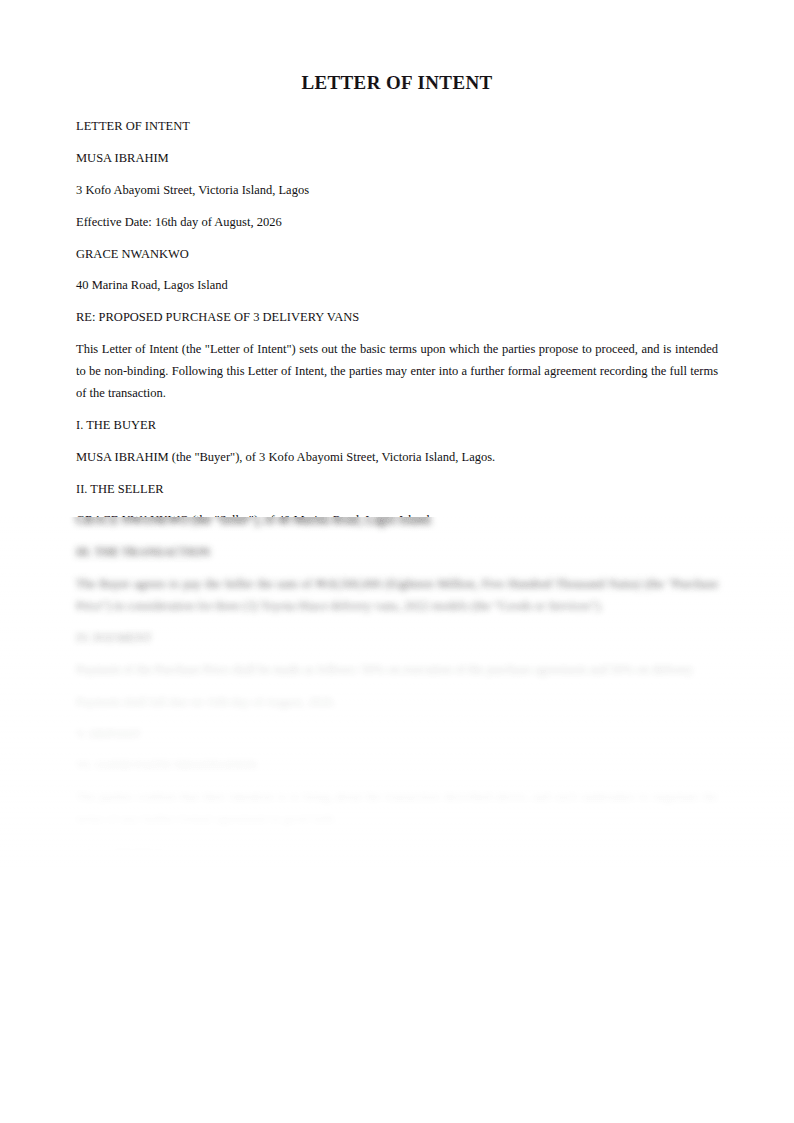
What a letter of intent is
A letter of intent sets out what two parties have agreed in principle, before the formal contract is drafted.
It records who is dealing with whom, what is being bought or sold, roughly on what terms, and what still has to happen. It gives both sides something concrete to work from and to take to their advisers, their banks or their boards.
The single most important question about any letter of intent is whether it binds. Most are written not to: they express an intention to proceed while leaving either side free to walk away. Some are binding, and some are a mixture, with the commercial terms non binding and provisions on confidentiality and exclusivity binding.
This form asks the question directly, which is unusually helpful. Answer it deliberately, because a party who thought they were expressing interest and finds they signed a contract has a genuine problem.
Who needs one
Businesses agreeing the shape of a transaction before instructing lawyers to draft it.
Buyers and sellers of equipment, vehicles, stock or a business who want the outline recorded.
Parties who need something in writing to show a bank, an investor or a board before proceeding.
Anybody negotiating a deal of enough value that a misunderstanding about the basics would be expensive.
For a property purchase specifically, the letter of intent for property purchase covers the conditions and exclusivity that a land transaction needs.
Before you start
Be clear about these before writing.
Whether you intend to be bound, and if only partly, which parts.
What is actually being bought, described well enough that both sides mean the same thing.
The price, or honestly that it is not yet agreed.
When payment would happen.
Whether a deposit is involved and what happens to it if the deal does not proceed.
And what still has to be done before anybody is committed.
The walkthrough
Filling in the form, step by step
Every question you will be asked, what it means, and an example of a good answer.
Step 1 of 4
Letter of Intent
Sender, recipient and what the deal is about
The letter opens as correspondence: who is writing, to whom, and about what.
The subject line does more work than it appears. It is the one line somebody reads before deciding how carefully to read the rest, and in a business with several negotiations running it is what identifies this one. Proposed purchase of three delivery vans is useful. Business proposal is not.
The effective date matters where the letter contains anything time limited, such as an exclusivity period or a deadline for signing the full contract. Those periods run from here.
Name the parties correctly. Where either side is a business, use the registered name, since the entity that will eventually contract should be the entity named in the letter that preceded it.
- Your name (the party sending this letter)
- Your name as the party sending the letter, or the registered name where a business is proposing the deal. It should be the same entity that will sign the eventual contract.
- Your address
- Your address for correspondence about the proposal.
- Who are you sending it to?
- Who you are writing to. Where they are a business, address the entity rather than only the individual you have been speaking to, since it is the entity that will contract.
- Their address
- Their address, where the letter is sent and any response is expected.
- Effective date of this letter
- The effective date. Anything time limited in the letter, such as a deadline for executing the full agreement, runs from here, so it should be the date you actually send it.
- What is this deal about? (subject line)
- A subject line naming the transaction, for example the proposed purchase of three delivery vans. It is the line somebody reads before deciding how carefully to read the rest, and it identifies this negotiation among any others running.
Step 2 of 4
Letter of Intent
Buyer, seller and whether this binds
This step names the transacting parties and answers the question the whole document turns on.
The binding status choice is the most consequential answer in this form. Non binding means the letter records an intention and neither side is committed: you can walk away without liability. Binding means you have made a contract, and the other side can hold you to it.
The form recommends non binding, and for most letters of intent that is right. The purpose is usually to establish common ground before the real agreement, not to create an obligation before the details are settled.
If you choose binding, understand what you are doing. Everything the letter says about price, payment and the subject matter becomes enforceable, on terms drafted without the detail a proper contract would contain. That is a poor way to enter a significant commitment.
The common middle position, which this form does not offer directly, is a letter that is non binding on the commercial terms but binding on confidentiality and exclusivity. If that is what you want, choose non binding and say expressly in the letter which provisions are intended to bind.
- Buyer's name
- The party acquiring, which may differ from whoever is sending the letter. Where a company will buy, name the company, since that is the entity that would eventually contract and pay.
- Is this letter binding or non-binding?
- The most consequential answer in the document. Non binding records an intention and leaves both sides free to walk away. Binding creates a contract on terms drafted without the detail a proper agreement would have, which is a poor way to commit to anything significant. If you want the commercial terms open but confidentiality and exclusivity binding, choose non binding and say expressly which provisions are intended to bind.
- Buyer's address
- The buyer's address, which will carry through into the eventual contract.
- Seller's name
- The party disposing, named as the entity that actually owns what is being sold and can transfer it.
- Seller's address
- The seller's address for the transaction and any correspondence about it.
Step 3 of 4
Letter of Intent
The price, what is being bought and when payment happens
This step records the commercial terms.
Describe what is being bought with enough precision that both sides are picturing the same thing. Three Toyota Hiace delivery vans, 2022 models is specific. Delivery vehicles is not, and vagueness here is how parties reach the contract stage and discover they were negotiating different transactions.
State the price in figures and words. Where the price is not yet agreed, say so honestly rather than inserting a number nobody has accepted, since a stated price in a binding letter is a price you may be held to.
The payment timing question has three routes and you complete only the one you chose. Payment at a later date suits a deal that will complete on a defined event or schedule. Payment on signing suits something straightforward. The third option covers everything else, including instalments.
Whichever you choose, describe the mechanism rather than just the timing. Fifty per cent on execution of the purchase agreement and fifty per cent on delivery tells the other side exactly what to expect and when.
- Purchase price
- The price in figures and words. Where it is not yet agreed, say so rather than inserting a number nobody has accepted, particularly if the letter is binding, since a stated price may be one you are held to.
- What is being bought?
- What is being bought, described precisely enough that both sides are picturing the same thing. Three Toyota Hiace vans, 2022 models is specific; delivery vehicles is how parties reach the contract stage and find they were negotiating different deals.
- When will payment be made?
- When payment happens. Choose the route that matches the deal and complete only the corresponding box below.
- Describe the payment arrangement
- If payment comes later, describe the arrangement, for example half on execution of the purchase agreement and half on delivery. Describe the mechanism rather than only the timing, so the other side knows exactly what to expect.
- Date payment is due
- The date payment falls due, where a specific date applies rather than an event.
- Describe the payment on signing
- If payment is made on signing, confirm it and state whether that means signing this letter or signing the eventual contract. Those are usually different moments and the distinction matters.
- Describe the payment arrangement
- If another arrangement, describe it fully, for example six monthly instalments beginning on a stated date. Instalment arrangements need the number, the amount and the dates.
Step 4 of 4
Letter of Intent
The deposit and the governing law
The final step deals with money paid up front and the applicable law.
The deposit question is where letters of intent most often cause real loss, because a deposit paid on a non binding letter is money handed over on an arrangement neither side is committed to. If you are paying one, the letter must say what happens to it in every outcome: if the buyer withdraws, if the seller withdraws, and if the parties simply fail to reach agreement.
Be aware of a tension worth understanding. A letter expressed as non binding, which nonetheless requires a deposit with conditions attached, contains binding obligations about that deposit. That is normal and it should be stated explicitly rather than left as an inconsistency somebody notices later.
Where no deposit is required, say so. Confirming it closes off any later suggestion that one was expected.
Name the law governing the letter. For a Nigerian transaction that is Nigerian law, and where the letter is non binding it still matters, since disputes about whether a letter bound the parties have to be resolved somewhere.
- Is a deposit required?
- Whether any money is paid up front. This is where letters of intent most often cause real loss, since a deposit paid on a non binding letter is money handed over on an arrangement neither side is committed to.
- Describe the deposit
- If a deposit is required, state the amount, when it is paid, and what happens to it in every outcome: if the buyer withdraws, if the seller withdraws, and if no agreement is reached by a stated date. Note that these deposit terms bind even in an otherwise non binding letter, and say so expressly.
- Confirm no deposit is required
- If no deposit is required, confirm it. Saying so closes off any later suggestion that one was expected or that the deal fell through because it was not paid.
- Which law governs this letter?
- The law governing the letter, for example the Federal Republic of Nigeria. It matters even for a non binding letter, since any dispute about whether the letter bound the parties has to be resolved somewhere.
Ready to make yours?
Answer those questions in the builder and download a finished letter of intent in Word and PDF.
Start now, ₦5,000After you download it
Say which parts bind
A letter that is non binding on commercial terms but binding on confidentiality and exclusivity is the usual arrangement. State it explicitly rather than leaving it implied.
Set a date to sign the real contract
A letter of intent with no deadline drifts. Give the parties a date by which the full agreement is executed or the letter lapses.
Be careful with deposits
Money paid on a non binding letter is money paid on an uncommitted arrangement. If a deposit is involved, its terms must cover every way the deal can end.
Move to the actual agreement
The letter has done its job once the terms are agreed. Its value falls sharply the longer it substitutes for the contract it was meant to precede.
Questions people ask
Is a letter of intent legally binding?
It depends what it says, and this form asks you directly. Most are written to be non binding, recording an intention while leaving both sides free to walk away.
Should I choose binding or non binding?
Non binding for almost all purposes. A binding letter creates a contract on terms drafted without the detail a proper agreement would contain, which is a poor way to commit to anything significant.
Can part of it be binding?
Yes, and that is the common arrangement: commercial terms non binding, confidentiality and exclusivity binding. Choose non binding and state expressly which provisions are intended to bind.
Should I pay a deposit on a letter of intent?
Be careful. Money paid on a non binding letter is money on an arrangement neither side is committed to. If a deposit is involved, the letter must say what happens to it in every outcome.
What if we never sign the full contract?
With a non binding letter, generally nothing happens and both sides walk away. That is why the deposit terms and any exclusivity period need to be clear.
How is this different from a memorandum of understanding?
In practice very little. Both record terms agreed in principle, and both turn on whether the parties intended to be bound, which is the question worth answering explicitly.
Documents that go with this
Terms used on this page
Letter of Intent
A letter of intent sets out the terms on which somebody proposes to do a deal, before the full contract is drafted. Most of it is not binding, and the parts that are should say so.
Offer and Acceptance
Offer and acceptance is how a contract comes into existence. One side proposes definite terms, the other agrees to them without changes, and at that moment an agreement exists.
Exclusivity
Exclusivity gives one party sole rights: to distribute in a territory, to supply a customer, or to negotiate a deal without the other side talking to anybody else. It is valuable, and it should be earned.
Deposit
A deposit is money paid to secure a transaction. Whether you get it back if the deal falls through depends on whether it was a true deposit or a part payment, and most people never ask.
Due Diligence
Due diligence is the investigation you carry out before committing to a deal. You are checking that what you are buying, funding or partnering with is actually what it was described to be.
Good Faith
Good faith means dealing honestly and not undermining the purpose of the bargain. Nigerian law does not imply a general duty of it into every commercial contract, so where you want it, write it in.
Consideration
Consideration is what each side gives up in a contract. Without something moving in both directions, you generally have a promise rather than an agreement a court will enforce.
Breach of Contract
A breach of contract happens when one side fails to do what the agreement says they would do. The other side can then claim damages, and in serious cases walk away from the contract entirely.
Read more on this
How to Terminate a Contract the Right Way
How to Terminate a Contract the Right Way How do you end a contract properly without creating bigger problems? Because terminating a contract is not just about walking away. If done carelessly, it can expose you to claim…
Importance and Benefits of a Purchase Order
Importance and Benefits of a Purchase Order: Serious Businesses Use It — You Should Too In the early stages of running a business, many entrepreneurs rely on informal arrangements when buying goods or services. A quick p…
10 Legal Documents Every Startup in Nigeria Needs
10 Legal Documents Every Startup in Nigeria Needs Starting a business in Nigeria is exciting. Entrepreneurs launch new ventures every day—technology startups, creative agencies, e-commerce platforms, consulting firms, an…
Step by step guides for every document on LegalDoc
Browse all guides