
How to Write a Letter of Intent for a Property Purchase
A letter of intent records what buyer and seller have agreed in principle, and buys the buyer time to check the title before committing.
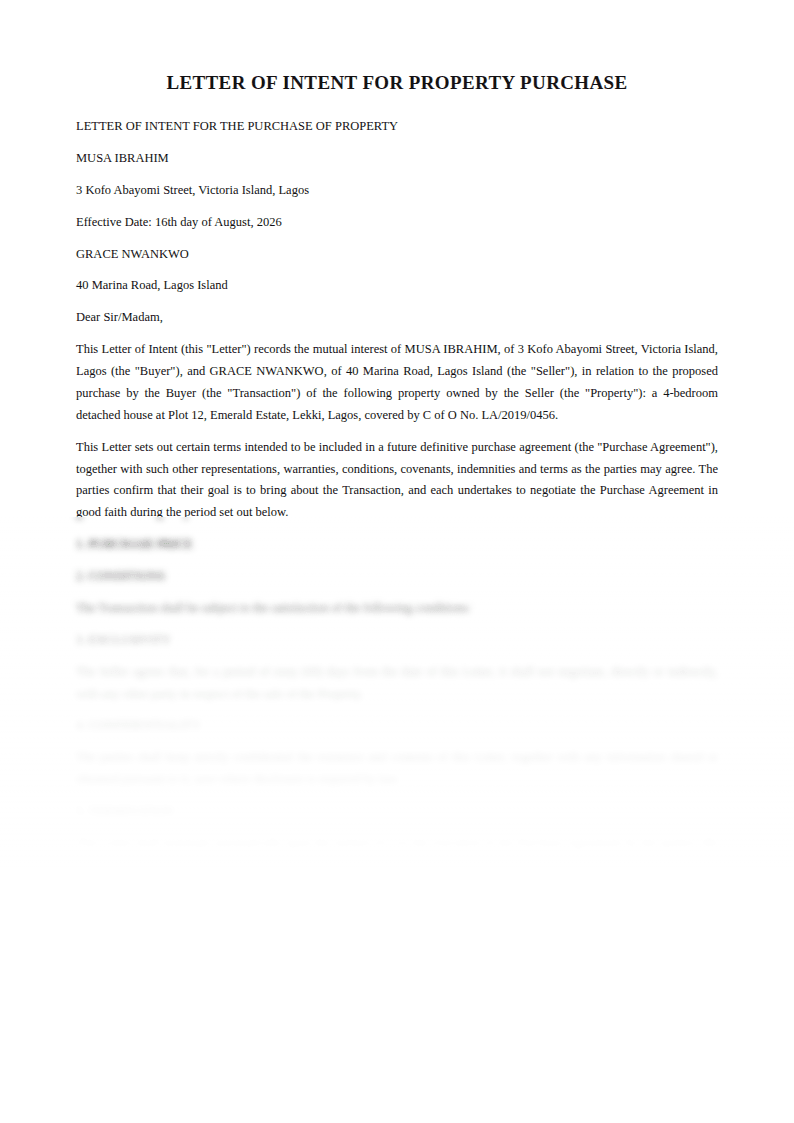
What a letter of intent for property purchase is
A letter of intent records the shape of a property deal before the formal contract exists.
It says who is buying from whom, what property, at roughly what price, and what has to happen before anybody is committed. It usually asks the seller to stop marketing for a defined period while the buyer investigates.
Most of it is not intended to bind. The price and the conditions are a statement of what the parties expect, not a contract of sale. But some parts usually are binding, particularly exclusivity and confidentiality, and it is worth being clear in your own mind which is which.
In a Nigerian purchase it does a specific job: it buys the buyer time to search the title and confirm the seller owns what they are selling, without another buyer appearing halfway through.
Who needs one
Buyers who have agreed a deal in principle and want the seller to hold off while they investigate.
Sellers who want a serious buyer committed to a process and a timetable rather than making enquiries indefinitely.
Anybody buying land or a house where the title needs verifying, which is every purchase in Nigeria.
It is not a substitute for the contract of sale or the deed of assignment. It is the step before them.
Before you start
Know the outline of the deal before you draft.
The property, described precisely enough to identify it, ideally with its title reference.
Whether a price has been agreed or is still subject to valuation.
What has to happen before completion: financing, survey, searches, and consent.
How long you need for those, since that sets the exclusivity period.
And whether the seller has actually agreed to stop marketing, because a letter recording something they never accepted is worth nothing.
The walkthrough
Filling in the form, step by step
Every question you will be asked, what it means, and an example of a good answer.
Step 1 of 4
Letter of Intent for Property Purchase
Sender, recipient and the property
The letter opens as a letter: who is writing, to whom, about what.
The sender is usually the buyer, since the buyer is the party asking for time. The recipient is the seller or their agent. Where an agent is involved, address the seller and copy the agent rather than the other way around, because the seller is the person whose agreement matters.
Describe the property carefully, and include the title reference if you have it. A certificate of occupancy number turns a description into an identification, and it lets you search the exact parcel rather than one that looks similar on a map.
- Your name
- Your name as the party sending the letter, usually the buyer. Where a company is buying, use the registered name, since that is the entity that will eventually take the title.
- Your address
- Your address for correspondence. The seller's response and any counter proposal comes here, so it should be somewhere you actually receive post.
- Who are you sending it to?
- The person you are writing to, normally the seller. Where an agent is handling the sale, still address the seller and copy the agent, because it is the seller's agreement that binds.
- Their address
- The seller's address. If you only have the agent's address, that is a signal to establish who the owner actually is before going further.
- Effective date
- The effective date of the letter. Any exclusivity period runs from here, so it should be the date the letter is actually sent rather than the date you drafted it.
- Describe the property
- The property in question, described precisely: type, size and full address, with the title reference where you have it, such as a certificate of occupancy number. A title reference turns a description into an identification you can search.
Step 2 of 4
Letter of Intent for Property Purchase
Buyer and seller named formally
Having opened as a letter, the document now names the parties to the proposed transaction.
This repetition looks redundant and is not. The sender might be a director writing on behalf of a company, or a spouse writing for a couple. The buyer named here is the party who will actually take title, and the seller is the party who must have the power to give it.
Name the seller as they appear on the title documents. Where the person selling is not the registered owner, that discrepancy needs explaining now rather than at the point of the deed. Executors, attorneys and family representatives all sell property legitimately, but each of them holds a specific authority that a buyer should see.
- Buyer's name
- The party who will actually take title, which may differ from whoever is writing the letter. For a joint purchase, name every buyer, and for a company purchase use the registered name.
- Buyer's address
- The buyer's address for the transaction. It will carry through into the contract and the deed, so use the address you want on the eventual title documents.
- Seller's name
- The owner, named as they appear on the title documents. Where the seller is an executor, attorney or family representative rather than the registered owner, establish and record the basis of their authority now.
- Seller's address
- The seller's address as owner. A mismatch between this and the address on the title documents is worth asking about before you spend money on searches.
Step 3 of 4
Letter of Intent for Property Purchase
The price and what must happen first
This step records the money position and the conditions, and it is the substance of the letter.
On price, the form gives two routes because both situations are real. Sometimes a figure is agreed and the letter records it. Sometimes the parties have agreed to proceed while the price waits on a valuation, and pretending otherwise creates a commitment neither intended.
The conditions are what the buyer is buying time to do. In a Nigerian purchase the important ones are a search at the state land registry, a physical inspection or survey, and, where the transfer needs it, the Governor's consent. Financing belongs here too if a mortgage is involved.
Setting these out does two things. It tells the seller what the timetable is for, and it gives the buyer a stated basis for withdrawing if a search turns up something wrong, rather than appearing to change their mind.
- Have you agreed a price?
- Choose There is a Purchase Price where a figure has been agreed, or Not Listed where it still depends on valuation or further negotiation. Answer honestly, since recording an agreed price that was never agreed creates an expectation you will have to manage later.
- Explain the price position
- If no price is fixed, explain the position: that it remains subject to negotiation following valuation, or whatever the parties have actually agreed. Vagueness here is fine; a false certainty is not.
- State the purchase price
- If a price is agreed, state it in figures and words, for example eighty five million naira. Note whether it is inclusive of anything, since assumptions about fixtures and outstanding charges differ.
- What must happen before the sale completes?
- Tick everything that must happen before completion. In a Nigerian purchase this normally includes inspection and a registry search, and financing where a mortgage is involved. These conditions are the buyer's protection.
- Describe the financing condition
- If financing is a condition, describe it: the type of facility and the period allowed, for example obtaining mortgage approval within sixty days. A condition without a deadline leaves the seller waiting indefinitely.
- Describe the inspection condition
- If inspection is a condition, describe what it involves, for example a satisfactory structural survey and a search at the state land registry. Naming the registry search explicitly is worth doing, because it is the step that matters most.
- Describe any other condition
- Any other condition, such as the seller obtaining the Governor's consent to the transfer, delivering vacant possession, or resolving an outstanding charge on the property. Set out anything that would stop you completing.
Step 4 of 4
Letter of Intent for Property Purchase
Exclusivity, governing law and anything else
The last step contains the part of the letter most likely to be binding, so read it as though it were.
Exclusivity is the buyer's real prize. A seller who agrees not to negotiate with anybody else for sixty days gives the buyer room to spend money on searches and surveys without the risk of being gazumped. Set the period by reference to how long those steps actually take in the state concerned, not by optimism.
The governing law should be the state where the property sits. Land is governed by the law of the state it is in, and the registry and consent processes are state processes.
The final box is for anything the parties have agreed that the form has not asked about. Vacant possession on completion is the common one, and it is worth stating, because a buyer expecting an empty house and receiving one with tenants in it has a serious problem.
- Exclusivity period (days)
- The exclusivity period in days. Set it by how long searches, survey and any consent actually take in that state rather than by hope. This is usually the most valuable thing the letter achieves for a buyer.
- Which law governs this letter?
- The state whose law governs the letter, which should be where the property is located. Land follows the law of the state it sits in, and the registry and consent processes are administered there.
- Any other terms? (optional)
- Optional. Anything else agreed that the form has not covered, such as the seller delivering vacant possession on completion, who bears the perfection costs, or what happens to a deposit if a condition fails.
Ready to make yours?
Answer those questions in the builder and download a finished letter of intent for property purchase in Word and PDF.
Start now, ₦5,000After you download it
Start the searches immediately
The exclusivity period is short and the registry is not fast. Instruct the search on the day the letter is accepted rather than a fortnight later.
Be clear what binds
Price and conditions are usually statements of intent. Exclusivity and confidentiality usually bind. Say which is which in the letter rather than assuming both sides read it the same way.
Do not pay a deposit yet
A letter of intent is not the point to hand over money. If a deposit is expected, agree in writing who holds it and what happens if a condition is not met.
Move to the contract and the deed
Once the searches are clear, the transaction proceeds to a contract of sale and then the deed of assignment. The letter of intent has done its job by then.
Questions people ask
What is a letter of intent for a property purchase?
A document recording what buyer and seller have agreed in principle, with the conditions to be met before completion. It usually asks the seller to stop marketing while the buyer investigates the title.
Is a letter of intent legally binding?
Partly, and it should say which parts. Price and conditions are normally statements of intent, while exclusivity and confidentiality are usually intended to bind.
How long should the exclusivity period be?
Long enough for a registry search, a survey and any consent process in that state. Set it against how long those actually take rather than how quickly you hope to move.
Do I pay a deposit at this stage?
Not usually. If a deposit is expected, agree in writing who holds it and what happens to it if a condition is not satisfied, before any money changes hands.
What conditions should a Nigerian buyer include?
A satisfactory search at the state land registry, a physical inspection or survey, financing if a mortgage is involved, and the Governor's consent where the transfer requires it.
What comes after the letter of intent?
A contract of sale recording the bargain, then the deed of assignment transferring the interest, followed by stamping, consent and registration.
Documents that go with this
Terms used on this page
Letter of Intent
A letter of intent sets out the terms on which somebody proposes to do a deal, before the full contract is drafted. Most of it is not binding, and the parts that are should say so.
Exclusivity
Exclusivity gives one party sole rights: to distribute in a territory, to supply a customer, or to negotiate a deal without the other side talking to anybody else. It is valuable, and it should be earned.
Due Diligence
Due diligence is the investigation you carry out before committing to a deal. You are checking that what you are buying, funding or partnering with is actually what it was described to be.
Title Search
A title search is the check you run at the lands registry before buying land, to find out who actually owns it and what is registered against it. It is the cheapest part of any Nigerian property purchase.
Governor's Consent
Governor's consent is the state governor's approval of a transfer of land held under a statutory title. Under Section 22 of the Land Use Act, a transfer made without it risks being void.
Deed of Assignment
A deed of assignment is the document that actually transfers land or property from a seller to a buyer in Nigeria. Without it, properly executed and registered, you have paid for land you cannot prove is yours.
Perfection of Title
Perfection of title is what you do after buying Nigerian land: obtain the Governor's consent, stamp the deed and register it. Skip it and you hold a receipt rather than a title.
Deposit
A deposit is money paid to secure a transaction. Whether you get it back if the deal falls through depends on whether it was a true deposit or a part payment, and most people never ask.
Read more on this
REAL ESTATE: Buyer’s Guide
Introduction: Real estate is one of the biggest investments most people make in their lifetime. Therefore, it is important to make an informed decision when buying a property. This guide will help you understand the key…
Title Perfection in Nigeria: From Search to Deed of Assignment to Registered Title
Title Perfection in Nigeria: From Search to Deed of Assignment to Registered Title and Consent There is a phrase that comes up often in Nigerian property circles: “the title is not perfected.” Sellers say it casually. Bu…
Unregistered Deed of Assignment: Do You Actually Own the Land?
Registration is not what transfers ownership; your deed does that. So an unregistered deed doesn't mean you own nothing.
Step by step guides for every document on LegalDoc
Browse all guides