
How to Write a Letter of Intent for a US Transaction
The US version of a letter of intent, with state fields throughout. The state you choose decides which law reads the document later.
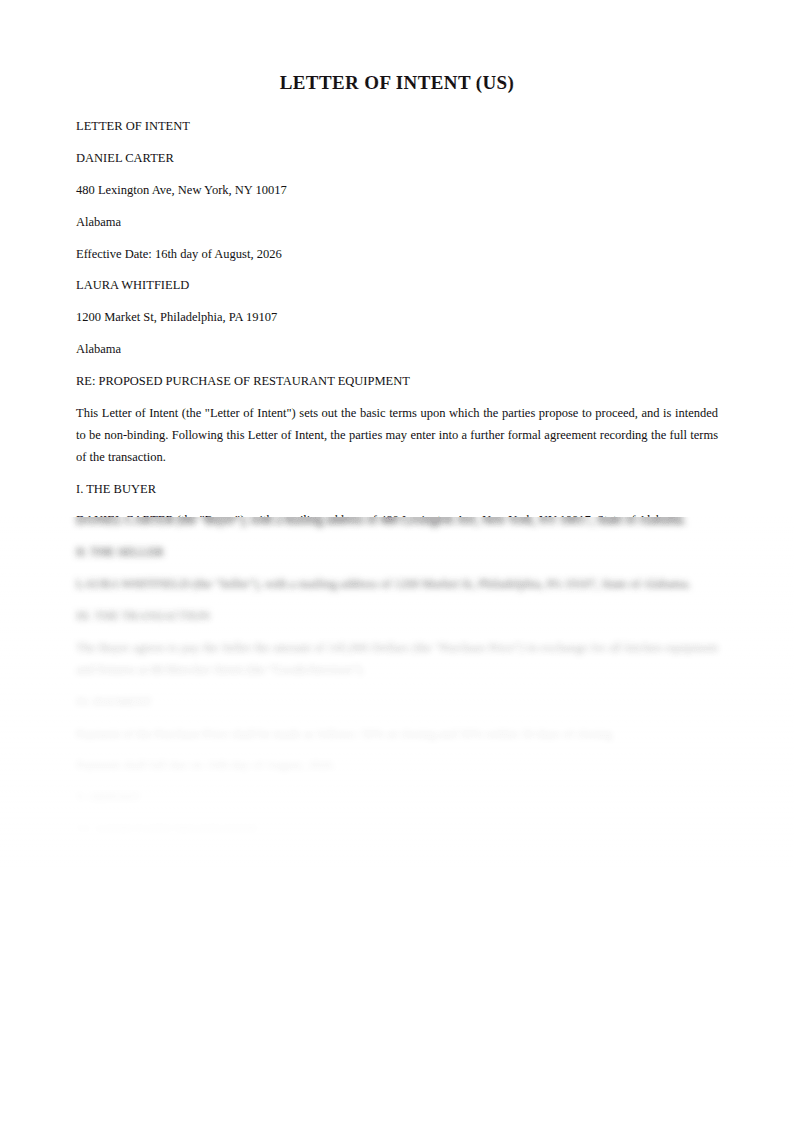
What a letter of intent (us) is
This is a letter of intent for a transaction in the United States, recording terms agreed in principle before the full contract is drafted.
It does the same job as any letter of intent: it captures what the parties have agreed, gives them something to work from, and states whether either side is committed.
What distinguishes this version is that it asks for a state at every turn, for both parties and for the governing law. That reflects how American commercial law works. Contract law is largely state law, and although the Uniform Commercial Code has been adopted across the states, it is adopted with variations, so the state whose law governs genuinely affects how the document is read.
For a Nigerian business, this is the form to use when the counterparty is American and the transaction will be governed by US law. For a domestic Nigerian deal, the ordinary letter of intent is the right document, since it names Nigeria rather than a US state.
Who needs one
Businesses transacting with a US counterparty where the deal will sit under American law.
Nigerian companies with a US entity buying or selling in the United States.
Founders negotiating the sale of a US business or its assets.
Anybody who has been sent a US letter of intent and wants to understand what they are being asked to sign.
For a purely Nigerian transaction, use the ordinary letter of intent, which names Nigerian law and avoids the awkwardness of a document that asks for your state and offers only American ones.
Before you start
Establish these before drafting.
Whether you intend the letter to bind, which matters more in a US context because American courts have developed substantial case law on when a letter of intent creates enforceable obligations.
Which state's law will govern, and whether that state has any connection to the transaction.
What is being bought, in enough detail to be identifiable.
The price in US dollars.
And the deposit position, including what happens to it if the deal does not close.
The walkthrough
Filling in the form, step by step
Every question you will be asked, what it means, and an example of a good answer.
Step 1 of 4
Letter of Intent (US)
The parties, their states and the subject
The letter opens with both correspondents and, unusually, the state each is in.
Those state fields are not decorative. In a US transaction the parties' locations bear on which courts could hear a dispute and which state's law might apply absent an express choice. A New York seller and a Pennsylvania buyer are transacting across state lines, which affects jurisdiction and, depending on the subject matter, the applicable rules.
For a Nigerian party dealing with an American counterparty, there is no Nigerian option in these lists. That is a signal about which document you are using: this form assumes both parties are in the United States. If you are in Nigeria and the counterparty is American, take advice about whether this is the right instrument, or use the ordinary letter of intent and specify the governing law expressly.
The subject line identifies the transaction, and in a US context it commonly appears as a formal Re line at the head of the letter.
- Your name
- Your name or your company's registered name as the party sending the letter.
- Your address
- Your mailing address, in US format where you are American based.
- Your state
- Your state. It bears on jurisdiction and on which law might apply absent an express choice. Note the list offers only US states, which is a signal about who this form is designed for.
- Who are you sending it to?
- Who the letter is addressed to, using the entity name where a business is involved.
- Their address
- Their mailing address.
- Their state
- Their state. Where it differs from yours, the transaction crosses state lines, which affects which courts could hear a dispute.
- Effective date
- The effective date. Any deadline in the letter, including one for signing the definitive agreement, runs from here.
- What is this deal about? (subject line)
- A subject line naming the transaction, which in a US letter usually appears as a formal Re line at the head, for example the proposed purchase of restaurant equipment.
Step 2 of 4
Letter of Intent (US)
Buyer, seller, their states, and whether this binds
This step names the transacting parties and settles the binding question, which carries particular weight in a US context.
American courts have considered at length when a letter of intent creates enforceable obligations, and the answer is not always what the parties assumed. A letter that reads like an agreement, uses definite language and leaves little to be settled can be held binding even where the parties thought they were still negotiating. Some states also recognise an obligation to negotiate in good faith arising from a letter of intent, which is a real obligation even where the commercial terms are not binding.
So the binding status answer should be deliberate, and the letter should reinforce it in its own language. A letter marked non binding but written in the language of commitment invites exactly the argument the marking was supposed to prevent.
Choose non binding unless you genuinely intend to be committed, and say expressly which provisions, if any, are intended to bind: confidentiality, exclusivity, and the allocation of costs are the usual candidates.
- Buyer's name
- The acquiring party, using the entity name where a company is buying.
- Is this letter binding or non-binding?
- Whether the letter binds. This carries particular weight in the United States, where courts have held letters binding even when parties thought they were still negotiating, and some states recognise an obligation to negotiate in good faith arising from one. Choose non binding unless you genuinely intend commitment, and state expressly which provisions, if any, are meant to bind.
- Buyer's mailing address
- The buyer's mailing address as it will appear in the definitive agreement.
- Buyer's state
- The buyer's state, relevant to jurisdiction and to which law applies where no express choice is made.
- Seller's name
- The disposing party, named as the entity that owns what is being sold.
- Seller's mailing address
- The seller's mailing address.
- Seller's state
- The seller's state. Where buyer and seller are in different states, the transaction is interstate, which affects both jurisdiction and the applicable framework.
Step 3 of 4
Letter of Intent (US)
Price, subject matter and payment
This step records the commercial terms in dollars.
Describe what is being bought precisely. Where the transaction is a sale of goods, note that Article 2 of the Uniform Commercial Code governs sales of goods in most states and supplies default terms that fill gaps the parties leave. That is useful and it means silence has consequences: the code will answer questions you did not, and not always the way you would have.
Give the price both as a figure and written out. Where it remains subject to diligence or valuation, say so, because in a jurisdiction where letters of intent are sometimes held binding, an unqualified price is a risk.
The payment routes work as in the Nigerian version: complete only the box matching your choice, and describe the mechanism rather than only the timing. Where the payment depends on closing conditions, financing or an escrow arrangement, this is the place to say so.
- Purchase price (US$)
- The price in US dollars, in figures and words. Where it remains subject to diligence or valuation, say so, since in a jurisdiction where letters are sometimes held binding an unqualified price carries risk.
- What is being bought?
- What is being bought, described precisely. Where this is a sale of goods, Article 2 of the Uniform Commercial Code applies in most states and supplies default terms filling any gaps you leave, so silence has consequences.
- When will payment be made?
- When payment happens. Complete only the box matching your choice below.
- Describe the payment arrangement
- If payment comes later, describe the arrangement and what triggers it, including any closing conditions, financing contingency or escrow. Describe the mechanism rather than only the date.
- Date payment is due
- The date payment falls due, where a fixed date applies rather than an event.
- Describe the payment on signing
- If payable on signing, state whether that means this letter or the definitive agreement, since those are different moments and the distinction is frequently disputed.
- Describe the payment arrangement
- Any other arrangement, described fully: instalments with their number, amounts and dates, or a structure tied to milestones or performance.
Step 4 of 4
Letter of Intent (US)
The deposit and the governing state
The final step handles money paid up front and the choice of law, which in a US letter is the answer with the longest reach.
Deposits in American transactions frequently sit in escrow with a third party rather than passing to the seller. That structure protects both sides: the money is committed but not spent, and its release depends on conditions being met. If a deposit is involved here, say who holds it, on what terms it is released, and what happens if the deal does not close.
The governing state deserves real thought. Contract law is state law, and states differ on matters that affect a letter of intent directly, including whether a duty to negotiate in good faith arises from one. Delaware and New York are common choices in commercial transactions because their law is well developed and predictable, and parties frequently choose them even with no other connection to the state.
For a Nigerian party, note that choosing a US state means any dispute is likely to be resolved there, with the cost and inconvenience that implies. That is a commercial decision rather than a formality, and it is worth taking advice before agreeing to it.
- Is a deposit required?
- Whether a deposit is payable. In US transactions deposits frequently sit in escrow with a third party rather than passing to the seller, which protects both sides.
- Describe the deposit
- If required, state the amount, who holds it and whether it goes into escrow, on what conditions it is released, and what happens if the transaction does not close. Note that deposit terms bind even within an otherwise non binding letter.
- Confirm no deposit is required
- If no deposit applies, confirm it, closing off any later suggestion that one was contemplated.
- Which state's law governs this letter?
- The state whose law governs. This has the longest reach of any answer here: contract law is state law, and states differ on whether a letter of intent creates a duty to negotiate in good faith. Delaware and New York are common choices for their developed commercial law. For a Nigerian party, choosing a US state means a dispute is likely resolved there, which is a commercial decision worth taking advice on.
Ready to make yours?
Answer those questions in the builder and download a finished letter of intent (us) in Word and PDF.
Start now, ₦7,000After you download it
Make the language match the marking
A letter marked non binding but written in the language of commitment invites the argument the marking was meant to prevent. US courts look at substance.
Consider escrow for any deposit
Money held by a third party on stated release conditions protects both sides far better than a deposit paid directly to a seller before closing.
Choose the governing state deliberately
It determines which law reads the document and where a dispute is heard. For a Nigerian party that means litigating abroad, which is a commercial decision.
Use the Nigerian version for a Nigerian deal
This form offers only US states. For a domestic transaction the ordinary letter of intent names Nigerian law and fits properly.
Questions people ask
How is this different from the ordinary letter of intent?
This version asks for a US state at every turn and for a US governing law. Contract law in America is state law, so the state chosen genuinely affects how the document is read.
Can a US letter of intent be binding even if marked non binding?
American courts look at substance as well as labels. A letter written in the language of commitment, leaving little to be settled, can be held binding despite the marking.
What is a duty to negotiate in good faith?
Some US states recognise an obligation arising from a letter of intent to negotiate the definitive agreement in good faith, which is a real obligation even where the commercial terms do not bind.
Which state law should govern?
Delaware and New York are common choices in commercial transactions for their developed and predictable law, and parties frequently select them even without another connection to the state.
Should the deposit go into escrow?
In US transactions that is the usual structure and it protects both sides: the money is committed but not spent, and release depends on stated conditions being met.
Can a Nigerian business use this form?
Where the counterparty is American and the deal will sit under US law, yes, though choosing a US state means disputes are likely resolved there. For a domestic Nigerian deal, use the ordinary letter of intent.
Documents that go with this
Terms used on this page
Letter of Intent
A letter of intent sets out the terms on which somebody proposes to do a deal, before the full contract is drafted. Most of it is not binding, and the parts that are should say so.
Offer and Acceptance
Offer and acceptance is how a contract comes into existence. One side proposes definite terms, the other agrees to them without changes, and at that moment an agreement exists.
Good Faith
Good faith means dealing honestly and not undermining the purpose of the bargain. Nigerian law does not imply a general duty of it into every commercial contract, so where you want it, write it in.
Escrow
Escrow is money or documents held by a neutral third party until both sides have done what they promised. It protects a buyer who does not want to pay first and a seller who does not want to deliver first.
Due Diligence
Due diligence is the investigation you carry out before committing to a deal. You are checking that what you are buying, funding or partnering with is actually what it was described to be.
Exclusivity
Exclusivity gives one party sole rights: to distribute in a territory, to supply a customer, or to negotiate a deal without the other side talking to anybody else. It is valuable, and it should be earned.
Deposit
A deposit is money paid to secure a transaction. Whether you get it back if the deal falls through depends on whether it was a true deposit or a part payment, and most people never ask.
Enforcement of Foreign Judgment
A judgment from another country does not enforce itself in Nigeria. It has to be registered or sued upon here first, and the routes are narrower than most litigants expect.
Read more on this
How to Register a Company in Nigeria from the USA: A Full Guide for Americans and Nigerians Abroad
How to Terminate a Contract the Right Way
How to Terminate a Contract the Right Way How do you end a contract properly without creating bigger problems? Because terminating a contract is not just about walking away. If done carelessly, it can expose you to claim…
10 Legal Documents Every Startup in Nigeria Needs
10 Legal Documents Every Startup in Nigeria Needs Starting a business in Nigeria is exciting. Entrepreneurs launch new ventures every day—technology startups, creative agencies, e-commerce platforms, consulting firms, an…
Step by step guides for every document on LegalDoc
Browse all guides