
How to Write a Non Compete Agreement
A non compete restricts where somebody can work after leaving you. Nigerian courts are sceptical of these, and an overreaching one is worth nothing.
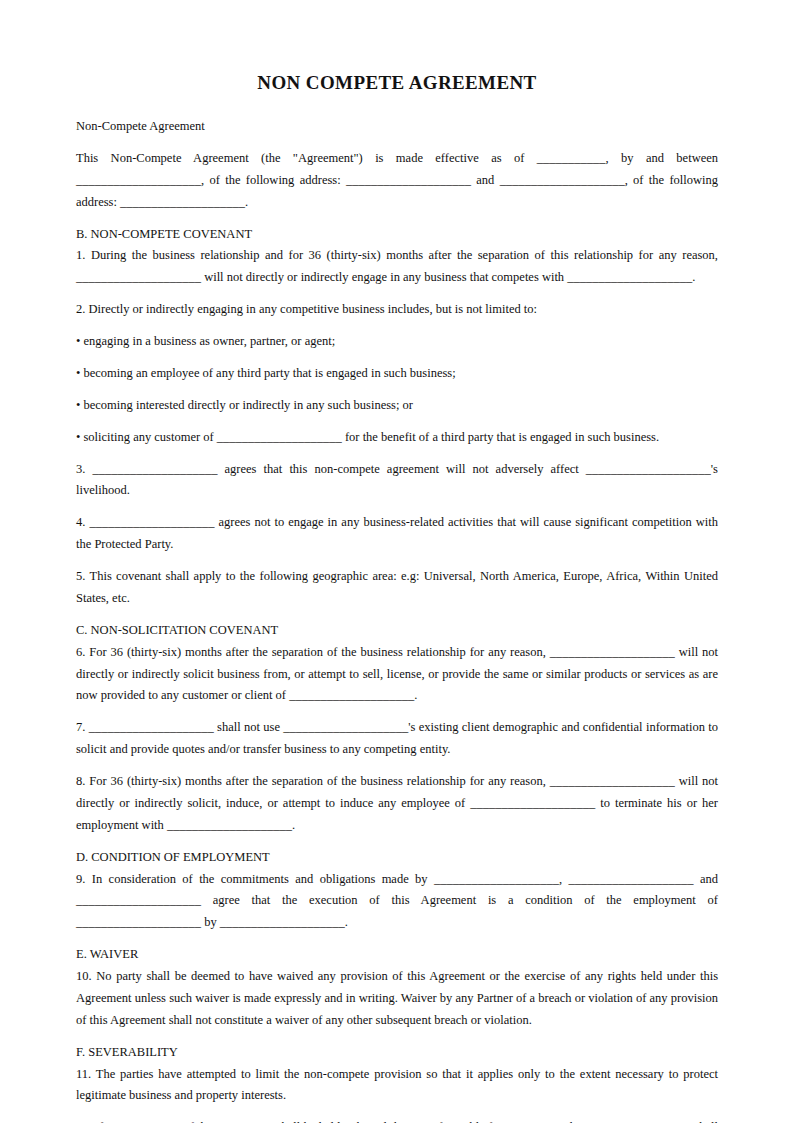
What a non compete agreement is
A non compete agreement restricts what somebody may do after they stop working for you.
Typically it prevents them joining a competitor, setting up in the same business, or approaching your customers, for a period and within an area.
The important thing to understand before writing one is that the starting position in law is against you. A restraint of trade is presumed void, because the law dislikes preventing people from earning a living. It becomes enforceable only where the employer shows it protects a legitimate interest and goes no further than reasonably necessary to do so.
That is why overreaching non competes fail entirely. A court asked to enforce a worldwide, five year restriction on a junior employee will usually refuse, and you are left with nothing rather than with a narrower version.
Who needs one
Employers with genuinely protectable interests: customer relationships, confidential methods, or trade connections a departing employee could exploit.
Businesses taking on senior staff who will hold real commercial knowledge.
Parties to a sale of a business, where a non compete on the seller is far more readily enforced, because the buyer paid for goodwill and is entitled to protect it.
For most junior roles, a confidentiality clause is the appropriate protection and a non compete is neither necessary nor likely to be upheld.
Before you start
Work out what you are actually protecting, and be honest about it.
If the answer is customer relationships, a non solicitation restriction is narrower, more targeted and far more likely to be enforced.
If it is confidential information, an NDA does the job directly.
If it is simply that you do not want a good employee working for a rival, that is not a legitimate interest and a court will not help you.
Then decide the narrowest area and shortest period that would genuinely protect the interest, since that is what enforceability turns on.
The walkthrough
Filling in the form, step by step
Every question you will be asked, what it means, and an example of a good answer.
Step 1 of 2
Non Compete Agreement
The employer and the employee
The agreement names the party seeking protection and the person being restricted.
Use the registered company name for the employer. A restriction in favour of a business that does not legally exist protects nobody.
The employee's seniority matters to whether this is enforceable at all, even though the form does not ask. A non compete on a managing director with client relationships stands a very different chance from the same restriction on an administrative assistant. If the person you are naming has no access to confidential information and no customer contact, reconsider whether this document is the right one.
Addresses identify the parties and are where any notice about the restriction would be sent.
- Employer's Name
- The registered name of the business seeking protection. It must be the entity that actually holds the customer relationships or confidential information, since that is the interest the restriction is supposed to protect.
- Employer's Address
- The employer's business address, used to identify the party and for any correspondence about the restriction.
- Employee's Name
- The full name of the person being restricted. Consider their role honestly: a non compete on somebody with no client contact and no confidential knowledge is unlikely to be enforced whatever it says.
- Employee's Address
- The employee's home address. It identifies them and is where any notice relating to the restriction would be sent after they leave.
Step 2 of 2
Non Compete Agreement
The area and the governing law
These two answers do most of the work in deciding whether this agreement is worth anything.
The geographical area is the single most common reason non competes fail. The form's own examples include Universal and continents, and those are exactly the answers to avoid. A restriction should cover the area where the business actually operates and where the employee could realistically damage it. For a Lagos business with Lagos customers, Lagos is the defensible answer. Worldwide is not, and asking for it risks losing the clause altogether.
Think about duration in the same way even though the form does not ask separately: the shorter and narrower the restriction, the more likely a court is to uphold it.
On governing law, name the Nigerian state where the employment is based. Employment matters go to the National Industrial Court, and a restriction governed by a foreign law that a Nigerian employee never had a connection with adds an obstacle to your own enforcement.
- Geographical Area
- The area the restriction covers. Keep it to where the business genuinely operates and where this person could realistically damage it, for example Lagos State. Broad answers such as worldwide are the most common reason non competes are struck down entirely.
- The Agreement is to be governed by the laws of which state/ Country?
- The Nigerian state where the employment is based, for example Lagos State, Nigeria. Employment disputes go to the National Industrial Court, and naming a foreign law the employee has no connection with only complicates your own enforcement.
Ready to make yours?
Answer those questions in the builder and download a finished non compete agreement in Word and PDF.
Start now, ₦10,000After you download it
Pair it with a non solicitation clause
A restriction on approaching your customers and staff is narrower, more targeted and considerably more likely to be upheld than a general ban on competing.
Give something for it
A restriction agreed at the point of hiring, or in exchange for a promotion or payment, is easier to defend than one introduced mid employment for nothing.
Review it as the role changes
A restriction that was reasonable for a junior role is not automatically reasonable when the person is promoted, and the reverse is also true.
Remember what it cannot do
A non compete cannot stop somebody using general skill and experience. It protects specific interests, not your investment in making somebody good at their job.
Questions people ask
Are non compete agreements enforceable in Nigeria?
They start from a position of being void as a restraint of trade, and become enforceable only where the employer shows a legitimate interest and a restriction no wider than reasonably necessary to protect it.
How wide can the geographical area be?
As wide as the business genuinely operates and no wider. Worldwide or continental restrictions on an employee are the most common reason these clauses are struck down entirely.
How long can a non compete last?
The shortest period that genuinely protects the interest. Months rather than years is the safer territory for an employee restriction, and overreaching risks losing the clause altogether.
What is a legitimate interest?
Customer connections, confidential information and trade secrets. Simply not wanting a good employee to work for a competitor is not one, and a court will not enforce a restriction based on it.
Is a non solicitation clause better?
Usually, yes. Restricting somebody from approaching your customers and staff is narrower and more targeted, which makes it considerably more likely to be upheld.
Does a non compete work against a business seller?
It is on much stronger ground there. A buyer who paid for goodwill is entitled to protect it, and courts treat restrictions in a sale of business far more favourably than employment restrictions.
Documents that go with this
Terms used on this page
Non-Compete
A non-compete is a clause restricting somebody from working for a competitor or starting a rival business for a period after they leave. Nigerian courts enforce them only where they are reasonable.
Restraint of Trade
A restraint of trade clause limits what somebody may do after a relationship ends, usually by stopping a former employee competing or poaching. It is void unless it is reasonable, and reasonable means narrow.
Non-Disclosure Agreement (NDA)
An NDA is a contract in which one or both sides promise to keep information confidential. It is what you sign before showing somebody your idea, your figures or your customer list.
Trade Secret
A trade secret is commercially valuable information that gives you an advantage because nobody else has it. There is nothing to register. Protection comes entirely from keeping it secret and from the contracts you sign.
Goodwill
Goodwill is the value of a business beyond its physical assets: the reputation, the customer relationships and the name that make people keep coming back. It is real, it is saleable, and it is fragile.
Injunction
An injunction is a court order requiring somebody to do something or, more often, to stop doing something. It is the remedy you seek when damages after the fact would come too late.
Contract of Employment
A contract of employment is the agreement between an employer and an employee setting out the job, the pay and the terms. Nigerian law expects it in writing within three months of starting.
Garden Leave
Garden leave keeps a departing employee on the payroll during notice while removing their access to clients, systems and information. It protects the business without relying on a restraint clause.
Read more on this
Employment Contracts: Key Clauses and Compliance Guide
Employment Contracts: Key Clauses and Compliance Guide An employment contract is one of the most important documents in any Nigerian workplace, yet it is also one of the most neglected. Many businesses, especially small…
10 Legal Documents Every Startup in Nigeria Needs
10 Legal Documents Every Startup in Nigeria Needs Starting a business in Nigeria is exciting. Entrepreneurs launch new ventures every day—technology startups, creative agencies, e-commerce platforms, consulting firms, an…
11 Essential and Protective Documents Needed by a Startup Company
Business Plan Certificate of Incorporation, Memart, Art. of association, Status Report Founders’ Agreement Service Level Agreements Non-Disclosure Agreement Employee Contracts Intellectual Property Agreements Shareholder…
Step by step guides for every document on LegalDoc
Browse all guides