
How to Write a Non Disclosure Agreement
An NDA protects information you are about to share with somebody who has no reason to keep it secret otherwise. It is short, and the duration is the part people get wrong.
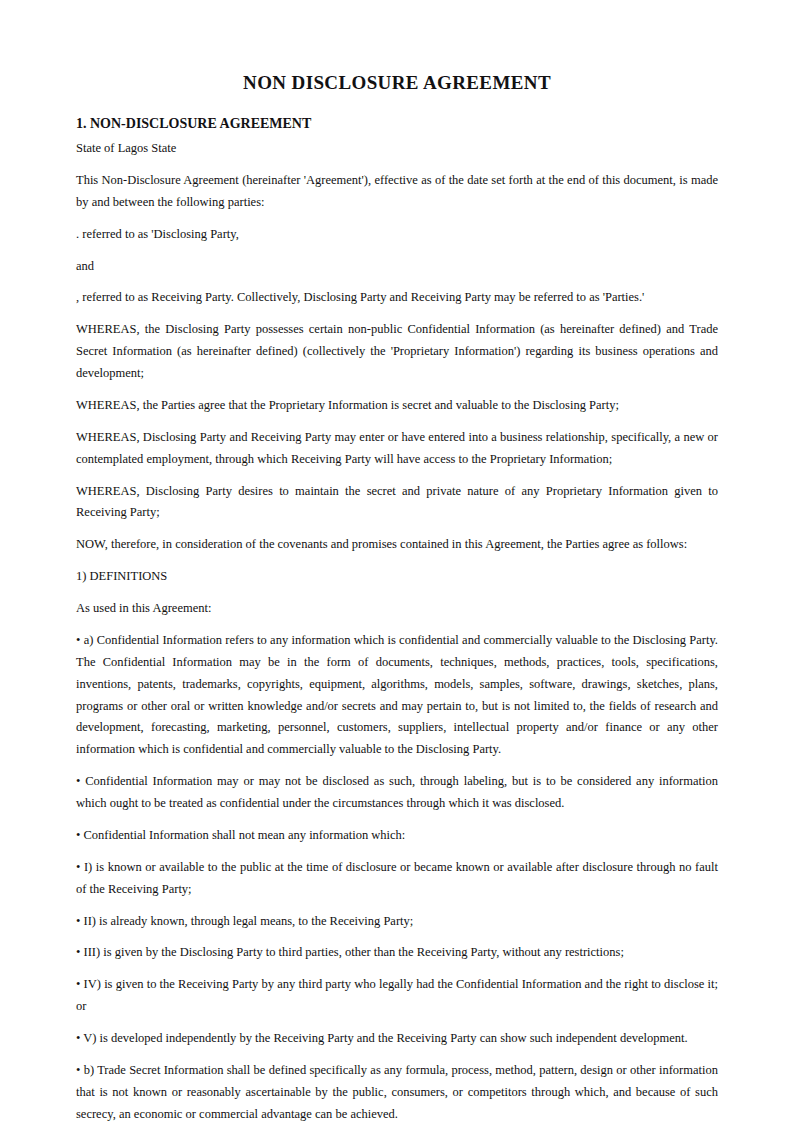
What a non disclosure agreement is
A non disclosure agreement is a promise not to repeat or misuse information somebody is about to share with you.
It turns a moral expectation into an enforceable obligation. Without one, information you disclose in a meeting is generally free for the other side to use, unless it falls into one of the narrow categories the law protects on its own.
This version is one directional in effect: one party is receiving and one is disclosing. Where both sides will be sharing sensitive material, a mutual arrangement is the better fit and each party should be named on both sides.
The agreement does not make information secret. It obliges a specific person not to spread it, which is a narrower and more realistic thing.
Who needs one
Founders discussing an idea with a developer, a manufacturer or a potential partner.
Businesses sharing customer lists, pricing, formulations or supplier terms with a contractor.
Anybody entering negotiations where the other side will see the inside of the business, including a possible sale or investment.
Employers taking on staff who will handle sensitive information, although an employment contract usually carries its own confidentiality clause and a separate NDA is not always needed.
Before you start
Think about three things before drafting.
What you are actually protecting. An NDA covering everything you ever say is weaker than one covering something identifiable, because a court asked to enforce the first has nothing to grip.
Who is genuinely receiving it: the individual, or the company they work for. Those are different obligations and the wrong choice makes the agreement hard to enforce.
And how long the obligation should run, which is where most NDAs are unrealistic.
The walkthrough
Filling in the form, step by step
Every question you will be asked, what it means, and an example of a good answer.
Step 1 of 2
Non Disclosure Agreement
Where the agreement will be used
The first question fixes the law and the forum.
Choose the Nigerian state where the parties are, or where the information will be used and any dispute would realistically be brought. Lagos is the common answer for commercial arrangements, and it should reflect a genuine connection rather than a preference for a court neither party has any link to.
The practical significance is enforcement. An NDA is only worth what you can do about a breach, and that means going to court somewhere. Naming a state the parties have no connection with makes an already difficult step harder.
- Where will this agreement mainly be used?
- The Nigerian state whose law governs the agreement and where a dispute would be heard, for example Lagos State. Pick somewhere the parties actually have a connection, since enforcement means going to court there.
Step 2 of 2
Non Disclosure Agreement
Who receives, who discloses, and for how long
This step names both sides and sets the duration, and each of the three answers repays thought.
The individual or company choice matters more than it looks. An NDA binding a company does not automatically bind the individual employee who walks out with the information, and one binding an individual does not reach the company they work for. Pick based on who will actually hold the information and who you would want to pursue. Where a company is receiving, it is common to bind the company and require it to impose the same obligation on its staff.
The duration is where NDAs are most often unrealistic. Two to five years is normal for commercial information, and it is enforceable because it is proportionate. A perpetual obligation over ordinary business information invites a court to find the whole clause unreasonable, which leaves you worse off than a shorter term would have.
Genuine trade secrets are a different matter and can justify a longer period, but most information in a commercial negotiation is not a trade secret.
- Who is receiving the confidential information?
- Choose Individual or Company for the side receiving the information. A company NDA does not automatically bind its employees personally, and an individual NDA does not reach their employer, so pick the party you would actually want to pursue.
- Receiving party — name and address
- If an individual is receiving, give their full name and address, for example Amara Okeke of 27 Ahmadu Bello Way, Kaduna. Naming the person makes the obligation personal to them and survives their leaving any employer.
- Receiving party — company name and address
- If a company is receiving, give the registered name and address. Consider also requiring the company to impose the same obligation on the staff who will actually see the information, since the company itself cannot keep a secret, only its people can.
- Who is sharing the confidential information?
- Choose Individual or Company for the side sharing the information. This is usually you. Where the information belongs to a company, name the company, since the company is the party that suffers the loss from a breach.
- Disclosing party — name and address
- If an individual is disclosing, give their full name and address. Use this where the information is genuinely personal to them rather than owned by a business they run.
- Disclosing party — company name and address
- If a company is disclosing, give the registered name and address. This should be the entity that actually owns the information, since that is the party entitled to enforce the agreement.
- How long should the obligation last?
- How long the obligation runs, for example two years. Two to five years is normal and enforceable for commercial information. A perpetual obligation over ordinary business material invites a court to strike the clause down as unreasonable.
Ready to make yours?
Answer those questions in the builder and download a finished non disclosure agreement in Word and PDF.
Start now, ₦10,000After you download it
Sign it before the meeting, not after
An NDA signed once information has already been shared does not retrospectively protect what was said. Get it in place first.
Mark what is confidential
Label sensitive documents and say in the meeting what is covered. It makes a later dispute about what was confidential very much easier.
Bind the people, not just the entity
Where a company is receiving, ask it to impose the same duty on the individuals who will see the material. Companies do not leak, people do.
Be realistic about enforcement
The value of an NDA is partly deterrent. Proving loss from a breach is difficult, so it is not a substitute for sharing only what the other side genuinely needs.
Questions people ask
What is a non disclosure agreement?
A promise not to repeat or misuse information somebody shares with you. It turns an expectation of confidence into an obligation that can be enforced.
How long should an NDA last?
Two to five years is normal and enforceable for commercial information. Perpetual obligations over ordinary business material invite a court to find the clause unreasonable and strike it down.
Should the NDA bind the company or the individual?
Whichever you would actually want to pursue. A company NDA does not automatically bind its staff personally, so where a company receives information, require it to impose the same duty on its people.
Is an NDA enforceable in Nigeria?
Yes, as a contract, provided the obligation is reasonable in scope and duration. Enforcement means going to court, which is why the governing state should be somewhere the parties have a real connection.
Do I need an NDA with an employee?
Often not separately, since employment contracts normally contain a confidentiality clause. A standalone NDA makes sense where the employee will see something unusually sensitive.
What if I have already shared the information?
An NDA signed afterwards does not retrospectively cover what was already disclosed. Put it in place before the conversation rather than after it.
Documents that go with this
Terms used on this page
Non-Disclosure Agreement (NDA)
An NDA is a contract in which one or both sides promise to keep information confidential. It is what you sign before showing somebody your idea, your figures or your customer list.
Trade Secret
A trade secret is commercially valuable information that gives you an advantage because nobody else has it. There is nothing to register. Protection comes entirely from keeping it secret and from the contracts you sign.
Non-Compete
A non-compete is a clause restricting somebody from working for a competitor or starting a rival business for a period after they leave. Nigerian courts enforce them only where they are reasonable.
Restraint of Trade
A restraint of trade clause limits what somebody may do after a relationship ends, usually by stopping a former employee competing or poaching. It is void unless it is reasonable, and reasonable means narrow.
Intellectual Property
Intellectual property is the legal ownership of things you create rather than things you can touch, including trademarks, copyright, patents and designs. In Nigeria each type has its own registry and its own rules.
Injunction
An injunction is a court order requiring somebody to do something or, more often, to stop doing something. It is the remedy you seek when damages after the fact would come too late.
Damages
Damages are money a court awards to compensate you for a loss somebody else caused. The aim is to put you where you would have been if the wrong had never happened, not to punish the other side.
Good Faith
Good faith means dealing honestly and not undermining the purpose of the bargain. Nigerian law does not imply a general duty of it into every commercial contract, so where you want it, write it in.
Read more on this
11 Essential and Protective Documents Needed by a Startup Company
Business Plan Certificate of Incorporation, Memart, Art. of association, Status Report Founders’ Agreement Service Level Agreements Non-Disclosure Agreement Employee Contracts Intellectual Property Agreements Shareholder…
10 Legal Documents Every Startup in Nigeria Needs
10 Legal Documents Every Startup in Nigeria Needs Starting a business in Nigeria is exciting. Entrepreneurs launch new ventures every day—technology startups, creative agencies, e-commerce platforms, consulting firms, an…
The Unpopular but Essential Document Called a Consulting Agreement in Nigeria
The Unpopular but Essential Document Called a Consulting Agreement Most business relationships don’t fall apart at the beginning—they unravel somewhere in the middle. At the start, everything feels clear. The consultant…
Step by step guides for every document on LegalDoc
Browse all guides