
How to Write a Partnership Agreement
Partners are personally liable for the partnership's debts, including ones the other partner ran up. That is the fact the agreement has to be written around.
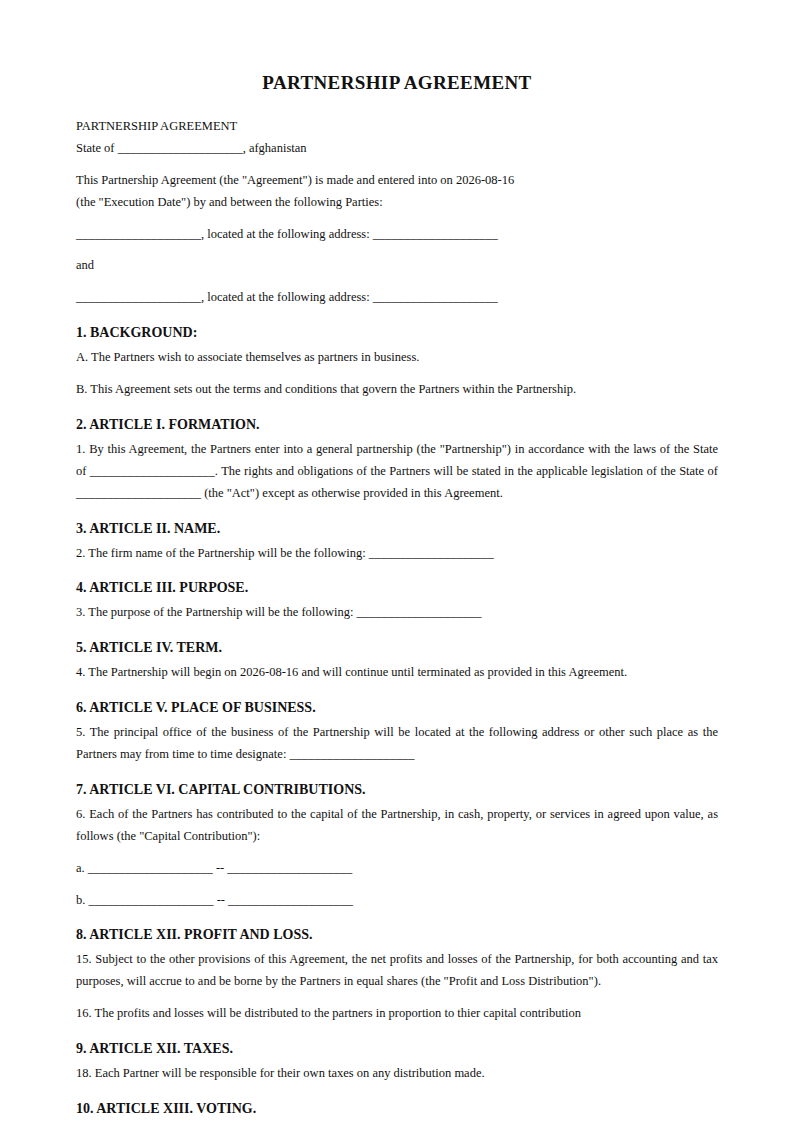
What a partnership agreement is
A partnership agreement governs a business carried on by two or more people together with a view to profit.
The defining characteristic, and the one that should shape every decision about whether to use this structure, is unlimited personal liability. Partners are generally liable for the debts of the partnership, and that liability is joint: a creditor who cannot recover from one partner can pursue the other for the whole amount.
That exposure extends to obligations your partner created without telling you, because each partner can generally bind the firm in the ordinary course of its business.
In Nigeria a partnership is registered as a business name with the Corporate Affairs Commission. It is not a separate legal person the way a limited company is, which is precisely why the liability lands on the individuals. Founders who want protection from business debts should be looking at a limited company instead.
Who needs one
Professionals practising together, where partnership remains the customary structure.
Small businesses run by two or more people who have chosen a business name registration over incorporation.
Family businesses operating jointly without a company.
Anybody already operating in partnership on an understanding rather than a document, which is where most partnership disputes begin.
If limited liability matters to you, and for most trading businesses it should, a limited company is the better vehicle and the shareholders agreement is the equivalent document.
Before you start
Agree these before drafting, because the default rules that apply without an agreement rarely suit anybody.
Who contributes what capital, and whether that determines profit share.
How profits and losses are divided.
Who manages the business and what decisions need both partners.
How a partner may leave, and what happens to their share.
And what happens if a partner dies, which without an agreement can dissolve the partnership entirely.
The walkthrough
Filling in the form, step by step
Every question you will be asked, what it means, and an example of a good answer.
Step 1 of 4
Partnership Agreement
The date and where the business operates
The agreement opens with the date and the jurisdiction.
The country list here is long because this form serves users anywhere. For a Nigerian partnership, select Nigeria and then name the state, since business name registration is administered by the Corporate Affairs Commission and the partnership operates under Nigerian law.
The state matters for practical reasons: it determines where the business is registered for state taxes, where disputes are likely to be heard, and which state regulations apply to the trade being carried on.
Where partners are in different states, choose the state where the business genuinely operates rather than where either partner happens to live.
- What is the date of the sale?
- The date the partnership agreement takes effect. Where the partners have already been trading together, use the real date and address the earlier trading separately, since debts incurred before this date still exist.
- Country
- The country the partnership operates in. Select Nigeria for a Nigerian business, which brings it under Nigerian partnership law and the Corporate Affairs Commission business name registration regime.
- State
- The state where the business operates, for example Lagos State. It determines the applicable state taxes and where a dispute would be heard, so choose where the business actually trades rather than where a partner lives.
Step 2 of 4
Partnership Agreement
The first partner
This step identifies the first partner.
Give the full legal name as it appears on identification, since a partner is personally liable and personal liability attaches to a person rather than to a nickname or a trading name.
The address is where formal notices reach them. It also matters because a creditor pursuing the partnership can pursue the partners personally, and a partner cannot be found is not a defence for the others.
If either partner is a company rather than an individual, which is possible, name the company and note that its liability is limited in a way an individual partner's is not, which changes the balance of exposure between the partners considerably.
- 1st Partner Information
- The first partner's full legal name as it appears on their identification. Personal liability attaches to the person, so accuracy here is not a formality. If the partner is a company, name the registered entity.
- Address
- The first partner's address for notices. It is also relevant because creditors of the partnership can pursue partners personally, so a current address matters to everybody involved.
Step 3 of 4
Partnership Agreement
The second partner
This step names the other partner on the same basis.
It is worth pausing here on what each partner is taking on. Once this agreement is signed, each of these two people can generally bind the firm in the ordinary course of its business, and each is exposed to the debts the other creates in doing so.
That is not a reason to avoid partnership, which remains a sensible structure for many professional practices. It is a reason to be certain about who you are entering it with, and to include in the agreement whatever limits on authority the partners want between themselves.
Limits agreed between partners bind the partners. They do not necessarily protect against a third party who dealt with one partner in good faith and knew nothing of the restriction, which is worth understanding before relying on them.
- 2nd Partner Information
- The second partner's full legal name as on their identification. Each partner can generally bind the firm in the ordinary course of business, so both should be certain about who they are joining.
- Address
- The second partner's address for notices and for the practical reason that partnership creditors may pursue either partner personally for the firm's debts.
Step 4 of 4
Partnership Agreement
The business, the capital and who manages it
The final step defines the business and settles the two questions partnerships most often fall out over.
Capital contributions should be recorded exactly, including non cash contributions such as equipment, premises or an existing client base. The reason is that profit share is frequently linked to contribution, and partners remember their own contribution generously.
Be aware of a trap here: capital contribution and profit share are separate questions, and the form does not ask about profit share at all. Without an express agreement, the default rule is generally equal sharing regardless of what each partner put in. If the partners intend profits to follow contribution, that must be written down separately.
The managing partner question sets who runs the business day to day. Naming one avoids the paralysis of two people with equal authority and no tie breaker, and the agreement should also say which decisions need both partners regardless of who manages.
The purpose defines the business the partnership carries on, which matters because a partner's authority to bind the firm extends to the ordinary course of that business.
- Proposed name for the Partnership
- The business name the partnership will trade under. Check availability with the Corporate Affairs Commission and register it, since operating under an unregistered business name is a compliance problem.
- Purpose for the partnership
- What business the partnership carries on. It matters beyond description: a partner's authority to bind the firm extends to the ordinary course of this business, so its scope has legal consequences.
- Proposed start date?
- When the partnership begins trading. Where the partners have already been operating together, address that earlier period separately rather than treating this as the start of everything.
- Capital contribution from 1st partner
- What the first partner contributes. Record non cash contributions such as equipment, premises or an existing client base as well as money, since partners recall their own contributions generously.
- Capital contribution from 2nd partner
- What the second partner contributes, on the same basis. Note that contribution and profit share are separate questions, and without an express agreement the default is generally equal sharing whatever each partner put in.
- Who will be the Managing Partner?
- Who runs the business day to day. Naming one avoids the paralysis of two equal authorities with no tie breaker, and the agreement should still specify which decisions require both partners.
- Business address
- Where the partnership operates from. This is the address registered with the Corporate Affairs Commission and where the business receives formal correspondence.
Ready to make yours?
Answer those questions in the builder and download a finished partnership agreement in Word and PDF.
Start now, ₦10,000After you download it
Register the business name
A Nigerian partnership registers as a business name with the Corporate Affairs Commission. Trading under an unregistered name is a compliance problem waiting to be noticed.
Write down the profit share
The form does not ask, and without an express term the default is generally equal sharing regardless of contribution. If you intend otherwise, record it.
Agree what happens on death or exit
Without provision, a partner's death can dissolve the partnership entirely. A continuation clause and a method for valuing a departing partner's share prevent that.
Reconsider whether you want a company
Partners are personally liable for the firm's debts, including those the other partner created. For most trading businesses a limited company is the safer structure.
Questions people ask
Are partners personally liable for business debts in Nigeria?
Generally yes, and the liability is joint. A creditor unable to recover from one partner can pursue the other for the whole amount, including debts that partner knew nothing about.
Is a partnership a separate legal person?
No. Unlike a limited company it has no separate legal personality, which is exactly why the liability falls on the individual partners rather than on the business.
How are profits shared in a partnership?
However the partners agree. Without an express agreement the default is generally equal sharing regardless of what each contributed, which surprises the partner who put in more.
Do I need to register a partnership in Nigeria?
Yes, as a business name with the Corporate Affairs Commission. Operating under an unregistered business name is a compliance problem.
What happens if a partner dies?
Without provision in the agreement, a partner's death can dissolve the partnership. A continuation clause and a valuation method for the departing share prevent that outcome.
Should I form a partnership or a company?
For most trading businesses, a company. Limited liability protects the owners from business debts, which is the protection a partnership specifically does not offer.
Documents that go with this
Terms used on this page
Partnership
A partnership is two or more people carrying on business together with a view to profit. Unless it is a limited liability partnership, the partners are personally liable for the debts, including debts a partner created alone.
Partnership Deed
A partnership deed is the written agreement between partners setting out shares, roles, decisions and exit. Without one, Nigerian partners fall back on default rules that suit almost nobody.
Unlimited Liability
Unlimited liability means the owner of a business is personally responsible for its debts. Sole proprietors and ordinary partners have it, and it is the main reason serious businesses incorporate.
Business Name
A business name is a trading name registered at the CAC by a sole proprietor or a partnership. It makes the name officially yours, but it does not create a separate legal entity, so the owner stays personally liable.
Joint and Several Liability
Joint and several liability means each person is liable for the whole amount, not just their share. A creditor can recover everything from whichever of them has money.
Limited Liability Company
A limited liability company is a business registered at the CAC as a separate legal person. It owns its own assets, owes its own debts, and shields its shareholders from personal liability.
Sole Proprietorship
A sole proprietorship is a business owned and run by one person, with no legal separation between the owner and the business. The owner takes all the profit and carries all the liability.
Winding Up
Winding up is the process of closing a company down: selling what it owns, paying who it owes in order of priority, and handing anything left to the shareholders before the company is dissolved.
Read more on this
Business Name vs Limited Liability Company in Nigeria
Business Name vs Limited Liability Company in Nigeria: Which One Should You Register First? If you are thinking about starting a business in Nigeria, one of the earliest decisions you will have to make is how to register…
Founders Vs. Shareholders
When building a company, it’s important to understand the distinct roles of founders and shareholders and the legal documents that formalize their relationships. Founders: Globally, roughly 40 million startup companies a…
Business Name vs Limited Liability Company (Ltd) vs Public Company (Plc)
Business Name vs Limited Liability Company (Ltd) vs Public Company (Plc) — A Practical Guide In Nigeria the Corporate Affairs Commission (CAC) and the Companies and Allied Matters Act (CAMA) provide the legal framework f…
Step by step guides for every document on LegalDoc
Browse all guides