
How to Write a Personal Guarantee
A guarantor promises to pay if the tenant does not. It is a short document with a long reach, and guarantors rarely understand what they are signing.
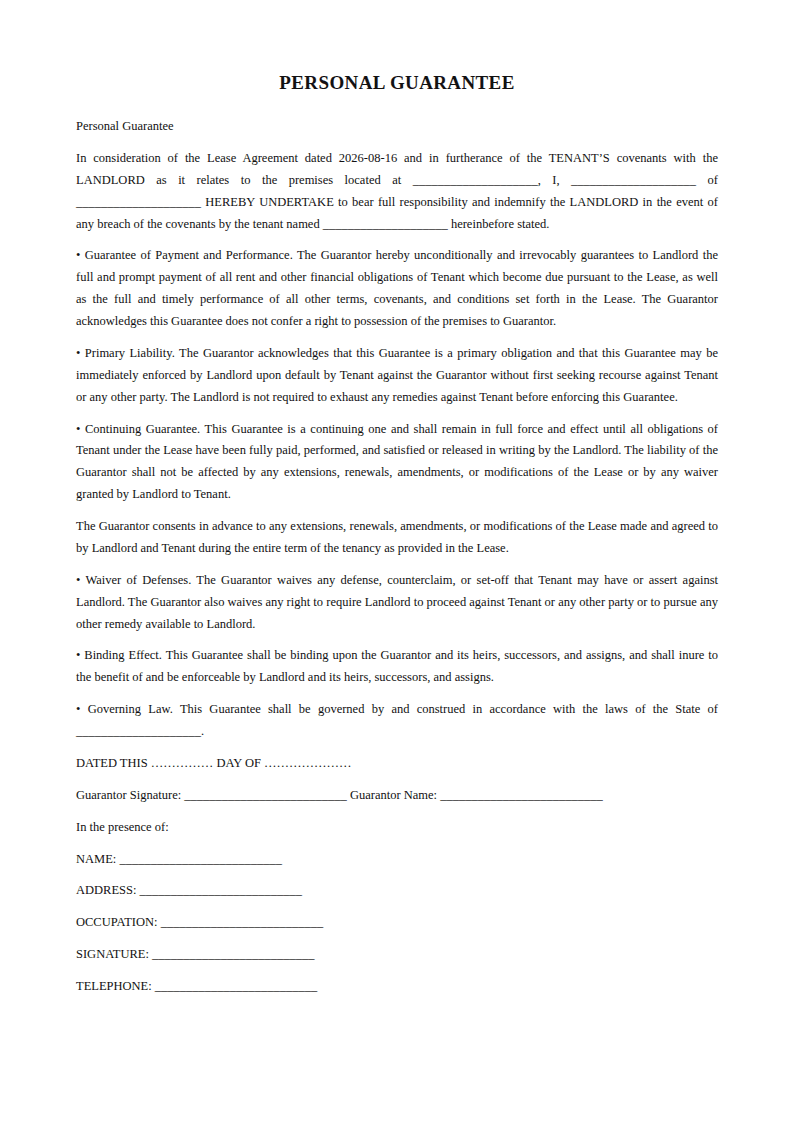
What a personal guarantee is
A personal guarantee is a promise by one person to meet another person's obligations if they fail to.
This version guarantees a tenancy. The guarantor accepts that if the tenant does not pay the rent, or breaches the lease and causes loss, the landlord can look to them instead.
It is short, and its brevity is misleading. A guarantee is one of the most consequential documents an individual signs, because it exposes their own assets to somebody else's default with no corresponding benefit to them. Guarantors routinely sign to help a relative or an employee without appreciating that the obligation can outlast the friendship, the job and the tenancy.
For the landlord it is straightforward protection: a second person to pursue where the tenant has nothing. For the guarantor it is worth understanding fully before signing, and this guide is written with both in mind.
Who needs one
Landlords letting to a tenant with no rental history, no verifiable income, or a company with no assets.
Landlords letting to students or first time renters, where a parent commonly guarantees.
Employers guaranteeing accommodation for staff.
Anybody asked to guarantee a tenancy that is not their own, who should read this before signing rather than afterwards.
A guarantee is also common in commercial lettings, where a landlord takes a personal guarantee from a director behind a company tenant precisely because the liability of the company is limited.
Before you start
If you are being asked to guarantee, establish these first.
What exactly you are guaranteeing: rent only, or rent plus damage and other losses.
How much your exposure could be, at the maximum.
How long the guarantee lasts, and whether it continues if the tenancy is renewed or extended.
Whether you can end it, and how.
And whether you would actually pay, because that is what you are agreeing to do.
The walkthrough
Filling in the form, step by step
Every question you will be asked, what it means, and an example of a good answer.
Step 1 of 2
Personal Guarantee
The tenancy, the guarantor and the tenant
This step ties the guarantee to a specific tenancy and names everybody involved.
The lease date and the property description are what define the scope. A guarantee should attach to an identified tenancy of an identified property, and a guarantor should be wary of anything drafted more widely than that.
The question a guarantor should ask here, and rarely does, is what happens when the tenancy is renewed. A guarantee expressed to cover the lease and any renewal or extension can continue for years beyond what the guarantor imagined, covering a tenancy at a higher rent they never agreed to. If you are guaranteeing, this is the point to establish whether your obligation ends with this term.
Name the guarantor and tenant in full. The landlord will look to the guarantor personally, so identifying them precisely matters, and a guarantor should confirm they are guaranteeing the person they think they are.
One further point for guarantors: this document does not state a financial limit. Where you want one, that has to be negotiated and written in, and a guarantee without a cap is a guarantee of whatever the tenant ends up owing.
- Lease Date
- The date of the tenancy being guaranteed. It ties the guarantee to one identified lease. A guarantor should establish whether the obligation ends with this term or continues into renewals, since the difference can be years.
- Description of the Leased Property
- The property covered, described precisely with unit number and address. The guarantee attaches to this tenancy of this property, and a guarantor should resist anything drafted more broadly.
- Guarantor's name
- The person accepting liability for the tenant's obligations, named in full. Their own assets are exposed by this document, so it should identify them beyond doubt.
- Guarantor's address
- The guarantor's address, where a demand under the guarantee would be served. This is the address a landlord writes to when the tenant stops paying.
- Tenant's Name
- The tenant whose obligations are being guaranteed, matching the tenancy agreement exactly. A guarantor should confirm this is the person and the tenancy they believe they are guaranteeing.
Step 2 of 2
Personal Guarantee
The governing state
The final question fixes the law, and it should follow the property.
Tenancy matters are governed by the law of the state the property sits in, and a guarantee supporting that tenancy sits most naturally under the same law. A landlord enforcing against a guarantor is bringing a claim, and it will realistically be brought where the property or the guarantor is.
Before signing, a guarantor should understand three practical things this short document does not spell out.
The landlord can usually come to you without first exhausting remedies against the tenant, depending on how the guarantee is worded. Many guarantees are drafted so the guarantor is liable as a principal debtor, which removes the expectation that the tenant is pursued first.
A guarantor who pays is entitled to recover from the tenant, and that right is only as good as the tenant's ability to pay. If they could pay, the guarantee would not have been called on.
And guarantees are difficult to withdraw from. Unless the document provides a way out, the obligation runs for as long as the guarantee covers.
- The agreement is to be governed by which State?
- The state whose law governs, which should follow the property being let. Tenancy is state law in Nigeria, and a claim against the guarantor will realistically be brought where the property or the guarantor is.
Ready to make yours?
Answer those questions in the builder and download a finished personal guarantee in Word and PDF.
Start now, ₦5,000After you download it
Guarantor should take advice
A short document with a long reach. Anybody guaranteeing somebody else's tenancy should understand the exposure before signing, not after a demand arrives.
Negotiate a cap and an end date
This form states neither. A financial limit and a clear end point are the two things a guarantor should ask for, and both have to be written in.
Attach it to the tenancy agreement
The guarantee and the lease belong together. The guarantor should hold a copy of both, since they are liable under a document they may never have read.
Landlord should verify the guarantor
A guarantee is only worth the guarantor's ability to pay. Confirm they have income or assets, otherwise you have a second name and no more security.
Questions people ask
What is a personal guarantee?
A promise by one person to meet another's obligations if they fail to. In a tenancy, the guarantor pays the rent or the losses if the tenant does not.
Can the landlord come to me before pursuing the tenant?
Often yes, depending on the wording. Many guarantees make the guarantor liable as a principal debtor, which removes any expectation that the tenant is pursued first.
How long does a guarantee last?
As long as the document says. Watch for wording extending it to renewals or extensions, which can keep a guarantor liable for years at a rent they never agreed.
Is there a limit on what I could owe?
Only if the guarantee states one, and this form does not. A guarantee without a cap covers whatever the tenant ends up owing, including damage and other losses.
Can I cancel a guarantee?
Usually not unilaterally. Unless the document provides a way out, the obligation runs for as long as the guarantee covers, so negotiate an exit before signing.
If I pay, can I recover from the tenant?
You are entitled to, and that right is worth what the tenant can pay. If they could pay, the guarantee would not have been called on in the first place.
Documents that go with this
Terms used on this page
Guarantor
A guarantor promises to pay somebody else's debt or perform their obligation if they fail to. Signing as one makes you liable for a debt you did not benefit from.
Surety
A surety is somebody who stands for a defendant released on bail, undertaking to produce them in court. Standing surety is a real obligation, not a formality.
Personal Guarantee
A personal guarantee is a promise to pay somebody else's debt if they do not. It is what Nigerian banks ask directors for, and it puts personal assets behind a company obligation.
Subrogation
Subrogation lets an insurer that has paid a claim step into your shoes and sue whoever caused the loss. Settle privately with them first and you can lose your cover.
Indemnity
An indemnity is a promise to cover somebody else's loss if a defined thing goes wrong. It is a primary obligation, which makes it stronger than a guarantee and heavier to give.
Joint and Several Liability
Joint and several liability means each person is liable for the whole amount, not just their share. A creditor can recover everything from whichever of them has money.
Landlord
A landlord is the person who grants somebody else the right to occupy their property in exchange for rent. The role carries rights to rent and possession, and duties that Nigerian law enforces.
Tenant
A tenant is a person who occupies property belonging to somebody else in exchange for rent. Nigerian law gives tenants real protections, including proper notice and the right to a refund of the caution fee.
Read more on this
Personal Guarantee for Tenancy Agreement: What You Need to Know
Personal Guarantee for Tenancy Agreement: What You Need to Know A tenancy may look simple from the outside. A landlord has a property. A tenant wants to live or operate there. Rent is paid, keys are handed over, and ever…
8 Essential Clauses Every Tenancy Agreement Should Contain
8 Essential Clauses Every Tenancy Agreement Should Contain Renting property in Nigeria is often straightforward at the beginning. A landlord has a space to let, a tenant needs accommodation, and both parties are eager to…
Landlord Rights in Nigeria
Landlord Rights in Nigeria: What Every Property Owner Needs to Know Being a landlord in Nigeria is one of those ventures that looks straightforward from the outside and reveals its complexities only after you’re already…
Step by step guides for every document on LegalDoc
Browse all guides