
How to Write a Quitclaim Deed
A quitclaim deed transfers whatever interest the grantor has, with no promise they have any. Nigeria uses a deed of assignment instead.
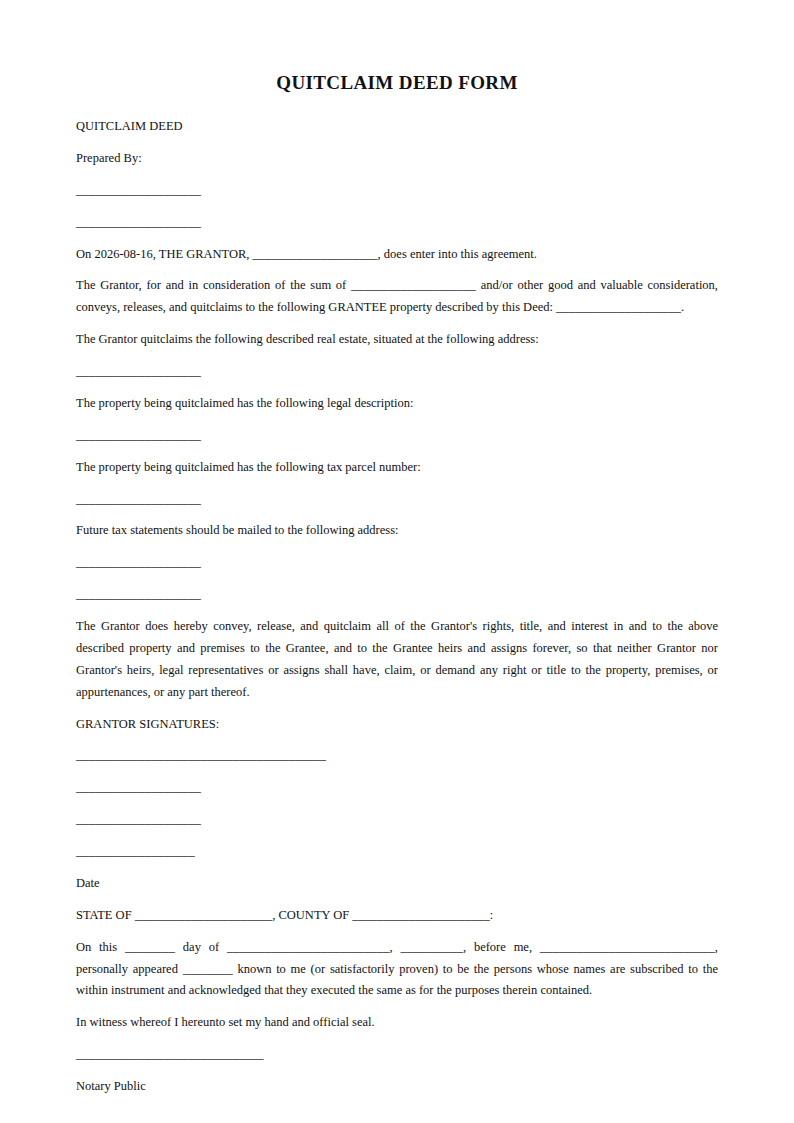
What a quitclaim deed form is
A quitclaim deed transfers whatever interest the grantor happens to have in a property, without promising they have any interest at all.
That is the defining feature and the reason to be careful with it. A warranty deed contains promises: that the grantor owns the property, that the title is clear, and that they will defend it. A quitclaim contains none of those. If the grantor turns out to have owned nothing, the grantee has received nothing and has no claim over the failure.
It is a US instrument. Nigeria transfers land by deed of assignment, followed by stamping, the Governor's consent under the Land Use Act, and registration at the state land registry. A Nigerian property transaction should use that route, not this one.
Where a quitclaim genuinely fits is between parties who already trust each other and where title is not in question: adding a spouse to a title, transferring between family members, moving property into a trust, or correcting an error in a previous deed.
Who needs one
Property owners in the United States transferring between spouses or family members.
People moving property into a trust or a company they control.
Anybody correcting a defect or a misspelling in an earlier recorded deed.
Divorcing couples where one party transfers their interest in the family home to the other.
It is the wrong instrument for a sale at arm's length to somebody you do not know, where a warranty deed and title insurance are what a buyer should insist on. And it is the wrong instrument entirely for Nigerian land.
Before you start
Get these before drafting.
The existing deed, for the legal description and how the current owner is named.
The parcel or tax identification number from the county records.
Confirmation of who currently holds title and in what form.
The county recording requirements, which vary and include formatting rules that cause rejections.
And advice about the tax consequences, since transferring property can trigger reassessment or gift tax exposure depending on the state and the relationship.
The walkthrough
Filling in the form, step by step
Every question you will be asked, what it means, and an example of a good answer.
Step 1 of 2
Quitclaim Deed Form
Who prepared it, and the parties
The deed opens with the preparer and both parties.
The preparer detail is a recording requirement in most US counties: the document has to say who drafted it and where they can be reached. A deed omitting it is commonly rejected at the recorder's office, which is an irritating delay for a document that is otherwise correct.
The grantor is the person giving up their interest, and the grantee is the person receiving it. Name the grantor exactly as they appear on the existing deed. Where the current deed says Mary Ann Okafor and the quitclaim says Mary Okafor, the chain of title has a gap in it that somebody will have to explain years later.
Name the grantee as they should appear on the record going forward, and where more than one person is taking, state how they hold: jointly, in common, or otherwise. That choice affects what happens when one of them dies, and it is not something to leave to a default.
- The name of the person preparing the document?
- Who drafted the deed. Most US counties require this on the face of the document, and a deed omitting it is commonly rejected at the recorder's office.
- Address of the person preparing the document?
- The preparer's address, which is part of the same recording requirement.
- Date the is being quit claimed?
- The date of the transfer. Recording usually follows shortly afterwards, and the deed generally takes effect between the parties on delivery rather than on recording.
- Full name of the Grantor
- The person giving up their interest, named exactly as they appear on the existing deed. Any difference creates a gap in the chain of title that somebody will have to explain later.
- Address of the Grantor
- The grantor's address, used to identify them and for any correspondence about the transfer.
- Full name of the Grantee
- The person receiving the interest, named as they should appear on the record going forward. Where more than one person is taking, state how they will hold it, since that determines what happens when one of them dies.
- Address of the Grantee
- The grantee's address. It often becomes the address of record for the property, so use one that will remain current.
Step 2 of 2
Quitclaim Deed Form
The property, the price and the taxes
This step describes what is being transferred, and the legal description is the part that matters.
A street address is not a legal description. The legal description is the formal identification used in the county records: a lot and block reference in a recorded subdivision, or a metes and bounds description. Copy it exactly from the existing deed. A deed with a street address alone, or with a description that does not match the record, is commonly rejected and, if recorded, creates a defect somebody has to cure.
The parcel or tax number is how the county identifies the property in its own system, and it belongs on the deed for the same reason.
The consideration is often nominal in a quitclaim, since many are gifts or transfers between family. A nominal figure is normal and honest. Be aware that a transfer for little or no consideration can have tax consequences: it may trigger reassessment, and it may amount to a gift for federal tax purposes. Take advice rather than assuming a family transfer is free of consequence.
The tax statement address determines who receives the property tax bill afterwards. Getting it wrong means the new owner never sees the bill and finds out when it is overdue.
- Amount of money to be exchanged for the transfer of property
- The consideration. Often nominal in a quitclaim, since many are gifts or family transfers, and that is normal. Take advice on the tax position, since a transfer for little or no consideration can trigger reassessment or gift tax exposure.
- The address of the property to be transferred
- The street address of the property. Useful for identification, and not sufficient on its own: the legal description below is what the county records rely on.
- The legal description of the property to be transferred
- The formal description from the existing deed: lot and block in a recorded subdivision, or a metes and bounds description. Copy it exactly. A deed relying on a street address alone is commonly rejected and, if recorded, leaves a defect to cure.
- The tax or Parcel number of the property to be transferred
- The parcel or tax identification number from the county records. It is how the county identifies the property in its own system and it belongs on the deed.
- Name of the person who will be paying taxes on the property
- Who becomes responsible for property taxes after the transfer, normally the grantee. Confirm the county updates its records, since an unpaid tax bill nobody received becomes a lien.
- Address where the tax statement should be sent to
- Where the property tax bill goes. Getting this wrong means the new owner never sees the bill and discovers it once it is overdue and has attracted penalties.
Ready to make yours?
Answer those questions in the builder and download a finished quitclaim deed form in Word and PDF.
Start now, ₦7,000After you download it
Notarise it
US counties require the grantor's signature to be notarised before a deed can be recorded. An unnotarised deed will not be accepted.
Record it with the county
Recording is what puts the world on notice of the transfer. An unrecorded deed leaves the grantee exposed to a later purchaser who records first.
Take advice on the tax consequences
A transfer for little or no consideration can trigger reassessment or amount to a gift for tax purposes. Family transfers are not automatically consequence free.
Use a deed of assignment in Nigeria
Nigerian land is transferred by deed of assignment, then stamped, taken for the Governor's consent and registered. A quitclaim deed has no place in that process.
Questions people ask
What is a quitclaim deed?
A deed transferring whatever interest the grantor has in a property, with no promise that they have any interest at all. If they owned nothing, the grantee receives nothing.
How is it different from a warranty deed?
A warranty deed promises the grantor owns the property, that title is clear, and that they will defend it. A quitclaim makes none of those promises, which is why it suits transfers between people who trust each other.
Can I use a quitclaim deed in Nigeria?
No. Nigerian land is transferred by deed of assignment, then stamped, taken for the Governor's consent under the Land Use Act and registered at the state land registry.
When is a quitclaim deed appropriate?
Adding a spouse to a title, transferring between family members, moving property into a trust, or correcting an error in an earlier deed. Not for an arm's length sale to a stranger.
What is a legal description?
The formal identification used in county records, such as a lot and block reference or a metes and bounds description. A street address is not a legal description and is not sufficient.
Does a quitclaim deed need to be recorded?
It should be. Recording puts the world on notice of the transfer, and an unrecorded deed leaves the grantee exposed to a later purchaser who records first.
Documents that go with this
Terms used on this page
Deed
A deed is a document executed with extra formality, which binds even where nothing was given in return. Nigerian land transfers, powers of attorney and gifts all have to be made this way.
Deed of Assignment
A deed of assignment is the document that actually transfers land or property from a seller to a buyer in Nigeria. Without it, properly executed and registered, you have paid for land you cannot prove is yours.
Title Search
A title search is the check you run at the lands registry before buying land, to find out who actually owns it and what is registered against it. It is the cheapest part of any Nigerian property purchase.
Perfection of Title
Perfection of title is what you do after buying Nigerian land: obtain the Governor's consent, stamp the deed and register it. Skip it and you hold a receipt rather than a title.
Ownership
Ownership is the greatest interest a person can hold in property. For Nigerian land it is qualified, because the Land Use Act vests land in the state and what you actually hold is a right of occupancy.
Notary Public
A notary public is a legal practitioner authorised to witness signatures, administer oaths and certify documents, particularly for use abroad. Their seal is what makes a Nigerian document acceptable overseas.
Governor's Consent
Governor's consent is the state governor's approval of a transfer of land held under a statutory title. Under Section 22 of the Land Use Act, a transfer made without it risks being void.
Gift
A gift is a transfer with nothing given in return. Because there is no consideration, land gifts must be made by deed, and the same consent and registration steps apply as on a sale.
Read more on this
Title Perfection in Nigeria: From Search to Deed of Assignment to Registered Title
Title Perfection in Nigeria: From Search to Deed of Assignment to Registered Title and Consent There is a phrase that comes up often in Nigerian property circles: “the title is not perfected.” Sellers say it casually. Bu…
Unregistered Deed of Assignment: Do You Actually Own the Land?
Registration is not what transfers ownership; your deed does that. So an unregistered deed doesn't mean you own nothing.
REAL ESTATE: Buyer’s Guide
Introduction: Real estate is one of the biggest investments most people make in their lifetime. Therefore, it is important to make an informed decision when buying a property. This guide will help you understand the key…
Step by step guides for every document on LegalDoc
Browse all guides