
How to Write a Resignation Letter
A resignation letter needs to do three things: state that you are leaving, give the date, and keep the relationship intact. Everything else is optional.
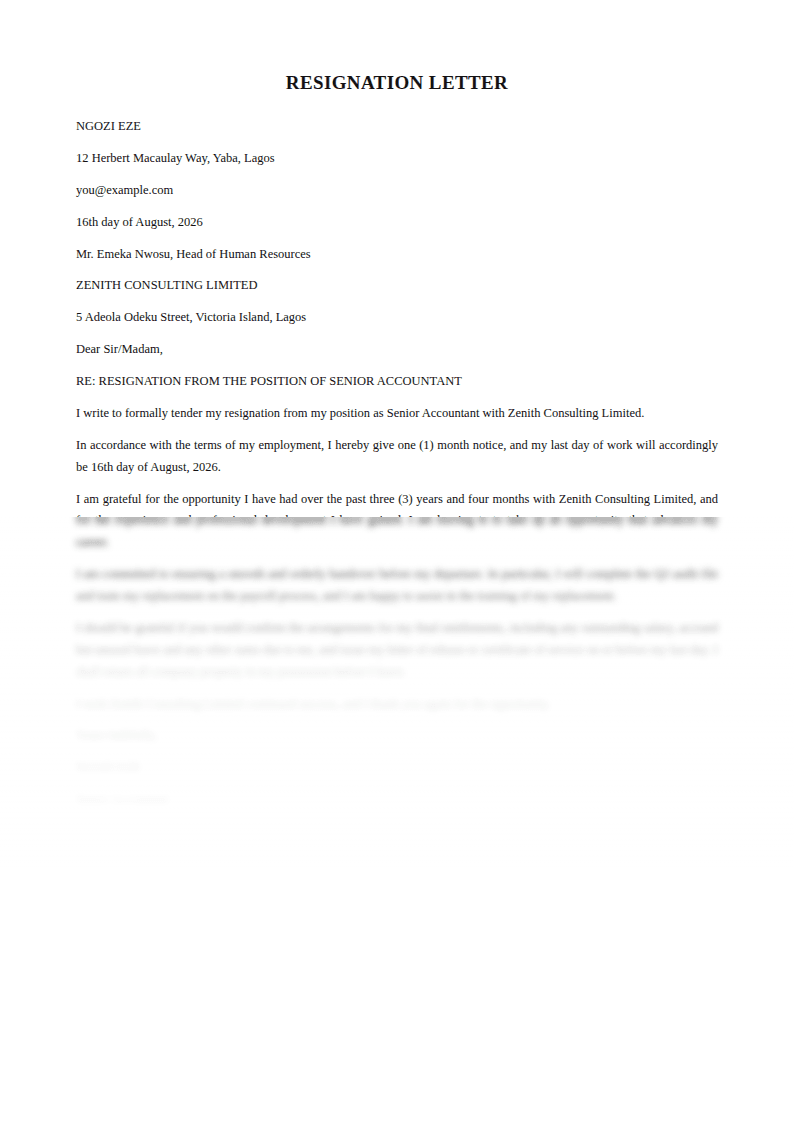
What a resignation letter is
A resignation letter is the formal notice that you are ending your employment.
It is short by design. It says you are resigning, when your last day will be, and it usually offers something about the handover. That is the whole job.
The reason it matters is not legal so much as practical. This letter goes on your personnel file, and it is the document a future employer's reference request lands next to. A calm, professional resignation is remembered as such; an angry one is remembered for considerably longer than the grievance that prompted it.
Check your contract before writing. The notice you must give is whatever it says, commonly a month in Nigeria for salaried roles.
Who needs one
Anybody leaving a job, whether for another role, to start a business, or to stop working for a while.
Employees on notice periods who need to fix the leaving date formally rather than by conversation.
Anybody who wants a clean record and a usable reference, which is almost everybody.
Where you are leaving because of something serious such as harassment or unpaid wages, take advice before resigning, because resigning can affect what claims remain open to you.
Before you start
Check three things before you write.
Your contractual notice period, which decides your last working day rather than your preference.
Whether you owe anything on leaving: an employment bond, training costs, or a company asset you are holding.
What leave you have accrued and not taken, since that is normally paid or offset against notice.
And whether your next role is genuinely confirmed in writing. Resigning on a verbal promise is a risk people take once.
The walkthrough
Filling in the form, step by step
Every question you will be asked, what it means, and an example of a good answer.
Step 1 of 3
Resignation Letter
Who you are and who you are writing to
The letter opens with the formalities, and it is worth being deliberate about the addressee.
Address it to the person your contract or company policy says should receive it, usually your line manager or the head of human resources. Sending it to the wrong person delays the date it takes effect, which matters when your notice period is counting down.
Give a personal email address rather than only your work one. Your work account will be closed on your last day, and the final correspondence, references and payroll documents need somewhere to go afterwards. People forget this routinely and lose access to their own paperwork.
- Your full name
- Your full name as it appears in your employment records, so the letter files correctly against your personnel record.
- Date of this letter
- The date you submit the letter. Your notice period runs from when the employer receives it, so submit it on the day you date it rather than backdating.
- Your home address
- Your home address. Final payslips, tax documents and any reference correspondence may be sent here after your access ends.
- Your personal email address
- A personal email address, not your work one. Your company account closes on your last day, and you will still need somewhere to receive final documents and references.
- Who are you addressing this to?
- The person the letter is addressed to, usually your line manager or the head of human resources, with their title. Check your contract, since sending it to the wrong person can delay when notice starts.
- Your employer's name
- Your employer's registered name, as it appears on your contract, for example Zenith Consulting Limited.
- Your employer's address
- The company address where the letter is delivered. Use the office that handles personnel matters if the company has several locations.
Step 2 of 3
Resignation Letter
Your role, your notice and your last day
This step contains the operative part of the letter: the date you leave.
Work it out rather than choosing it. Count your contractual notice from the date the employer receives the letter, and that gives you the last working day. Naming a date shorter than your notice is a breach of contract, and while many employers will not pursue it, some deduct the shortfall from your final pay and are entitled to.
If you want to leave sooner, ask rather than announce. Employers frequently agree to a shorter notice, particularly where a handover is straightforward, but that is a negotiation and not a decision you can make alone.
Stating how long you have worked there is a small courtesy that helps the human resources team calculate your final entitlements without going back through the file.
- Your job title
- Your job title as it appears in your contract. It identifies the role being vacated, which matters in a company where several people share a similar title.
- Your last working day
- Your final working day, calculated by counting your contractual notice from the date the employer receives this letter. Naming a shorter date is a breach, and some employers deduct the shortfall from final pay.
- What notice does your contract require?
- The notice your contract requires, for example one month. Check the document rather than relying on what is customary, since the two are frequently different.
- How long have you worked there?
- How long you have worked there, for example three years and four months. It is a courtesy that helps human resources calculate final entitlements without digging through your file.
Step 3 of 3
Resignation Letter
Your reason and the handover
The closing step is optional in substance and important in tone.
You do not have to give a reason for resigning, and a short neutral one is almost always better than a detailed one. To take up an opportunity that advances my career says enough. A list of grievances belongs in a different conversation, and putting it in a resignation letter usually costs you more than it achieves, because this document outlives the feeling that produced it.
The handover offer is where you actually build goodwill. Naming what you will complete and who you will train is concrete and useful, and it is the part a manager remembers when a reference request arrives eighteen months later.
If you are leaving because of something serious, take advice before resigning rather than recording it here.
- Why are you leaving? (optional)
- Optional, and brief is better. Something neutral such as taking up an opportunity that advances my career is sufficient. A resignation letter is a poor place for grievances, since it stays on file long after the feeling has passed.
- How will you hand over?
- What you will do to hand over: which work you will finish, what you will document, and who you will train. This is the part that earns goodwill, and goodwill is what a future reference is made of.
Ready to make yours?
Answer those questions in the builder and download a finished resignation letter in Word and PDF.
Start now, ₦2,000After you download it
Submit it to the right person
Notice runs from when the employer receives it. Deliver it to whoever your contract names, and keep evidence of the date you did.
Ask for written acknowledgement
A short confirmation of your last working day settles the leaving date and prevents a disagreement about it during your final month.
Settle leave, assets and any bond
Accrued leave, company property and any employment bond or training cost should be resolved before your last day rather than after.
Do the handover you promised
It is the thing your manager will actually remember. The reference you need later is written by somebody recalling how you left.
Questions people ask
How much notice do I have to give when resigning in Nigeria?
Whatever your contract says, commonly one month for salaried roles. Check the document rather than relying on what is customary, since the two often differ.
Do I have to give a reason for resigning?
No. A short neutral reason is fine and usually better than a detailed one, because the letter stays on your personnel file long after the circumstances are forgotten.
Can I leave before my notice period ends?
Only by agreement. Ask rather than announce. Employers frequently agree to a shorter notice, but leaving early without consent is a breach and the shortfall may be deducted from final pay.
What happens to my unused leave?
It is normally paid out or offset against your notice period, depending on your contract and company policy. Raise it before your last day rather than after.
Should I resign if I am being treated badly?
Take advice first. Resigning can affect what claims remain available to you, so it is worth understanding the position before you put anything in writing.
Can my employer refuse to accept my resignation?
They cannot force you to stay, but they can hold you to your notice period. The resignation takes effect on receipt, and the leaving date follows the contract.
Documents that go with this
Terms used on this page
Notice Period
A notice period is how much warning either side must give before ending an employment. The Labour Act sets minimums based on length of service, and the contract can give more but not less.
Contract of Employment
A contract of employment is the agreement between an employer and an employee setting out the job, the pay and the terms. Nigerian law expects it in writing within three months of starting.
Employee
An employee works under a contract of service, meaning the employer controls how the work is done. The label on the contract does not decide it, and getting the classification wrong is expensive for the employer.
Gratuity
Gratuity is a lump sum paid to an employee on leaving after long service. In Nigeria it is contractual rather than automatic, so whether you get it depends on what your contract or handbook says.
Termination
Termination is the ending of a contract on its terms. In employment it means the relationship ends, normally with notice or payment in lieu, and it does not imply that anybody did anything wrong.
Garden Leave
Garden leave keeps a departing employee on the payroll during notice while removing their access to clients, systems and information. It protects the business without relying on a restraint clause.
Employment Bond
An employment bond requires an employee to serve a minimum period or repay training costs if they leave early. It is enforceable only if the amount reflects real cost.
Annual Leave
Annual leave is paid time off an employee earns by working. The Labour Act sets a minimum of six working days after twelve months of continuous service, and most Nigerian employers give considerably more.
Read more on this
Employment Contracts: Key Clauses and Compliance Guide
Employment Contracts: Key Clauses and Compliance Guide An employment contract is one of the most important documents in any Nigerian workplace, yet it is also one of the most neglected. Many businesses, especially small…
How to Terminate a Contract the Right Way
How to Terminate a Contract the Right Way How do you end a contract properly without creating bigger problems? Because terminating a contract is not just about walking away. If done carelessly, it can expose you to claim…
Difference Between an Offer Letter and an Employment Contract in Nigeria
Difference Between an Offer Letter and an Employment Contract in Nigeria What Is an Offer Letter? An offer letter is a preliminary document issued by an employer to a prospective employee after a successful recruitment p…
Step by step guides for every document on LegalDoc
Browse all guides