
How to Write a Return and Refund Policy
A return and refund policy tells buyers when they can send something back and when they get their money. Each question below is a commercial decision before it is a drafting one.
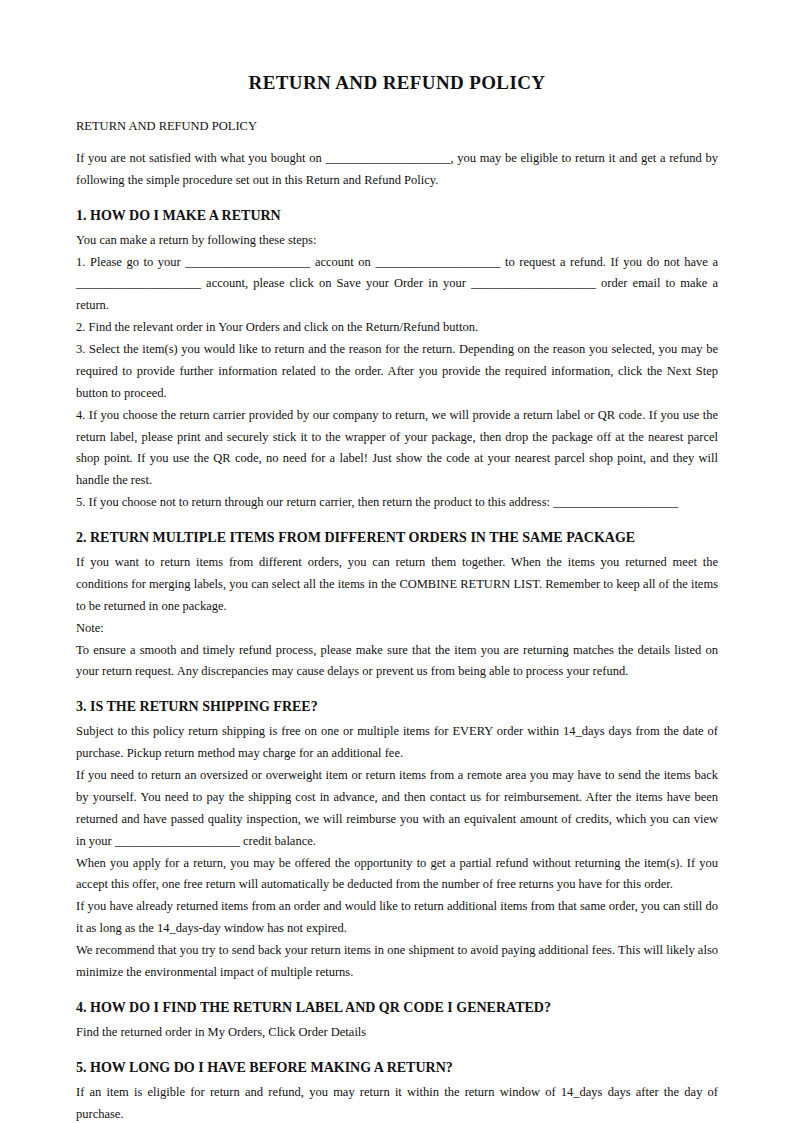
What a return and refund policy is
A return and refund policy sets out when a customer can send something back, what condition it has to be in, and how quickly they get their money.
It is the most commercially loaded document a small store publishes. Too strict and buyers hesitate at checkout. Too loose and you carry the cost of every change of mind.
The policy also decides how disputes end. When a customer says they were entitled to a refund and you say they were not, the published policy is what settles it, provided it was visible before they bought.
Who needs one
Any business selling goods, physical or digital, through any channel.
Stores with a proper checkout, sellers working through Instagram or WhatsApp, and anybody listing on a marketplace.
Payment processors look for one when reviewing a merchant account, because clear refund terms reduce chargebacks.
And Nigerian consumer protection law expects buyers to be told the material terms before they commit. What happens when something arrives faulty is about as material as it gets.
Before you start
Decide the commercial questions first, because the wording only records them.
How long a customer has to ask. Fourteen days is tight, thirty is the common middle, ninety is generous.
How quickly you will actually process a refund once you agree to it, allowing for your bank rather than your intentions.
What condition an item must come back in.
Who pays return postage, which is the question customers ask most and policies answer least.
And where returns physically go.
The walkthrough
Filling in the form, step by step
Every question you will be asked, what it means, and an example of a good answer.
Step 1 of 4
Return and Refund Policy
Where the policy applies
The opening question is about the surface your customers buy through.
A policy written for a website talks about orders placed on the site and refunds to the original payment method. One written for an app has to account for the app stores, which run their own refund process for in app purchases and can issue refunds without consulting you.
That distinction matters commercially. For in app purchases the store's rules sit on top of yours, and your policy should not promise something the store's process contradicts.
- Return and Refund Policy for?
- Choose Website for orders placed through a browser based store. Choose App where purchases happen inside a mobile application, in which case the app store's own refund process applies alongside your policy. Selling through both, pick where the orders are and link the same policy from the other.
Step 2 of 4
Return and Refund Policy
Your store and where you trade
These answers scope the policy and set the consumer law backdrop.
The country is not merely descriptive here. Consumer protection rules differ, and they set a floor your policy cannot write its way beneath. In Nigeria the Federal Competition and Consumer Protection Act gives buyers rights to goods of acceptable quality and to a remedy when goods are defective.
That is the important thing to understand before you set your terms: a refund policy governs change of mind returns, but it cannot remove a customer's statutory rights when an item is faulty. A policy saying all sales are final does not survive contact with a defective product.
- What is your website URL?
- The store customers buy from, for example www.yourstore.com. Use the live domain. If you sell mainly through an Instagram or WhatsApp account, use the profile link buyers order through.
- Enter the Country
- The country you trade from, which fixes the consumer protection backdrop. A Nigerian store should say Nigeria. Whatever return window you then choose, statutory rights over faulty goods sit above it.
Step 3 of 4
Return and Refund Policy
Who the customer is dealing with
This step names the business that owes the refund.
Buyers reading a refund policy are, at that moment, assessing whether you can be held to it. A named entity with an address reads as accountable. An anonymous store does not, and cautious buyers act accordingly.
Use the entity that receives the payment. If money arrives in a company account, name the company. A policy promising refunds from a business that does not exist is a problem you will only discover during a dispute.
- Pick One
- Choose I am a Business or Startup if a registered business name or company runs the store. Choose I am an Individual if you sell in your own name. Answer truthfully, since the entity named here is the one that owes the refund.
- Name of Business/ Startup
- The name customers know you by, and the registered name where you have one, for example Bright Home Supplies Limited. Match it to the account the payments arrive in, so the refund promise and the money trail line up.
- Address of Business
- A real address with street, city and state. Buyers weigh this when deciding whether to trust a store, and payment processors reviewing a merchant account look for it.
Step 4 of 4
Return and Refund Policy
Windows, conditions and where returns go
This step is where the policy earns or costs you money, so answer as the business you actually run.
The request window and the processing window are different promises. The first is how long the customer has to come to you. The second is how long you take to send the money back once you have agreed. State both, and make the second one honest about your bank rather than your intention. A store promising seven days and taking three weeks converts a resolved complaint into a chargeback.
The conditions are where most disputes actually start. Unused and undamaged is reasonable. Original packaging is reasonable for many products and unreasonable for some, since a buyer often cannot inspect an item without opening it. Pick conditions you would defend to a reasonable customer.
And note what these conditions do not cover: they govern change of mind returns. A faulty item is a different matter, and a buyer's statutory rights are not lost because they threw the box away.
- Within how many days do customers have to ask for a refund?
- How long after delivery a customer has to request a refund. Fourteen days is tight, thirty is the common middle ground, and longer windows reduce hesitation at checkout at the cost of more late returns. Choose what you can live with year round.
- Within how many days do you intend to process the refund?
- How long you take to return the money once a refund is agreed. Count your payment processor and bank, not just your own decision. Promising faster than you can deliver is what turns a satisfied refund into a dispute.
- What conditions must be met to issue a refund?
- Tick the conditions an item must meet. Unused and undamaged is standard. Requiring original packaging is fair for some products and harsh for others, since buyers often must open a box to inspect what is inside. These conditions apply to change of mind returns, not to faulty goods.
- How can visitors/users contact you as regards your return and refund policy
- List only what you check daily. Refund requests are time sensitive, and a customer who feels ignored goes to their bank rather than back to you.
- Phone No.
- A number customers can reach about returns, if you ticked phone. Include the country code where you sell abroad, for example +234 801 234 5678. Give a line that is answered during stated hours.
- The address for refund requests, if you ticked email. Something like returns@yourstore.com keeps these separate from general enquiries and makes them easier to track and hand over.
- Link
- A returns or contact page, if you ticked that option, for example www.yourstore.com/returns. A short form there beats a bare email address, because it prompts customers for the order number.
- Address for return
- Where customers physically send items back, with street, city and state. Say who pays return postage, since it is the question buyers ask most and policies answer least. For digital goods with nothing to return, note that instead.
Ready to make yours?
Answer those questions in the builder and download a finished return and refund policy in Word and PDF.
Start now, ₦5,000After you download it
Show it before the buy button
Link it in the footer and at checkout. A refund policy the customer sees only after paying is much weaker if they later dispute the charge.
Do not write below the legal floor
Your policy sets change of mind terms. It cannot remove a buyer's statutory rights over faulty goods, and a no refunds line does not survive a defective product.
Give staff the same answer
Whoever replies to refund emails should be working from this policy. Most escalations start when a customer is told something different from what the page says.
Pair it with your shipping policy
Delivery and returns are the two questions buyers have before ordering. Publishing one without the other leaves the more expensive half unanswered.
Questions people ask
What is a refund policy?
The published terms setting out when a customer can return something, what condition it must be in, how long they have to ask, and how quickly you send the money back.
How many days should I give for returns?
Fourteen days is tight, thirty is the common middle ground, and longer windows reduce hesitation at checkout at the cost of more late returns. Pick a window you can honour all year.
Can I say all sales are final?
Not for faulty goods. Nigerian consumer protection law gives buyers rights to goods of acceptable quality and a remedy when they are defective, and a policy cannot write beneath that floor.
Who pays for return postage?
Whatever your policy says, so it should say. This is the question buyers ask most often and the one policies most often leave out, which is how disputes start.
How quickly must I process a refund?
As quickly as your policy promises. Count your payment processor and bank rather than your own decision, because promising faster than you can deliver turns a resolved refund into a chargeback.
Do I need a refund policy for digital products?
Yes, and it should address the fact that nothing comes back. Say plainly whether digital purchases are refundable and in what circumstances, rather than leaving buyers to guess.
Documents that go with this
Terms used on this page
Consumer Protection
Consumer protection law gives buyers rights against sellers: honest information, safe goods, and redress when something is wrong. In Nigeria it is enforced by the FCCPC.
Warranty
A warranty is a promise in a contract that something is true. If it turns out not to be, the other side can claim damages, though usually not walk away from the deal.
Sale of Goods
A sale of goods is a contract to transfer ownership of moveable property for a price. Nigerian law implies terms about title, description and quality that a seller cannot always contract out of.
Unfair Contract Terms
Unfair contract terms are provisions in a consumer agreement that are unreasonable or one sided. Nigerian consumer protection law allows them to be challenged even though the consumer signed.
Product Liability
Product liability is responsibility for harm caused by a defective product. In Nigeria it can reach the manufacturer, the importer, the distributor and the retailer.
Read more on this
What Is a Shipping Policy? Guide and Template
What Is a Shipping Policy? Why Your Business Needs One and What It Actually Protects If you run an online business or sell physical products, one part of your website quietly carries enormous importance: the shipping pol…
What Should I Write in My Terms and Conditions? Guide and Template
What Should I Write in My Terms and Conditions Most people see terms and conditions as a long legal document sitting at the bottom of a website. Many users click “agree” without reading it. Yet behind that simple checkbo…
Where to Get Legal Documents Online in Nigeria
Where to Get Legal Documents Online in Nigeria Running a business or managing personal affairs often requires legal documentation. Whether you are starting a company, hiring a freelancer, creating a partnership agreement…
Step by step guides for every document on LegalDoc
Browse all guides