
How to Write a Shipping Policy
A shipping policy tells buyers when their order will be processed, how it will reach them and what happens when it does not. This walks through the form one question at a time.
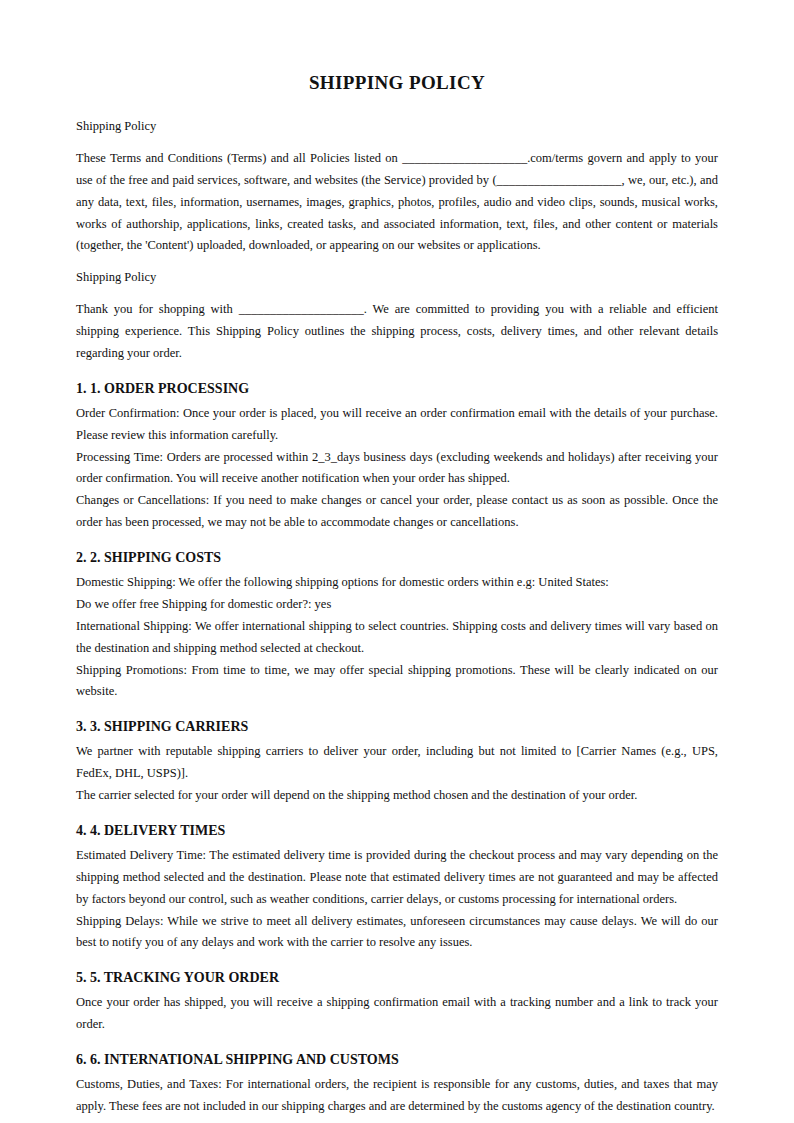
What a shipping policy is
A shipping policy is the page on your store that tells a buyer what happens between paying and receiving.
It covers how long you take to prepare an order, how long delivery takes, what it costs, where you deliver to, and what happens when a parcel is late, lost or damaged.
It is not a legal formality. It is the page buyers read before deciding whether to trust you with money, and it is the page you point to when somebody says their order should have arrived by now.
Who needs one
Anybody selling physical goods online, whether through a full store, a marketplace listing or an Instagram or WhatsApp account.
Payment processors and marketplaces frequently require one before they will approve an account, and app stores ask for policy links at review.
And under consumer protection law a seller is expected to give buyers clear information before they buy. Delivery timing and cost is exactly the kind of information that means.
Before you start
Decide four things before you open the form, because they are business decisions rather than drafting ones.
How long you realistically take to prepare an order once it is paid for. Be honest rather than optimistic.
Whether you offer free delivery, and above what order value.
Which courier or couriers you use, and the delivery windows they actually achieve.
How a buyer should reach you about a delayed order, and who answers.
The walkthrough
Filling in the form, step by step
Every question you will be asked, what it means, and an example of a good answer.
Step 1 of 4
Shipping Policy
Where the policy will live
The first question is short and it only asks where this policy will be published.
The answer changes the wording slightly. A policy written for a website refers to visitors and pages. A policy written for an app refers to users and screens, and app store reviewers expect to see it linked from inside the app rather than only on a website.
If you sell in both places, pick the one buyers actually check out on, and link the same policy from the other.
- Shipping Policy for?
- Choose Website if buyers order through a web store, including a Shopify, WooCommerce or similar storefront. Choose App if the policy will sit inside a mobile application. If you sell through both, choose the one where checkout happens and link the same policy from the other.
Step 2 of 4
Shipping Policy
Your store and where you ship from
These two answers identify the store the policy belongs to and the country you dispatch from.
The country is doing more work than it appears. It sets the baseline for what counts as a domestic order and what counts as international, which is the distinction the rest of the policy is built on. It also signals to a buyer where the parcel is starting its journey, which is the honest way to set expectations about how long it will take.
Use the country you actually dispatch from, not where the company is registered, if those differ.
- What is your website URL?
- The address buyers reach your store at, for example www.yourstore.com. Use the domain customers actually visit rather than an admin or staging address. If you sell only through an Instagram or WhatsApp account, use the profile link buyers order from.
- Enter the Country
- The country you ship orders from. This sets what counts as domestic delivery and what counts as international, which the rest of the policy depends on. If you dispatch from Nigeria, enter Nigeria, even if the business is registered elsewhere.
Step 3 of 4
Shipping Policy
Who is behind the store
This step records whether the seller is a registered business or an individual, and gives the trading name and address.
Buyers treat a policy differently when they can see who stands behind it. An address and a business name convert better than an anonymous store, and payment processors reviewing your account look for exactly this.
If you are trading as an individual, that is a legitimate answer and the policy is written accordingly. Do not describe yourself as a registered company if you are not one, because that is a misrepresentation that becomes very awkward in a dispute.
- Pick One
- Choose whichever is true. Pick I am a Business or Startup if the store is run through a registered business name or company. Pick I am an Individual if you sell in your own name. Do not claim registration you do not have.
- Name of Business/ Startup
- The name buyers know you by, and the registered name if you have one. For example, Bright Home Supplies Limited. If the trading name differs from the registered name, use the registered name and mention the trading name, so the entity in the policy matches the one taking the money.
- Address of Business
- A real address where post reaches you. Give the street, city and state. An address raises buyer confidence noticeably, and a store with a policy naming no location at all is one of the things cautious buyers screen out.
Step 4 of 4
Shipping Policy
Processing, free delivery and contact
This is the substance of the policy: how quickly you prepare an order, whether delivery is free, and how a buyer reaches you when something goes wrong.
Processing time is not delivery time. Processing is how long the parcel sits with you before a courier collects it, and delivery is what happens afterwards. Buyers routinely add the two together, so state the processing window honestly and let the courier estimate stand separately. A store that promises two to three days and ships in seven generates most of its own complaints.
The contact answers are the ones people fill in carelessly and regret. Whatever channel you name here is the channel buyers will use, and an unmonitored inbox on a shipping policy turns a late parcel into a chargeback.
- What is your processing time for orders?
- How long you take to prepare and dispatch an order once payment clears, before the courier takes over. Choose the window you actually achieve on a normal week, not your best case. If you handmake items or ship from a supplier, choose the longer option, because understating this is what generates complaints.
- Do you offer free Shipping for domestic order?
- Answer Yes only if delivery inside your own country is genuinely free to the buyer, whether always or above an order value. Answer No if you always charge, or if free delivery is an occasional promotion rather than a standing offer. This appears in the policy as a promise, so answer it as one.
- How can visitors/users contact you as regards your shipping policy
- Pick every channel you will actually monitor. You can choose more than one. Buyers use whatever you list here first, so listing a channel nobody watches is worse than not listing it. Most stores do well with email plus one other.
- Phone No.
- The number buyers can reach you on about deliveries, if you chose phone above. Include the country code if you sell internationally, for example +234 801 234 5678. Use a line somebody answers during stated hours rather than a personal number you silence.
- The address for delivery questions, if you chose email above. A dedicated address such as orders@yourstore.com looks more established than a personal one and is easier to hand to somebody else later. Whichever you use, make sure it is monitored.
- Link
- The page buyers should visit to reach you, if you chose that option. Usually a contact or support page, for example www.yourstore.com/contact. Check the link works before publishing, because a broken contact link on a shipping policy is where disputes start.
Ready to make yours?
Answer those questions in the builder and download a finished shipping policy in Word and PDF.
Start now, ₦5,000After you download it
Publish it where buyers see it before paying
Link the policy in your footer and from the checkout page. A shipping policy a buyer can only find after ordering has not done its job, and processors reviewing your account look for it in the footer.
Make the promises match reality
Read the finished policy against what your store actually does this month. If the processing window no longer reflects how you work, change the policy rather than hoping nobody notices.
Pair it with a returns policy
Shipping and returns are the two questions buyers have, and they are separate documents. A store with a shipping policy and no returns position leaves the more expensive question unanswered.
Review it when your couriers change
Delivery windows move when you change courier or add a region. Diary a look at this page whenever that happens, because an out of date policy is the one a buyer will quote back at you.
Questions people ask
What is a shipping policy?
The page telling buyers what happens between paying and receiving: how long you take to prepare an order, how long delivery takes, what it costs, where you deliver, and what happens if a parcel is late, lost or damaged.
How do I write a shipping policy for an online store?
Answer four business questions first: your real processing time, whether domestic delivery is free, which couriers you use and the windows they achieve, and how buyers should contact you. The wording follows once those are settled.
What is the difference between processing time and delivery time?
Processing is how long the order sits with you before a courier collects it. Delivery is what happens after. Buyers add the two together, so state them separately and honestly.
Do I need a shipping policy if I sell on Instagram or WhatsApp?
Yes. Any seller of physical goods benefits from one, and consumer protection law expects buyers to be given clear information before they buy. Delivery timing and cost is exactly that kind of information.
Is a shipping policy legally required?
There is no single statute that names it, but payment processors and marketplaces frequently require one before approving an account, and consumer protection law expects clear pre-purchase information. In practice you need one.
What should I do about lost or damaged parcels?
Say in the policy who carries the risk and what a buyer should do, including any time limit for reporting. Leaving it unstated does not remove the problem, it just means it gets resolved by argument.
Documents that go with this
Terms used on this page
Consumer Protection
Consumer protection law gives buyers rights against sellers: honest information, safe goods, and redress when something is wrong. In Nigeria it is enforced by the FCCPC.
Sale of Goods
A sale of goods is a contract to transfer ownership of moveable property for a price. Nigerian law implies terms about title, description and quality that a seller cannot always contract out of.
Warranty
A warranty is a promise in a contract that something is true. If it turns out not to be, the other side can claim damages, though usually not walk away from the deal.
Unfair Contract Terms
Unfair contract terms are provisions in a consumer agreement that are unreasonable or one sided. Nigerian consumer protection law allows them to be challenged even though the consumer signed.
Read more on this
What Is a Shipping Policy? Guide and Template
What Is a Shipping Policy? Why Your Business Needs One and What It Actually Protects If you run an online business or sell physical products, one part of your website quietly carries enormous importance: the shipping pol…
What Should I Write in My Terms and Conditions? Guide and Template
What Should I Write in My Terms and Conditions Most people see terms and conditions as a long legal document sitting at the bottom of a website. Many users click “agree” without reading it. Yet behind that simple checkbo…
NDPA 2023: Why Every Nigerian Website — Even Your Instagram Shop — Now Needs a Privacy Policy
The Nigeria Data Protection Act 2023 (NDPA) is not theoretical. It is being enforced. And if you run any business that collects personal data from Nigerians...
Step by step guides for every document on LegalDoc
Browse all guides