
How to Write a Sublease Agreement
A sublease lets a tenant rent out space they hold under someone else's lease. The head lease decides whether you can, and the sublease decides on what terms.
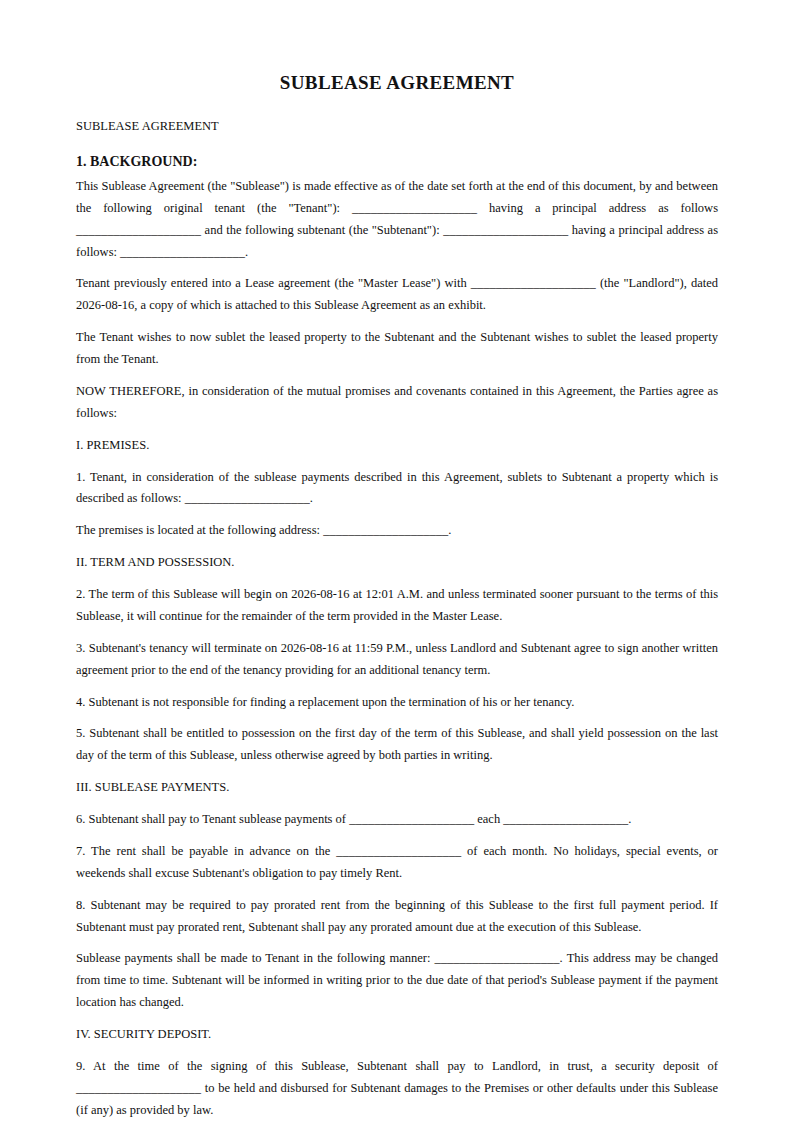
What a sublease agreement is
A sublease is a letting granted by a tenant, out of the interest that tenant already holds.
The original tenant becomes a landlord to somebody new while remaining a tenant to the head landlord. Two relationships now run at once, and the tenant in the middle is answerable in both directions.
That middle position is the thing to understand. If the sub tenant wrecks the place or stops paying, the head landlord does not chase them. The head landlord chases the tenant named on the original lease, because that is who they contracted with.
The sublease cannot grant more than the tenant holds, and it cannot outlast the head lease.
Who needs one
Tenants who need to move out before their term ends and want somebody else covering the rent.
Businesses with more space than they currently use, letting a portion to another occupier.
Anybody sharing premises where one person holds the lease and the other pays a share.
Before any of that, check the head lease. Most leases prohibit subletting without the landlord's written consent, and subletting in breach of that is a ground for forfeiting the whole lease.
Before you start
Three things to settle before drafting.
Read the head lease and find the subletting clause. If consent is required, get it in writing first, using a consent to sublet document.
Work out the dates. The sublease must end on or before the head lease ends, because you cannot grant what you do not hold.
And decide what happens to the deposit, since the tenant in the middle is holding money for one party while another holds money from them.
The walkthrough
Filling in the form, step by step
Every question you will be asked, what it means, and an example of a good answer.
Step 1 of 3
Sublease Agreement
Three parties, two of them yours
A sublease involves three people, and this step names all of them.
The tenant is you, the person who holds the head lease and is now granting a sublease. The sub tenant is the new occupier. The head landlord is named too, even though they are not a party to this agreement, because the whole arrangement depends on their lease and often on their consent.
Naming the head landlord serves a practical purpose: it tells the sub tenant that a lease sits above this one, and puts them on notice that their occupation depends on it. A sub tenant who did not know there was a head lease has a legitimate complaint when it ends early.
- Tenant's Full name
- Your full name, as the tenant under the head lease. It must match the name on that lease exactly, since your right to grant a sublease comes from it. A mismatch invites the sub tenant to ask whether you hold what you are letting.
- Tenant's Address
- Your address for correspondence under this sublease. If you are moving out of the property, this should be where you will actually be, since rent and notices come to you here.
- Sub-tenant's Full name
- The full name of the new occupier. Name every adult who will occupy under the sublease, because somebody not named is not bound by it and cannot be held to the rent.
- Sub-tenant's Address
- Where the sub tenant lives now, before moving in. It identifies them and gives you a fallback address if they leave owing money.
- Landlord's Full name
- The head landlord, taken from the original lease. They are not a party to this agreement, but naming them shows the sub tenant that a lease sits above theirs and that their occupation depends on it.
Step 2 of 3
Sublease Agreement
The head lease, the space and the term
This step ties the sublease to the lease it comes out of.
The date of the original lease matters because everything here is limited by it. A sublease cannot run past the head lease, and one that tries to is defective for the overhanging period. Work the end date backwards from the head lease rather than forwards from the sub tenant's preference.
Describe the part being sublet precisely. Where you are subletting the whole property, say so. Where it is a room, a floor or a portion, define it and say what shared areas the sub tenant may use.
The rent under the sublease is a separate figure from the rent you pay upstairs. Charging more than you pay is not automatically wrong, but check the head lease, because some prohibit profiting from a sublet.
- Date of original lease (the main lease agreement)
- The date of the head lease you hold. It anchors this sublease to the interest it comes from, and it is the document a sub tenant should ask to see before signing.
- Description of the premises (property) to be sub-let
- What exactly is being sublet: the whole property, or a defined part of it. Where it is a portion, describe it and state which shared areas, such as kitchen, parking or reception, the sub tenant may use.
- Address (the location) of the property
- The full address of the property, including flat or unit number, street, area, town and state. It should match the address in the head lease.
- Date the sublease will start?
- When the sub tenant may take occupation. It cannot be earlier than the start of your own lease, and where consent is required, it should not precede the date consent was given.
- Date the sublease will end?
- When the sublease ends. This must be on or before the head lease expires. You cannot grant a longer interest than you hold, and a sublease running past the head lease fails for the extra period.
- Rent to be paid by the sub-tenant
- The amount the sub tenant pays and the period it covers, for example nine hundred thousand naira per annum. This is separate from what you pay the head landlord, and some head leases restrict charging more than you pay.
Step 3 of 3
Sublease Agreement
Payment terms, deposit and governing state
The last step deals with mechanics, and the deposit question is the one to think about properly.
You are in the middle of two deposits. The head landlord likely holds one from you, and you are now holding one from the sub tenant. Those are separate sums with separate purposes, and they should not be treated as a single pot. Say what the sub tenant's deposit covers and when it comes back, because they will ask at the end and the answer should already be written down.
Set the payment interval and method to match how you pay upstairs where you can. A sub tenant paying you monthly while you owe the head landlord annually leaves you funding the gap, which is a cash flow problem you can avoid at the drafting stage.
- The rent is to be paid at what interval?
- How often the sub tenant pays: monthly, quarterly or annually. Where possible align it with your own obligation upstairs, since a mismatch means you are financing the difference out of your own pocket.
- Payment method?
- How the money reaches you, for example bank transfer to a named account. Specify one method and keep records, because a sub tenant who claims to have paid in cash is difficult to contradict.
- Amount to be paid as security deposit?
- The sum you hold against damage or unpaid rent. Record what it can be applied to and the point at which the remainder goes back. Keep it distinct from any deposit you gave the head landlord, since the two answer to different people.
- State where is the property located?
- The state where the property sits, which governs the sublease as it governs the head lease. Tenancy law is state law, so this should follow the property rather than either party's preference.
Ready to make yours?
Answer those questions in the builder and download a finished sublease agreement in Word and PDF.
Start now, ₦10,000After you download it
Get consent in writing first
If the head lease requires the landlord's consent, obtain it before the sub tenant moves in. Subletting in breach is a ground for forfeiting your own lease.
Give the sub tenant sight of the head lease
They are taking an interest that depends on it. Showing them the relevant terms avoids the argument that they were never told their occupation could end with yours.
Keep the two deposits separate
The deposit you hold from the sub tenant is not the deposit you gave the head landlord. Track them separately so the end of each arrangement is straightforward.
Remember you stay liable upstairs
Subletting does not transfer your obligations. If the sub tenant stops paying, the head landlord still looks to you for the rent.
Questions people ask
What is a sublease?
A letting granted by a tenant out of the interest they already hold. The original tenant becomes a landlord to the sub tenant while remaining a tenant to the head landlord.
Do I need my landlord's permission to sublet?
Almost always. Most leases prohibit subletting without written consent, and subletting in breach of that clause is a ground for forfeiting your own lease.
Can a sublease last longer than my own lease?
No. You cannot grant a longer interest than you hold. A sublease that runs past the head lease fails for the overhanging period, leaving the sub tenant without the occupation they paid for.
Who does the landlord chase if the sub tenant stops paying?
You. The head landlord contracted with you, not with the sub tenant, so the rent obligation upstairs stays yours regardless of what happens below.
Can I charge the sub tenant more than I pay?
Sometimes, but check the head lease first, since some prohibit profiting from a sublet. Where it is permitted, the sublease rent is a separate figure from your own.
What is the difference between a sublease and an assignment?
A sublease grants a new, shorter interest while you remain the tenant. An assignment transfers your whole interest to somebody else, who takes your place under the lease.
Documents that go with this
Terms used on this page
Subletting
Subletting is a tenant renting out all or part of the property to somebody else while remaining the landlord's tenant. Most Nigerian tenancy agreements require the landlord's consent first.
Lease
A lease is a grant of exclusive possession of property for a fixed term, in exchange for rent. It creates an interest in the land itself, which is what separates it from a mere permission to occupy.
Assignment of Lease
Assigning a lease transfers the whole remaining term to somebody else. Unless the landlord releases you, you can remain liable for the rent after the new tenant stops paying.
Landlord
A landlord is the person who grants somebody else the right to occupy their property in exchange for rent. The role carries rights to rent and possession, and duties that Nigerian law enforces.
Tenant
A tenant is a person who occupies property belonging to somebody else in exchange for rent. Nigerian law gives tenants real protections, including proper notice and the right to a refund of the caution fee.
Rent
Rent is what a tenant pays for the right to occupy a property. In Nigeria it is normally paid in advance, and how far in advance a landlord may demand is limited by law in some states.
Deposit
A deposit is money paid to secure a transaction. Whether you get it back if the deal falls through depends on whether it was a true deposit or a part payment, and most people never ask.
Forfeiture
Forfeiture is a landlord ending a lease early because the tenant breached it. The right has to be reserved in the lease, and a tenant can apply for relief against it.
Read more on this
Tenancy Relationships: The Different Types of Tenants
Tenancy Relationships: The Different Types of Tenants If you rent property in Nigeria—or you own one—you’ve probably used the word “tenant” casually. But in law, not all tenants are the same. The type of tenancy relation…
8 Essential Clauses Every Tenancy Agreement Should Contain
8 Essential Clauses Every Tenancy Agreement Should Contain Renting property in Nigeria is often straightforward at the beginning. A landlord has a space to let, a tenant needs accommodation, and both parties are eager to…
Tenancy Agreement vs Commercial Lease Agreement
Tenancy Agreement vs Commercial Lease Agreement Choosing the right agreement for occupying property in Nigeria is more than just a paperwork exercise. Whether you are renting a flat, opening a shop, or taking a warehouse…
Step by step guides for every document on LegalDoc
Browse all guides