
How to Write an Employee Warning Letter
A warning letter records a problem, says what has to change, and gives the employee a chance to fix it. Skipping it is what makes dismissals go wrong.
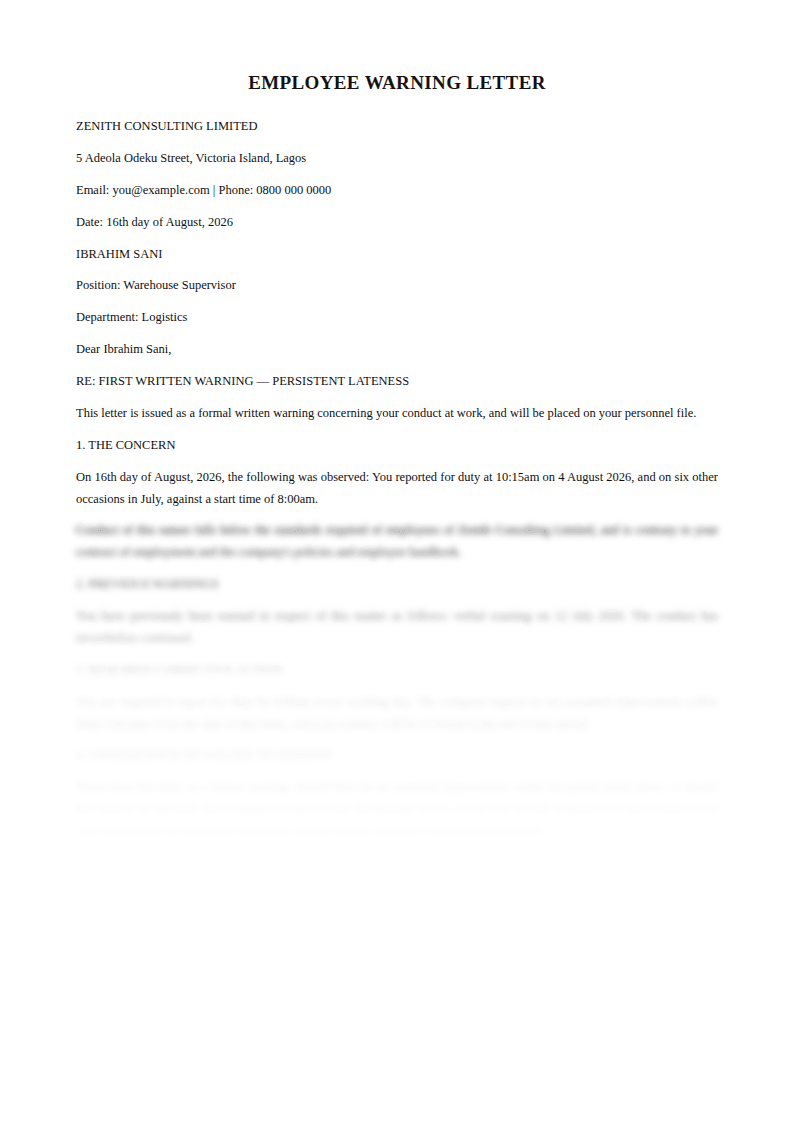
What a employee warning letter is
A warning letter tells an employee formally that something is wrong and what must change.
It does three things at once. It puts the employee on notice, so they cannot later say they were never told. It records the facts while they are fresh. And it builds the sequence that makes a later dismissal defensible if the behaviour does not improve.
That last point is where Nigerian employers most often come unstuck. A dismissal following a fair process, with warnings given and a chance to improve, is a very different case from one where the employer lost patience after months of unrecorded frustration.
The letter is also, genuinely, a chance for the employee to correct course. Most people who receive a clear first warning improve.
Who needs one
Employers dealing with lateness, poor performance, conduct issues or breaches of company policy.
Managers who have had the informal conversation twice and need to escalate.
Any business whose disciplinary record consists of remembered conversations rather than documents.
Where the conduct is serious enough to justify summary dismissal, a warning is not the right instrument and the matter should be handled through a proper disciplinary process instead.
Before you start
Get the facts straight before you write anything.
What happened, on what dates, with specifics rather than impressions.
What rule or standard it breached, and where that standard is written down.
Whether the employee has been warned before, and whether those warnings were recorded.
What you actually want them to do differently.
And whether you have heard their side, because a warning issued without asking is a weaker document and an unfair process.
The walkthrough
Filling in the form, step by step
Every question you will be asked, what it means, and an example of a good answer.
Step 1 of 3
Employee Warning Letter
The company issuing the warning
The letter starts by identifying the employer, and it should look like a formal document rather than an email sent in irritation.
Use the registered company name and the business address. A warning letter may end up in a file that is read months later by somebody deciding whether a dismissal was fair, and its formality is part of what makes it credible.
Include working contact details. The employee may want to respond, appeal, or explain something you did not know, and a process that gives them nowhere to reply is a process with a hole in it.
- Company name
- The registered name of the employing company, for example Zenith Consulting Limited. Use the same entity named in the employee's contract, since consistency across the personnel file matters if this is ever reviewed.
- Company address
- The company's business address. It makes the letter a formal record rather than an informal note, which is what it needs to be if it is later relied on.
- Company email address
- A monitored company email address. The employee may want to respond or appeal, and a warning process with no route for reply is incomplete.
- Company phone number
- A company telephone number. It supports the formality of the letter and gives the employee a way to arrange a meeting to discuss it.
Step 2 of 3
Employee Warning Letter
The employee and the level of warning
This step identifies the recipient and, importantly, where this letter sits in the sequence.
The warning level is the part to get right. A first warning, a second and a final are steps on a ladder, and each one should follow the last. Issuing a final written warning as the opening move, with no earlier steps recorded, looks like an employer building a case rather than running a process.
Record previous warnings honestly. If there was a verbal warning in July, say so and give the date. That is what turns a single letter into a documented sequence, and the sequence is what makes any eventual dismissal defensible.
Where there genuinely were no earlier warnings, use the first level. Starting at the beginning is not weakness; it is what makes the process hold up.
- Date of this letter
- The date the warning is issued. It anchors the improvement period below and places this letter in sequence with any earlier ones, so it should be accurate.
- Employee's full name
- The employee's full name as it appears in their contract and personnel file. This document belongs on that file, so the names should match across it.
- Employee's job title
- Their job title. It matters because the standard expected is judged against the role, and what is unacceptable in a supervisor may be viewed differently in a junior position.
- Employee's department
- The department or team. It routes the letter correctly and gives context, particularly in a larger business where the same name may appear more than once.
- What level of warning is this?
- Where this sits in the sequence. Follow the ladder honestly: a final written warning issued with no recorded earlier steps looks like an employer constructing a case rather than running a fair process.
- Previous warnings given (if any)
- Any earlier warnings with their dates, including verbal ones, for example a verbal warning on 12 July 2026. This is what turns a single letter into a documented sequence, which is what makes a later dismissal defensible.
Step 3 of 3
Employee Warning Letter
What happened and what must change
This is the substance, and specificity is everything.
Write facts rather than characterisations. You reported at 10:15am on 4 August against a start time of 8:00am, and on six other occasions in July, is a fact the employee can accept or dispute. Your attitude to timekeeping is poor is an opinion they can only resent.
The corrective action should be something the employee can actually do and you can actually measure. Report by 8:00am every working day is measurable. Improve your commitment is not, and a warning built on it cannot fairly support anything later.
The improvement period gives them a real chance. Thirty days is common. Make a note to review it on the date, because a warning nobody follows up quietly signals that the standard did not matter after all.
Sign it at a level that carries authority, and give the employee a copy.
- What is the warning about?
- The issue in a short phrase, for example persistent lateness. This is the heading of the matter, with the detail set out below.
- Date of the incident
- The date of the incident that prompted this letter. Where the problem is a pattern rather than a single event, use the most recent occurrence and list the others in the description.
- What exactly happened?
- Exactly what happened, in facts rather than characterisations: dates, times, and what was observed. A specific account can be accepted or disputed, while a general complaint about attitude can only be resented.
- What must the employee do to put it right?
- What the employee must do, stated so that both sides can tell whether it has happened. Report for duty by 8:00am every working day is measurable. Show more commitment is not.
- By when must you see improvement?
- How long they have to put it right, for example thirty days from the date of this letter. Diary the review date, since a warning nobody follows up tells the employee the standard was not serious.
- Who is issuing this letter?
- Who is issuing the warning. It should be somebody with authority over the employee, typically their manager or a member of the human resources team.
- Their job title
- The signatory's job title, for example Head of Human Resources. Signing at an appropriate level is part of what makes the warning a formal step rather than a personal complaint.
Ready to make yours?
Answer those questions in the builder and download a finished employee warning letter in Word and PDF.
Start now, ₦5,000After you download it
Give it to them in person where you can
Hand it over in a short meeting, explain it, and let them respond. A warning delivered by email with no conversation lands badly and teaches nothing.
Record their response
Note what the employee said, including any explanation you had not heard. A process that never asked for their side is a weak process.
Review on the date you set
If they improved, say so in writing. If they did not, the next step follows naturally. Either way the follow up is what makes the warning mean something.
Keep it on the personnel file
Warnings only work as a sequence. Filed properly, they show a fair process was followed; scattered across inboxes, they show very little.
Questions people ask
How many warnings before dismissal in Nigeria?
There is no fixed number. What matters is that the process was fair: the employee knew what was wrong, was given a chance to improve, and the steps were recorded.
Should a warning letter be specific?
Yes. Dates, times and what was observed can be accepted or disputed. Vague complaints about attitude cannot be answered and do not support anything later.
Can I issue a final warning first?
You can, but it looks like building a case rather than running a process. Unless the conduct is serious, follow the ladder and start at the beginning.
Does the employee have to sign the warning?
Signing acknowledges receipt rather than agreement. If they refuse, note the refusal and the fact that a copy was given, which serves the same evidential purpose.
What if the employee disputes the facts?
Hear them out and record what they say. If they raise something you did not know, the fair course may be to withdraw or amend the warning rather than press on.
Do I need to follow up at the end of the improvement period?
Yes. A warning nobody reviews tells the employee the standard was not serious, which undermines both this warning and any that follow.
Documents that go with this
Terms used on this page
Gross Misconduct
Gross misconduct is behaviour serious enough to justify dismissing an employee immediately, without notice. Theft, fraud and violence are the clear cases, and the process still has to be fair.
Warning Letter
A warning letter records misconduct or poor performance in writing and tells the employee what must change. It is the document that makes a later dismissal defensible.
Termination
Termination is the ending of a contract on its terms. In employment it means the relationship ends, normally with notice or payment in lieu, and it does not imply that anybody did anything wrong.
Unfair Dismissal
Unfair dismissal is a sacking that the National Industrial Court considers unjust, even where the employer followed the contract. Nigerian employment law shifted on this, and many employers have not caught up.
Employee
An employee works under a contract of service, meaning the employer controls how the work is done. The label on the contract does not decide it, and getting the classification wrong is expensive for the employer.
Grievance
A grievance is a formal complaint an employee raises about their treatment at work. A written procedure for handling one is what stops a problem becoming a claim.
Notice Period
A notice period is how much warning either side must give before ending an employment. The Labour Act sets minimums based on length of service, and the contract can give more but not less.
Contract of Employment
A contract of employment is the agreement between an employer and an employee setting out the job, the pay and the terms. Nigerian law expects it in writing within three months of starting.
Read more on this
Employment Contracts: Key Clauses and Compliance Guide
Employment Contracts: Key Clauses and Compliance Guide An employment contract is one of the most important documents in any Nigerian workplace, yet it is also one of the most neglected. Many businesses, especially small…
Difference Between an Offer Letter and an Employment Contract in Nigeria
Difference Between an Offer Letter and an Employment Contract in Nigeria What Is an Offer Letter? An offer letter is a preliminary document issued by an employer to a prospective employee after a successful recruitment p…
How to Terminate a Contract the Right Way
How to Terminate a Contract the Right Way How do you end a contract properly without creating bigger problems? Because terminating a contract is not just about walking away. If done carelessly, it can expose you to claim…
Step by step guides for every document on LegalDoc
Browse all guides