
How to Write an LLC Operating Agreement
An operating agreement governs how a US limited liability company runs. Nigeria has no LLC, so a Nigerian business needs articles of association instead.
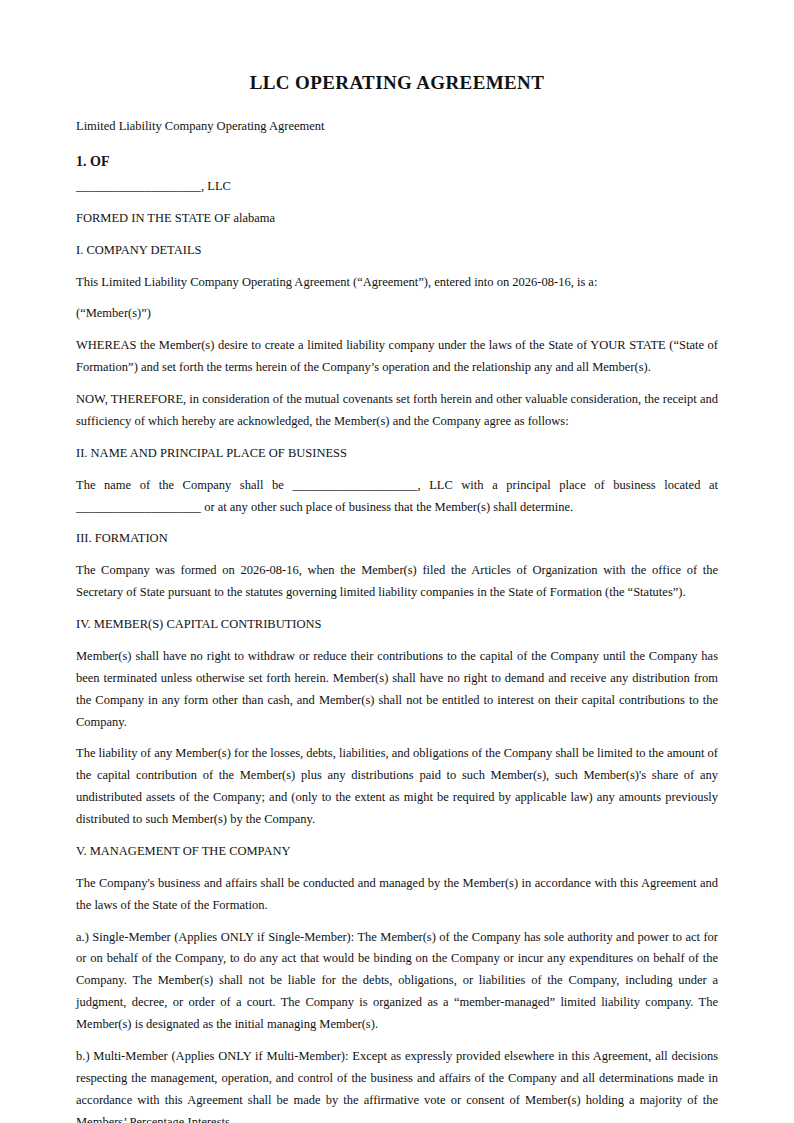
What a llc operating agreement is
An operating agreement is the internal rulebook of a limited liability company, setting out who owns it, who runs it, and how profits and decisions are shared.
The limited liability company is an American structure. It combines the liability protection of a corporation with the tax treatment and flexibility of a partnership, and it is formed at state level.
Nigeria has no direct equivalent. A Nigerian business wanting limited liability incorporates a private company limited by shares with the Corporate Affairs Commission under CAMA 2020, and its internal rules live in its articles of association. The name is similar enough to mislead: a Nigerian limited liability company is a company limited by shares, not an American LLC.
So if you are setting up in Nigeria, this is not the document. If you are a Nigerian founder forming a US entity, or joining one, it is exactly the document, and most states do not require you to file it but every well run LLC has one.
Who needs one
Anybody forming a limited liability company in the United States.
Nigerian founders setting up a US entity to hold a Nigerian operating business or to raise from American investors.
Members joining an existing LLC who want the ownership and profit arrangements recorded.
Single member LLCs too, despite the temptation to skip it. The agreement is part of what demonstrates the company is genuinely separate from its owner, which is what the liability protection depends on.
For a Nigerian company, articles of association filed with the CAC are the equivalent and the correct route.
Before you start
Settle these first.
The state of formation, which determines the default rules that apply where your agreement is silent.
Whether the LLC has one member or several.
What each member is contributing, in cash or otherwise, and what ownership percentage that buys.
How profits and losses are allocated, which need not match ownership.
And who manages: the members themselves, or an appointed manager.
The walkthrough
Filling in the form, step by step
Every question you will be asked, what it means, and an example of a good answer.
Step 1 of 3
LLC Operating Agreement
The dates and the state of formation
The agreement opens with the state and two dates.
The state of formation matters more than any other answer here. Each US state has its own LLC statute, and those statutes supply default rules that apply wherever your agreement is silent. Delaware and Wyoming are common choices for their business friendly law, though forming in a state where you do not operate brings its own registration obligations in the state where you actually do business.
Each date records something separate. The date of formation is when the state accepted the filing that created the company. The date of the agreement is when the members signed this document, which is frequently later. Both belong in the record, and a gap between them is normal.
For a Nigerian founder: forming a US LLC does not remove the need to register a Nigerian operating entity with the CAC, nor the NIPC registration that follows foreign shareholding in a Nigerian company.
- Date on the agreement
- When the members sign this agreement. It is often later than the formation date, since companies are frequently formed first and documented afterwards.
- State of Formation
- The US state where the LLC is formed. It determines the statute that governs, and its default rules fill any gap your agreement leaves. Forming outside the state where you operate brings separate registration obligations there.
- Date of Formation
- When the state accepted the filing that created the company. Take it from the certificate rather than from memory, since it is the company's official start date.
Step 2 of 3
LLC Operating Agreement
The company
This step names the company and its address.
Use the exact name on the certificate of formation, including the LLC or Limited Liability Company suffix the state requires. An operating agreement naming an entity slightly differently from the state record is the kind of inconsistency that surfaces during due diligence.
The address should be the company's principal place of business, which for a Nigerian founder with a US holding entity is frequently not in the United States at all. That is acceptable, and it is separate from the registered agent address the state requires, which must be in the state of formation.
Be aware that operating substantially from Nigeria while formed in the US raises tax questions in both places. It is worth taking advice on that rather than assuming the structure is neutral.
- Name of the Company
- The company name exactly as it appears on the certificate of formation, including the required LLC suffix. A discrepancy between this and the state record is exactly what due diligence picks up.
- Company address
- The principal place of business. For a Nigerian founder with a US entity this is often not in the United States, which is acceptable, though it raises tax questions in both countries worth taking advice on.
Step 3 of 3
LLC Operating Agreement
Members and what they contribute
The final step is the substance: who owns the company and what they put in.
The single or multi member choice changes the character of the agreement. A single member LLC is simpler, and the agreement mostly exists to demonstrate the company is separate from its owner, which is what preserves the liability protection. Skipping it in a single member company weakens exactly the protection the structure was chosen for.
A multi member LLC needs considerably more. Ownership percentages, how profits and losses are allocated, voting, what happens when a member wants out, and what happens if one dies. Those are the provisions that prevent a two person company deadlocking.
On contributions, record what each member actually put in and the ownership it corresponds to. Cash is straightforward. Property, equipment and services contributed in kind should be valued and recorded, because members remember their own contributions generously and this is the document that settles it.
Worth adding, since the form does not ask: how a member exits and how their interest is valued. That omission causes more LLC disputes than anything else.
- Membership
- Whether the LLC has one member or several. A single member agreement is mostly about demonstrating separation between company and owner, which is what preserves the liability shield. A multi member one has to govern a relationship.
- Single member
- If single member, name the sole member with their full name and address. Even here the agreement matters: it is part of what shows the company is genuinely separate from you personally.
- Multi member
- If multi member, list every member with their full name, address and ownership percentage. Also state how they vote and who manages, since a multi member LLC without a decision rule deadlocks the first time members disagree.
- Member Capital Contribution
- What the single member contributed, in cash or in kind. Value non cash contributions such as equipment or intellectual property, since the company's books need a figure and so does any future investor.
- Multi Member Capital Contribution
- What each member contributed and the ownership it buys. Record contributions of property, equipment or services explicitly and at a stated value, because members recall their own contributions generously and this document is what settles it.
Ready to make yours?
Answer those questions in the builder and download a finished llc operating agreement in Word and PDF.
Start now, ₦7,000After you download it
Keep it with the company records
Most states do not require the operating agreement to be filed, but banks, investors and buyers all ask for it. Store it where it can be produced quickly.
Add exit and valuation terms
The form does not ask how a member leaves or how their interest is valued. That omission causes more LLC disputes than any other, so deal with it separately.
Keep company and personal money apart
The liability protection depends on the company being genuinely separate. Mixing personal and company funds is the fastest way to lose it.
Register the Nigerian entity separately
A US LLC does not cover Nigerian operations. Incorporate with the CAC and register with the NIPC where there is foreign shareholding.
Questions people ask
Can I form an LLC in Nigeria?
No. The LLC is a US structure. A Nigerian business wanting limited liability incorporates a private company limited by shares with the CAC under CAMA 2020, with articles of association as its internal rulebook.
Does a single member LLC need an operating agreement?
Yes, and skipping it undermines the point of the structure. The agreement is part of what demonstrates the company is separate from its owner, which is what preserves the liability protection.
Which state should I form in?
Delaware and Wyoming are common for their business friendly statutes. Forming outside the state where you actually operate brings separate registration obligations in that state.
Does the operating agreement get filed?
Usually not. Most states do not require it, but banks, investors and buyers all ask to see it, so it should be kept where it can be produced.
How are profits shared in an LLC?
However the agreement says, and it need not match ownership percentages. That flexibility is one of the reasons the structure is popular, but it has to be written down.
What happens when a member wants to leave?
Only what the agreement provides for, so it needs to provide for it. This form does not ask, and the absence of exit and valuation terms causes more LLC disputes than anything else.
Documents that go with this
Terms used on this page
Limited Liability Company
A limited liability company is a business registered at the CAC as a separate legal person. It owns its own assets, owes its own debts, and shields its shareholders from personal liability.
Foreign Company
A foreign company wanting to do business in Nigeria generally cannot open a branch. It must incorporate a Nigerian company, and that requirement catches most first time entrants by surprise.
Share Capital
Share capital is the value of shares a company has issued or is permitted to issue. It is not cash in the bank, and the figure you declare at the CAC drives your registration cost.
Articles of Association
The articles of association are the internal rulebook of a company. They set out how decisions get made, how shares move, and what powers directors have.
Company
A company is a business registered at the CAC as its own legal person, separate from the people who own it. It signs contracts, owns property and owes debts in its own name, which is what keeps those debts away from your personal bank account.
Partnership
A partnership is two or more people carrying on business together with a view to profit. Unless it is a limited liability partnership, the partners are personally liable for the debts, including debts a partner created alone.
Unlimited Liability
Unlimited liability means the owner of a business is personally responsible for its debts. Sole proprietors and ordinary partners have it, and it is the main reason serious businesses incorporate.
NIPC Registration
A Nigerian company with any foreign shareholding must register with the Nigerian Investment Promotion Commission before it starts business. Incorporation alone is not enough.
Read more on this
How to Register a Company in Nigeria from the USA: A Full Guide for Americans and Nigerians Abroad
Business Name vs Limited Liability Company in Nigeria
Business Name vs Limited Liability Company in Nigeria: Which One Should You Register First? If you are thinking about starting a business in Nigeria, one of the earliest decisions you will have to make is how to register…
11 Essential and Protective Documents Needed by a Startup Company
Business Plan Certificate of Incorporation, Memart, Art. of association, Status Report Founders’ Agreement Service Level Agreements Non-Disclosure Agreement Employee Contracts Intellectual Property Agreements Shareholder…
Step by step guides for every document on LegalDoc
Browse all guides