
How to Write Articles of Incorporation
Articles of incorporation bring a company into existence and fix its share structure. Nigeria uses a memorandum and articles filed at the CAC, so read this before choosing.
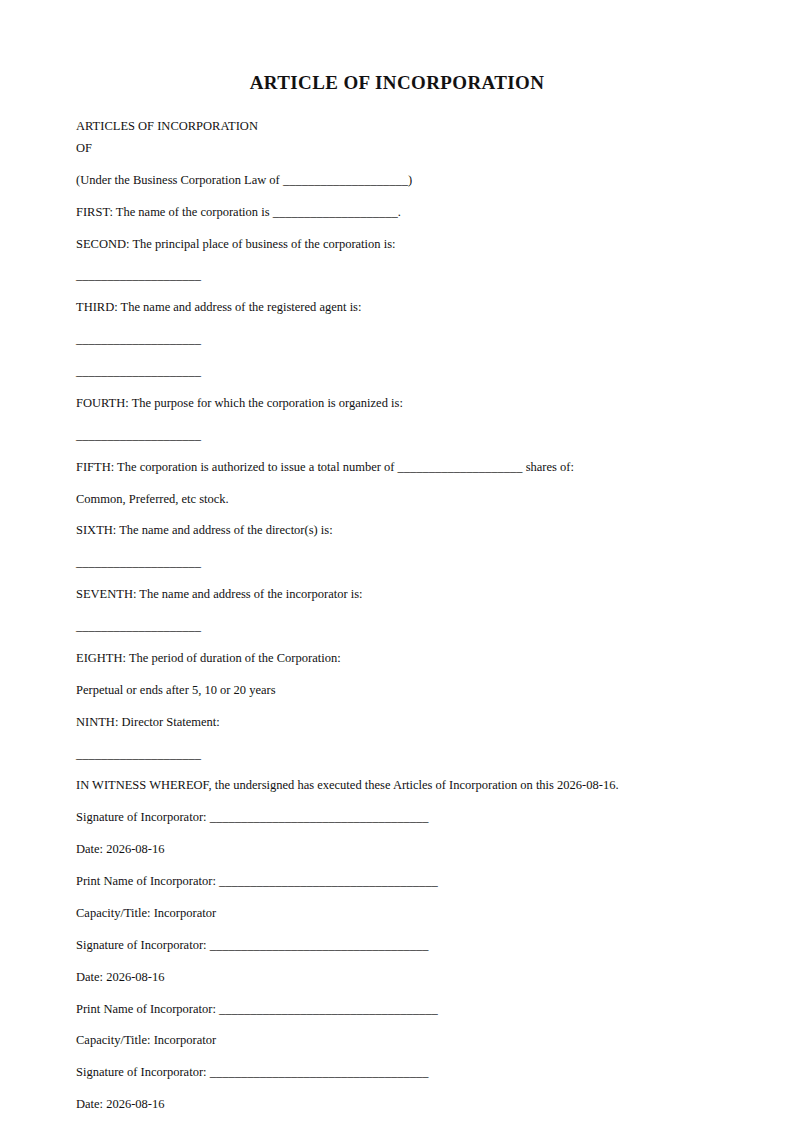
What a article of incorporation is
Articles of incorporation are the founding document that creates a corporation and sets out its basic structure: its name, its purpose, how many shares it may issue, and who its first directors are.
The term is American. In Nigeria the equivalent function is performed by the memorandum and articles of association, filed with the Corporate Affairs Commission under the Companies and Allied Matters Act 2020, and the registration is completed through the CAC portal rather than by lodging a document called articles of incorporation.
So if you are forming a Nigerian company, this form is not the route. What it is genuinely useful for is a Nigerian founder incorporating in the United States, most often Delaware, to raise from American investors or to hold a US entity above a Nigerian operating company.
Read the questions with that in mind, because several of them use concepts Nigerian company law does not share.
Who needs one
Founders incorporating a company in a jurisdiction that uses articles of incorporation, principally the United States.
Nigerian startups setting up a US parent to access American investment, where the Nigerian company becomes a subsidiary.
Anybody who needs to understand the structure of a corporation they are being asked to join or invest in.
If you are registering a company in Nigeria, you need CAC incorporation instead. The service page for company registration is the right starting point, and the memorandum and articles are prepared as part of it.
Before you start
Have these settled before you fill anything in.
The company name, checked for availability in the state of incorporation.
A registered agent with an address in that state, which is a legal requirement and not a formality.
How many shares the company is authorised to issue, which is a decision with long consequences for future funding.
Whether shares carry a par value.
And who the initial directors are.
The walkthrough
Filling in the form, step by step
Every question you will be asked, what it means, and an example of a good answer.
Step 1 of 3
Article of Incorporation
The company name and where it is formed
The opening step names the corporation and fixes the jurisdiction.
Name availability is checked in the state of incorporation, and the name usually has to carry a corporate identifier such as Incorporated, Corporation or Inc. Reserving the name before filing avoids the irritation of a rejected submission.
The state of incorporation is a genuine decision rather than an administrative one. Delaware is the common choice for companies expecting to raise venture capital, because investors are familiar with its corporate law and its courts. It is also the state whose law will govern the company's internal affairs regardless of where the business actually operates.
For a Nigerian founder this is the point to be clear about the structure: incorporating a US parent does not remove the need to register the Nigerian operating entity with the CAC.
- Name of the Corporation
- The proposed company name, including the required corporate identifier such as Inc or Corporation. Check availability in the state of incorporation before filing, and reserve it if the state allows, since a name clash means starting the submission again.
- Address of the Corporation
- The principal business address of the company. This can differ from the registered agent address below, and for a Nigerian founder with a US holding company it is frequently the operational address rather than a US one.
- State of Incorporation
- The state whose law will govern the company, for example Delaware. This is a substantive choice: it fixes the corporate law that applies to the company's internal affairs no matter where the business actually trades.
Step 2 of 3
Article of Incorporation
The registered agent, the purpose and the shares
This step covers the statutory contact and the share structure, and the share questions carry the most weight.
A registered agent is the person or firm authorised to receive legal documents on the company's behalf in the state of incorporation. It is a requirement, and a founder living outside the country will normally appoint a commercial registered agent service. This is not the same as a company secretary in Nigerian practice.
On purpose, most modern incorporations use a general clause permitting any lawful business. That is deliberate: a narrowly drafted purpose limits what the company can do later without amending its constitution.
The authorised share number is the decision people regret. Authorising too few shares means an amendment later, at cost and with signatures, exactly when you are trying to close a funding round. Founders commonly authorise a generous number and issue only a fraction of it, keeping the remainder available for future investors and an option pool.
Par value is a nominal figure per share, often a very small amount, and it is not the price anybody pays.
- Name of the Registered Agent
- The person or firm authorised to receive legal documents for the company in the state of incorporation. Founders based outside the country normally appoint a commercial registered agent service, which is a routine paid arrangement.
- Address of the Registered Agent
- The agent's address, which must be a physical address in the state of incorporation. A post box will not satisfy the requirement, and the state rejects filings that try.
- Purpose of Incorporation
- What the company is formed to do. A general clause permitting any lawful business is the usual choice, because a narrow purpose limits what the company can do later without amending its constitution.
- Total number of Shares
- The number of shares the company is authorised to issue. Authorise generously and issue only a fraction, since running out means amending the articles at the least convenient moment, usually mid funding round.
- Stock Type
- The class or classes of shares, for example common stock. Preferred shares carry different rights and are usually created later when investors require them, so most incorporations start with common alone.
- With or without par value
- The nominal value assigned to each share, often a very small figure. It is an accounting concept rather than the price anybody pays, and in some states it affects the franchise tax calculation.
Step 3 of 3
Article of Incorporation
Directors, duration and signing
The final step names the initial board and closes the document.
List the directors with their addresses. These are the people responsible for the company at formation, and the list can change afterwards through the company's own governance process.
Duration is almost always perpetual. A company formed for a fixed term is unusual and creates a problem you will have to solve later, so unless there is a specific reason, perpetual is the sensible answer.
The director's statement is where the incorporator confirms the accuracy of what is being filed. Read it rather than skimming it, because it is a statement made to a state authority.
The signing date is when the articles are executed for filing. Incorporation takes effect when the state accepts the filing, not when the document is signed, so the two dates are usually a few days apart.
- Names and Addresses of the directors
- The initial directors, each with a full name and address. These are the people responsible for the company from formation, and the composition can be changed afterwards through the company's own governance.
- Duration of the Incorporation
- How long the company will exist. Perpetual is the standard answer and almost always the right one. A fixed duration creates a problem that has to be solved before it expires.
- Director's Statement
- The confirmation given by the incorporator or directors about the accuracy of the filing. Read it properly, since it is a statement made to a state authority and being casual about it is unwise.
- What is the date these Articles of Incorporation will be signed?
- The date of execution. Note that incorporation takes effect when the state accepts the filing rather than on this date, so expect a short gap between the two.
Ready to make yours?
Answer those questions in the builder and download a finished article of incorporation in Word and PDF.
Start now, ₦7,000After you download it
File with the state
The document does nothing until it is filed and accepted. Filing fees and processing times vary by state, and expedited options usually exist.
Adopt bylaws and issue shares
Articles create the company; bylaws govern how it runs. The first board then issues shares to the founders, which is a separate step people forget.
Register the Nigerian entity separately
A US holding company does not remove the need to incorporate the operating business with the CAC in Nigeria, and to register it with the NIPC where there is foreign shareholding.
Keep the registered agent current
A lapsed registered agent puts the company out of good standing, which surfaces at exactly the wrong moment during due diligence.
Questions people ask
Do I use articles of incorporation to register a company in Nigeria?
No. Nigeria uses a memorandum and articles of association filed with the Corporate Affairs Commission under CAMA 2020. Articles of incorporation are the equivalent in the United States.
Why would a Nigerian founder incorporate in the US?
Usually to raise from American investors, who are familiar with Delaware corporate law. The Nigerian operating company then typically sits as a subsidiary of the US parent.
How many shares should I authorise?
More than you need now. Authorising generously and issuing only a fraction keeps room for investors and an option pool, and avoids amending the articles mid funding round.
What is a registered agent?
A person or firm authorised to receive legal documents for the company in its state of incorporation. Founders abroad normally appoint a commercial service, and a physical address is required.
What is par value?
A nominal accounting figure assigned to each share, often very small. It is not the price anybody pays for the share, and in some states it feeds into the franchise tax calculation.
Should the duration be perpetual?
Almost always. A company formed for a fixed term creates an expiry you will have to deal with, and there is rarely a good reason to accept that.
Documents that go with this
Terms used on this page
Certificate of Incorporation
A certificate of incorporation is the document the CAC issues the day your company is registered. It carries your RC number, and it is the proof that banks, clients and government agencies ask for when they want to know the company actually exists.
Memorandum of Association
The memorandum of association is the founding document of a company, stating its name, its objects and its share capital. Together with the articles it forms what Nigerians call MEMART.
Articles of Association
The articles of association are the internal rulebook of a company. They set out how decisions get made, how shares move, and what powers directors have.
Share Capital
Share capital is the value of shares a company has issued or is permitted to issue. It is not cash in the bank, and the figure you declare at the CAC drives your registration cost.
Authorised Share Capital
Authorised share capital is the total value of shares your company is allowed to issue, as declared at the CAC. It drives your registration fee and your stamp duty, so the number you pick costs money.
Director
A director is a person appointed to manage a company and make decisions on its behalf. The role comes with legal duties owed to the company, and with personal exposure when those duties are ignored.
Company
A company is a business registered at the CAC as its own legal person, separate from the people who own it. It signs contracts, owns property and owes debts in its own name, which is what keeps those debts away from your personal bank account.
Foreign Company
A foreign company wanting to do business in Nigeria generally cannot open a branch. It must incorporate a Nigerian company, and that requirement catches most first time entrants by surprise.
Read more on this
How to Register a Company in Nigeria from the USA: A Full Guide for Americans and Nigerians Abroad
11 Essential and Protective Documents Needed by a Startup Company
Business Plan Certificate of Incorporation, Memart, Art. of association, Status Report Founders’ Agreement Service Level Agreements Non-Disclosure Agreement Employee Contracts Intellectual Property Agreements Shareholder…
10 Legal Documents Every Startup in Nigeria Needs
10 Legal Documents Every Startup in Nigeria Needs Starting a business in Nigeria is exciting. Entrepreneurs launch new ventures every day—technology startups, creative agencies, e-commerce platforms, consulting firms, an…
Step by step guides for every document on LegalDoc
Browse all guides