

Write the next supply contract with clear terms
Price, payment, delivery and termination set out in a sale of goods agreement that both sides sign.
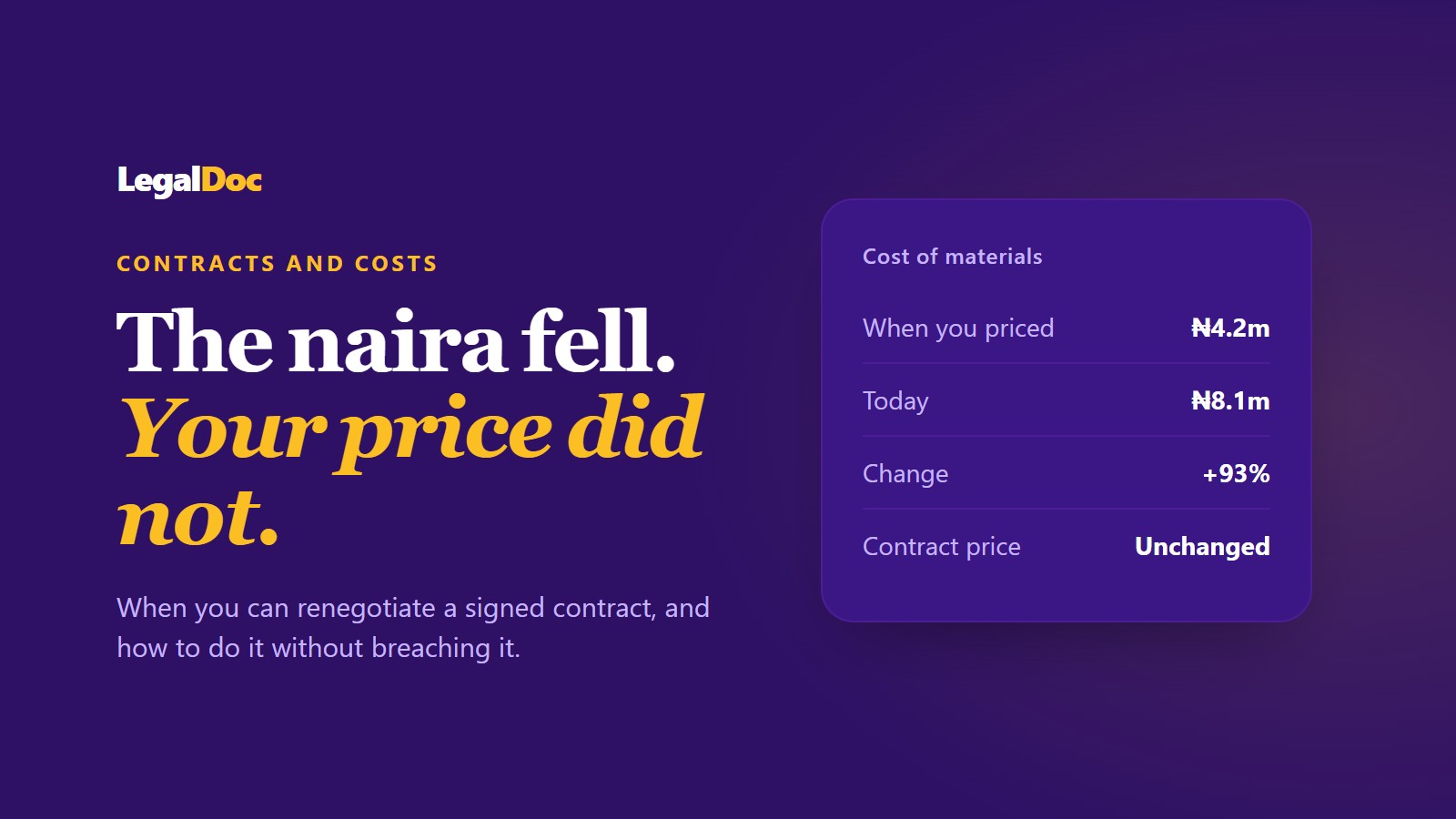
Draft a sale of goods agreementYou quoted for the job in the spring. Cement, steel, imported parts, diesel: you priced it all carefully and won the contract. Then the naira fell again, fuel went up again, and by the time you came to buy the materials, they cost nearly twice what you budgeted. The client is expecting delivery at the agreed price.
Since the exchange rate unification and the removal of the fuel subsidy, a great many Nigerian businesses have been in exactly this position: tied to prices agreed in one economy while paying costs in another. The question is always the same. Can you renegotiate a contract you have already signed, or are you stuck with it?
The short answer
A contract does not end just because it has become more expensive to perform. Unless your contract has a price adjustment clause, the agreed price stands, and stopping work would be a breach. Force majeure helps only if the contract has such a clause and it covers what happened, which a rise in costs usually does not. Frustration applies only when performance becomes impossible or radically different, not merely costlier. Your real route is to renegotiate a contract by agreement: show the numbers, offer options, and record any change in a signed variation.
Start with what your contract says
Before you think about the law, read the contract again, looking for three things: a clause that adjusts the price, a force majeure clause, and a clause about how the contract can be varied. Those three decide most of what happens next.
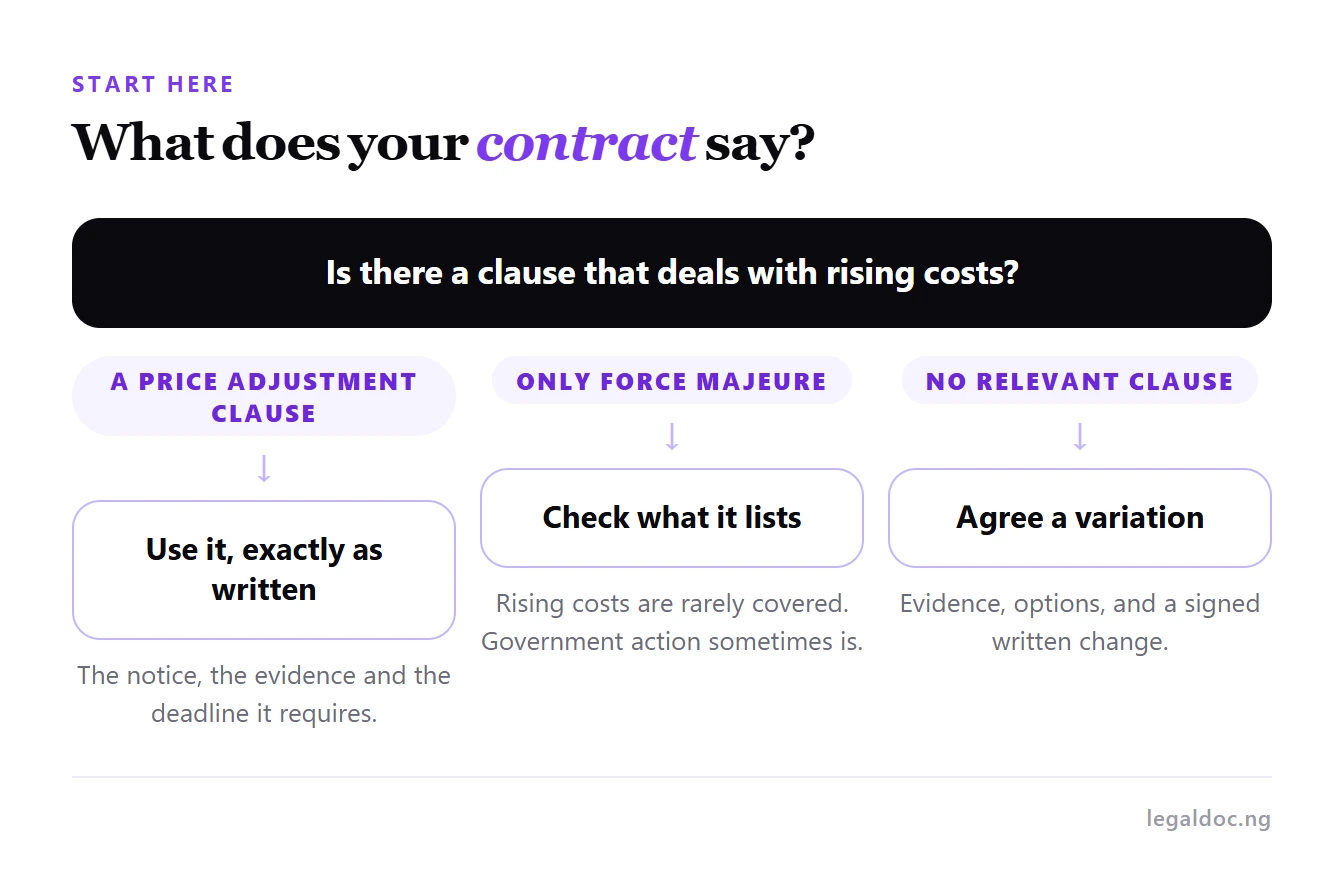
The clause you need is the one you did not think about when you signed.
The four ways a price can change
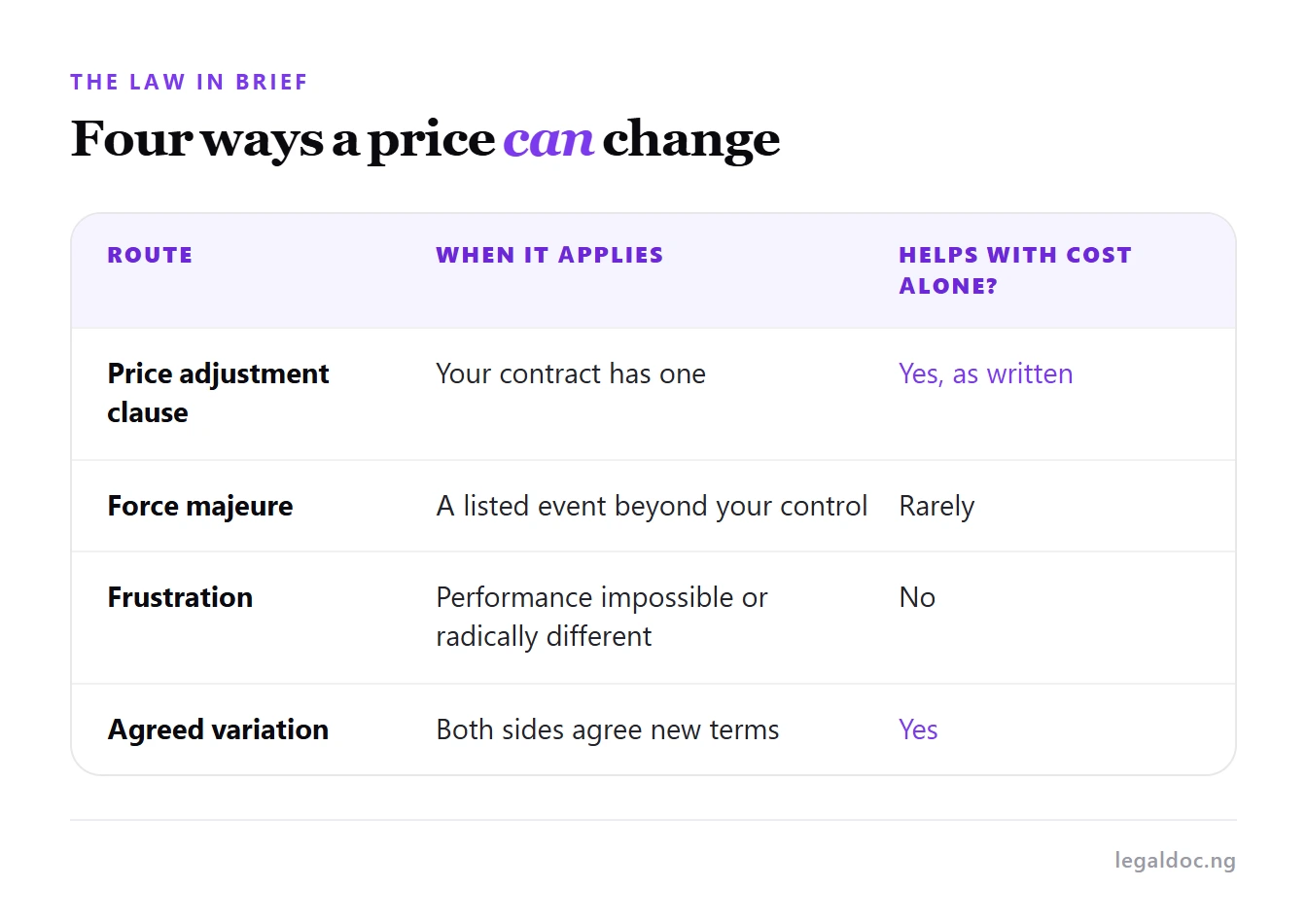
Only two of the four reliably help when the only problem is cost.
A price adjustment clause
Some contracts, especially construction and long-term supply contracts, include a clause that adjusts the price if costs move: tied to an index, to the exchange rate, or to the documented cost of specific materials. If yours has one, use it exactly as written. Give the notice it requires, with the evidence it requires, by the date it requires. A valid claim made late can be lost on the timing alone.
Force majeure
Force majeure is not a general rule of Nigerian law. It exists only if your contract has a clause creating it, and it covers only the events that clause lists: typically natural disasters, war, riots, epidemics and acts of government. Courts read these clauses for what they actually say.
A rise in costs, even a steep one, is usually not on the list, and most clauses say expressly that it is not. Where a clause does apply, it normally suspends performance or allows termination. It rarely lets you charge more. If a specific government action, such as an import ban, is what stopped you, read the clause carefully, because that is where force majeure most often does help.
Frustration
A contract is frustrated when something happens that makes performance impossible, or so radically different from what was agreed that holding the parties to it would be unjust. The courts set this bar high on purpose. A contract that has become much more expensive, or no longer profitable, is not frustrated. Frustration ends the contract; it does not reprice it. It is very rarely the answer to inflation or a falling currency.
An agreed variation
Which leaves the route that actually works in most cases: agreement. Your client usually does not want a supplier who goes under, cuts corners or walks away mid-project. A reasonable variation, properly recorded, is very often better for both sides than a dispute.
Contract hit by the exchange rate? Ask where you stand
Upload it and LegalDoc+ checks the price, force majeure and termination clauses, then sets out how to reopen the terms.
Ask LegalDoc+What not to do
Do not simply stop work, or announce that the price has gone up. If the contract fixes the price and has no adjustment clause, refusing to perform at that price is a breach, and it may entitle the client to end the contract, hire somebody else and claim the difference from you. You turn a cost problem into a liability problem.
Keep performing while you negotiate, unless the contract allows you to suspend.
How to renegotiate a contract without a fight
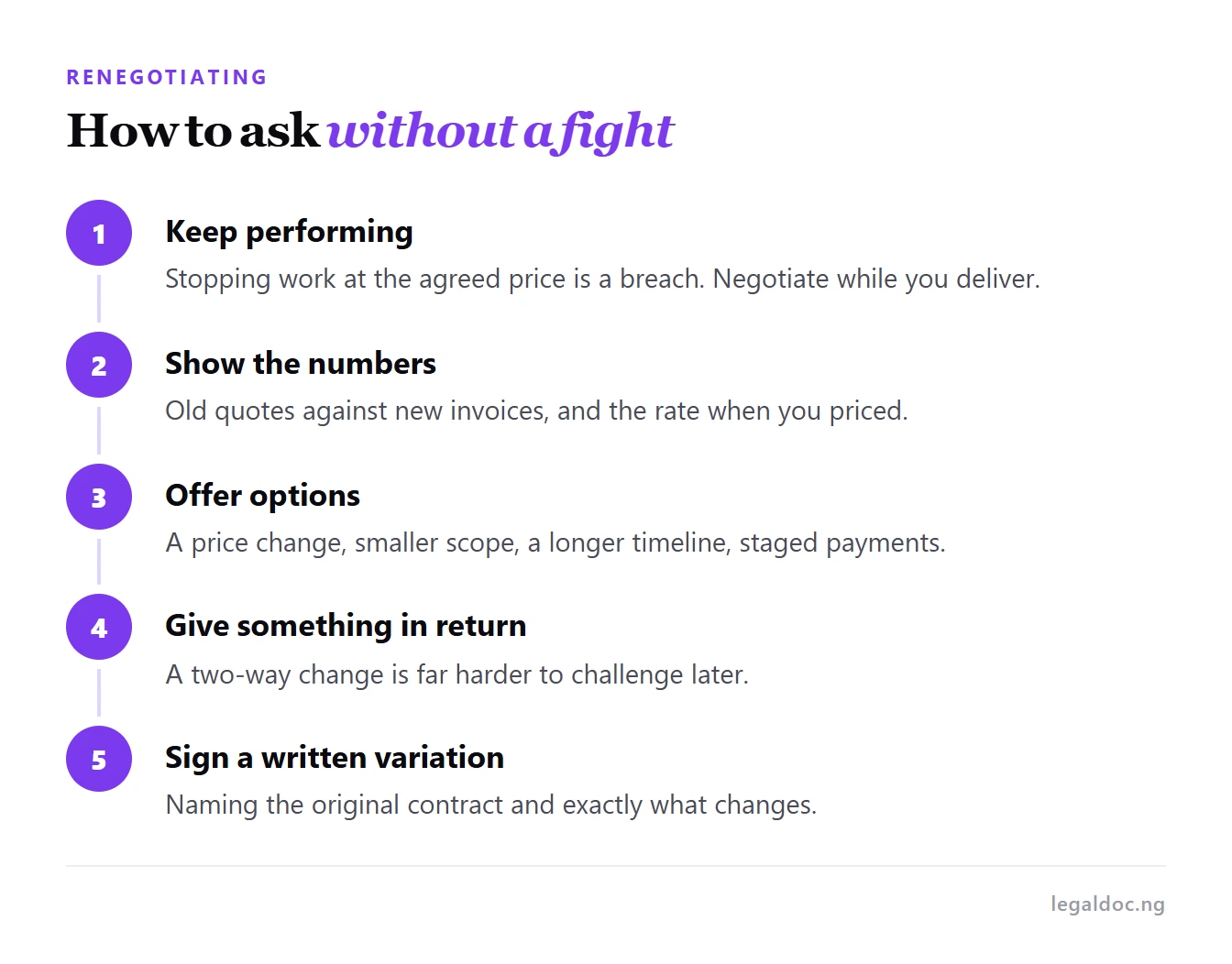
Evidence and options get a yes far more often than a bare demand.
Show the numbers. Old quotes against new invoices, the exchange rate when you priced and now. A client can say no to a feeling; it is harder to say no to a supplier's actual costs.
Offer options, not an ultimatum. A price adjustment is one option. So is a reduced scope, a longer timeline that lets you buy more cheaply, substitute materials of equal quality, staged payments that let you buy before prices move again, or the client buying certain materials directly.
Put the change in writing. Check the contract's variation clause; many say changes are valid only if written and signed by both parties. An email exchange may not be enough. A short variation agreement, signed by both, that names the original contract and sets out exactly what changes, is.
Make it a two-way change. A promise to pay more for exactly the same work can be argued over later. Agreeing something in return, a revised deadline, an adjusted specification, a faster payment schedule, makes the variation much harder to challenge.
Pricing the next contract for a moving economy
If the last two years have taught Nigerian businesses anything, it is that a fixed price over a long period is a bet on the exchange rate. The next contract should say what happens when costs move.
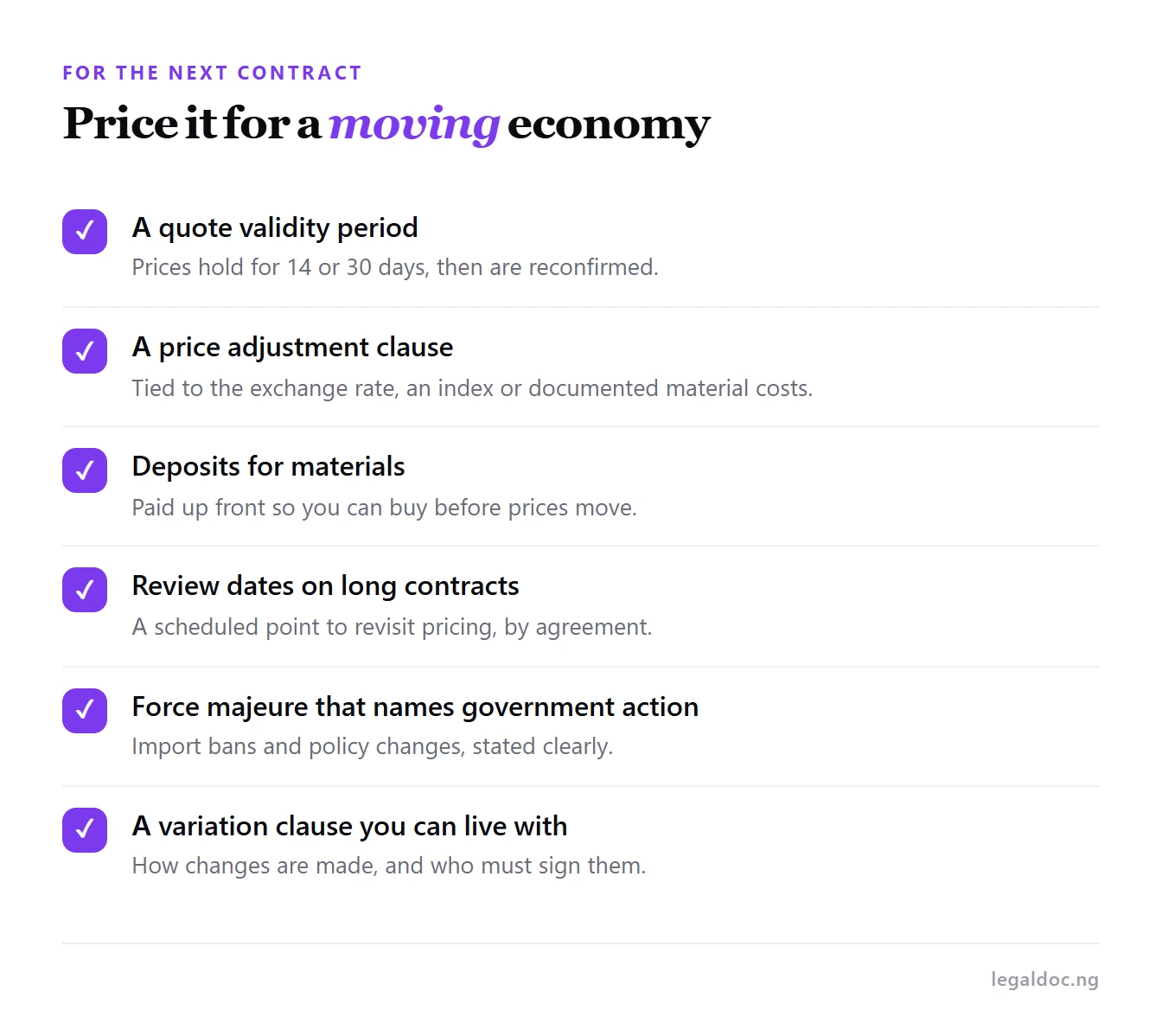
Each of these is cheaper to agree before signing than after.
A LegalDoc sale of goods agreement, service level agreement or purchase order gives you a clean starting point, and our contract review checklist covers the other clauses to settle before you sign.
Where LegalDoc+ helps
When costs move, the first question is what your contract actually allows. Upload it to LegalDoc+ and it finds the clauses that matter, price adjustment, force majeure, variation, termination, and tells you under Nigerian law where you stand and what you can ask for. When you have agreed new terms, LegalDoc+ can draft the variation agreement that records them, so the change is binding rather than a promise on the phone.
Frequently Asked Questions About Renegotiating a Contract
Can I increase my price after signing a contract? Only if the contract allows it, for example through a price adjustment clause, or if the other party agrees. Otherwise the agreed price stands, and refusing to perform at that price is a breach.
Does naira devaluation count as force majeure in Nigeria? Usually not. Force majeure applies only if your contract has the clause and it covers the event. Most clauses do not list currency movements or rising costs, and many exclude them expressly.
Is a contract frustrated if it becomes too expensive? No. Frustration needs performance to become impossible or radically different from what was agreed. A rise in cost, however large, does not meet that test.
How do I renegotiate a contract? Show the evidence of your increased costs, offer options such as a price adjustment, reduced scope or new timeline, and record whatever is agreed in a written variation signed by both parties.
Is an email agreeing a new price enough? Sometimes, but check the variation clause. Many contracts require changes to be in writing and signed by both parties, so a short signed variation agreement is the safer course.
Where this leaves you
A contract that has become expensive is still a contract. The law will rarely rescue you from it, but a sensible client usually will, if you come with evidence, options and a written variation ready to sign. And the next time you price a job, put the exchange rate in the contract rather than in your prayers.